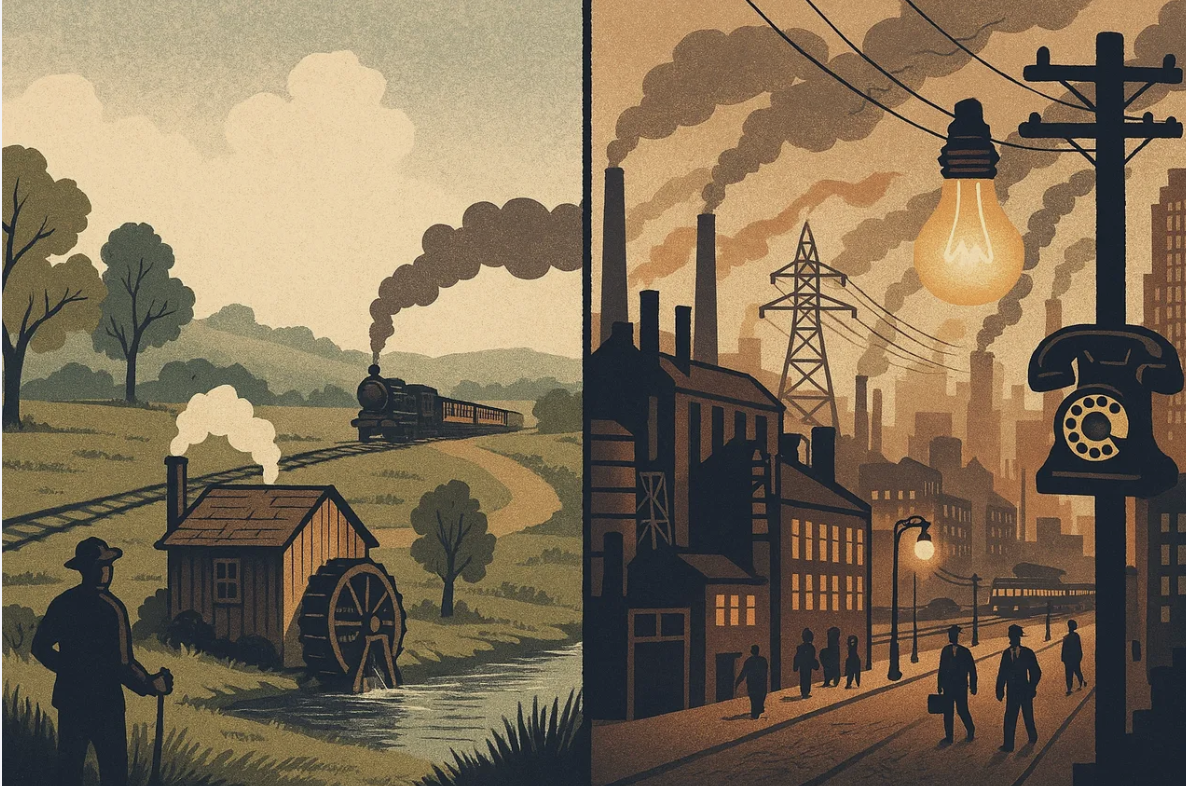
One hundred and fifty years ago, countries faced challenges like those confronting Latin America and the Caribbean today. Beginning in 1870, a group of nations chose to enter the next phase of the Industrial Revolution and underwent rapid, far-reaching transformation.
By 1920, these countries were replete with steel mills, rail systems, electricity generation and transmission, electric lighting, telephones, canneries, and large industrial cities. Their economies reorganized around new infrastructure, industries, and social arrangements.
The governments of eight countries — the USA, Britain, Germany, France, Italy, Belgium, the Netherlands, and Japan — played decisive roles in steering these changes in partnership with the private sector. Governments set national missions, built infrastructure, shaped markets, expanded education, and helped manage inherent disruption and conflict.
For Latin America and the Caribbean, this history matters. The world is entering a new era of disruptive technological change built around green and digital technologies. This new wave presents a significant opportunity for the region. Government choices will determine national trajectories over the next 50 years. This blog shows that rapid transformation is possible, even for latecomers, when states, societies, and markets align around a shared mission.
This blog examines how these countries navigated the third great technology wave by exploring what changed, what drove those changes, and the role governments played.
The global human ecosystem was transformed.
From 1870 to 1920, natural and socio-economic systems changed dramatically across these countries. The Bessemer and Siemens‑Martin steelmaking processes became the backbone of development in Germany and the USA. US steel production rose from 68,000 tons in 1870 to 42 million tons in 1920 — a 600-fold increase. Electrification after 1890 reorganized production and urbanization, with the USA and Germany building large grids, followed by Britain, France, and Belgium. These countries went from producing no electricity in 1870 to generating tens of terawatt‑hours by 1920.
Coal extraction intensified environmental change in the Ruhr, Appalachia, Wallonia, and northern France, while Japan and Italy relied on imported minerals, demonstrating that resource scarcity was not a limitation. Rail networks unified national markets and helped accelerate urbanization. Electric lighting extended working hours, and telephones and telegraphs enabled broader and more effective coordination — supporting US corporations, Britain’s global trade, and Germany’s universal banks. Canning, led by the USA and Britain, reshaped diets and urban supply chains. Public health systems — water, sanitation, and pasteurization — improved urban living conditions and supported population growth.
Social systems and institutions also evolved. State capacities expanded to universal schooling, welfare, and stronger regulation. Land‑grant colleges in the USA, technical education in Germany, and republican schools in France built human capital. Germany pioneered social insurance; Britain introduced national insurance; Belgium and France expanded labor protections. Antitrust laws emerged in the USA; labor laws strengthened in Britain and France; and administrative modernization advanced in Japan and the Netherlands.
Nationalist narratives linked modernization and industrial strength in Germany, Japan, Britain, and the USA. Mass media — newspapers, cinema, and early radio — diffused national cultures. Scientific and technical capacities expanded, with universities in Germany, France, and Britain leading globally. Class structures hardened, with strong labor movements in Britain, Belgium, and Germany, and labor conflicts in the USA and France. Women’s suffrage expanded toward the end of the period, though patriarchal norms persisted.
Britain was the world’s premier creditor until World War I, holding foreign assets worth twice its GDP in 1914. The USA shifted from a capital importer in 1870 to a major creditor by 1920, with New York rivaling London. Germany, France, Belgium, and the Netherlands also exported capital, while Italy and Japan imported capital and technology.
Transatlantic migration reshaped labor markets: Italians, Germans, and Belgians migrated in the millions, many to the USA. Britain, France, Belgium, and the Netherlands extracted resources and labor from their empires. Rural‑to‑urban migration accelerated, fueling industrialization and transforming social institutions.
Steel, electricity, and telecommunications diffused rapidly through global trade networks. Germany and the USA dominated machinery and chemical exports. Japan and Italy imported technologies to industrialize. By 1920, these eight countries — home to about 20% of the world’s population — produced half of global economic output and 70% of global industrial production.
Drivers of change between 1870 and 1920.
Countries with strong coal and iron resources — the USA, Germany, Britain, Belgium, and France — built heavy industry. Japan, Italy, and the Netherlands relied on trade and efficiency. Technologies such as steel, electricity, and machinery reorganized production and logistics. Canning, refrigeration, sanitation, and public health supported dense urbanization.
The USA and Germany built large integrated corporations and universal banks; Britain and Belgium relied on merchant‑finance networks. US Steel, founded in 1901, became the world’s first billion-dollar corporation; economies of scale are critical in global competitiveness. Germany and France built strong bureaucratic and fiscal states; Britain and the Netherlands refined liberal‑parliamentary systems. Built infrastructure — railways, ports, and electrical grids — shaped national trajectories.
Cultural traditions — German Bildung, French republicanism, British imperialism, American settler republicanism, and Japanese nationalism — shaped modernization. Belgium and the Netherlands developed pillarized societies: separate social groups with their own institutions. Strong unions emerged in Britain and Germany; class politics intensified in Italy and France.
Countries that produce steel, machinery, electricity, and chemicals dominate the global industry. Japan and Italy entered global markets through textiles and light industry. Military competition reinforced demand for steel and machinery, unfortunately, culminating in World War I.
Large integrated firms outcompeted smaller producers. Industrial clusters — the Ruhr, Northeast USA, northern Italy, Wallonia, and the Randstad — became growth poles. Electrified and connected cities outperformed historical coal‑and steam regions. Labor movements reshaped institutions: countries that reformed adaptively maintained stronger trajectories. National narratives tied modernization to national destiny.
Successful countries institutionalized new routines. They enacted laws, built infrastructure, and expanded education systems. Germany, France, the USA, Japan, and the Netherlands moved toward universal schooling. High-cost infrastructure — railways, ports, power grids, telecommunications — are locked in development paths. Path dependence means that early choices matter. State set
Welfare and labor institutions expanded. Technologies diffused through trade, foreign investment, and imitation. Corporate and financial models spread. The media shaped ideas about modern lifestyles. Once heavy industry bases were established, research, skills, and capital created cascades of innovation. Japan and Italy selected technologies suited to their conditions, shaping future constraints.
Multiple institutional models emerged — corporate capitalism (USA), liberal‑parliamentary capitalism (Britain), state-organized capitalism (Germany), pillarized systems (Netherlands and Belgium), and French republican statism.
What was the role of the state?
The state sets direction, mandates, coordinates, and partners with the private sector. Governments articulated modernization narratives — the USA’s continental expansion, Britain’s imperial mission, Germany’s industrial‑scientific state, Japan’s “rich country, strong army.” Statutory reforms in education, civil service, and the military created durable foundations. State-mandated delivery units — railway ministries, telecommunications authorities, public works agencies — coordinated large-scale projects.
States identified bottlenecks and developed solutions — Germany’s technical education, Japan’s administrative modernization. They expanded suffrage, enacted parliamentary reforms, and introduced welfare and labor protections. Multi-level governance coordinated diverse regions. Crises — wars, depressions, financial shocks — were managed to accelerate reforms.
States shaped markets through rules and standards. Spatial planning and eminent domain enabled infrastructure. Standardized gauges, safety codes, and engineering norms reduced costs. Technical standards for electricity, telephones, and railways enabled diffusion. Urban zoning and public health systems supported density.
Corporate law reforms enabled capital pooling. Labor laws stabilized industrial relations. Financial regulation enabled long-term industrial finance. Tariffs shaped specialization: subsidies and procurement created early markets for steel, telephones, and electrification.
States mobilized capital through development banks, sovereign bonds, insurance, and guarantees. They invested in railways, ports, electricity, telegraph and telephone networks, and water systems. Education and public health improved productivity. R&D ecosystems — German chemical institutes, US agricultural experiment stations, Japanese technical schools — built absorptive capacity. Industrial clusters were supported through targeted policy. Adaptive management, statistics, and monitoring improved governance.
States also managed social conflict resulting from change and disruption. Early welfare systems, arbitration, inspectors, and social insurance reduced the risks of unrest. Migration policies shaped labor supply. The USA received more than 30 million immigrants between 1870 and 1920.
Conclusion –
The transformations of 1870–1920 were fundamental. They were not only about steel mills, power grids, and telephones — they were about nation-building. Countries that aligned technology, institutions, and finance advanced rapidly. Crises became opportunities for reform.
For Latin America and the Caribbean, the lesson is clear: rapid change is possible when the state provides direction, legitimacy, and market-shaping tools to mobilize capital toward new objectives. The region is at a turning point. Green technologies and digitalization are reshaping global competition.
Countries that industrialized between 1870 and 1920 did three things: they aligned behind a national mission; they built institutions and infrastructure; and they managed disruption by protecting people. These principles remain essential today.