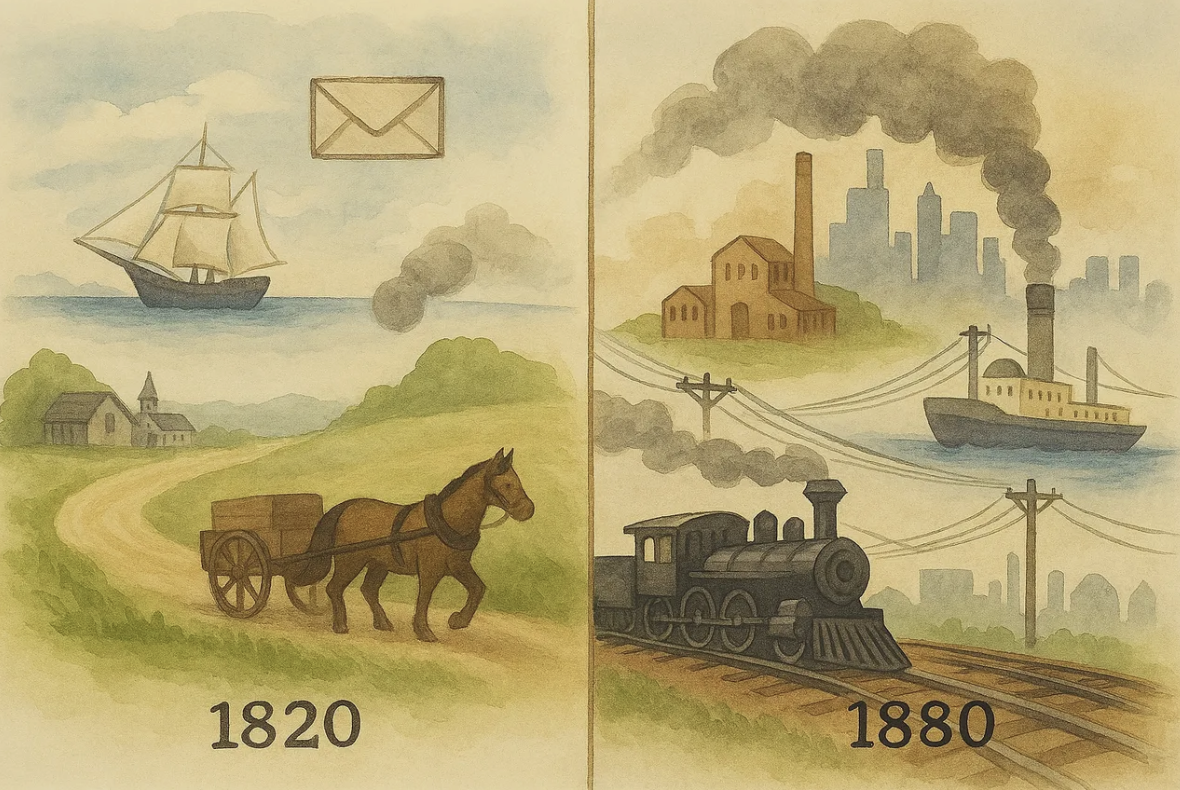
Between 1820 and 1880, leading industrial economies transitioned from waiting weeks for messages and materials to arrive to waiting minutes for messages and hours for materials.
Within a single lifetime, cities exploded in size, countries built vast railway networks, and steamships increasingly replaced sailing ships on major cargo routes. Some nations seized the moment and surged ahead, while others—despite their size and resources—chose different paths or delayed action.
Understanding these historical processes of change helps us grasp the choices facing Latin America and the Caribbean today. This blog examines the changes that occurred, why they happened so quickly, and the role of central governments in these transformations.
The World Changed Radically Between 1820 and 1880
If the first industrial revolution reflected rapid change in Britain, the second industrial revolution saw tectonic shifts globally. Railways, coal extraction, and steam-powered transport expanded dramatically between 1820 and 1880. These changes swept across Britain, Germany, France, Belgium, and later Russia and Japan, with the United States emerging as the fastest-growing industrial power. Railway lines grew from near zero in 1810 to well over 150,000 miles globally by 1880, transforming landscapes and creating industrial corridors. The Manchester-Liverpool Railway of 1830 cut travel time from 12 hours by canal to just 1.5 hours by rail. Coal production grew exponentially, with Britain increasing from 20 million tons in 1820 to 150 million tons by 1880. This marked a shift from an agrarian economy to one driven by fossil-fuel energy. Steam engines and steamships multiplied, enabling major nations to expand trade routes, strengthen national industries, and project economic influence worldwide. By 1880, Britain controlled around 60% of the world’s steamship tonnage.
Industrial machinery and national financial systems expanded rapidly alongside urbanization. Railway engine production surged from dozens to thousands by the 1880s, with the USA and Britain leading and Germany catching up. Urban populations in leading industrial countries grew from 10 million in 1820 to over 50 million by 1870, creating labor markets, new social classes, and purchasing power. Britain was over 70% urbanized by 1880. Telegraph networks did not exist in 1820, yet by 1870, there were 200,000 miles of lines helping to coordinate markets and governments. Financial capital deepened as London became the first financial hub, closely followed by New York, while Germany and France built modern banking systems for industrial investment at scale. The London Stock Exchange’s capitalization grew by an order of magnitude between 1825 and 1880.
Countries changed culturally, as literacy, communication, civic norms, and national identities emerged and grew. Literacy rates rose, reaching over 80% in some countries by 1870. Improvements in schooling, newspapers, and scientific societies helped diffuse new knowledge. Print culture and the telegraph accelerated the spread of ideas, connecting cities and regions within countries and nations, and facilitating trade. The Atlantic Telegraph Company laid the first transatlantic cable in 1858, which became operational by 1866, cutting communication time from 10 days to minutes. Working-class cultures generated reform movements that influenced labor laws and public health, as rapid urbanization and industrialization accelerated. Cultural systems evolved from locally focused communities to nationally connected societies, allowing people to coordinate economic activity and share ideas at unprecedented speed.
Why and How Did These Changes Happen?
Railways, steam engines, steamships, and coal together created a powerful positive feedback loop. More coal enabled more engines, which enabled more transport, which enabled more coal extraction, leading to more machines and railway lines. As production grew exponentially under what we now call Wright’s Law, costs fell rapidly. Telegraph communications were much faster than courier and postal systems, reducing communication from weeks to minutes and enabling modern finance, journalism, coordination, and global trade. Improved information flows meant firms, cities, and countries could experiment at scale and rapidly select the best solutions, diffusing them quickly across the international landscape. This technological surge reshaped national economies far faster than the first industrial revolution, opening new opportunities for workers, businesses, and entire regions that evolved with innovative technologies. Britain, the USA, Belgium, and then Germany built early rail networks and developed financial markets, engineering capabilities, and regulatory systems, enabling rapid expansion. Countries scaled telegraph systems, urbanized, implemented banking reforms, and connected across regions with resources—coal mines, ports, and industrial centers. These early choices created momentum; once the right systems were in place, progress accelerated and set each country on a long-term path.
Cultural and institutional changes further accelerated the differences between the “early industrializers” and other countries. High literacy, scientific societies, and civic cultures were critical in Britain, Germany, France, and the USA, accelerating the absorption of innovative technologies. Countries like Russia and Japan, before the Meiji period, with rigid hierarchies and limited educational access, experienced much slower diffusion until institutional reforms took place. Early changes in infrastructure and institutions created long-term advantages for the early movers. Urbanization deepened these changes by concentrating skilled labor, capital, and knowledge in dense cities, fostering rapid innovation and imitation. Notably, Qing China, the Ottoman Empire, the Mughal States, Persia, and Southeast Asian Kingdoms saw little industrialization at this time—highlighting how rare the USA and European takeoff truly was.
What Was the Role of the State?
As in the first industrial revolution, the centralized state played a decisive role in accelerating economic transformation. Governments set clear rules, enabled private investment, and built essential infrastructure to support business growth. Britain’s Railway Acts, the US Federal Land Grants, and Germany’s post-unification industrial strategy all stabilized predictable contexts to align private investment with national priorities. States also shaped markets with property rules, standards, and permitting systems that determined where to build railways, extract coal, or connect telegraph networks. Public investments in transport, education, and statistics lowered costs and expanded the skilled workforce. Development banks, public guarantees, and capital markets further reduced risk and helped crowd in private capital, enabling large long-term infrastructure projects.
Countries that moved early did so because their states built the institutional and financial architectures needed to increase returns and lock in innovative technologies. Britain’s parliamentary reforms, legal protections, and financial institutions, which were necessary for canal building, enabled it to finance railways and mining well before everyone else. The USA accelerated after 1850 as federal and state governments combined to pursue land policy, public finance, and regulation to build a vast railway network. Germany caught up after 1871 due to strong centralized coordination, technical education, and social insurance systems, which stabilized labor markets. By setting stable rules and investing in core infrastructure, governments created the conditions for private enterprise to innovate, compete, and expand at extraordinary speed.
Countries that progressed more slowly did so because their governments lacked the capacity, political cohesion, and financial systems to mobilize and coordinate massive transformations. In Russia, autocracy and serfdom, weak fiscal institutions, limited labor mobility, limited capital formation, and reduced technological diffusion meant they did not move until well after 1860, despite abundant natural resources. Japan was constrained under the Tokugawa shogunate, with feudal governance and limited external engagement, until the Meiji Restoration established the modern state. France was slowed by repeated political upheavals—revolutions, regime changes, and wars—that disrupted long-term plans and weakened investor confidence. Stable governance, coherent rules, and institutions capable of learning and adaptation are crucial, along with resources, to convert innovative technologies into rapid economic transformation.
Conclusion
While history may not repeat, it is full of lessons. The forces that shaped the period between 1820 and 1880—technologies, institutions, and leadership—are at play again. The second industrial revolution teaches us that countries that invest early, coordinate effectively, and build strong institutions are most likely to shape the future. History shows that countries that delay investment or lack a clear national strategy often miss the moment—and the opportunity goes to others. As the world enters a new technological wave, the choices countries make today will determine whether Latin America and the Caribbean are part of the leadership group, follow slowly, or remain on the sidelines.