Tag: infrastructure

Infrastructure consists of the physical and organizational assets—such as transport, energy, water, and digital networks—that enable economic activity and service delivery.

  • Engines of Change 1920-1970 Cars, Planes, Fridges, Assembly Lines

    Engines of Change 1920-1970 Cars, Planes, Fridges, Assembly Lines

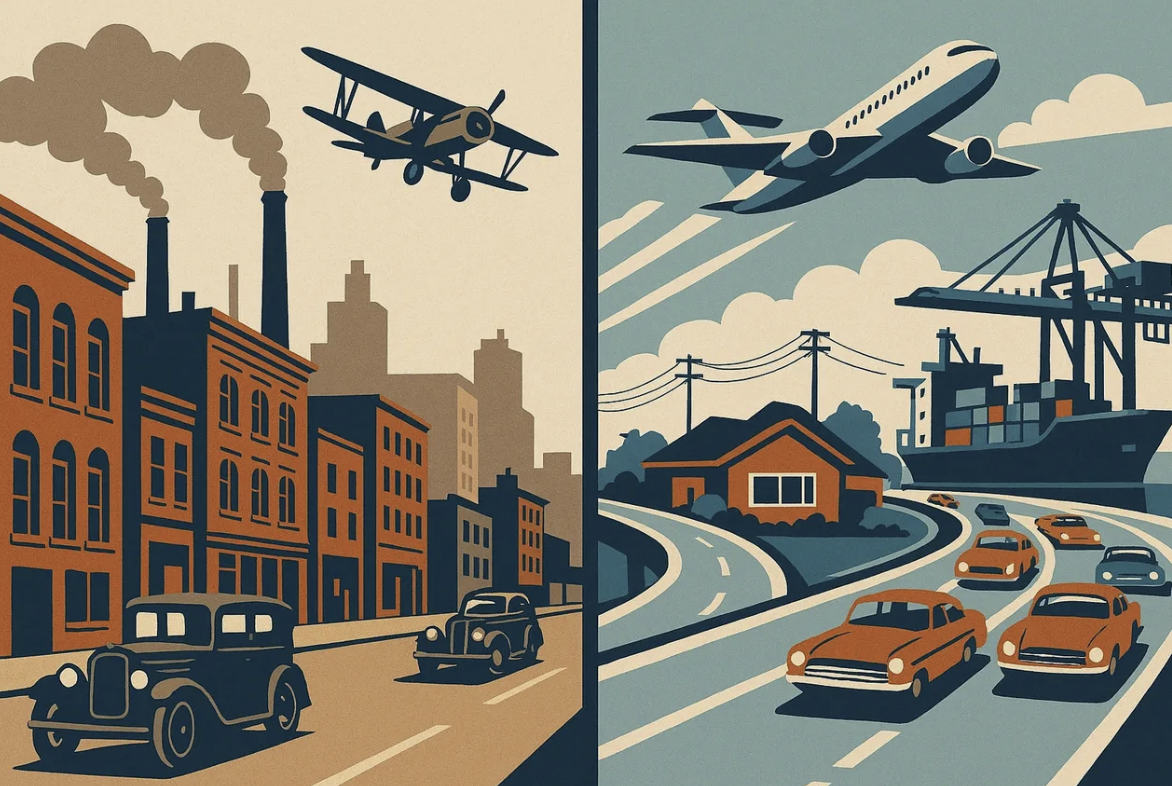
    The human ecosystem changed fundamentally across many countries between 1920 and 1970. Much of what we recognize in modern life emerged during this period: cars, planes, refrigerators, televisions, and container ships. These innovations reshaped cities, reconfigured trade routes, and reordered the global hierarchy. The United States led these transformations, followed by West Germany, France, Italy, Belgium, Greece, and Sweden. South Korea, Taiwan, Hong Kong, Singapore, and the Soviet Union also underwent rapid structural change.

    Two major growth booms defined the era. The first, in the United States during the 1920s, established the country as a technological leader. The second came after 1945, when U.S.-backed reconstruction accelerated industrial recovery across Europe and Asia. Together, these waves produced decades of sustained growth driven by urbanization, industrialization, and mass production—supported by government-backed development finance that took risks private banks would not.

    Countries that mastered innovative technologies and organizational practices grew rapidly and became global leaders. Those that struggled with weak coordination, underinvestment in infrastructure, adversarial labor relations, or elite-dominated politics fell behind. 

    The lesson for Latin America and the Caribbean is clear: modernizing infrastructure, mobilizing patient capital, upgrading skills, and enforcing standards that reward quality and sustainability are essential to riding today’s technological wave. Doing so will create jobs, raise health standards, boost productivity, and strengthen urban resilience.

    This blog examines the transformations of 1920–1970, the drivers behind them, and the state’s role in shaping outcomes. 

    A rapidly changing human ecosystem

    The environmental and resource landscape shifted dramatically. Energy systems moved from coal to oil and electricity, powering growth in transport, petrochemicals, and manufacturing. These transitions varied by country: Sweden expanded hydropower, the United States built oil‑ and electricity-powered suburbs, Mexico and Venezuela leveraged petroleum, and Brazil invested heavily in hydroelectricity.

    Urbanization surged, accompanied by large-scale land conversion for infrastructure, energy, and materials. In Japan, the share of urban residents rose from 60 percent in 1950 to 70 percent in 1970. Environmental stresses also became more visible. London’s Great Smog of 1952, which caused an estimated 10,000–12,000 deaths, led to the Clean Air Act of 1956. Similar concerns in the United States contributed to the Clean Air Act Amendments and the creation of the Environmental Protection Agency in 1970.

    Mass production and mass consumption took hold as households acquired cars and, later, refrigerators and televisions. U.S. vehicle ownership rose from 60 cars per 1,000 people in 1920 to 516 per 1,000 by 1968. Argentina was an early adopter too, with 35 cars per 1,000 people in 1930. Ford’s assembly lines created millions of middle-class jobs, while mass production made consumer goods affordable for working families. As an anecdote about the speed of technological change, New York went from horse-drawn to motorized between 1900 and 1913.

    The United States, West Germany, and Japan converted wartime industrial capacity into high-quality civilian production—cars, appliances, and electronics for export. Japan imported U.S. and German technologies, improved them, and built globally competitive firms in steel, shipbuilding, automobiles, and electronics. Between 1950 and 1970, life expectancy and per capita GDP rose sharply across the USA, Japan, West Germany, France, Italy, Belgium, Sweden, South Korea, and Greece. Britain, by contrast, experienced slower diffusion of consumer goods and weaker industrial modernization. Mexico and Brazil also industrialized, with output rising sharply between 1950 and 1980, and urbanization increasing severalfold. But LAC’s import‑substitution strategies, focused on protected domestic markets, limited economies of scale, and enabled rent‑seeking by powerful elites.

    Media and mobility reshaped culture. Radio and television became dominant channels. Commercial jet travel—introduced in 1952—dramatically reduced travel times. Together, mobility and mass media helped forge national narratives and shared identities.

    Global trade expanded rapidly, supported by new logistics and financial flows. Container shipping, introduced in 1956, revolutionized cargo transport by standardizing metal containers that moved seamlessly across ships, trains, and trucks. Handling costs fell from US$5.86 per ton to US$0.16 per ton. Ports such as Rotterdam, Hong Kong, and Singapore expanded dramatically. Export-led industrial models emerged in West Germany, Japan, Korea, and Taiwan, which built manufacturing clusters tied to global markets. The Marshall Plan accelerated reconstruction and market integration across Western Europe, creating new consumer markets. Many countries strengthened public institutions, expanding welfare systems, development banks, and national accounts to support fiscal management.  

    Drivers of change: technology, institutions, and war

    Innovative technologies and practices emerged in the 1920s, including mass-production techniques such as Ford’s assembly line. Model T production rose from 170,000 vehicles in 1913 to more than 941,000 in 1920. Cars and planes evolved rapidly, culminating in jet aircraft like the Boeing 707 in 1958. Many early advances were spin-offs from World War II industrial machinery.

    Containerization later standardized logistics, slashing costs and enabling modern globalization. Innovation also included new corporate structures, professionalized management, and novel approaches to quality control and workflow.

    World War II mobilization accelerated research and development in aviation, petrochemicals, and electronics, and forced industrial-scale production that later shifted to civilian use. Post-war support—including the Marshall Plan and U.S. aid to Japan and Korea—helped countries adopt advanced development models. Market competition rewarded firms with access to technology and long-term finance, enabling them to outcompete protected or fragmented economies.

    Strong state narratives anchored policy approaches: the U.S. “New Deal,” Japan’s “Income Doubling Plan,” West Germany and Austria’s “Wirtschaftswunder,” and France’s “Trente Glorieuses.” The United States New Deal focused on stabilizing the financial system, expanding infrastructure, and recovering from the Depression. Europe and Japan emphasized reconstruction and the expansion of welfare states. The post-war Golden Age of Capitalism delivered massive investments in highways, ports, grids, and telecommunications. Education and vocational training systems codified modern technologies and routines, spreading innovation across firms and regions. 

    The role of the state: rapid change, uneven results

    Successful countries built strong planning agencies that set targets and coordinated across finance and industry—Japan’s Ministry of International Trade and Industry and South Korea’s Economic Planning Board are emblematic. These countries focused on industrial capability and global integration. The Soviet Union’s planned industrialization made it the world’s second-largest economy by the 1960s, but it came with serious design flaws.

    Others faltered. Britain, burdened by post-war debt, weak industrial strategy, and political conflict, failed to modernize quickly. Fragmentation, strikes, and adversarial labor relations slowed progress. The former industrial leader lost momentum, competitive advantage, and investment.

    Successful countries also regulated effectively and set standards. Land reform and quality standards boosted productivity. Trade agreements and the European Economic Community opened markets. Expanding welfare states provided pensions, healthcare, education, and unemployment insurance. The Soviet Union, however, set production targets without market signals or consumer‑quality standards, leading to chronic shortages. Greece’s clientelist politics limited productivity gains and left regions disconnected from export-led growth.

    Public finance capacity was equally important. Development banks such as West Germany’s KfW, Japan’s JDB, and Italy’s IRI de-risked significant industrial and infrastructure investments and supported small and medium-sized enterprises. Large infrastructure projects paid off: Japan’s Shinkansen, launched in 1964, symbolized integrated investments in mobility and growth.

    The Marshall Plan injected over US$13 billion (about US$200 billion today) into reconstruction, institutional reform, and the European Payments Union. This support accelerated structural change, helped prevent a repeat of the political fallout from World War I, and built consumer markets for U.S. products. Public investment also expanded human capital and welfare systems, creating skilled workforces and social stability. The most successful states cultivated innovation ecosystems by funding basic and applied research. Japan, Korea, Taiwan, and Singapore targeted specific export sectors, incentivized cluster development, and compressed industrialization timelines. 

    Conclusion

    The period from 1920 to 1970 was one of extraordinary turmoil and transformation. Old powers declined, and new manufacturing giants emerged. This rapid change was possible because governments worked with businesses to set direction, create market space, and build the skills needed for innovation and diffusion. Development banks played a significant role in financing infrastructure that reduced costs and enabled the formation of new industrial clusters.

    If Latin America and the Caribbean choose coordination over fragmentation, patient investment over short-termism, and strong standards over shortcuts, they can write their own economic miracle. 

    For the region, this means prioritizing infrastructure, long-term financing, skills development, standards and quality control, and export promotion—anchored in industrial clusters that leverage comparative advantages in renewables and critical minerals. 
  • Third Technology Wave, 1870-1920: Steel, Electricity, & Telephone

    Third Technology Wave, 1870-1920: Steel, Electricity, & Telephone

    One hundred and fifty years ago, countries faced challenges like those confronting Latin America and the Caribbean today. Beginning in 1870, a group of nations chose to enter the next phase of the Industrial Revolution and underwent rapid, far-reaching transformation. 

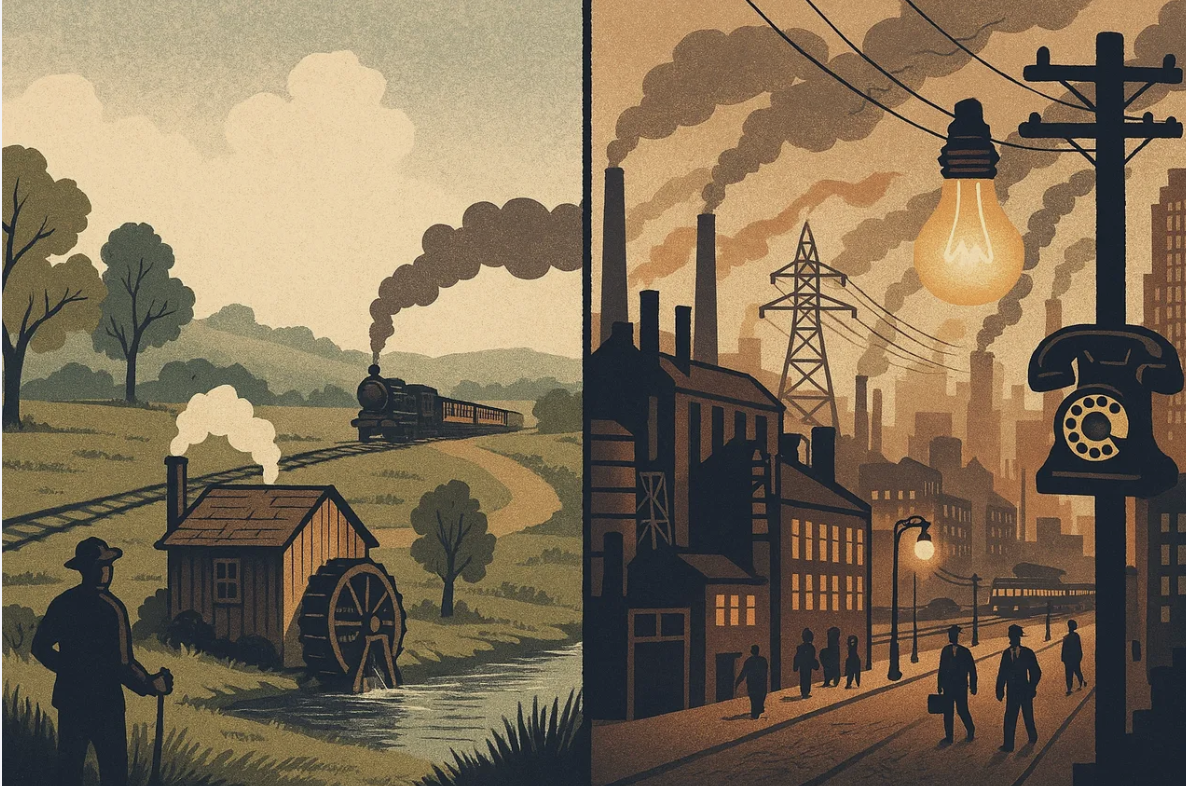
    By 1920, these countries were replete with steel mills, rail systems, electricity generation and transmission, electric lighting, telephones, canneries, and large industrial cities. Their economies reorganized around new infrastructure, industries, and social arrangements.

    The governments of eight countries — the USA, Britain, Germany, France, Italy, Belgium, the Netherlands, and Japan — played decisive roles in steering these changes in partnership with the private sector. Governments set national missions, built infrastructure, shaped markets, expanded education, and helped manage inherent disruption and conflict.

    For Latin America and the Caribbean, this history matters. The world is entering a new era of disruptive technological change built around green and digital technologies. This new wave presents a significant opportunity for the region. Government choices will determine national trajectories over the next 50 years. This blog shows that rapid transformation is possible, even for latecomers, when states, societies, and markets align around a shared mission.

    This blog examines how these countries navigated the third great technology wave by exploring what changed, what drove those changes, and the role governments played. 

    The global human ecosystem was transformed.

    From 1870 to 1920, natural and socio-economic systems changed dramatically across these countries. The Bessemer and Siemens‑Martin steelmaking processes became the backbone of development in Germany and the USA. US steel production rose from 68,000 tons in 1870 to 42 million tons in 1920 — a 600-fold increase. Electrification after 1890 reorganized production and urbanization, with the USA and Germany building large grids, followed by Britain, France, and Belgium. These countries went from producing no electricity in 1870 to generating tens of terawatt‑hours by 1920.

    Coal extraction intensified environmental change in the Ruhr, Appalachia, Wallonia, and northern France, while Japan and Italy relied on imported minerals, demonstrating that resource scarcity was not a limitation. Rail networks unified national markets and helped accelerate urbanization. Electric lighting extended working hours, and telephones and telegraphs enabled broader and more effective coordination — supporting US corporations, Britain’s global trade, and Germany’s universal banks. Canning, led by the USA and Britain, reshaped diets and urban supply chains. Public health systems — water, sanitation, and pasteurization — improved urban living conditions and supported population growth.

    Social systems and institutions also evolved. State capacities expanded to universal schooling, welfare, and stronger regulation. Land‑grant colleges in the USA, technical education in Germany, and republican schools in France built human capital. Germany pioneered social insurance; Britain introduced national insurance; Belgium and France expanded labor protections. Antitrust laws emerged in the USA; labor laws strengthened in Britain and France; and administrative modernization advanced in Japan and the Netherlands.

    Nationalist narratives linked modernization and industrial strength in Germany, Japan, Britain, and the USA. Mass media — newspapers, cinema, and early radio — diffused national cultures. Scientific and technical capacities expanded, with universities in Germany, France, and Britain leading globally. Class structures hardened, with strong labor movements in Britain, Belgium, and Germany, and labor conflicts in the USA and France. Women’s suffrage expanded toward the end of the period, though patriarchal norms persisted. 

    Britain was the world’s premier creditor until World War I, holding foreign assets worth twice its GDP in 1914. The USA shifted from a capital importer in 1870 to a major creditor by 1920, with New York rivaling London. Germany, France, Belgium, and the Netherlands also exported capital, while Italy and Japan imported capital and technology.

    Transatlantic migration reshaped labor markets: Italians, Germans, and Belgians migrated in the millions, many to the USA. Britain, France, Belgium, and the Netherlands extracted resources and labor from their empires. Rural‑to‑urban migration accelerated, fueling industrialization and transforming social institutions.

    Steel, electricity, and telecommunications diffused rapidly through global trade networks. Germany and the USA dominated machinery and chemical exports. Japan and Italy imported technologies to industrialize. By 1920, these eight countries — home to about 20% of the world’s population — produced half of global economic output and 70% of global industrial production. 

    Drivers of change between 1870 and 1920.

    Countries with strong coal and iron resources — the USA, Germany, Britain, Belgium, and France — built heavy industry. Japan, Italy, and the Netherlands relied on trade and efficiency. Technologies such as steel, electricity, and machinery reorganized production and logistics. Canning, refrigeration, sanitation, and public health supported dense urbanization.

    The USA and Germany built large integrated corporations and universal banks; Britain and Belgium relied on merchant‑finance networks. US Steel, founded in 1901, became the world’s first billion-dollar corporation; economies of scale are critical in global competitiveness. Germany and France built strong bureaucratic and fiscal states; Britain and the Netherlands refined liberal‑parliamentary systems. Built infrastructure — railways, ports, and electrical grids — shaped national trajectories.

    Cultural traditions — German Bildung, French republicanism, British imperialism, American settler republicanism, and Japanese nationalism — shaped modernization. Belgium and the Netherlands developed pillarized societies: separate social groups with their own institutions. Strong unions emerged in Britain and Germany; class politics intensified in Italy and France.

    Countries that produce steel, machinery, electricity, and chemicals dominate the global industry. Japan and Italy entered global markets through textiles and light industry. Military competition reinforced demand for steel and machinery, unfortunately, culminating in World War I.

    Large integrated firms outcompeted smaller producers. Industrial clusters — the Ruhr, Northeast USA, northern Italy, Wallonia, and the Randstad — became growth poles. Electrified and connected cities outperformed historical coal‑and steam regions. Labor movements reshaped institutions: countries that reformed adaptively maintained stronger trajectories. National narratives tied modernization to national destiny. 

    Successful countries institutionalized new routines. They enacted laws, built infrastructure, and expanded education systems. Germany, France, the USA, Japan, and the Netherlands moved toward universal schooling. High-cost infrastructure — railways, ports, power grids, telecommunications — are locked in development paths. Path dependence means that early choices matter. State set 

    Welfare and labor institutions expanded. Technologies diffused through trade, foreign investment, and imitation. Corporate and financial models spread. The media shaped ideas about modern lifestyles. Once heavy industry bases were established, research, skills, and capital created cascades of innovation. Japan and Italy selected technologies suited to their conditions, shaping future constraints.

    Multiple institutional models emerged — corporate capitalism (USA), liberal‑parliamentary capitalism (Britain), state-organized capitalism (Germany), pillarized systems (Netherlands and Belgium), and French republican statism. 

    What was the role of the state?

    The state sets direction, mandates, coordinates, and partners with the private sector. Governments articulated modernization narratives — the USA’s continental expansion, Britain’s imperial mission, Germany’s industrial‑scientific state, Japan’s “rich country, strong army.” Statutory reforms in education, civil service, and the military created durable foundations. State-mandated delivery units — railway ministries, telecommunications authorities, public works agencies — coordinated large-scale projects.

    States identified bottlenecks and developed solutions — Germany’s technical education, Japan’s administrative modernization. They expanded suffrage, enacted parliamentary reforms, and introduced welfare and labor protections. Multi-level governance coordinated diverse regions. Crises — wars, depressions, financial shocks — were managed to accelerate reforms.

    States shaped markets through rules and standards. Spatial planning and eminent domain enabled infrastructure. Standardized gauges, safety codes, and engineering norms reduced costs. Technical standards for electricity, telephones, and railways enabled diffusion. Urban zoning and public health systems supported density.

    Corporate law reforms enabled capital pooling. Labor laws stabilized industrial relations. Financial regulation enabled long-term industrial finance. Tariffs shaped specialization: subsidies and procurement created early markets for steel, telephones, and electrification.

    States mobilized capital through development banks, sovereign bonds, insurance, and guarantees. They invested in railways, ports, electricity, telegraph and telephone networks, and water systems. Education and public health improved productivity. R&D ecosystems — German chemical institutes, US agricultural experiment stations, Japanese technical schools — built absorptive capacity. Industrial clusters were supported through targeted policy. Adaptive management, statistics, and monitoring improved governance.

    States also managed social conflict resulting from change and disruption. Early welfare systems, arbitration, inspectors, and social insurance reduced the risks of unrest. Migration policies shaped labor supply. The USA received more than 30 million immigrants between 1870 and 1920.  

    Conclusion – 

    The transformations of 1870–1920 were fundamental. They were not only about steel mills, power grids, and telephones — they were about nation-building. Countries that aligned technology, institutions, and finance advanced rapidly. Crises became opportunities for reform.

    For Latin America and the Caribbean, the lesson is clear: rapid change is possible when the state provides direction, legitimacy, and market-shaping tools to mobilize capital toward new objectives. The region is at a turning point. Green technologies and digitalization are reshaping global competition.

    Countries that industrialized between 1870 and 1920 did three things: they aligned behind a national mission; they built institutions and infrastructure; and they managed disruption by protecting people. These principles remain essential today. 

  • Railways, Rail Engines, Steam Ships, and Telegraph

    Railways, Rail Engines, Steam Ships, and Telegraph

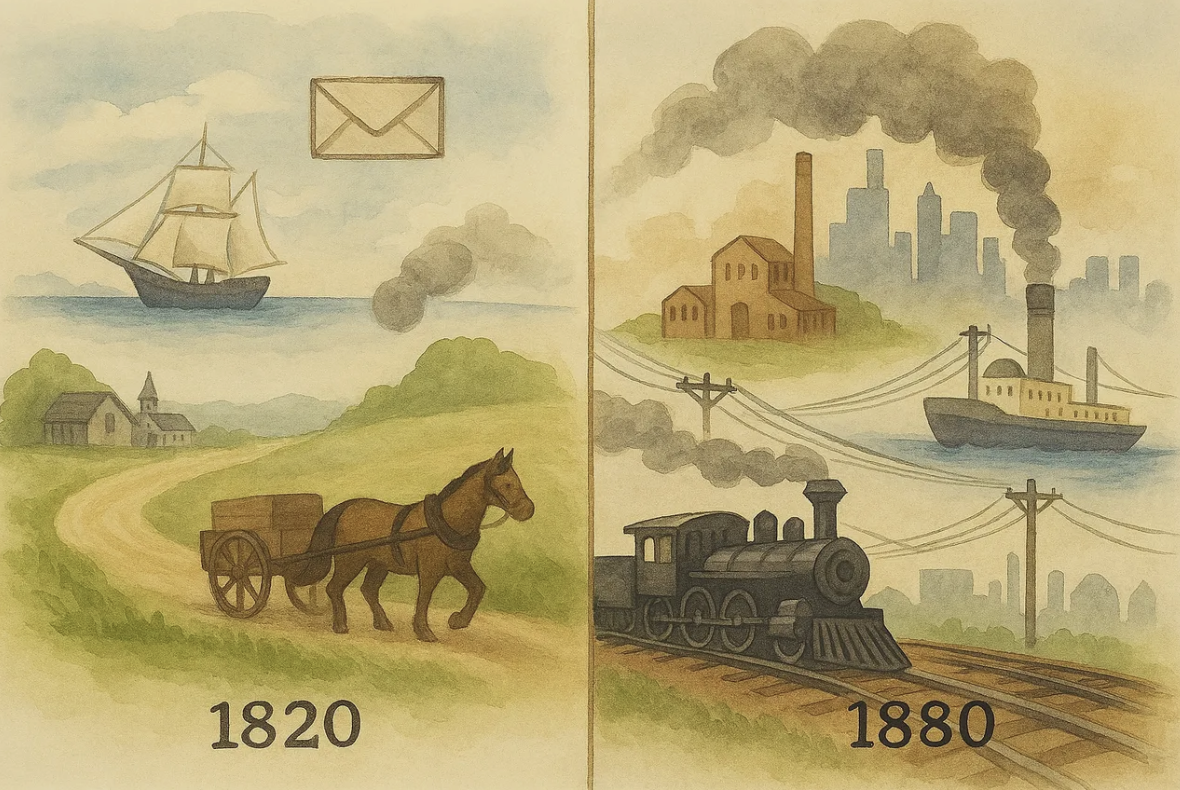
    Between 1820 and 1880, leading industrial economies transitioned from waiting weeks for messages and materials to arrive to waiting minutes for messages and hours for materials. 

    Within a single lifetime, cities exploded in size, countries built vast railway networks, and steamships increasingly replaced sailing ships on major cargo routes. Some nations seized the moment and surged ahead, while others—despite their size and resources—chose different paths or delayed action.

    Understanding these historical processes of change helps us grasp the choices facing Latin America and the Caribbean today. This blog examines the changes that occurred, why they happened so quickly, and the role of central governments in these transformations. 

    The World Changed Radically Between 1820 and 1880

    If the first industrial revolution reflected rapid change in Britain, the second industrial revolution saw tectonic shifts globally. Railways, coal extraction, and steam-powered transport expanded dramatically between 1820 and 1880. These changes swept across Britain, Germany, France, Belgium, and later Russia and Japan, with the United States emerging as the fastest-growing industrial power. Railway lines grew from near zero in 1810 to well over 150,000 miles globally by 1880, transforming landscapes and creating industrial corridors. The Manchester-Liverpool Railway of 1830 cut travel time from 12 hours by canal to just 1.5 hours by rail. Coal production grew exponentially, with Britain increasing from 20 million tons in 1820 to 150 million tons by 1880. This marked a shift from an agrarian economy to one driven by fossil-fuel energy. Steam engines and steamships multiplied, enabling major nations to expand trade routes, strengthen national industries, and project economic influence worldwide. By 1880, Britain controlled around 60% of the world’s steamship tonnage. 

    Industrial machinery and national financial systems expanded rapidly alongside urbanization. Railway engine production surged from dozens to thousands by the 1880s, with the USA and Britain leading and Germany catching up. Urban populations in leading industrial countries grew from 10 million in 1820 to over 50 million by 1870, creating labor markets, new social classes, and purchasing power. Britain was over 70% urbanized by 1880. Telegraph networks did not exist in 1820, yet by 1870, there were 200,000 miles of lines helping to coordinate markets and governments. Financial capital deepened as London became the first financial hub, closely followed by New York, while Germany and France built modern banking systems for industrial investment at scale. The London Stock Exchange’s capitalization grew by an order of magnitude between 1825 and 1880.  

    Countries changed culturally, as literacy, communication, civic norms, and national identities emerged and grew. Literacy rates rose, reaching over 80% in some countries by 1870. Improvements in schooling, newspapers, and scientific societies helped diffuse new knowledge. Print culture and the telegraph accelerated the spread of ideas, connecting cities and regions within countries and nations, and facilitating trade. The Atlantic Telegraph Company laid the first transatlantic cable in 1858, which became operational by 1866, cutting communication time from 10 days to minutes. Working-class cultures generated reform movements that influenced labor laws and public health, as rapid urbanization and industrialization accelerated. Cultural systems evolved from locally focused communities to nationally connected societies, allowing people to coordinate economic activity and share ideas at unprecedented speed. 

    Why and How Did These Changes Happen?

    Railways, steam engines, steamships, and coal together created a powerful positive feedback loop. More coal enabled more engines, which enabled more transport, which enabled more coal extraction, leading to more machines and railway lines. As production grew exponentially under what we now call Wright’s Law, costs fell rapidly. Telegraph communications were much faster than courier and postal systems, reducing communication from weeks to minutes and enabling modern finance, journalism, coordination, and global trade. Improved information flows meant firms, cities, and countries could experiment at scale and rapidly select the best solutions, diffusing them quickly across the international landscape. This technological surge reshaped national economies far faster than the first industrial revolution, opening new opportunities for workers, businesses, and entire regions that evolved with innovative technologies. Britain, the USA, Belgium, and then Germany built early rail networks and developed financial markets, engineering capabilities, and regulatory systems, enabling rapid expansion. Countries scaled telegraph systems, urbanized, implemented banking reforms, and connected across regions with resources—coal mines, ports, and industrial centers. These early choices created momentum; once the right systems were in place, progress accelerated and set each country on a long-term path. 

    Cultural and institutional changes further accelerated the differences between the “early industrializers” and other countries. High literacy, scientific societies, and civic cultures were critical in Britain, Germany, France, and the USA, accelerating the absorption of innovative technologies. Countries like Russia and Japan, before the Meiji period, with rigid hierarchies and limited educational access, experienced much slower diffusion until institutional reforms took place. Early changes in infrastructure and institutions created long-term advantages for the early movers. Urbanization deepened these changes by concentrating skilled labor, capital, and knowledge in dense cities, fostering rapid innovation and imitation. Notably, Qing China, the Ottoman Empire, the Mughal States, Persia, and Southeast Asian Kingdoms saw little industrialization at this time—highlighting how rare the USA and European takeoff truly was. 

    What Was the Role of the State?

    As in the first industrial revolution, the centralized state played a decisive role in accelerating economic transformation. Governments set clear rules, enabled private investment, and built essential infrastructure to support business growth. Britain’s Railway Acts, the US Federal Land Grants, and Germany’s post-unification industrial strategy all stabilized predictable contexts to align private investment with national priorities. States also shaped markets with property rules, standards, and permitting systems that determined where to build railways, extract coal, or connect telegraph networks. Public investments in transport, education, and statistics lowered costs and expanded the skilled workforce. Development banks, public guarantees, and capital markets further reduced risk and helped crowd in private capital, enabling large long-term infrastructure projects.

    Countries that moved early did so because their states built the institutional and financial architectures needed to increase returns and lock in innovative technologies. Britain’s parliamentary reforms, legal protections, and financial institutions, which were necessary for canal building, enabled it to finance railways and mining well before everyone else. The USA accelerated after 1850 as federal and state governments combined to pursue land policy, public finance, and regulation to build a vast railway network. Germany caught up after 1871 due to strong centralized coordination, technical education, and social insurance systems, which stabilized labor markets. By setting stable rules and investing in core infrastructure, governments created the conditions for private enterprise to innovate, compete, and expand at extraordinary speed. 

    Countries that progressed more slowly did so because their governments lacked the capacity, political cohesion, and financial systems to mobilize and coordinate massive transformations. In Russia, autocracy and serfdom, weak fiscal institutions, limited labor mobility, limited capital formation, and reduced technological diffusion meant they did not move until well after 1860, despite abundant natural resources. Japan was constrained under the Tokugawa shogunate, with feudal governance and limited external engagement, until the Meiji Restoration established the modern state. France was slowed by repeated political upheavals—revolutions, regime changes, and wars—that disrupted long-term plans and weakened investor confidence. Stable governance, coherent rules, and institutions capable of learning and adaptation are crucial, along with resources, to convert innovative technologies into rapid economic transformation.

    Conclusion

    While history may not repeat, it is full of lessons. The forces that shaped the period between 1820 and 1880—technologies, institutions, and leadership—are at play again. The second industrial revolution teaches us that countries that invest early, coordinate effectively, and build strong institutions are most likely to shape the future. History shows that countries that delay investment or lack a clear national strategy often miss the moment—and the opportunity goes to others. As the world enters a new technological wave, the choices countries make today will determine whether Latin America and the Caribbean are part of the leadership group, follow slowly, or remain on the sidelines.