Tag: structural-transformation

Focuses on shifts in production, employment, and economic structure over the development process.

  • How Costa Rica Made EVs Scale

    How Costa Rica Made EVs Scale

    In 2015, Costa Rica registered fewer than 500 electric vehicles. By 2024, EVs accounted for more than 1 in 10 new registrations—powered almost entirely by renewable electricity. The country did this without oil money, without a massive industrial base, and across two major political transitions. That is the puzzle this blog tries to explain—and to translate for policymakers elsewhere in the region.

    Costa Rica shifted toward high-value manufacturing and knowledge-based services after 2015. Services accounted for most output and export earnings, and export earnings concentrated in sophisticated segments. Real GDP growth averaged about 3.5% before 2020, contracted sharply when the pandemic hit, then rebounded strongly in 2021 and remained solid through 2023–2024. The free trade zone (FTZ) platform and foreign direct investment (FDI) in life sciences and corporate services anchored export performance and modern-sector jobs.

    The core argument is simple: Costa Rica’s transformation since 2015 did not come from a single policy or sector. Three enabling systems reinforced each other—an export platform anchored in FTZ-led sophistication, a renewable electricity base that enables low-carbon electrification, and a state able to digitize high-volume services. The lesson for policymakers elsewhere in Latin America is not to copy a flagship reform, but to focus on sequencing and reinforcement: what changes when these systems are built in parallel rather than in isolation.

    The sections that follow show how the systems compounded: first, shifts in capital stocks, institutions, and economic structure; second, how variation, selection, and diffusion turned pilots into routines; and third, how laws, market rules, coordination, and adaptive management helped reforms persist across political cycles.

    What is transferable—and what is not

    Costa Rica is a structural outlier in Latin America: it is small (roughly 5 million people), has maintained an overwhelmingly renewable power mix, lacks a hydrocarbon sector, and, since 2021, has been anchored by OECD accession standards. The point is not that other countries can replicate these conditions, but that many can adapt the mechanisms that turned them into durable change. Read the case by separating transferable policy design from context-dependent enablers:

    Broadly transferable lessons (mechanisms): stabilize incentives with a clear glidepath (e.g., extend EV incentives to 2034 with phased adjustments rather than abrupt reversals); run charging rollout as a service network with spacing and reliability targets; start digital transformation with one or two high-volume services (such as digital health) before pushing interoperability across government; and coordinate an export platform (investment promotion, skills, and supplier development) so tradable upgrading can finance and legitimize longer-horizon transitions.

    Context-dependent lessons (starting conditions): a near-zero-carbon power system makes transport electrification immediately low-emissions; countries with fossil-heavy grids may need to pair EV rollout with a credible power-sector decarbonization and reliability plan. OECD accession provided an external governance anchor (a credible external commitment that raises the cost of backsliding on institutional reforms); where that is unavailable, governments can mimic the effect through domestic fiscal rules, independent regulators, performance compacts, and peer-review partnerships. Costa Rica’s small geography and concentrated corridors simplified charging rollout; larger countries may need phased corridors (freight and bus depots first, then intercity routes, then nationwide coverage) and stronger subnational execution capacity.

    Three systems, not one policy, drove the shift

    Costa Rica shifted its capital stock toward knowledge-intensive production amid persistent physical infrastructure constraints. Electricity generation remained overwhelmingly renewable after 2015, anchored in hydropower and complemented by geothermal and wind power, laying the groundwork for low-carbon electrification. Fiscal reforms strengthened buffers, with debt declining from pandemic peaks and international reserves reaching historically high levels by mid‑2025. In tradables, the economy deepened its specialization in advanced manufacturing—especially medical devices—supported by FTZ infrastructure and sustained FDI inflows that recovered after the 2020 shock and reached high levels by 2024. Transport energy use remained dominated by liquid fuels because most vehicles still relied on internal combustion engines, even as new registrations shifted. The distinction is between rapid electrification in new private vehicles and slower, operations‑constrained electrification in high‑utilization segments such as buses, taxis, and delivery fleets. Those segments often deliver larger emissions and air-quality gains per vehicle but require depot charging, route planning, financing, and maintenance capacity. The dual reality is a clean-electricity base and fast-moving EV adoption at the margin, alongside a legacy fleet and public-transport systems that still drive emissions and dependence on fuel imports.

    Costa Rica focused institutional reforms on three domains: fiscal governance, decarbonization policy, and digital government coordination. In 2018, the legislature passed a major fiscal reform that introduced a spending cap and broadened taxation through a value-added tax framework, reshaping what the state could fund and how it could finance it. Also in 2018, lawmakers enacted an EV incentives law that created tax exemptions for EVs and charging infrastructure and assigned responsibilities for charging rollout and fleet transitions. In 2019, the executive launched a long-horizon decarbonization plan that set economy-wide direction and embedded transport electrification targets within a broader net‑zero pathway. In public administration, successive digital transformation strategies culminated in a 2023–2027 framework, and the state created a national digital government agency to coordinate interoperability and service delivery across institutions. These moves turned political intent into enforceable rules, multi-year plans, and implementation mandates that could survive electoral cycles.

    Economic and social outcomes shifted unevenly: growth strengthened alongside persistent labor-market duality and regional disparities. In 2020, tourism and contact-intensive services collapsed, unemployment surged, and household vulnerability increased. After reopening, export manufacturing, corporate services, and tourism drove the recovery, with unemployment falling to low single digits by late 2025. Informality remained high—about 40% of workers in several recent years—showing that productivity gains in the modern sector did not automatically translate into broad formalization. High-skill jobs and the export platform stayed concentrated in the Greater Metropolitan Area, while regional inequality motivated new territorial policy instruments, including a regional development law designed to strengthen regional planning and financing. The period combined macro stabilization and modern-sector dynamism with distributional frictions that complicate inclusive growth and the politics of sustained reform.

    The pandemic sorted winners and losers — and Costa Rica was ready

    By 2019, Costa Rica’s public health system had implemented a single nationwide digital health record, changing how clinics recorded visits, handled referrals, and interacted with patients. In transport, an EV incentives law and early charging corridors lowered the perceived risk of owning an EV and attracted private investment in EV models, chargers, and maintenance services. After the 2022 cybersecurity crisis, agencies improvised new coordination and operating practices under pressure, accelerating changes in how the state managed digital systems. When the pandemic hit in 2020, these were not contingency measures—they were already operating routines, which made them resilience assets rather than emergency responses. In evolutionary terms, these were sources of “variation”: policy experiments and shocks that introduced new routines in public services, mobility, and administrative coordination. The takeaway is that the highest-impact pilots were not symbolic; they were designed (or forced) to touch high-volume transactions and operational bottlenecks, so learning could accumulate quickly and be institutionalized.

    Selection is the filter that decides which experiments scale and which fade. In Costa Rica, the 2018 EV incentive law tilted relative prices toward battery-electric vehicles and helped EVs outcompete conventional vehicles where exemptions and operating costs mattered most. As more global manufacturers offered EV models and prices fell, competition expanded choice and lowered entry barriers. The pandemic acted as an economy-wide selection event: it punished tourism in 2020 while favoring export manufacturing and digitally enabled services that could keep operating. Fiscal rules and IMF-supported stabilization limited room for recurrent spending expansions, pushing the state toward reforms that improved compliance and efficiency rather than simply adding programs. OECD accession reinforced institutional upgrades by tying governance standards and peer expectations to membership. These filters favored tradable upgrading, digital service modernization, and electrified mobility—while making infrastructure delivery, skills supply, and implementation capacity the binding constraints.

    Diffusion is where Costa Rica’s story is most useful for implementation-minded readers: it shows how a pilot becomes “the way the system works.” In digital health, a single record and workflow moved from partial rollout to near-universal use by 2019. Clinics and hospitals stopped treating digitization as an add-on and treated the digital record as the default system of record for visits, prescriptions, and referrals. That shift required a multi-year bet: standardized processes and an implementation owner able to roll the system out site by site until coverage became routine. In electric mobility, diffusion looked like an ecosystem: as registrations rose, charging points expanded, dealerships broadened model lines, and early user experience reduced perceived risk for the next cohort of buyers. Diffusion sticks when rules are stable enough for private actors to invest, the service platform is visible to users (a record they must use, a charger they can find), and an accountable owner sustains execution through the unglamorous years of rollout. But diffusion at this scale doesn’t happen by accident — it requires a state that has converted political intent into durable rules and institutions, which is the subject of the next section.

    Rules outlast governments: how policy survived three elections

    Costa Rica made the transition durable by embedding long-horizon objectives in rules, standards, and market architecture rather than relying on ad hoc programs. The 2019 decarbonization plan defined a pathway to net‑zero by 2050 and translated it into sectoral commitments, with transport electrification as a central pillar. The EV law established a concrete incentive regime—tax exemptions and institutional obligations—that altered relative prices and clarified the responsibilities of agencies and utilities. The 2018 fiscal reform created binding constraints through a fiscal rule and tax base changes, narrowing the feasible set of public choices while strengthening credibility with lenders and investors. OECD accession in 2021 added a governance anchor, reinforcing continuity across areas such as competition policy, statistics, and institutional standards. These actions reduced uncertainty for investors and households and created a predictable environment for adoption and upgrading.

    The state backed the rules with enabling infrastructure and platforms, even as infrastructure quality remained a constraint. The national electricity utility (ICE) and the broader electricity system maintained near-universal access and a renewable generation base, giving Costa Rica a backbone for electrifying end uses without increasing power-sector emissions. After the EV law set rollout expectations, utilities and partners expanded public charging points as EV demand rose. In health, the public system financed and rolled out nationwide digital records and supporting applications through a multi-year effort. Telecommunications policy and regulator-led programs expanded broadband coverage, widening the user base for digital public services. In tradables, the state sustained the FTZ framework and export promotion institutions that helped attract and retain investment in life sciences and corporate services. Coordination across ministries, regulators, utilities, and promotion agencies aligned rules, investments, and execution—and often shaped outcomes as much as budget spending did.

    Costa Rica’s institutions learned by adjusting policies, carrying out reforms across administrations, and changing implementation practices after shocks exposed weaknesses. In 2022, policymakers revised the EV incentive regime and extended it through 2034, phasing benefits as the market matured and reducing the risk of abrupt withdrawal. After the 2022 cyber crisis, agencies changed how they govern and operate digital systems by introducing new coordination mechanisms and strengthening operational security for cross-agency response. Successive digital transformation strategies signaled a shift from isolated digitization projects to whole-of-government interoperability. In macro-fiscal management, the fiscal rule and post-pandemic consolidation kept stabilization mechanisms in place as debt ratios declined from their peaks. Institutions learned by recalibrating incentives as markets evolved, strengthening governance after failures, and retaining reforms that improved credibility and reduced fiscal risk.

    One episode illustrates crisis-driven learning: the 2022 cybersecurity attack disrupted core government digital services and forced leaders to treat cyber resilience as an operational problem rather than an IT add-on. Agencies responded by tightening incident-response routines (who declares an incident, who communicates, and how systems are isolated and restored), increasing cross-agency coordination, and strengthening continuity planning for critical services. Digital government scales safely only when the state invests in the backbone—security standards, shared monitoring, clear authority in a crisis, and practiced recovery procedures—alongside visible user-facing platforms.

    The lesson for LAC: sequence matters more than ambition

    The compounding dynamic shows up in outcomes. Growth dipped sharply in 2020 but rebounded with record growth in 2021 and remained robust through 2023–2024, reflecting resilience in tradables and recovery in services. EV adoption moved from near zero to a sizable share of new registrations by 2023–2024, supported by a stable incentive regime and expanding charging availability. Digital delivery proved feasible at scale in health services, where nationwide digital records and high usage normalized citizen interaction with state systems through digital channels. These outcomes show how an export base, clean power, and state capacity reinforce one another—while also revealing where constraints (skills, infrastructure delivery, and electricity-system resilience) become binding as adoption grows. The sequence that worked in Costa Rica—stabilize the fiscal position, anchor a renewable power base, build export sophistication, then layer in electrification and digital transformation incentives—is not a universal template, but the logic is: don’t let adoption outrun the infrastructure and institutions that make it durable. That is why the next phase is harder: as electrification and digital government move from early wins to economy-wide coverage, fiscal space, digital service capacity, and electricity-system resilience increasingly determine whether progress continues.

    The desired future state is an economy that sustains export upgrading while turning electrification and digitalization into broad productivity gains rather than enclave performance. That requires transport electrification to move beyond early adopters toward high‑utilization segments—buses, taxis, ride-hailing, municipal fleets, and logistics—while maintaining electricity reliability as hydrological variability increases pressure on the generation mix. It also requires digital government to move from flagship systems to routine, cross-agency interoperability so firms and households face lower transaction costs and better everyday service. On the labor side, narrowing skill mismatches and reducing informality would help tradable sophistication translate into broader income security and tax capacity. The practical question is not just “train more,” but “build pathways”: competency-based technical programs aligned with employer demand, paid work-based learning (apprenticeships/internships), portable certifications, and placement mechanisms that connect graduates—especially from outside the main metropolitan area—to formal jobs in export-linked firms and their suppliers.

    Policymakers can act by prioritizing measures that strengthen infrastructure-to-adoption feedback loops, reduce duality, and improve execution capacity across institutions—while adapting choices to national starting conditions (power mix, geography/scale, and available governance anchors). First, align workforce development with the export platform’s needs by moving from “training supply” to “training-to-job pathways”: co-designed curricula with employers, paid apprenticeships, short modular credentials in priority occupations, and placement support that connects trainees to formal jobs (including in supplier networks and outside the capital region). Second, protect the credibility of EV incentives while tightening delivery on charging corridor coverage and reliability so adoption does not outpace infrastructure—and treat public transport and fleets as the scale lever by pairing vehicle incentives with operator-ready enablers (depot charging, grid connections, maintenance training, and financing/procurement models that pay for uptime). In countries with fossil-heavy grids or weak reliability, pair EV scaling with a power-sector plan that improves firmness, affordability, and emissions intensity. Third, scale digital government by enforcing interoperability standards and institutional workplans, using platforms like digital health as templates for other high-volume services. Fourth, preserve macro-fiscal credibility by maintaining fiscal rule discipline while prioritizing high-return public investment to relieve infrastructure bottlenecks, strengthen electricity system resilience, and support productivity.

  • Dominican Republic: economic booms can hide financial fragility

    Dominican Republic: economic booms can hide financial fragility

    In 2003, the Dominican Republic’s growth model collapsed, turning a boom into a national emergency. Three banks failed, depositors lost roughly US$2.2 billion, unemployment approached 20 percent, and the peso lost about half its value amid surging inflation. This was not a random accident: it was a sequencing failure—financial liberalization and fast credit growth ran ahead of the supervisory capacity needed to detect fraud, enforce prudential rules, and resolve weak institutions quickly. For today’s nearshoring and tourism agenda in Latin America and the Caribbean, the DR case matters because it shows how quickly headline growth can be erased when oversight is added after the fact.

    Between 1990 and 2005, the Dominican Republic shifted from protectionism toward outward‑oriented growth. By the mid‑1990s, trade liberalization had dismantled hundreds of import restrictions, unified the exchange rate, and opened all sectors to foreign investment. Export Processing Zones became the backbone of goods exports, accounting for more than four‑fifths of total exports by 2000, while tourism revenues more than doubled during the 1990s. By 2005, services employed over 60 percent of the workforce, and agricultural employment had fallen to just over one‑tenth—but the 2003 banking crisis showed how fragile these gains could be when oversight lagged market opening.

    Across Latin America and the Caribbean, nearshoring is reshaping where factories locate, and tourism is rebounding post‑pandemic—often faster than the institutions meant to regulate finance, utilities, and land use. The Dominican Republic’s 1990–2005 experience is a useful dress rehearsal: export processing zones and mass tourism delivered rapid growth, but the same investment push also heightened incentives for regulatory arbitrage and exposed supervisory gaps, connected lending, and hidden balance‑sheet risks. This post uses the 2003 banking crisis as the lens for interpreting the preceding boom—and for drawing lessons for today’s nearshoring and tourism agenda. It first shows how capital, institutions, and labor shifted as free zones and tourism scaled, then explains how incentive regimes and shocks reshaped what firms did and how dominant models spread, and finally shows where the state enabled scale while regulatory capacity fell behind.

    Capital and jobs shifted to exports and tourism

    Capital stocks and flows shifted decisively toward services, export manufacturing, and external finance. Physical capital expanded rapidly in tourism and export manufacturing, with hotel room stock rising from just over 7,000 in the mid-1980s to more than 45,000 by the late 1990s, and export processing parks increasing from a handful to more than 50 by the early 2000s. Foreign direct investment averaged around 4 percent of GDP, concentrated in tourism, telecommunications, and free zones. Financial inflows were complemented by growing remittance flows, which reached more than US$2 billion by 2004 and helped stabilize consumption during downturns. Human capital indicators improved in coverage, with gross primary and secondary enrollment rising by more than 40 percentage points between 1992 and 2002, even as average years of schooling among new labor market entrants remained low. Knowledge capital deepened mainly through imported routines and technologies embedded in multinational firms rather than domestic research, as national R&D spending remained negligible.

    Social institutions were reconfigured to support export orientation and private investment. New laws and agencies reshaped the institutional landscape, beginning with the creation of a comprehensive export processing regime that granted full tax exemptions to zone firms and defined a parallel customs framework. A decade‑long education plan doubled basic education spending and standardized curricula, expanding access even if quality gains lagged. Foreign investment legislation in the mid‑1990s eliminated restrictions on capital entry and repatriation, locking in openness across sectors. Partial privatization of state enterprises in energy and sugar shifted operational control to private partners while retaining public stakes. Financial regulation was modernized in 2002, but supervisory capacity proved insufficient to detect systemic fraud until the crisis struck.

    Social order and economic cycles were transformed through rapid sectoral reallocation and uneven distributional outcomes. Labor moved out of agriculture into services and export manufacturing, with agriculture’s employment share falling from roughly one‑quarter to just over one‑tenth between 1990 and 2005. Urbanization accelerated around tourism poles and industrial parks, reshaping regional economies and labor markets. Growth was rapid but uneven, with inequality remaining high and a significant share of the population living on low daily incomes even at the height of expansion. The 2003 banking crisis marked a sharp cyclical break, with unemployment nearing 20 percent and poverty rising as inflation spiked and the currency collapsed. By 2005, recovery restored growth but left lasting fiscal and social scars.

    Incentives and shocks chose winners as models scaled

    New export and tourism models took shape under incentive regimes. In plain terms, this section tracks which new business models emerged, which survived major shocks, and how the winners spread. Export Processing Zones introduced new organizational routines centered on offshore assembly for foreign markets, initially dominated by garments and light manufacturing. Firms experimented with production arrangements that split tasks across borders, gradually moving some operations toward higher‑value products such as medical devices. In tourism, foreign hotel chains standardized all‑inclusive resort models that integrated accommodation, food, and entertainment into a single routine. These experiments created a diverse set of production practices distinct from traditional agriculture and import substitution. Variation was largely driven by foreign firms responding to policy incentives rather than by domestic entrepreneurial discovery.

    Trade rules and shocks determined which sectors endured. Trade liberalization and export incentives removed anti‑export biases and selected for firms capable of competing internationally. Preferential access to foreign markets sheltered some activities, particularly apparel, until external conditions shifted. The expiration of global textile quotas in 2005 acted as a powerful selection shock, eliminating low-skilled garment producers and favoring more specialized manufacturing. The 2003 financial crisis functioned as a systemic selection event, forcing the exit of fraudulent banks and imposing new prudential standards on survivors. Together, these pressures determined which routines persisted and which were extinguished.

    Winning models spread through replication, rules, and training. Successful models spread geographically as industrial parks and tourism poles were replicated across regions. Vocational training institutions disseminated standardized production techniques from leading firms to the broader manufacturing base. Legal frameworks for foreign investment and free zones stabilized expectations and reduced policy uncertainty, embedding export orientation into the economic architecture. Tourism clusters achieved lock‑in through dedicated infrastructure and international marketing, reinforcing scale advantages. Diffusion favored breadth and speed over deep domestic integration, leaving enclave characteristics largely intact.

    Breaking the enclave is a design choice, not an automatic spillover. The DR experience suggests that zones and resorts will not deepen domestic linkages on their own: without explicit requirements and enabling institutions, investors optimize for speed, imported inputs, and tightly managed supply chains. Costa Rica offers partial evidence that governments can tilt incentives toward integration by tying benefits to skills pipelines and supplier development (for example, structured technical training partnerships, supplier certification support, and performance-based incentives that reward local procurement or technology transfer rather than simply granting blanket tax holidays). Honduras illustrates the opposite outcome: when zones expand under weak domestic capability and few linkage mandates, export jobs grow, but supplier networks and upgrading remain thin. For policymakers, the operational levers are concrete—attach time-bound incentives to measurable linkage targets, fund supplier-upgrading programs and standards labs that let local firms meet lead-firm requirements, and build training compacts that move workers into higher-skill tasks inside and beyond the zone.

    State incentives scaled growth, while oversight lagged

    The state provided direction and market rules that reshaped incentives and reduced policy uncertainty. Early reforms articulated a clear shift toward outward‑oriented growth through trade liberalization, exchange‑rate unification, and the removal of price controls. Export processing and tourism laws establish enforceable incentive regimes with clear eligibility and duration, providing investors with predictable conditions. Tariff simplification reduced dispersion and lowered maximum rates, reinforcing openness. These measures were sequenced to dismantle protection before scaling incentives, reshaping market signals across the economy. The direction was clear, even as oversight capacity lagged behind market expansion.

    Public investment and coordination mobilized private capital and concentrated growth spatially. State agencies identified and serviced priority tourism regions with basic infrastructure, enabling private hotel investment to scale rapidly. The government directly owned shares in industrial parks, lowering entry barriers for manufacturers while crowding in private operators. Partial privatization in energy and airports mobilized foreign capital and management expertise, though operational challenges persisted. During the crisis, the state absorbed massive financial losses to protect depositors, stabilizing the system at high fiscal cost. Coordination succeeded in mobilizing scale but struggled to manage risks.

    Institutional learning was reactive, shaped more by crisis than by systematic evaluation. The banking collapse forced a rapid overhaul of supervision, audits, and resolution frameworks, embedding new rules into law and practice. Fiscal policy shifted from generalized subsidies to targeted social assistance programs after 2003, improving the precision of social support. Program interruptions and restarts revealed the influence of political cycles on reform implementation. Learning occurred through failure rather than through continuous monitoring, with limited evidence of ex ante policy evaluation. Adaptation improved resilience but did not fully address underlying structural weaknesses.

    Export and services growth requires credible supervision and domestic linkages

    The strongest evidence shows that export processing and tourism can drive rapid growth when paired with credible liberalization. The Dominican Republic achieved one of the fastest growth episodes in the region by combining openness, incentives, and foreign investment. Structural change reallocated labor and capital toward higher‑productivity activities, transforming the economic base. Legal and institutional reforms locked in investor confidence and enabled scale. At the same time, weak financial oversight allowed systemic risks to accumulate.

    The desired future state is one where growth is matched by institutional depth and domestic integration. Sustained expansion requires financial systems that detect and deter risk before a crisis. Export and tourism regimes need stronger linkages to domestic suppliers and skills formation to deepen value creation. Social protection systems must adjust automatically to shocks rather than expand only after a crisis. Stability depends on aligning growth engines with institutional capacity.

    Policymakers should act on a focused set of priorities grounded in this experience. First, sequence market opening with supervisory strengthening, especially in finance and utilities, because in the DR, Banco InterContinental’s hidden, off‑balance‑sheet liabilities went undetected as auditors were captured and supervisory reporting was not routinely cross‑validated across institutions and payment systems. Second, redesign export and tourism incentives to reward domestic sourcing and skills upgrading—because free zones and all-inclusive resorts scaled quickly but retained enclave characteristics, with limited supplier linkages and spillover of learning occurring only where training institutions deliberately transmitted standardized techniques beyond lead firms. Third, invest early in monitoring systems that track systemic risk and distributional outcomes—because the 2003 break was preceded by rapid credit growth, connected lending, and widening balance‑sheet mismatches, while labor reallocation and crisis inflation translated quickly into unemployment and poverty; fourth, institutionalize policy evaluation to convert learning‑by‑failure into learning‑by‑design—because key upgrades in supervision and social protection came only after the crash, rather than through regular stress tests, independent reviews of incentive programs, and pre‑committed triggers for tightening rules when risk indicators flash red.

  • The Discipline Behind the Miracle: Learning from Taiwan and Korea

    The Discipline Behind the Miracle: Learning from Taiwan and Korea

    Many industrial policies share a common flaw: they are designed for success and unprepared for failure. Subsidies get extended, protection becomes permanent, and development banks accumulate risk without a clear plan to exit. Taiwan and South Korea’s experience between roughly 1955 and 1990 offers a structurally different model. In one generation, both converted agrarian economies into world-class exporters—showing that late-industrializing states can scale manufacturing capabilities rapidly when policy ambition is matched by institutional discipline.

    The core mechanism was not simply “more state,” but concentrated state authority over credit and trade, paired with hard performance tests. Governments steered finance, foreign exchange, and incentives toward priority sectors—and then used export results, investment targets, and periodic restructuring to cut losses and redirect capital when bets failed. Its relevance today lies in what both states got wrong as much as what they got right: rapid gains that concentrated risk, requiring painful restructuring later. Korea’s heavy and chemical industries’ rapid expansion in the 1970s produced overcapacity and non-performing loans that contributed to the 1979–80 crisis, followed by restructuring. Taiwan faced mounting pressure in the 1980s as labor-intensive exports lost competitiveness, forcing upgrading.

    The lesson for LAC is therefore less about replicating Korea’s conglomerates or Taiwan’s SME networks than about building the public-finance and planning routines that make industrial policy reversible: clear objectives, measurable milestones, and credible exit and restructuring rules. In both economies, instruments evolved over time—shifting from tighter vertical targeting toward more horizontal, capability-building policies in the 1980s—without abandoning outward orientation. Korea eased its most directive tools and restructured chaebol after 1979–80; Taiwan adopted a 10‑year economic plan in 1980 to steer upgrading toward technology‑intensive sectors. The sections that follow document what changed, what drove it, and how the state governed the process.

    What changed (1955–1990): the shape of structural transformation

    Industrialization shifted capital stocks from agriculture toward manufacturing and tradable industry. This reallocation was reinforced by outward‑oriented flows of goods, finance, and knowledge. Export earnings financed the import of machinery, thereby raising productivity and enabling further investment. Rising domestic savings deepened this accumulation loop. In Korea, commodity trade expanded from roughly US$480 million in 1962 to nearly US$128 billion by 1990, while domestic savings rose from about 3 percent of GNP in 1962 to over 35 percent by 1989. In Taiwan, exports accounted for a large share of non‑food manufacturing growth in the 1960s, and total trade increased nearly tenfold in the 1970s.

    Both states rebuilt social institutions to support export‑oriented industrialization. Planning agencies, trade regimes, and financial systems were redesigned to privilege industrial upgrading. Control over banking and foreign exchange allowed governments to steer investment toward priority sectors. Institutional designs diverged in form but not in intent. In Korea, five‑year plans, the National Investment Fund, and the Korea Development Bank channelled credit to steel, shipbuilding, machinery, petrochemicals, and electronics after 1973. In Taiwan, exchange rate reform in 1958–1960, export processing zones in the 1960s, and a 10-year economic plan adopted in 1980 structured export promotion and technology upgrading.

    Structural change reshaped social coalitions and distributional outcomes. Export‑oriented growth expanded urban employment and new middle classes while reducing agriculture’s economic role. At the same time, sectoral and regional disparities intensified. Periodic crises forced the renegotiation of coalitions. In Korea, factories in Seoul and surrounding regions accounted for nearly half of manufacturing value added and employed almost half of factory workers by the late 1970s. In Taiwan, sugar and rice declined to about 3 percent of exports by 1970, shifting rents and political influence toward industrial and small to medium-sized enterprise interests. For LAC, this political-economy channel is not incidental: reform efforts—from phasing out agro-industrial protection to restructuring energy subsidies—often fail or stall when governments underestimate how quickly rents and regional power bases shift during structural transformation.

    What drove the changes: experimentation, selection, and upgrading

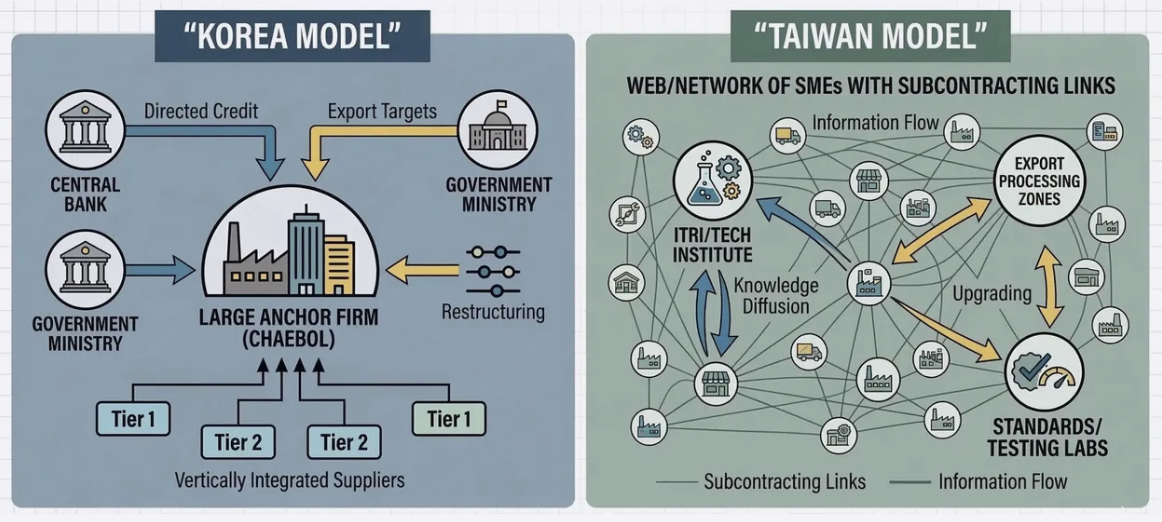
    Both economies generated variation through policy and organizational experimentation. Early import‑substitution strategies were tested and then abandoned as constraints emerged. Export promotion created new competitive environments that encouraged further experimentation. The analytically powerful contrast is that Korea and Taiwan converged on the same goal—solving the coordination problems of scale, finance, and capability upgrading—through two divergent firm structures. Taiwan’s export boom was coordinated through dense networks of small and medium-sized firms (SMEs) and flexible subcontracting. At the same time, South Korea solved the same scale‑and‑coordination problem through large, vertically integrated chaebol (large, family-controlled conglomerates organized as diversified groups of affiliated firms, historically supported by close ties to state-directed finance) backed by state‑directed credit. This is not a historical curiosity; it maps directly onto a live LAC design tension: whether states should back national champions (e.g., Brazil’s BNDES-style approach; Chile’s large copper firms) or build ecosystems that help many smaller firms scale (e.g., the Dominican Republic’s export processing zones; Costa Rica’s tech‑linked upgrading). The lesson is not that one structure is universally superior, but that each requires different instruments to coordinate investment—and different forms of discipline to prevent support from becoming permanent.

    Selection operated through state‑mediated credit allocation and international markets. Access to subsidized finance depended on meeting export and investment targets. World‑market competition filtered out firms and sectors unable to meet price and quality standards. Political reassessment followed failure. In Korea, subsidized credit was rationed through state‑controlled banks and withdrawn from underperforming firms during the 1980s restructuring. In Taiwan, preferential credit, tax incentives, and access to export processing zones rewarded firms that succeeded in export markets. Once successful, export‑oriented industrialization diffused and became entrenched. Institutional routines reduced the cost of repeating outward‑oriented strategies. Learning by doing and sunk investments created path dependence. Core features were adjusted but not abandoned. Taiwan’s growth acceleration began around 1962 and lasted for more than three decades, with real GDP growth averaging roughly 8–9 percent per year through the early 1980s. Korea maintained an export-oriented approach from the early 1960s through the 1980s, despite scaling back vertical industrial policies after the 1979–80 crisis.

    How the state guided change: credit, trade, and discipline

    The state provided clear direction and engineered market rules to align private incentives with national goals. Strategic coordination was exercised through multi‑year plans and central agencies. Trade and exchange‑rate regimes were redesigned to favor exports. Regulatory architectures shaped firm behavior. Korea’s Economic Planning Board, created in 1961, coordinated five‑year plans and export targets across ministries and banks. Taiwan’s exchange rate reform in 1958–1960 and the export promotion statutes of the 1960s restructured market incentives toward outward orientation.

    Public investment provided the infrastructure and human capital needed for industrial-scale production. Both Taiwan and Korea expanded technical and vocational training—and strengthened engineering education—to match the skill needs of export manufacturing and technology upgrading. State‑controlled finance mobilized savings and absorbed risk in priority sectors. These interventions enabled large, long‑gestation projects. They also concentrated fiscal and financial exposure. In Korea, public and public‑enterprise investment accounted for roughly 40 percent of total domestic investment between 1963 and 1979, with major spending on power, ports, and transport. Korea’s domestic savings rate rose from 3.3 percent of GNP in 1962 to 35.8 percent by 1989, channelled through controlled banking systems into industry.

    Innovation systems emerged through learning‑by‑doing within export‑oriented ecosystems. Acquisition and adaptation of technology were prioritized over frontier invention. Organizational forms shaped how learning diffused. Policy feedback adjusted support mechanisms over time. In Korea, targeted support for steel, shipbuilding, and electronics enabled chaebol to become global players by the mid‑1990s. In Taiwan, public technology institutions—most notably the Industrial Technology Research Institute (ITRI)—helped absorb foreign know‑how, incubate new capabilities (especially in electronics), and diffuse process and design improvements across networks of SMEs.

    The practical implication for LAC is not a single template but a shared design principle: the organizational form matters less than the discipline built around it. Korea’s chaebol and Taiwan’s SME networks succeeded not because one structure is superior, but because each was embedded in credible performance tests—and governments were willing to act when those tests were failed. 

    Implications for LAC 

    For finance and planning ministries, the Taiwan–Korea comparison is most relevant as a lesson in state capacity to coordinate investment under hard budget constraints. Both countries solved early coordination failures by steering credit, trade incentives, and planning priorities—but they did so with clear performance tests and a willingness to restructure when bets went wrong. The LAC takeaway is that any modern industrial or productive‑development push (nearshoring, energy transition, strategic minerals, advanced services) must be designed as a fiscally legible program: explicit objectives, quantified milestones, transparent costs (including tax expenditures), and a credible plan to manage fiscal risks arising from public banks, guarantees, state-owned enterprises, and public-private partnerships.

    A second implication is to recreate “export discipline” using instruments that sit squarely within finance and planning systems. Rather than open-ended protection, support should be conditional and time-bound—linked to verifiable indicators such as export survival, productivity, formal job creation, certification/quality adoption, and integration into higher-value-added segments of value chains. Ministries of Finance can operationalize this through results-based transfers and credit lines, rules for tax incentives (ex-ante costings, publication, and periodic review), and procurement that rewards performance and innovation while preserving competition. Planning ministries can align these tools with a national investment pipeline and a small set of priority missions that are revised as capabilities change.

    Finally, the institutional lesson is to treat structural transformation as a governed portfolio of experiments. For finance and planning authorities, the priority is not picking winners once but building routines to allocate, monitor, and exit public support in a way that protects the sovereign balance sheet. That, in turn, means agreeing on a single results framework with a short list of metrics; funding independent evaluation and public reporting; writing sunset clauses and restructuring triggers into programs from the outset; and maintaining fiscal-risk oversight of development banks, SOEs, and PPPs—including stress tests and caps on guarantees. Done well, this shifts LAC policy from ad hoc deals toward credible commitment: investors get stability and coordination, while governments retain the ability to correct course when external conditions tighten.

    Taiwan and Korea show that state-led transformation is possible—but not as a permanent arrangement. Both states eventually had to let go of favored sectors, protected firms, and comfortable credit concentrations. The question for LAC is not whether governments can pick priorities, but whether they can build the institutional reflexes to revise them. That capacity doesn’t emerge from good intentions. It must be designed from the start.

  • Why Reforms Fail: Five Functions for Change in LAC

    Why Reforms Fail: Five Functions for Change in LAC

    In 2013, Mexico’s energy reform looked like a textbook transformation package: a clear legal opening, new regulators, competitive processes to attract investment, and the promise of cheaper, cleaner, more reliable power. Within a few years, the trajectory shifted. Rules were contested, permits and contracts became politicized, and investors faced rising uncertainty. The problem was not just “policy design.” Distributional conflict, institutional veto points, capacity constraints, and credibility gaps made implementation fragile and reversals politically feasible. The lesson for governments across Latin America and the Caribbean (LAC) is straightforward: even reforms that look right on paper can fail to deliver. Institutional change only holds when legitimacy, coalitions, coordination, and learning under uncertainty are managed as an integrated pathway.

    Cases like this show that the core problem is less a lack of ideas than a lack of execution discipline across interdependent steps. Institutional change must be managed as a coordinated sequence in a contested environment. When transformation is treated as a long list of separate reforms, leaders lose clarity on what comes first, what must run in parallel, and what must be sustained long enough to become routine. They also struggle to reduce uncertainty about impacts and costs. Resistance then becomes predictable—distributional conflict, bureaucratic turf wars, capability gaps, and private interests seeking exemptions or delay. The result is familiar: partial progress, missed complementarities, and ad hoc trade-offs. Credibility erodes, and the package underperforms.

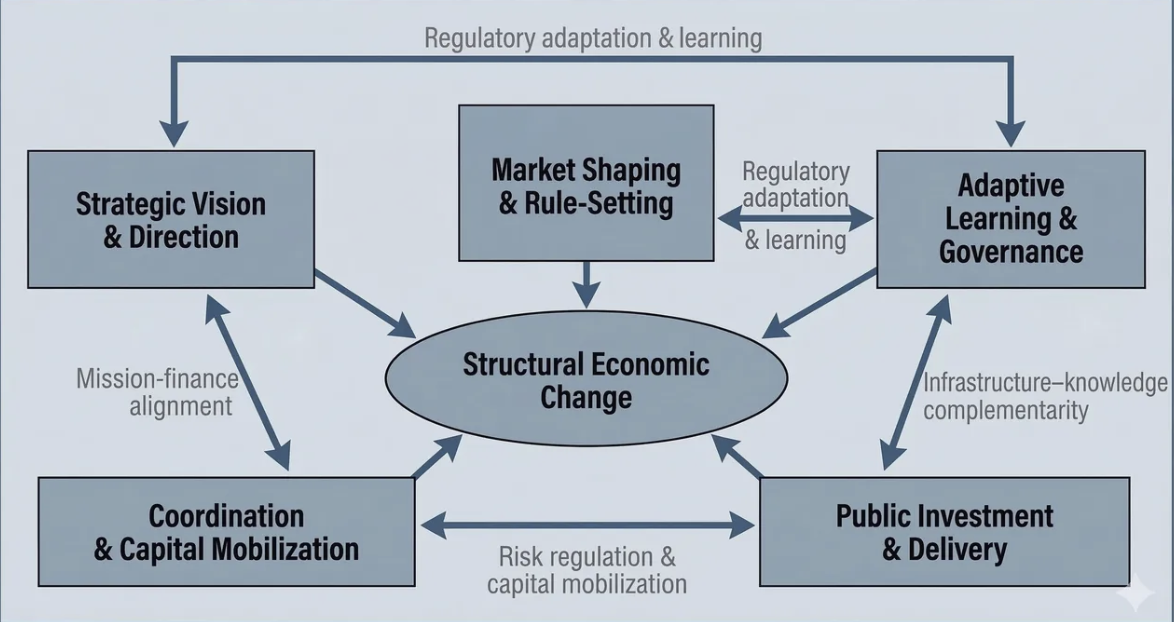
    A coherent approach starts by making the pathway explicit. It turns a complex agenda into manageable blocks that you can share, sequence, and run. I propose five state functions. These five functions don’t overlap, and you can’t skip any of them: strategic vision, market shaping, public investment, coordination and capital mobilization, and adaptive learning. Read as a change pathway, they clarify what governments must put in place. Vision sets direction, market shaping creates the rules and incentives that make it possible, investment turns intent into delivery, coordination keeps everyone aligned, and learning builds in feedback and adaptation. When these functions align, they create reinforcing loops that build capability and credibility. When they do not, predictable failure modes follow—misallocation, reversals, and erosion of trust.

    Why transformation efforts stall: complexity, silos, and partial diagnostics

    Development theories illuminate important state roles. Each tends to focus on a subset of functions rather than offering a complete map for transformation. Developmental state theory emphasizes long-term vision and coordination, but it underplays institutionalized learning and adaptation. Innovation systems theory highlights networks and knowledge flows, yet it treats the state as an implicit actor and offers limited guidance on direction-setting or market creation. New institutional economics foregrounds property rights and the enforcement of rules. It often says less about how states actively shape markets or build productive capabilities. No single framework is jointly exhaustive. Policymakers who apply any of them in isolation will overlook critical functions for sustained change.

    Standard diagnostics often reinforce the problem by treating governance, regulation, finance, and investment as separate silos. They can tell you whether rules are clear, procedures are followed, and projects are well costed. They rarely ask whether the government knows where it is going. They also rarely ask whether institutions are aligned to sustain delivery, or whether the system can learn and adapt when things go wrong. Targeted political economy work can help by identifying who stands to lose (or gain), which agencies can block implementation, and which groups can mobilize against change—such as state-owned enterprises, public-sector unions, or concentrated industry lobbies. But operational evidence still struggles to accumulate into system-level learning without a unifying functional architecture.

    Disconnected reform tracks produce predictable results. They weaken sequencing and suppress learning, which lowers the returns to reform and investment. Resistance and capture risks amplify the damage. Reforms that threaten rents can trigger pushback from incumbent firms, privileged contractors, or protected state-owned enterprises; agencies also protect turf, and weak accountability increases the risk of corruption. Countries may improve governance indicators without achieving a productivity takeoff. Missing functions—especially coordination and capability-building—often explain the gap. Ambitious investment or industrial strategies can also falter. Weak regulation, accountability, or learning then produces misallocation, capture, and backlash. Learning is rarely treated as an explicit state function. Failures persist without correction, and successes are not systematically scaled. The net result is low and volatile returns. Skepticism about state-led transformation grows.

    The five functions that drive institutional change

    Governments need a simple way to describe what must be done and how the pieces fit together over time. The goal is not simplification for its own sake. It is a pathway that is complete enough to guide execution in the real world. Structural change requires five distinct state functions that cannot be collapsed into isolated policies. Progress depends on moving through them as a coherent sequence, not as independent checkboxes. The sequence also helps manage uncertainty and resistance. Credible direction builds legitimacy, enabling rules to reduce discretion and rent-seeking; early delivery builds confidence; coordination brokers compromises; and learning course-corrects when assumptions fail. The model identifies five functions: strategic vision, market shaping and regulation, investment and service delivery, coordination and capital mobilization, and adaptive governance and learning. Each corresponds to a different mode of state action—choosing direction, setting rules, allocating resources, aligning actors, and adjusting in response to feedback. Together, they describe how change is initiated, implemented, and sustained. The absence of any one function can derail transformation even when others are strong.

    Recent LAC experience shows how a missing function can derail change. In Mexico, shifts in strategic direction weakened legitimacy and raised regulatory uncertainty after the 2013 energy opening. Weak enabling rules and oversight can also turn programs into rent opportunities. Brazil’s Petrobras contracting scandal illustrates how discretion and weak controls can corrode performance and trust. Delivery gaps can be just as damaging. In Haiti, repeated difficulties translating reconstruction and service commitments into sustained results eroded confidence. Coordination failures can stall implementation even when the direction is clear. In Colombia, implementation of the peace accord has faced coordination and financing bottlenecks that have slowed delivery in territories. Finally, weak feedback and adaptation can lock in underperforming policies. Argentina’s repeated cycles of price controls and ad hoc subsidies show how reversals can substitute for learning.

    The model is designed so that each function is distinct, yet together they cover the full spectrum of state roles. That is what makes it useful as a practical change sequence. Strategic vision concerns choosing ends. Market shaping governs rules and incentives, while investment focuses on direct provision and asset creation. Coordination and accountability manage cross-government incentives, distributional conflict, and capital mobilization across institutions. Adaptive learning institutionalizes feedback and adjustment over time. The literature maps unevenly onto these functions. Most approaches emphasize some functions but not others, which is why partial diagnostics persist. For policymakers, the implication is practical. Durable change often fails when a single block is missing, even when other reforms are advanced.

    Development outcomes depend on alignment and feedback across functions, not excellence in any single domain. Momentum must also carry early actions into institutionalized routines. Strong public investment without market discipline or accountability raises fiscal risk and lowers returns, as repeated LAC debt cycles show. Strong regulation without investment and coordination can also disappoint. Productive capabilities remain underdeveloped when delivery and alignment are weak. The model treats transformation as a system. Vision focuses effort, shaping the market enables action, investment delivers tangible progress, coordination provides the glue that holds the institution together, and learning embeds adaptation, so gains persist. Uruguay’s renewable energy transition is a useful counterexample. A clear direction, stable market rules (including auction design), credible delivery of new generation, effective coordination among public entities and investors, and ongoing learning sustained rapid change over time. This logic explains why fragmented reform packages underperform despite isolated improvements.

    How the model improves diagnosis, sequencing, and credibility

    A functional lens turns diagnosis into a plan. It shows which block in the change pathway is missing and where the capability is binding. By assessing performance across the five functions, analysts can identify whether stagnation reflects weak vision, poor market shaping, thin delivery capacity, coordination failures, or missing learning mechanisms. That is more actionable than sectoral or institutional checklists. In LAC, many countries strengthened rule-of-law and regulatory indicators, yet failed to diversify or innovate. Gaps in vision and learning often explain why governance improvements did not translate into transformation.

    The model also operationalizes political economy and financial constraints. It supports realistic sequencing from enabling conditions to delivery to durability. Sequencing choices—such as whether to reform regulation before scaling investment, or to pilot before scaling—should be evaluated based on functional readiness, not ideology. Many failures are not technical. They reflect veto points, distributional conflict, and credibility problems—for example, resistance from public-sector unions, pushback from incumbent utilities or other state-owned enterprises, or pressure from export industry lobbies for exemptions and special regimes. Pilots, phased implementation, and transparent risk governance can reduce uncertainty and lower resistance. They clarify who bears costs and how risks are managed. Large-scale capital mobilization without credible oversight can create contingent liabilities and credibility loss. Repeated renegotiations and legal disputes in some LAC transport concessions show how weak risk allocation and accountability can undermine long-term credibility. By linking finance, accountability, and learning, the model helps governments manage trade-offs transparently and sustain momentum beyond the first wave.

    Learning strengthens credibility by turning reform into a self-correcting routine. It also raises long-run impact by improving policy over time. Monitoring, evaluation, and experimentation help governments detect failure, end ineffective programs, and scale what works. Mexico’s PROGRESA illustrates the point. Rigorous evaluation supported evidence-based scaling and political sustainability. The contrast is costly. Prolonged protection of underperforming industries shows what happens when learning is missing. Treating learning as integral helps institutionalize change. Performance improves through feedback rather than waiting for a crisis.

    Making change stick

    LAC’s productivity gaps persist for many reasons, but a common pattern emerges in practice: reforms often move in pieces, and those pieces do not reinforce one another. The result is predictable. Progress stalls, credibility erodes, and governments end up reiterating the same agenda under tighter constraints.

    One practical application is to design a policy-based MDB loan around the five functions, with actions sequenced to build credibility and manage resistance. A first step could set the direction (a published, costed transformation strategy with a delivery mandate) and establish clear rules (time-bound regulatory changes that reduce discretion and clarify incentives). A second tranche could tie disbursement to early delivery (a small number of visible, implementable investments or services) and to coordination (a standing cross-ministry delivery unit with agreed financing, risk governance, and stakeholder engagement). A final tranche could institutionalize learning (monitoring and evaluation, feedback loops, and pre-agreed “course-correction” triggers if targets are missed). Across different groups, indicators would track not only outputs, but credibility signals—policy stability, dispute-resolution performance, procurement integrity, and whether feedback is acted on—so the loan supports lasting change rather than one-off compliance.

    What success looks like is alignment that compounds over time: direction that stays credible, rules that enable action, delivery that builds confidence, coordination that sustains coalitions, and learning that keeps the system adaptive. Uruguay’s renewables build-out shows what this alignment can look like in practice. The payoff is cumulative capability and resilience, not episodic reform cycles.

    Policymakers can use this functional lens to break transformation into manageable blocks and to communicate a credible pathway, internally and with partners. The key is to plan reforms as a reinforcing portfolio, not as disconnected initiatives. That requires managing uncertainty and resistance throughout implementation—distributional conflict, bureaucratic inertia, veto points, and interests seeking delay or exemptions. In practice, governments should ask two discipline questions at each stage: what function is missing, and what would make the next step politically and operationally credible? For MDB-supported programs, this lens also helps shift policy loans from checklist compliance to sequenced capability-building, with disbursements and indicators that reward delivery, coordination, and learning—not just legal changes on paper. Used this way, the model supports coherent, durable transformation.

  • Venezuela’s Oil Boom 1920–1970: Institutional Lessons

    Venezuela’s Oil Boom 1920–1970: Institutional Lessons

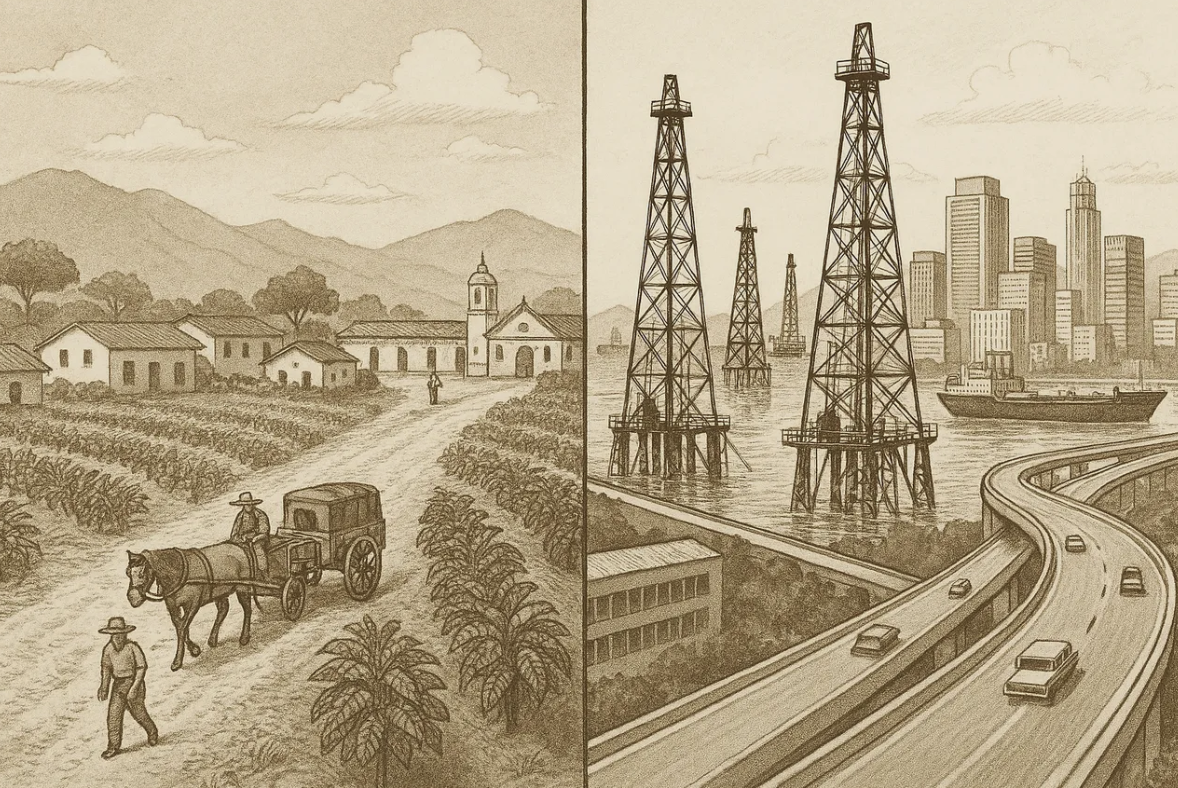
    Venezuela’s oil boom between 1920 and 1970 represents one of the most compressed episodes of economic transformation in Latin American history, driven overwhelmingly by petroleum extraction. Real GDP per capita rose from roughly 20% of U.S. levels in 1920 to about 90% by 1958, growth unmatched elsewhere in the region during the period. This was powered almost entirely by foreign direct investment in oil, with crude production rising from about 1 million barrels annually in the early 1920s to 137 million barrels by 1929, making Venezuela one of the world’s largest oil producers and exporters. Oil’s share of exports jumped from 1.9% in 1920 to 91.2% by 1935, while agriculture’s share of GDP fell from over 30% toward single digits by mid‑century. The same mechanisms that generated rapid income growth, therefore, restructured the entire economy around a single enclave sector.

    The core policy challenge was that oil‑driven growth reconfigured Venezuela into a rent‑dependent state before institutions capable of managing diversification were built. Massive inflows of foreign capital appreciated the Bolívar, eroding competitiveness in agriculture and manufacturing, a phenomenon later known as Dutch Disease. By the 1950s, oil revenues had almost entirely replaced personal income taxation, transforming the state from a tax‑collecting institution into a rent-distributor. This fiscal architecture weakened incentives to build productivity in non‑oil sectors and severed the accountability link between citizens and the state. Inequality remained extreme despite high average incomes: in 1970, the poorest quintile received only 3% of national income, while the richest quintile received 54%.

    The implied policy objective was to convert temporary oil windfalls into a diversified, productivity‑based economy supported by durable fiscal and learning institutions. Venezuela’s own reform debates articulated this goal explicitly, most notably in the 1936 call to “sembrar el petroleo” by reinvesting rents into productive capacity beyond petroleum. Achieving this outcome required sequencing: first capturing rents, then building tax institutions, learning systems, and diversification mechanisms before rent distribution became politically locked in. The historical record shows that this transition was only partially attempted and never completed. The call to action is therefore to extract institutional lessons from this failure rather than replicate its revenue successes alone.

    Oil reshaped the whole economy around one sector

    Oil discovery irreversibly reallocated Venezuela’s dominant capital stock from cultivated land to subsoil hydrocarbons, concentrating both energy and financial flows in petroleum extraction. Between 1920 and 1935, oil’s share of exports rose from 1.9% to 91.2%, while agriculture’s contribution to GDP declined from over 30% in 1920 toward roughly 5–6% by the 1970s. Annual crude production expanded from about 1 million barrels in the early 1920s to 137 million barrels by 1929, supported by more than 100 foreign companies operating in the country by the late 1920s. These inflows generated rapid income growth but also appreciated the Bolívar, systematically undermining price competitiveness in other tradable sectors. The result was an economy whose growth depended on a single, externally operated capital stock.

    The oil boom triggered a rapid reconfiguration of social institutions as labor and population followed oil‑linked income opportunities. Venezuela’s urban population rose from an estimated 20% in 1920 to 39.2% by the 1941 census, and then accelerated further to nearly 80% by 1980. Oil revenues raised wages in the petroleum sector and the state, pulling labor out of agriculture as coffee income fell to less than one‑tenth of GDP by the 1950s. Population growth accelerated from about 2.8% per year in 1920–1940 to 3–4% thereafter, driven by falling mortality and immigration attracted by oil prosperity. The state attempted to meet surging demand for housing, health, and education primarily through oil rents rather than through broad‑based taxation.

    A new social order emerged in which political stability depended on the distribution of oil rents rather than on taxing citizens. By the 1950s, oil revenues had largely replaced personal income taxes, creating a rentier bargain between the state and society. The 1958 Punto Fijo pact institutionalized this logic by allocating state employment and oil revenues among major political parties in proportion to electoral results. While this arrangement sustained democratic stability, it concentrated wealth and entrenched inequality, with the bottom quintile receiving only 3% of income in 1970. Social services expanded, but the underlying income distribution and productive structure remained unchanged.

    Rent capture over diversification

    Early oil development generated significant institutional and technological variation, particularly under the Gómez concession regime between 1908 and 1935. More than 100 foreign firms introduced different extraction technologies, management practices, and labor models, creating a diverse organizational ecology in the oil sector. At the same time, competing development ideas emerged domestically, including the 1936 proposal to reinvest oil rents into a diversified economy. Political movements also differed in their visions, ranging from low‑royalty concession models to more assertive resource nationalism. This variation created genuine choice over Venezuela’s development trajectory.

    From this range of options, the state selected institutional arrangements that maximize revenue while preserving foreign operational control. The 1943 Hydrocarbons Law standardized concessions, set a 16.67% royalty, and codified the 50/50 profit‑sharing principle, which was strengthened in 1948. Within five years of the 1943 law, government oil income was widely reported to have increased roughly sixfold, a powerful selection signal that favored rent capture over riskier diversification strategies. At the macro level, attempts at import‑substitution industrialization were repeatedly undercut by an appreciated currency and a political preference for distributing rents. The 1958 Punto Fijo pact represented a second‑order selection, choosing a democratic patronage system over both dictatorship and radical redistribution.

    Venezuela’s chosen institutions diffused unevenly, with global influence but domestic lock‑in. Internationally, the 50/50 profit‑sharing model spread rapidly and became a global norm, and Venezuela co‑founded OPEC in 1960 to extend state sovereignty over oil pricing. Domestically, however, rentier institutions were retained and deepened: personal income taxation remained marginal, and non‑oil sectors relied on oil‑funded subsidies. Even as labor productivity in the oil sector rose by 125% between 1960 and 1970, these gains did not diffuse into broader industrial ecosystems. The economy became path‑dependent on the distribution of rents rather than on productivity growth.

    Revenue capacity outpaced learning capacity

    The Venezuelan state’s most effective interventions involved rule‑setting that increased its share of oil rents without disrupting production. The 1943 Hydrocarbons Law and its 1948 amendments created predictable fiscal rules that balanced state revenue with continued foreign investment. In 1960, the creation of the Corporación Venezolana de Petróleo inserted the state into commercial operations, and Venezuela’s role in founding OPEC demonstrated its capacity to shape global market architecture. These actions show strong regulatory and negotiating capability. However, they focused on revenue extraction rather than on steering the structure of domestic markets.

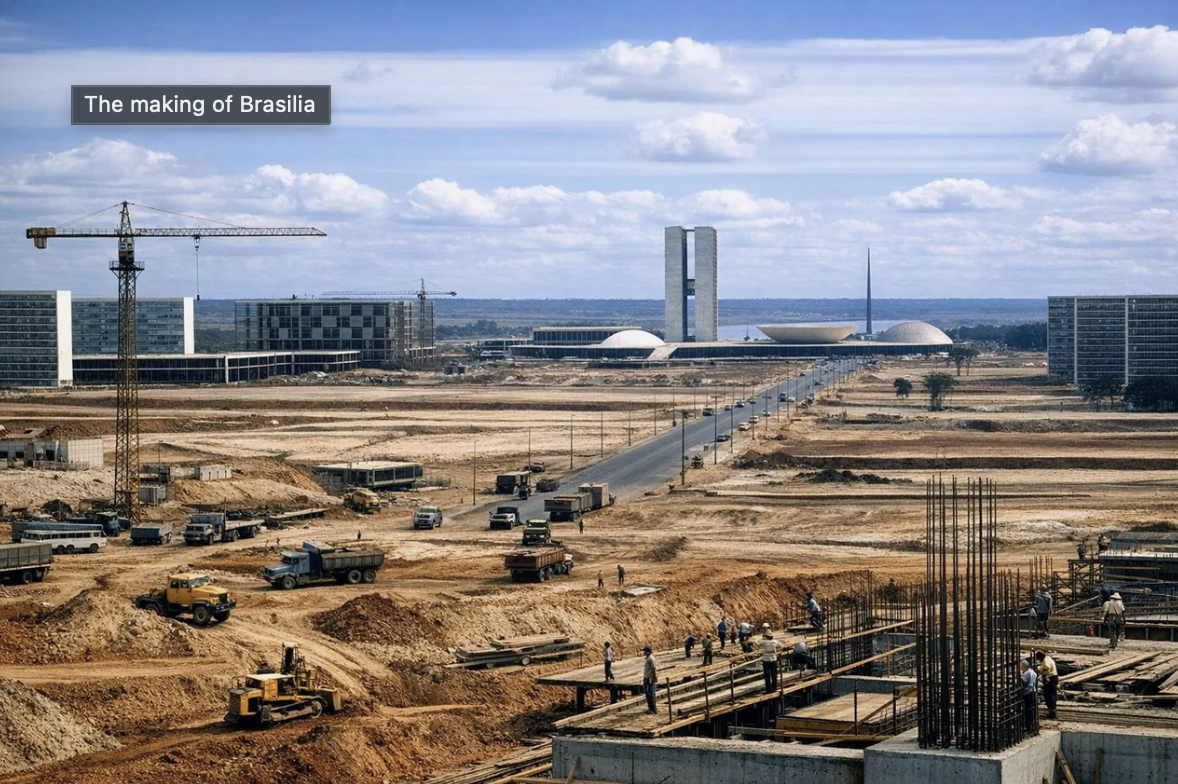
    Oil revenues financed unprecedented levels of public investment in infrastructure and social services. Between 1920 and 1958, oil rents funded road networks, urban expansion in Caracas, and improvements in health and education that reduced mortality from about 12.3 per 1,000 in 1950–55 toward 5.5 per 1,000 by 1980. In the 1960s, the state launched the Ciudad Guayana industrial complex, combining steel, aluminum, and hydroelectric power as a planned growth pole. Public investment reached 24% of total investment by 1970, rising further thereafter. Yet increasing state dominance also crowded out private capital and raised risks of misallocation.

    State capacity to absorb and diffuse knowledge lagged its fiscal power. The Corporación Venezolana de Fomento, created in 1946 to promote non‑oil industries, struggled because an appreciated currency and cheap imports undermined competitiveness. Despite a 125% rise in oil‑sector labor productivity between 1960 and 1970, the state failed to build institutions that transferred skills, technology, or management practices into downstream or unrelated sectors. Fiscal surpluses in the 1960s, averaging 0.9% of GDP, provided an opportunity to capitalize on a stabilization or sovereign wealth fund, but no such institution was created. This missed sequencing step left the economy exposed to future shocks.

    Key lessons for policymakers

    Venezuela’s oil boom demonstrates that rapid income growth without institutional sequencing can entrench structural vulnerability. The country solved the problem of rent capture, but not the harder problem of converting rents into diversified productive capacity. By substituting oil revenues for taxation, the state weakened accountability and tied political stability to commodity cycles. High growth, therefore, coexisted with persistent inequality and fragile institutions.

    Success would have required a state that used oil rents to build tax institutions, learning systems, and counter‑cyclical buffers before distributing rents broadly. In such a scenario, oil would have financed diversification rather than replaced it, and productivity gains in the enclave sector would have diffused into the wider economy. Fiscal stability would not have depended on continuous oil price growth, and political coalitions would have been anchored in productive capacity rather than rent allocation.

    For today’s LAC policymakers, the lesson is to prioritize institutional sequencing over revenue maximization. Capture rents early while simultaneously building tax capacity, learning institutions, and stabilization mechanisms before rent distribution becomes politically entrenched. Invest explicitly in knowledge transfer and absorptive capacity, not just infrastructure. Avoid designing political settlements that depend on permanent commodity windfalls. The cost of delaying these steps is not slower growth, but the long‑term fragility that Venezuela’s experience makes clear.

  • Mexico 1994–2007: Growth Without Diffusion—Policy for Transitions

    Mexico 1994–2007: Growth Without Diffusion—Policy for Transitions

    Between 1994 and 2007, Mexico carried out one of the most far-reaching economic reforms in Latin America. In little more than a decade, the country moved from a state-led, inward-oriented development model to a deeply integrated export‑manufacturing platform anchored in North American value chains. The scale of the transformation was substantial: foreign direct investment averaged USD 18–20 billion annually by the early 2000s, manufacturing exports rose to more than 80 percent of total exports, and formal employment expanded rapidly in export corridors. For policymakers across Latin America and the Caribbean, Mexico’s experience is one of the clearest real-world tests of what happens when trade openness, foreign investment, and macro stability are allowed to drive structural change at speed.

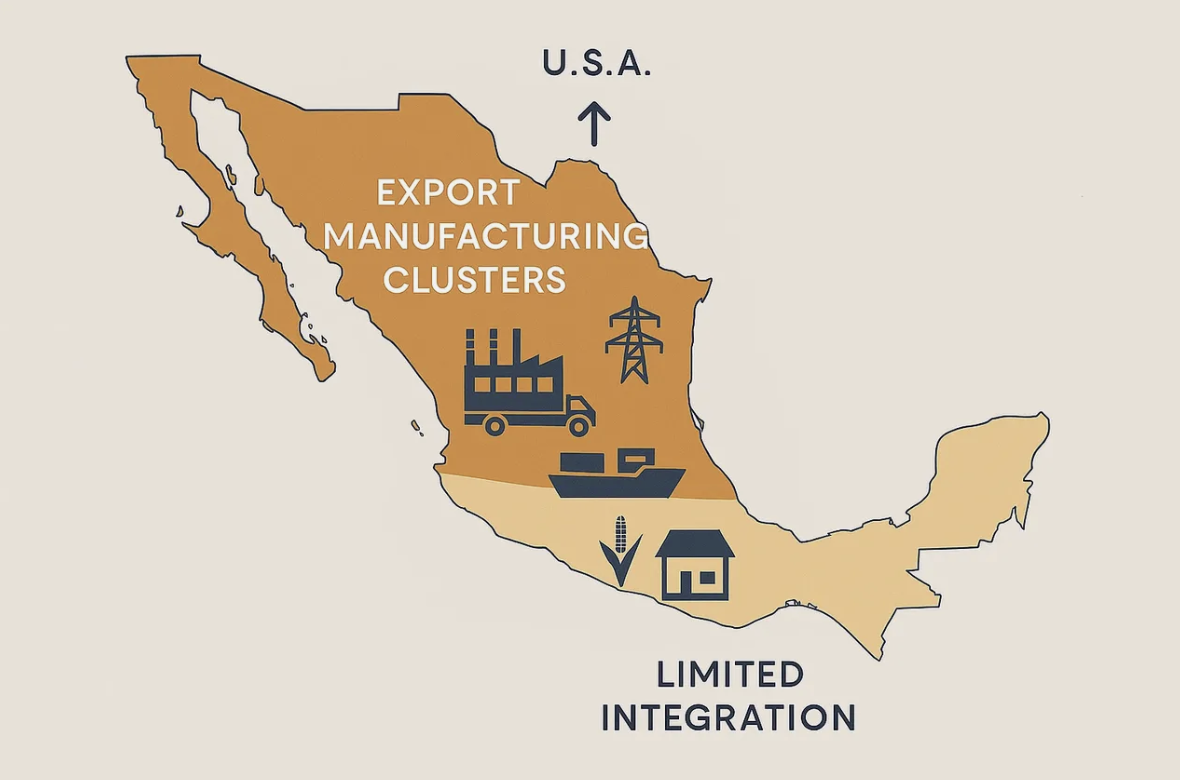
    What is at stake for today’s policymakers is not whether integration can generate growth—it clearly can—but what kind of growth it generates, where it concentrates, and what capabilities it leaves behind. Mexico’s transformation produced globally competitive automotive and electronics clusters in the North and the center of the country. At the same time, large parts of the South remained trapped in low-productivity agriculture and informality. Real wages lost nearly 50 percent of purchasing power during the 1990s, employment cycles became tightly synchronized with U.S. demand, and domestic innovation capacity remained weak despite massive capital inflows. The result was a development pattern often described as “production without distribution”—high export performance combined with limited domestic upgrading and persistent territorial inequality.

    This blog addresses a challenge that is directly relevant to current policy debates on renewable energy, green industrialization, and regional development: how to design growth strategies that do more than attract capital. Drawing on Mexico’s experience between 1994 and 2007, it explains how the country’s human ecosystem—capital stocks, capital flows, institutions, and social cycles—was reconfigured; how evolutionary forces of variation, selection, and diffusion shaped winners and losers; and how the state’s choices as market architect amplified both successes and failures. The central proposition is that openness without deliberate capability building leads to fragile, uneven, and environmentally costly development paths.

    Hopefully, readers should come away with a sharper ability to distinguish between integration-led growth and capability-driven development, and with a clearer sense of which policy levers matter most when planning large-scale transitions—especially in energy systems that require long-term investment, learning, and territorial inclusion. The call to action is explicit: future industrial and renewable energy strategies must be designed not only to connect economies to global markets, but also to embed learning, resilience, and regional balance into the structure of growth itself.

    FDI selected winners, but the policy failed to diffuse

    Mexico’s capital stocks were reallocated toward export manufacturing, with the reallocation geographically concentrated. Formal employment expanded quickly in the second half of the 1990s: total employment rose from 33.9 million to 39.1 million between 1995 and 1999 (about 3.7% annually). At the same time, manufacturing became the dominant destination for foreign capital—by the early 2000s, FDI inflows averaged USD 18–20 billion annually, and manufacturing absorbed a large share of those inflows (about 53%). This concentration accelerated the build-out of industrial and urban assets in northern and central export hubs while leaving the agrarian South comparatively disconnected from high‑productivity networks. 

    Capital flows increased sharply and became structurally asymmetric—especially in the “import‑assemble‑export” structure of production. On the real economy side, Mexico’s export platform relied heavily on imported intermediates: raw material and intermediate imports grew at roughly 18.5% per year (1995–1999), indicating that a comparable deepening of domestic input industries did not keep pace with production expansion. On the labor side, internal migration surged northward toward export corridors. Still, knowledge spillovers remained modest because many plants operated as “assembly‑only” maquiladoraswith limited research and development and thin domestic supplier development. For policymakers, the key point is that rapid capital inflows can boost output without automatically building local capabilities unless policy deliberately strengthens learning and linkages. 

    Institutions were adjusted in ways that reduced investor uncertainty but weakened the inclusion and bargaining power of many workers and regions. NAFTA institutionalized trade rules and investor protections that served as durable “political risk insurance,” strengthening policy credibility beyond domestic political cycles. Yet social order became more fragile: domestic real wages lost nearly 50% of purchasing power in the 1990s following currency shocks and labor surplus. Labor institutions also became segmented—export plants often paid better than informal alternatives, but collective bargaining remained weak in many settings while informality expanded elsewhere. This matters for transitions: credibility and capital attraction are necessary, but social legitimacy depends on wages, working conditions, and distributional outcomes that markets do not fix on their own. 

    Social cycles became more externalized and volatile as manufacturing synchronized with U.S. demand. The early 2000s downturn is a concrete example: maquila employment fell by 17–18% between 2000 and 2003, showing how an externally driven model transmits shocks to domestic employment. Regionally, the divergence became persistent: poverty was around 57% and informality at roughly 70% in the South, versus roughly 40% informality in the North. This is not just inequity; it is a constraint on national productivity and political stability. For renewable energy, the parallel is direct: if grid upgrades, clean‑industry corridors, and skills systems concentrate only where institutions are already strongest, the transition can reproduce the same dualism—modern enclaves alongside regions left structurally unable to participate.

    Infrastructure chose regions

    In evolutionary terms, NAFTA was a major source of economic variation in Mexico. Trade opening introduced many “new variants” of production—new firm types, organizational models, and process standards—especially in autos, electronics, and other export platforms. Multinational firms brought modular production, just-in-time logistics, and global quality regimes (including ISO‑style standards) that reshaped the “work culture” of northern hubs. At the same time, regional initial conditions mattered: northern states were “pre-adapted” by stronger education and infrastructure. In contrast, southern states entered the period with weaker absorptive capacity and fewer connective assets. 

    Selection pressures then sorted these variants quickly and unevenly. The U.S. market served as the primary selective agent, rewarding proximity, speed, compliance with standards, and scale—especially in autos, electronics, and aerospace. In quantitative terms, higher-complexity states increased their share of national output (north rising from 39% to 42.7%), while less-diversified southern states saw their share decline (from 9.8% to 6.9%). Macro financial shocks also served as selection events: the 1994–95 crisis and the early 2000s downturn filtered out weaker firms. They reinforced the position of well-capitalized multinationals with access to global finance and technology, deepening foreign dominance in key export sectors. 

    Diffusion—the spread of practices, knowledge, and benefits—was the most incomplete stage of the evolutionary process. Some diffusion occurred within export supply chains: domestic suppliers upgraded in pockets due to quality and delivery requirements, and clusters formed in the Bajío and border regions through agglomeration effects. However, diffusion largely failed at a national scale because market failures in education, infrastructure, and finance prevented lagging regions from catching up. These factors served as diffusion barriers, keeping the South in a lower productivity “evolutionary trap.” The policy implication for transitions is operational: markets will generate variation (new technologies and projects) and selection (winners and losers), but diffusion (skills, suppliers, innovation capability, regional participation) requires explicit design.

    Risk was socialized, but capability was not

    The state’s central achievement during 1994–2007 was serving as a credible market architect. Mexico used NAFTA to “lock in” liberalization, signaling to global capital that the country would not revert to protectionism. Coordination then shifted toward sectoral programs and preferential conditions for multinational firms in autos and electronics, creating legal certainty and targeted support for export corridors. This approach was effective at attracting investment and scaling exports, but it also narrowed the state’s attention to what investors demanded rather than what domestic capability-building required. For transitions, this distinction is critical: credibility and market architecture can mobilize capital, but they do not guarantee domestic learning or broad inclusion unless those outcomes are built into the strategy. 

    Public investment was decisive—but spatially uneven—and that unevenness shaped long-run outcomes. Major public-private investments supported northern logistics, border crossings, and power grids to serve U.S. value chains. In contrast, infrastructure investment in southern states such as Oaxaca and Chiapas remained insufficient, contributing to “deficient economic institutionality” and weak FDI attraction. This pattern shows that infrastructure is not merely supportive; it is selection-shaping. When public goods concentrate in already‑competitive corridors, agglomeration strengthens, and divergence hardens. For today’s transition, the comparable risk is the buildout of transmission, ports, and industrial energy infrastructure, primarily in areas where industrial capacity already exists, thereby locking lagging regions out of clean‑industry participation. 

    In finance and risk management, the state served as a systemic shock absorber, most visibly during the 1995 crisis via the FOBAPROA bailout, prioritizing the survival of the financial system to maintain trade and investment flows. This preserved openness and investor confidence, but it also socialized risk and, by itself, did not create inclusive financing channels for domestic firms to upgrade. Growth reliant on external demand and foreign firms exposed Mexico to vulnerabilities when capital and demand cycles turned. For upcoming transitions—capital-intensive and exposed to price, currency, and policy shocks—this underscores the need for deliberate risk-sharing instruments and capital mobilization that build domestic balance sheets rather than just foreign project pipelines. 

    Innovation and learning were the state’s most significant gaps. While maquiladora learning was underway, Mexico lacked a robust national innovation capacity to move domestic firms from assembly to design and higher‑value activities, leaving the technology gap with the U.S. largely unclosed. In practice, this meant that many high-value functions remained abroad and that domestic upgrading was thinner than the scale of investment would suggest. For the future, the analogous risk is a transition dominated by imported technology and engineering, with limited domestic supplier upgrading in the construction delivery. A policy‑credible alternative is to treat innovation systems—technical institutes, supplier development, standards for learning, and finance for upgrading—as core infrastructure of the transition rather than optional add-ons.

    Transitions need diffusion by design

    Three core lessons from Mexico’s 1994–2007 experience stand out for policymakers. First, integration delivers scale, but it does not automatically enable development. Mexico successfully locked itself into one of the world’s most lucrative value chains, becoming a leading exporter of manufactured goods and generating millions of formal jobs. Yet the same period saw stagnant real wages, limited domestic firm upgrading, and heavy dependence on imported intermediates, underscoring that export growth alone does not create endogenous capabilities or sustained productivity gains.

    Second, regional divergence is not an accident—it is an outcome of policy design. Manufacturing clusters flourished in regions with strong infrastructure, logistics, energy systems, and institutional capacity, increasing the northern and central states’ share of national output from 39 percent to over 42 percent, while the South’s share declined. The absence of sustained public investment in southern education, connectivity, and productive infrastructure created an “evolutionary trap” in which lagging regions could not absorb knowledge or capital, even as the national economy expanded.

    Third, the state matters most in what it builds, not just in what it opens. Mexico’s government was highly effective at rule-setting, macro‑stabilization, and risk absorption—most notably during the 1995 financial crisis—but far less effective at fostering innovation systems, upgrading domestic suppliers, and diffusing beyond export enclaves. The state assumed an active role in shaping markets but did not fully develop comprehensive learning ecosystems. This imbalance explains why maquiladora learning remained shallow and why domestic research and development intensity stayed far below OECD benchmarks.

    The core message for today’s policymakers—especially those designing renewable‑energy and green industrial strategies—is straightforward. Investment attraction is necessary but insufficient. Clean‑energy transitions will replicate Mexico-style outcomes unless they are paired with deliberate policies for skills, local supply chains, innovation, and territorial inclusion. Energy infrastructure, like manufacturing infrastructure before it, will concentrate where institutions are strongest unless the state actively counterbalances market selection.

    The call to action is therefore strategic rather than technical: design transitions that treat learning, diffusion, and regional balance as core objectives rather than secondary benefits. Mexico’s experience shows that speed without structure creates growth that is vulnerable, uneven, and politically fragile. Today’s policymakers have the opportunity to apply these lessons early, building energy systems that not only decarbonize economies but also anchor inclusive, resilient, and capability-based development for decades to come.

  • Costa Rica (1950-2010): a Distinctive Development Trajectory.

    Costa Rica (1950-2010): a Distinctive Development Trajectory.

    In 1948, Costa Rica redirected the money it had been spending on its military into schools and hospitals. Emerging from a brief civil war in 1948, the country abolished its army, redirected public resources to schools, health, and infrastructure, and developed a policy mix that combined social inclusion with environmental protection. 

    Between 1950 and 2010, Costa Rica built one of the most distinctive development trajectories in Latin America. Life expectancy rose from the mid-50s in 1950 to around 79 years by 2010. Adult literacy increased from roughly 80–85% in 1970 to about 95% by 2010, while GDP per capita approximately tripled between 1960 and 2010. This 60-year period matters for today’s green transition because it shows how a small, middle-income country can reshape its institutions, firms, and social norms and rebuild natural capital.

    During these decades, Costa Rica moved from an economy based on coffee, bananas, and cattle to one increasingly driven by services, ecotourism, and higher-value manufacturing, while recovering forest cover and decarbonizing its power system. Forest cover initially declined to around 20–25% by the mid‑1980s and recovered to over 50% by 2010. Public agencies such as the Instituto Costarricense de Electricidad (ICE), the national parks system, and later forest and climate institutions played central roles in steering investment and learning. By 2010, protected areas covered about 28% of land, and renewables accounted for roughly 85% of electricity generation.

    This blog explores that story through three lenses: what changed, what drove those changes, and what the state did to make them possible.

    From frontier expansion to forest recovery

    From 1950 onward, Costa Rica expanded human capital while undertaking a rapid boom‑and‑then‑recovery in natural capital. The country showed significant gains in literacy, life expectancy, and access to public services. At the same time, it experienced rapid deforestation between 1960 and 1980, followed by one of the most effective examples of tropical forest recovery in the world. Costa Rica maintained stable democratic institutions and built strong public service and environmental stewardship norms. Inequality and informality persisted, and fiscal pressures grew, especially around the 1980s debt crisis. By 2010, electricity and water access were both close to universal, and the country had held uninterrupted competitive elections since 1950.

    After abolishing military spending in 1948, Costa Rica redirected resources to education, health, and electricity generation. In 1949, ICE began investing in large-scale hydropower, later expanding into geothermal and wind power, laying the foundation for the country’s renewable power base in 2010. 

    Rapid agricultural expansion and cattle ranching between 1960 and 1980 drove massive deforestation, but this was reversed by the creation of protected areas from the 1980s onwards and the establishment of payments‑for‑environmental‑services schemes in the mid‑1990s. By 2010, more than a quarter of the country was protected, and forest cover had substantially recovered – serving as a base for a booming ecotourism sector and repositioning tropical forests as productive environmental assets.

    The Intel plant established in Costa Rica in the 1990s was the clearest signal that the country’s decades of social investment had paid off in ways the original policymakers hadn’t anticipated. Intel chose Costa Rica over larger, cheaper neighbors not because of low wages but because of workforce quality, political stability, and — critically — the environmental reputation that made the country attractive to a company that needed to be seen operating responsibly. 

    The country underwent structural transformation, shifting from primary commodities to services, tourism, and high-value manufacturing and business services. The share of services in GDP was over 60% by 2010, and FDI inflows reached more than 5% of GDP in the 2000s. Much of this shift was supported by foreign direct investment in electronics and medical devices. Costa Rica has built comparatively high levels of trust in institutions and political stability compared to its regional peers. The 1980s crisis and some later reforms reintroduced new inequality and employment pressures.

    Variation, selection, and diffusion in Costa Rica

    Costa Rica’s transformation was not planned from the beginning. It was the outcome of a series of experiments, some of which worked and many of which didn’t, with the market, political coalitions, and periodic crises doing the selecting. The country established new public agencies, introduced new environmental regulations, and explored new export‑promotion regimes. The private sector initially responded through natural‑resource‑extraction enterprises, which later shifted to eco‑lodges and tech clusters. Domestic political coalitions favored certain strategies, which were reinforced by changes in commodity prices and cycles of foreign direct investment. Social and environmental policies were retained through various coalitions, while a focus on frontier agriculture and import substitution was abandoned. Hydropower electrification, protected areas, payments for environmental services, and export services diffused across territories and sectors through replication, learning, and deliberate Costa Rica branding. The connections among clean energy, ecotourism, and high-tech assembly plants were synergistic, accelerating adoption.

    The 1980s debt crisis hit Costa Rica hard. Real wages fell, imports dried up, and the import-substitution industrial model that had underpinned the previous decade’s growth became fiscally unsustainable almost overnight. The debt crisis drove structural adjustment, leading to the failure of fiscally unsustainable and protectionist approaches. Social and environmental programs remained, and politically supported models of human‑capital investment, ecotourism, and grid-scale renewables were reinforced. Low productivity and extensive cattle expansion became less attractive from both national policy and market perspectives.

    The Costa Rica model did not stay inside Costa Rica. Today, Central America as a region stands out globally for its terrestrial protected area coverage of around 30 percent — a figure that reflects decades of regional learning and policy diffusion, substantially inspired by the Costa Rican example. Costa Rica has also historically led the storyline of a renewable-dominated power system and has linked its green agenda and brand to tourism, foreign direct investment, marketing, and diplomacy. Renewable energy accounted for around 80% of electricity generation by 2010, rising to more than 95% by 2015. This narrative has been crucial in shaping expectations amongst citizens, firms, and investors.

    The state as mission setter, investor, and learner

    The Costa Rican state was neither a passive observer of this transformation nor an omniscient planner. It set broad missions, built institutions capable of pursuing them, and then learned from what worked and what didn’t over the course of six decades. Post-1950 governments defined broad goals for social services, territorial integration, and environmental conservation, and established semi-autonomous public enterprises and ministries to deliver them. Over six decades, the state invested in dams, transmission lines, and roads, expanded social protection, and created regulatory frameworks for water, forests, and electricity that favored a shift toward low-carbon, nature-based development.

    These efforts were pursued despite limited fiscal space, reliance on external finance, and persistent tensions between conservation, agriculture, and urban expansion. The transformation required coordination among sectoral ministries, including energy, environment, agriculture, and planning. 

    Costa Rica’s decision to integrate energy and environment into a single ministry is worth considering. In most countries, these portfolios sit in separate ministries with separate budgets and often conflicting mandates — energy agencies prioritize generation and grid expansion. In contrast, environmental agencies resist the infrastructure required. Putting both under one roof forced those conflicts into the open, where they could be resolved at the policy level rather than being paralyzed by bureaucratic turf wars. The result was an energy strategy that treated hydropower, geothermal, and wind not just as power sources but as components of a national environmental identity. That institutional design choice — deliberately creating productive tension rather than administrative separation — is one of the most transferable lessons in the Costa Rica story.

    The Costa Rican state has been particularly strong in learning and course‑correction in forest policy and environmental regulation. Symbolic early moves—the abolition of the army and the establishment of robust social security, healthcare, and education systems—set a long-term trajectory focused on developing people, not war, while decisions to create national parks and protected forests embedded natural capital into the national mission.

    The state also guided public investment and rulemaking toward a green‑growth model. Agencies such as ICE focused on renewable energy infrastructure, building technical capacity, and attracting investment to ensure high electricity access rates while producing clean energy. Rules in forestry, land use, and environmental‑impact assessment progressively restricted environmentally destructive practices while creating financial incentives for forest conservation and restoration through payments for environmental services that blended national and climate finance with carbon markets. For example, payments for the environmental services scheme were supported by a fuel tax, while an airport arrival fee partly supported the protected areas system.

    The state also experimented and learned, ensuring co-evolution between the state and the market. Different governments have experimented with policies such as payments‑for‑environmental‑services schemes, ecotourism development and promotion, and free‑trade zones to test approaches to mobilizing private capital with public steering. Some experiments were not fully inclusive or financially sustainable, but the state has progressively aligned development with environmental and human‑capital objectives.

    Lessons for Latin America’s green transition

    From 1950 to 2010, Costa Rica did not follow a linear pathway. It went through severe deforestation, debt crises, and distributional challenges. It remains a middle-income country with real development challenges. Yet over 60 years, it combined institutional stability, social investment, and environmental recovery in ways that altered its asset base and contributed to development. Electricity shifted from fossil fuels to renewables; the economy shifted from commodities to knowledge-intensive services, driven by strong human capital and environmental conservation.

    Three lessons stand out. First, green transitions are cumulative and path-dependent: Costa Rica’s renewable power system in 2010 was only possible because ICE started building hydropower dams in 1949, before anyone called it a green transition. Decisions made under one set of conditions create capabilities that enable entirely different decisions a generation later. Countries that want to lead the next technological wave need to start making foundational investments now. Second, state capability matters more than state size. What made ICE effective was not that it was public but that it was technically competent, financially autonomous, and given a clear long-term mandate that survived changes of government. Building that kind of institutional capacity takes decades and cannot be shortcut. Third, natural capital can be rebuilt faster than most models assume: Costa Rica’s forest transition occurred within 30 years of peak deforestation, suggesting that ecosystems are more resilient than standard development economics credits them with — provided the incentive structure changes and the political will holds.

    For policymakers and investors, the Costa Rica model suggests it is possible to anchor growth in human capital, services, and environmental assets through public utilities, protected‑area systems, payment incentives, and green branding to engage global markets and attract foreign direct investment. Costa Rica’s path cannot be copied. It is a small, unusually politically stable country with no oil wealth, and a foundational decision in 1948 that most countries will never take. But its logic can be borrowed: invest in people alongside infrastructure, price environmental destruction honestly, build public institutions that learn, and treat the natural environment as an economic asset rather than a constraint on growth. 

    The countries that will lead Latin America’s green transition are not those that try to replicate a model built on six decades of choices they didn’t make — they are those that find their own version of these commitments, starting with the decisions available to them today.

  • Brazil’s Transformation from 1930 to 1980

    Brazil’s Transformation from 1930 to 1980

    Brazil transformed from a coffee exporter to an industrial economy between 1930 and 1980. This is one of the most deliberate and consequential development experiments of the twentieth century. This was not simply a story of Brazil building “more factories.” It was an economy-wide transformation: what Brazil invested in, how capital moved through the system, which institutions gained influence, how cities expanded, how work and living conditions changed, and how the state learned to plan and coordinate long-horizon development. Within a single lifetime, Brazil built industrial platforms, expanded infrastructure, created development finance institutions, and assembled policy tools to mobilize investment over decades. But that transformation did not occur under a single political regime: after the 1964 military coup, industrialization was pursued under authoritarian rule, which increased technocratic insulation and centralized coordination while constraining labor politics and civic feedback—changing both the pace of growth and the distribution of its gains.

    For policymakers across Latin America and the Caribbean (LAC), Brazil’s experience remains relevant because many countries today face a comparable challenge under new conditions. The green transition, rapid technological change, and geopolitical fragmentation are forcing economies to adapt quickly while maintaining social cohesion. The core question is no longer whether economies will change, but whether that change will be shaped deliberately or left to shocks. Brazil illustrates what becomes possible when structural transformation is treated as a national project—and what can go wrong when investment and production expand faster than the institutions needed to manage inflation, external exposure, and distributional conflict. 

    This blog offers a practical reading of Brazil’s transformation through three lenses. First, it clarifies what changed—from physical capital and capital flows to institutions, social order, and the rhythms of boom and vulnerability. Second, it explains what drove those changes—how crises and policy choices generated new economic “experiments,” how some models were selected and scaled, and how capabilities diffused across the economy. Third, it identifies how the state made the transition possible—through direction and coordination, macro rules, infrastructure and public goods, financing and risk management, and the learning systems needed to adapt over time. The goal is not to romanticize the era or offer a blueprint, but to extract usable lessons: what to emulate, what to avoid, and which institutional capacities matter most when a country attempts to industrialize under uncertainty.

    Scale and composition of Brazil’s structural shift

    Brazil shifted from a primarily agricultural export economy to a major industrial economy between 1930 and 1980. Import substitution played a central role, and early heavy-industry platforms were built in steel, with the National Steel Company (CSN) established in 1941 and operating by 1946. Vale (1942) and Petrobras (1953) emerged as additional platform firms supporting minerals/logistics and energy, respectively. By 1980, manufacturing accounted for roughly 30% of GDP. 

    Import-substitution policies reduced reliance on imported manufactures and redirected capital toward domestic production. Brazil founded its National Bank for Economic Development (BNDE) in 1952 (later renamed BNDES) to finance national development, focusing on infrastructure and industry. Alongside development banking, major private banks such as Bradesco (1943) and Itaú (1945) expanded financial intermediation as the urban-industrial economy scaled. Foreign capital inflows became increasingly important—especially in the 1970s, when imports grew faster than exports—supporting investment in capital-intensive sectors such as energy (Petrobras) and heavy-industry supply chains.

    Economic planning and coordinated industrial policy became the norm. The 1956–1961 Goals Plan (Plano de Metas) reflected this growing planning capacity, prioritizing energy, transport, and industry to reduce bottlenecks and accelerate investment. This period also supported the expansion of national power capabilities through firms such as Eletrobras. BNDES played a long-term role in infrastructure and industrial finance and later expanded its use of capital-market instruments to channel funds toward development priorities. Brasília—constructed as a new federal capital beginning in 1956—became the flagship “planning-as-project” symbol of the era, bundling transport links, housing, utilities, and administrative functions into a single national initiative. The 1964 military coup marked a structural break in how this coordination operated. Planning and macroeconomic management became increasingly centralized and insulated from politics, as the authoritarian regime curtailed labor bargaining and constrained subnational autonomy. After 1964, the Government Economic Action Plan (PAEG) strengthened modern central banking functions and fiscal controls under conditions that enabled wage restraint and tighter political control, helping govern inflation and stabilize investment cycles that affected capital‑intensive champions such as Petrobras and Eletrobras, and later strategic manufacturers such as Embraer, founded in 1969.

    Brazil urbanized rapidly, rising from an estimated 30% urban in 1930 to about 68% by 1980, driven by massive rural-to-urban migration of roughly 20 million people. Large transport megaprojects also reshaped settlement dynamics—most notably the Trans-Amazonian Highway, initiated in 1970 as part of a national integration strategy. Industrial labor markets and labor politics became central features of development. During the military dictatorship, rapid industrial expansion was accompanied by explicit repression of organized labor and limits on collective bargaining. Wage growth was deliberately compressed as part of a broader strategy to stabilize inflation and raise profitability, allowing capital accumulation and industry to advance while postponing distributional adjustment. As a result, the “economic miracle” rested not only on productivity gains and investment surges, but also on authoritarian management of labor relations and income distribution.

    Brazil sustained very high growth for decades, averaging roughly 8% per year from the 1950s through the 1970s. Growth peaked between 1968 and 1974 at roughly 11% annual real GDP growth. This expansion coexisted with chronic inflation: inflation peaked around 100% in 1964, declined to roughly 19% by the late 1960s, and then rose again to around 80% per year in the 1970s. The post‑1964 decline in inflation reflected not only improved macroeconomic instruments but also the regime’s capacity to suppress wage‑price spirals through political control. While this strengthened short‑term investment predictability, it also masked unresolved distributional pressures that re‑emerged later as macroeconomic fragility.

    Shocks, policy choices, and the build-out of capabilities

    External shocks—including the Great Depression and World War II-era disruptions—pushed the state to experiment with new industrial activities, from steel and autos to capital goods. Coffee’s dominance in the export economy heightened this vulnerability: between 1889 and 1933, coffee accounted for roughly 61% of export earnings. When global demand collapsed, coffee prices fell sharply, and the state intervened aggressively, purchasing and destroying roughly 78 million sacks of coffee between 1931 and 1944. In the 1960s and 1970s, policy shifted toward export diversification and large-scale industrial upgrading. 

    The state protected domestic industry through tariffs, trade controls, and market structuring, allowing firms time to learn, invest, and scale. State enterprises focused on strategic sectors underprovided by private capital—especially in heavy industry. Output indicators underline the scale of industrial deepening: steel production rose from about 2.8 million tons in 1964 to about 9.2 million tons in 1976, while passenger car production increased from roughly 184,000 in 1964 to about 986,000 in 1976. BNDE/BNDES financed development priorities and later expanded industrial finance instruments, including a Special Agency for Industrial Financing (FINAME), a key mechanism for financing industrial machinery and equipment. 

    Energy and transport investments lowered system-wide costs and enabled industrial activities to spread beyond initial enclaves, including the São Paulo industrial core that had grown around the earlier coffee economy. Urbanization accelerated the diffusion of labor, skills, and markets, creating larger industrial labor pools and consumer demand. Policy frameworks and investment pipelines—often implemented through large development projects—helped replicate industrial capabilities across sectors, although regional gaps persisted and some areas remained underserved.

    Planning, finance, and public investment as development engines

    The Brazilian state guided development through planning and policy, beginning with import substitution in the 1930s and expanding into broader industrialization from the 1950s through the 1970s. Goal-based planning made priorities explicit and emphasized rapid structural change. After 1964, coordination became highly centralized under authoritarian rule, enabling technocratic agencies to scale investment, deliver major infrastructure projects, and expand export capacity with limited political resistance. This insulation accelerated execution but reduced feedback from labor, regions, and civil society.

    The state also pursued macroeconomic stabilization and institution building during the 1960s, including the PAEG program in 1964 and the creation and strengthening of central banking functions. It established trade and industrial-policy rules—tariffs, incentives, and credit allocation mechanisms—that shaped investment and protected learning-by-doing in manufacturing. These reforms proved more durable under authoritarian conditions that constrained wage demands and political contestation. However, by resolving macroeconomic tensions through repression rather than negotiated adjustment, the model accumulated vulnerabilities that became visible once external conditions tightened and political liberalization began.

    Public investment in infrastructure and public goods provided the base for industrial development. Investment prioritized energy and transport, reducing bottlenecks and enabling scale. In practice, this included major state-led expansion of power generation and distribution from the 1940s onward, especially large-scale hydropower that supported industrial growth. State-owned enterprises built the base for upstream industries such as steel, a critical input for machinery, construction, autos, and infrastructure. Under military rule, large-scale projects also served political and geopolitical objectives—symbolizing regime modernity, reinforcing territorial control, and channeling capital through centralized state institutions. Investment in human capital and social welfare lagged behind physical infrastructure, contributing to uneven progress and compounding the long‑run costs of rapid industrialization. Some 1970s integration projects, including frontier highways, generated environmental and social stresses that were weakly addressed under authoritarian conditions. 

    BNDES played a critical role in mobilizing long-term capital. It financed infrastructure and industrial development and later evolved instruments to support equipment investment and equity participation. Crowding in private and foreign capital was also central to the model, helping fund expansion in capital-intensive sectors. However, reliance on imported inputs, capital goods, and external financing increased exposure to global shocks—vulnerabilities that became more visible after the 1970s.

    Import substitution built foundational capabilities for industrial production and broader industrial ecosystems. However, investment often outpaced adaptive management: the model scaled rapidly but struggled to reconfigure toward sustained export competitiveness. Urbanization and infrastructure clusters helped spread knowledge and capabilities, but the uneven diffusion across regions contributed to distributional tensions that became harder to manage over time.

    Practical lessons on industrial policy, macro-stability, and inclusion

    Brazil’s development arc from 1930 to 1980 shows that structural transformation can be engineered—especially when the state plays a sustained role as strategist, builder, and financier. Over these decades, Brazil expanded industrial capacity and infrastructure, strengthened planning and development finance, and built institutional scaffolding capable of coordinating long-horizon investment. At the same time, the experience of industrialization under military rule highlights that coordination achieved through authoritarian action is limited. Growth acceleration after 1964 relied on suppressing distributional conflict rather than resolving it through durable institutions. As a result, Brazil built industry faster than it built legitimate stabilizers—credible macro rules, social compacts, and adaptive governance mechanisms—leaving the model exposed when external shocks and political liberalization arrived. 

    At the same time, Brazil’s experience shows that growth and industrial scale are not the same as resilience and inclusion. The model’s most important weaknesses were institutional and social, not merely technical—rapid expansion coexisted with persistent inflationary pressure and rising macro fragility. Urbanization outpaced housing and service provision, and the distribution of gains often lagged what was needed to sustain long-term legitimacy. In short, Brazil built factories and infrastructure faster than it built stabilizers—credible rules, risk management, and social compacts—that protect development gains when conditions change. 

    For LAC policymakers today, the most useful lesson is to treat development strategy as a balanced portfolio of state functions rather than a single policy tool. Direction and coordination matter—but so do macro rules that prevent inflation and external exposure from undermining investment. Public investment must build enabling platforms and be matched with financing systems that mobilize private capital while managing risk. Above all, governments need dynamic capabilities: the ability to learn, correct course, and upgrade competitiveness as technologies and markets evolve. Brazil’s story is a reminder that industrialization is not a single leap, but a sequence of choices made over decades. Countries succeed not by avoiding shocks, but by building institutions strong enough to adapt—so that transformation becomes a source of shared prosperity rather than recurring vulnerability. 

  • Booms Without Transformation: Peru’s Guano and Chile’s Nitrates

    Booms Without Transformation: Peru’s Guano and Chile’s Nitrates

    Latin America has long been rich in natural resources, and for much of its history, those resources have been presented as a promise of progress. In the nineteenth century, Peru and Chile occupied a privileged position in the global economy because they controlled something the industrial world desperately needed: nitrogen. First through guano exported from Peruvian islands, and later through nitrates mined in the Atacama Desert, these countries became essential suppliers for global agriculture and warfare. Revenues were enormous, state budgets expanded rapidly, and foreign capital poured in. From the outside, it looked like development was inevitable.

    But prosperity based on extraction alone proved fragile. Despite decades of booming exports, neither Peru nor Chile used these resources to build diversified economies, strong technological capabilities, or inclusive social systems. Instead, wealth flowed outward through foreign firms, while states focused on collecting revenues rather than transforming production. When deposits were exhausted or global technology changed, fiscal crises, unemployment, and social instability followed. What had seemed like national success quickly became national vulnerability.

    This blog revisits the guano and nitrate booms not as distant historical curiosities, but as early warnings. By examining how these industries were organized—who controlled them, how labor was used, where profits went, and what institutions were built—we can better understand why extraordinary resource wealth failed to deliver long-term development. For today’s policymakers and citizens in Latin America and the Caribbean, these cases raise a critical question that remains unresolved: how can the region turn natural wealth into lasting economic and social capacity, rather than repeating cycles of boom and collapse?

    From Islands to Desert: The Rise of Latin America’s Nitrogen Economy

    Between the 1840s and 1860s, guano extracted from Peruvian coastal islands functioned as the dominant global source of industrial nitrogen fertilizer. Approximately 11–12 million tons were exported between 1840 and 1870, financing most Peruvian public expenditures during this period. The production system was based on rapid physical depletion rather than renewable management, leading to a collapse of the resource base beginning in the 1860s. Labor inputs were coercive and low-skilled, relying on convicts, indigenous laborers, and roughly 100,000 Chinese indentured workers operating under hazardous conditions. Exports were directed primarily to Europe and North America to support agricultural intensification during industrialization. British firms controlled shipping, marketing, and chemical validation, while Peru retained ownership through a state monopoly operating via consignment contracts. This structure maximized short-term fiscal revenue but produced minimal domestic spillovers in technology, skills, or institutional learning. 

    From the 1870s onward, sodium nitrate extracted from the Atacama Desert replaced guano as the primary nitrogen input for fertilizers and explosives. The underlying production model remained unchanged: dependence on a single export commodity, reliance on natural resource rents, dominance of foreign capital, and weak economic diversification. The War of the Pacific (1879–1883) reallocated control of nitrate reserves, with Chile annexing Peru’s Tarapacá region and Bolivia’s coastal territory, including Antofagasta. Following annexation, nitrate exports expanded rapidly, reaching approximately 2–3 million metric tons per year by 1910 and generating up to 60% of Chilean central government revenue. Extraction imposed high environmental costs, including land degradation and water depletion. Labor demand drove large-scale migration from Peru and Bolivia, with total employment reaching roughly 70,000 workers by the 1910s. Public and private investment focused on ports (notably Iquique and Pisagua) and railways connecting extraction zones to export terminals. 

    As with Argentina during the same period, British capital dominated ownership, finance, and trade logistics in Chile’s nitrate sector. A substantial share of profits was repatriated rather than reinvested domestically. Chile supplied up to 80% of global nitrate demand for European and U.S. markets. State capacity improved selectively, particularly in customs administration, export taxation, and regulatory oversight of nitrate shipments. However, institutional development remained narrowly focused on extraction. Labor protections were weak, investment in industrial diversification was minimal, and public support for technical or scientific education was limited. Mining towns operated as closed systems under company control, including housing, retail supply, and wage payment through company stores. Employment levels, fiscal revenues, and urban growth were therefore tightly coupled to nitrate price cycles, leaving the economy exposed to external shocks, including the post–World War I collapse following the introduction of synthetic nitrates. 

    The Forces Behind Expansion and Collapse

    Guano extraction exhibited limited technological variation due to its labor-intensive methods. In contrast, British-owned nitrate firms differed in size, processing approaches, logistics, and labor management. Firms adopted varying models for worker housing, compensation (cash wages versus company scrip), and transportation, particularly through railway integration. Most change occurred through expansion in the number of producing entities and consolidation rather than through innovation in extraction or processing technologies. 

    Global market selection mechanisms, institutional structures, and geopolitical pressures increased demand for nitrogen inputs as European agriculture and munitions production prioritized scale and cost efficiency. In the guano system, this favored low prices and high volumes. In Chile, export tax policy favored firms capable of sustaining high throughput. World War I temporarily increased demand for nitrates for munitions production. However, the commercialization of the Haber–Bosch process enabled synthetic nitrogen production at an industrial scale, rapidly eliminating the nitrate industry’s competitive advantage and market base.

    Profitable nitrate practices became institutionalized, but spillovers into domestic manufacturing, chemistry, or engineering education remained limited. Investment patterns reinforced specialization in raw-material extraction rather than in capability development. As a result, Chile became locked into a single‑commodity trajectory, increasing systemic vulnerability to technological substitution and demand shocks. 

    Fiscal Capacity Without Transformation

    The Peruvian state prioritized revenue generation over long-term development by maximizing guano rents without reinvesting in structural transformation. Revenues were centralized through a national monopoly and consignment system. Chile similarly relied on nitrate rents without articulating a diversification strategy or directing flows toward industrial upgrading. Neither state pursued value-added integration, such as linking nitrogen production to domestic agriculture, chemistry education, or human capital development. Fiscal capacity expanded, but political and social legitimacy eroded due to labor repression and visible inequality. 

    In Peru, state monopoly arrangements and exclusive contracts stabilized prices and volumes but constrained innovation. Public investment in railways and urban infrastructure supported extraction but not export diversification. Labor standards and resource stewardship received minimal attention. In Chile, export-oriented policy ensured stable property rights and predictable taxation for predominantly British capital. Significant public-private investment supported ports and railways servicing nitrate zones, but integration with the broader economy remained weak. Despite fiscal surpluses, funding for education, public health, and urban services remained limited. 

    The Peruvian state failed to account for depletion risk or the systemic vulnerability created by reliance on a single asset. Revenues were consumed or leveraged rather than saved or hedged. The resulting collapse triggered a fiscal crisis, sovereign default, and political instability, increasing Peru’s susceptibility to entering the War of the Pacific. Chile similarly underestimated fiscal dependence risks, consuming nitrate revenues without counter-cyclical planning. The collapse of the nitrate industry due to synthetic substitution led to mass unemployment, regional economic failure in Tarapacá and Antofagasta, and large-scale internal migration to Santiago and Valparaíso. The global economic collapse of 1929 amplified these effects. Unlike Peru, Chile used the crisis as a pivot toward state-led industrialization, expanded public ownership, and a strategic shift toward copper exports. 

    What Guano and Nitrates Still Teach Us

    The history of guano in Peru and nitrates in Chile shows that development does not come automatically from abundance. Both countries built highly effective systems to extract, tax, and export natural resources. Roads, ports, railways, and state institutions expanded rapidly. Yet these systems were designed to export raw materials rather than to strengthen domestic capabilities. Education, industrial diversification, and technological learning were treated as secondary concerns—until it was too late.

    When global conditions changed, the weaknesses became visible. Peru’s guano revenues collapsed with depletion, leaving the state financially fragile and politically unstable. Chile’s nitrate economy was destroyed not by exhaustion of the desert, but by a technological breakthrough abroad that made natural nitrates obsolete. Workers were displaced, entire regions declined, and public finances deteriorated. The difference between the two countries lies in their response: Chile eventually used the crisis as a turning point to pursue industrialization and new export sectors, while Peru lacked the institutional capacity to do so on the same scale.

    For Latin America and the Caribbean today, the lesson is not to reject natural resources, but to treat them with caution and strategy. Extractive industries can generate revenue, but without deliberate investment in people, technology, and diversification, they also generate dependency and risk. The guano islands and nitrate deserts remind us that the real challenge is not how much wealth a country extracts, but whether it uses that wealth to prepare for a future in which the boom will inevitably end. 

  • What Coffee Did That Rubber Didn’t: Brazil, 1879–1912

    What Coffee Did That Rubber Didn’t: Brazil, 1879–1912

    Between 1879 and 1912, Brazil experienced two commodity booms that unfolded simultaneously within the same country and under the same global economic forces, yet produced radically different long-term outcomes. Rubber and coffee both connected Brazil to world markets, generated export revenues, and attracted labor and capital. But only one of these commodities helped build durable institutions, accumulate productive capabilities, and lay the groundwork for sustained development. The other collapsed, leaving behind wealth and growth but no transformation.

    This contrast matters well beyond Brazilian history. Across Latin America and the Caribbean, policymakers continue to grapple with a familiar dilemma: how to convert commodity abundance into long-term prosperity. Natural resources remain central to national economies, whether in agriculture, mining, energy, or biodiversity-based products. Yet the region’s experience shows that export success alone is not enough. What matters is how production is organized, how labor is incorporated, how infrastructure is built, and—above all—how the state engages with markets over time.

    The comparison between rubber and coffee offers a powerful lens for examining these issues. Rubber was extracted from the Amazon under conditions of weak governance, fragmented markets, coercive labor systems, and minimal state coordination. Despite Brazil’s near-monopoly position in global rubber markets, the boom proved fragile and collapsed rapidly once external competition emerged. Coffee, by contrast, became embedded in a denser institutional environment in São Paulo and the Southeast. It helped generate transport, finance, regulation, and labor systems that gradually aligned private incentives with public capacity. Over time, this alignment enabled adaptation, learning, diversification, and ultimately industrialization.

    Coffee production was not benign or equitable, nor was rubber doomed by nature or geography alone. Instead, this blog demonstrates how distinct institutional choices and state roles shaped the evolution of two commodity systems under similar external conditions. For contemporary policymakers and citizens alike, the lesson is clear: development is not determined by what a country exports, but by how economic activity is governed, coordinated, and allowed to evolve.

    How rubber and coffee rewired Brazil’s economy

    Between 1879 and 1912, Brazil underwent substantial economic and social transformations centered on rubber and coffee. Rubber was exported primarily as latex, with minimal value-added processing, whereas coffee production required processing, transportation, and the development of financial intermediation capacity. Rubber followed a classic boom‑and‑bust cycle, while coffee evolved through a longer-term, managed cycle.

    Rubber-producing cities such as Manaus and Belém expanded rapidly in the Amazon, while São Paulo grew as the center of the coffee economy. However, whereas population settlement in São Paulo was persistent, migration to the Amazon was more precarious and often reversible, with substantial return migration following the collapse of rubber prices. The Amazonian rubber economy relied on a transient labor system, while coffee production anchored migrants more durably into local demographic structures.

    Infrastructure investments in both the Amazon and Sao Paolo focused on ports, river steam navigation, and railways in areas where sufficient resources and political coordination were available. Despite export growth, most of Brazil remained poorly integrated and underdeveloped.

    Skill formation remained limited, particularly in the rubber economy, where production remained centered on extraction. Nevertheless, there was significant migration from northeastern Brazil to the Amazon and from Europe to São Paulo. Formal education systems advanced little during this period. Rubber extraction required minimal training and relied heavily on local ecological knowledge, whereas coffee production demanded agronomic, financial, and logistical expertise that could be accumulated, transmitted, and diffused regionally.

    Institutional capacity expanded significantly in São Paulo through taxation, rail regulation, and financial development. In contrast, the Amazon retained an informal, personalized governance structure characterized by weak, coercive authority and limited support for public goods. These patterns persisted after the fall of the Empire in 1889, as regional oligarchies consolidated power and continued their respective development paths. Social systems were highly hierarchical, with extreme inequality between owners and indigenous or migrant laborers, often enforced through violence.

    The rubber boom required relatively limited transformation of natural ecosystems, as latex was extracted directly from dispersed wild Hevea trees. Coffee cultivation, by contrast, required extensive land‑use conversion and soil depletion, pushing agricultural frontiers deeper into forested areas. In both systems, natural capital was treated as effectively inexhaustible.

    Coffee elites acquired national prominence and political influence. In contrast, wealth and power in the rubber economy were concentrated among the so-called “rubber barons,” who remained socially and culturally isolated within the Amazon. Rubber production relied heavily on debt peonage and coercion to secure labor, frequently accompanied by extreme violence, while coffee plantations gradually transitioned toward wage labor and contractual arrangements.

    Export rents from rubber were largely consumed or transferred abroad, including investment in luxury projects such as the Manaus opera house, rather than reinvested in productive diversification. 

    Why did the two systems evolve differently?

    In the rubber economy, production was constrained by an extractive system that could not be scaled efficiently because trees were widely dispersed and extraction techniques changed little over time. Coffee, in contrast, could be scaled through plantation agriculture and supported by innovations in transport, finance, and labor organization. Rubber production was structured around patronage-based debt networks between traders and tappers, whereas coffee was organized through firms, banks, transport systems, and export houses. The Amazon posed severe logistical challenges, including limited connectivity, high disease burdens, and weak or nonexistent institutions. The Southeast, by contrast, benefited from ports, railways, skilled migrants, and dense financial networks.

    Rubber succeeded as a raw material primarily in the absence of external competition. The industry collapsed rapidly once Asian plantation rubber entered global markets. Initial rubber profits were high but volatile and fragile. Coffee remained competitive as economies of scale expanded, supporting infrastructure development and improved coordination. Although coffee margins were lower, the system proved more resilient to external shocks, in part because coffee-growing regions developed institutions aligned with market needs. Rubber regions failed to institutionalize learning or adapt their production model.

    As an extractive industry, rubber exhibited little innovation and remained locked into coercive labor arrangements. Coffee production evolved in response to competition, developing increasingly sophisticated financial, logistical, and contractual systems. São Paulo later built on these institutional foundations to transition to industrialization after 1910.  

    The state makes a decisive difference

    In the early stages, the state played a limited role in both coffee and rubber, beyond promoting export expansion and relying heavily on commodity rents. Over time, coffee elites gained influence over federal policy, while rubber elites remained politically isolated and lacked national leverage. As infrastructure and public services expanded in São Paulo, the state assumed a progressively more legitimate and active role. In the Amazon, the absence of state authority enabled coercive labor practices and land appropriation, whereas in São Paulo, property rights, contract enforcement, and financial regulation became increasingly important for coffee production.

    Coffee production in São Paulo and the Southeast became embedded within strong state governments that developed fiscal, administrative, and coordination capacities. These governments actively shaped markets through infrastructure investment, immigration policies, banking development, and price management. By contrast, the rubber boom unfolded largely in the absence of effective state presence, with government involvement confined primarily to export taxation and territorial sovereignty. Coordinated market governance proved essential for stabilizing coffee prices amid external shocks, whereas such mechanisms were absent in the rubber economy. Labor systems in rubber production remained characterized by debt peonage, coercion, and violence, whereas coffee production gradually transitioned toward regulated free labor following abolition, supporting longer-term development. Political alignment between São Paulo, the Southeast, and the federal government was critical in securing national support, whereas the Amazon’s limited political power translated into minimal federal assistance.

    Rubber extraction depended almost entirely on river transport, and attempts to extend rail infrastructure—such as the Madeira–Mamore railway—were extraordinarily costly and often disastrous. Railways, ports, and financial institutions were central to the expansion of coffee. Coffee benefited from coordinated export systems, while the rubber market remained fragmented and predatory. In São Paulo and the Southeast, infrastructure development was part of an integrated, state-led process linking politics and the economy, creating durable institutions and enabling diversification. In the Amazon, rubber production was driven by the boom itself, with limited state involvement in long-term development or institutional durability.

    Export taxes played an important role in both systems, but were not effectively deployed to promote diversification or stabilization. The state proved unable to respond to the displacement of Amazonian rubber by Asian production after 1912. In contrast, the coffee sector adapted through price management and institutional evolution, supporting a gradual transition toward industrialization. 

    Lessons for development policy

    The Brazilian experience between 1879 and 1912 demonstrates that commodity booms are not inherently a curse or a blessing. They are moments of choice. Rubber and coffee generated wealth under similar global conditions, yet only one sustained a trajectory of development. The difference lay not in prices or demand, but in institutions, governance, and the evolving relationship between the state, markets, and society.

    Rubber’s collapse was not caused by a lack of global importance—Brazil supplied the vast majority of the world’s rubber at the height of the boom—nor by a lack of profits. It failed because production remained locked into an extractive model that discouraged learning, relied on coercion rather than contracts, fragmented markets, and operated largely beyond the reach of effective public authority. When competition arrived, the system had no capacity to adapt or shift focus. Coffee, by contrast, faced recurring crises of overproduction and price volatility, yet proved more resilient because it was embedded in institutions that enabled coordination, investment, and gradual transformation.

    For Latin America and the Caribbean today, this historical comparison carries a direct and practical message. Commodity-based growth can support development only when it is accompanied by deliberate efforts to build state capacity, regulate markets, protect labor, and reinvest rents into productive systems. Infrastructure without institutions is fragile. Market power without coordination is fleeting. And growth without learning rarely endures.

    As the region confronts new commodity frontiers—from energy transition minerals to artificial intelligence to biodiversity-based products and climate-related services—the question is not whether these resources can generate exports, but whether they can be embedded in economic systems that promote resilience, inclusion, and adaptation. Brazil’s past shows that outcomes are not predetermined. It is shaped by policy choices, political coalitions, and states’ willingness to move beyond extraction toward governance.

    History does not offer simple templates, but it does offer warnings—and possibilities. The tale of rubber and coffee ultimately reminds us that development is built not on commodities themselves, but on the institutions that grow around them.