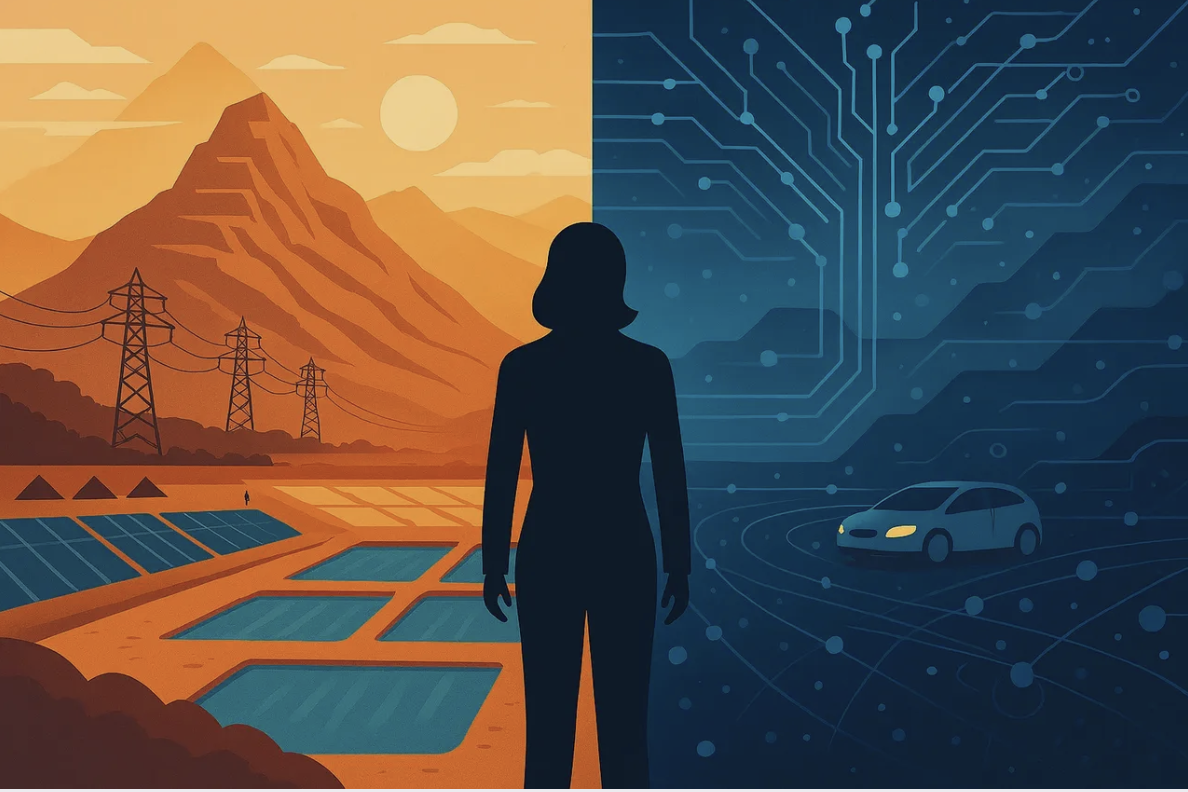
Chile exports US$50 billion in copper annually. At the same time, Chile imports the software that runs its mines, manages its power grid, and processes its financial transactions. By 2050, which side of this export–import equation will matter more?
Energy systems are shifting quickly. Jobs are changing. Innovative technologies are emerging and spreading. These changes are already visible across Latin America and the Caribbean, where the energy is already clean. Exports of technology, information technology services, and business services have grown at double-digit rates in recent years. The future cannot be predicted with precision, but the broad direction is clear and widely recognized among futurists.
Artificial intelligence is advancing at an extraordinary speed. Energy and mobility systems are being restructured. Work is being reorganized. Democracies are under pressure as online worlds reshape how people communicate and mobilize. Climate impacts are increasingly visible.
The region enters this transition with a mix of vulnerabilities and advantages. Growth has been volatile. Many economies depend heavily on natural resource rents; in Chile and Peru, these rents account for 10–15 percent of GDP. Inequality remains high, and political power is often concentrated. At the same time, LAC holds abundant renewable‑energy resources, critical minerals, young populations, rich biodiversity, and a rapidly expanding digital ecosystem. Chile and Peru produce about 40 percent of the world’s copper, and Chile, Argentina, and Brazil together produce one-third of global lithium.
Countries that build the capacity to adapt, learn, and steer change will be best positioned to ensure that these transformations improve people’s lives. This blog outlines how the human ecosystem is likely to evolve, the forces driving those changes, and how states can guide transitions already underway. The future that emerges is likely to feature lower energy costs, cleaner transportation, more accessible public services, and broader opportunities.
Where is the capital shifting?
Energy remains the foundation of every economy. The coming decades will be shaped by clean, affordable energy, widespread electrification, and intelligent infrastructure. Financial capital is already shifting away from fossil-fuel assets toward large-scale investment in renewable energy, modern grids, energy storage, and electrified transport. As clean technologies scale, costs fall, which accelerates further deployment. Countries that move early will gain productivity, reduce energy costs, and build competitive industrial ecosystems. Those who delay risk being locked into high-cost fossil‑fuel systems, facing stranded assets, and losing competitiveness.
The energy transition is also reshaping global demand for critical minerals such as lithium, cobalt, copper, and rare‑earth elements. This shift creates a major opportunity for LAC, which holds some of the world’s most important reserves and production capacity.
Natural capital will become increasingly valuable as high-income economies move toward circular material flows. LAC can generate new revenue streams by recognizing and monetizing the value of its ecosystems. The region contains some of the world’s most productive agricultural land and freshwater reserves. Regenerative agriculture and climate-smart farming could position LAC as a global anchor for food security.
Knowledge will continue to expand rapidly, but so will misinformation and fragmentation. The ability to filter, absorb, and apply information will matter more than access to information itself. A small number of global actors will dominate energy and knowledge technologies, and LAC risks remaining a consumer rather than a producer unless it invests in capabilities and innovation.
How will institutions and societies change?
Social institutions will be reshaped by the online world and artificial intelligence. Economies will become more service-oriented and more dependent on knowledge-intensive work. AI will automate coordination, logistics, and decision-making across sectors. This will require novel approaches to governance, transparency, and workforce development, including changes in academic training.
Institutions that fail to modernize will face legitimacy challenges. Those that adapt will become more networked, multi-stakeholder, and technocratic, using digital tools to guide decisions. Trade will shift toward services, data, and intellectual property, as well as regionalization, friend-shoring, and customized products. LAC can benefit from these shifts if it manages governance, energy, and logistics costs effectively. Mexico is already one of the United States’ top trading partners, reflecting these trends.
Social systems will need to adapt to rising temperatures, droughts, and extreme events—especially in smaller states and coastal cities. As automation expands globally, the region’s traditional advantage in low‑ and mid-skilled labor will erode, pushing economies toward commodities and natural‑resource rents unless they diversify.
How will social order evolve?
Transitions in energy, mobility, logistics, and labor will disrupt existing hierarchies and political coalitions. Conflicts over land, minerals, and labor mobility are likely to intensify. Social media will amplify polarization and shorten political cycles. Fragmentation and institutional erosion could weaken states’ ability to plan and execute long-term strategies.
The global order will continue shifting toward a more multipolar system built around regional blocs and shared markets. LAC’s regional institutions—such as the Americas Partnership for Economic Prosperity, CARICOM, and MERCOSUR—are likely to play larger roles. Societies that embrace inclusive governance will be more stable; those that do not may face greater fragmentation and confrontation.
What drives which technologies and practices win?
A new wave of technologies—AI, digital platforms, advanced materials, synthetic biology, robotics—will reshape production and services. AI will reduce experimentation costs, enabling rapid innovation in design, business models, and industrial processes. Countries such as Chile, Colombia, Brazil, and Mexico are already expanding electric‑vehicle adoption and electrifying bus fleets.
Market selection will favor technologies that reduce costs. AI and clean energy will lower marginal costs, increase reliability, and enable faster scaling across energy generation, storage, electrification, and logistics. Economies of scale, network effects, and cost curves will reinforce these trends. Subsidies, standards, regulations, and procurement will shape which technologies succeed. Social movements and public opinion will also influence adoption.
Digital networks will accelerate the spread of ideas and practices, but they will also create fragmentation and echo chambers. Technology diffusion will depend on state capacity, infrastructure readiness, and social acceptance. Countries with strong grids, digital connectivity, mass transit, and the ability to mobilize capital will see faster diffusion. Those with weaker institutions or limited social license will lag. Corporate supply chains will accelerate cross-border diffusion, and policy emulation will spread successful models.
What can states do?
States will remain central to setting direction, defining mandates, and coordinating across sectors. The focus will increasingly be on improving livelihoods, creating quality jobs, and reducing the cost of living, rather than just meeting international targets. Strategic coordination is essential to build pathways to lower energy costs, electrification, digital infrastructure, and AI deployment. Clear direction reduces the risk of technological lock-in and market fragmentation.
States must also shape market rules that align profitability with social outcomes. These include results-based contracts, revenue‑stabilization mechanisms, infrastructure reforms, new financial instruments, data standards, and AI governance. States will continue to absorb risks that enable private investment in modern technologies and infrastructure.
Multilateral systems will remain important but will progress slowly. Smaller groups of aligned states, technological partners, and regional blocs will drive faster implementation.
Public investment in infrastructure, public goods, and industrial ecosystems will remain essential. States will lay the foundations for clean energy and the AI economy. Public finance will be critical for blending with private capital to scale investment. Chile and Uruguay are leading in innovative financing instruments such as green and sustainability-linked sovereign bonds, while Ecuador, Belize, and Barbados have recently completed debt conversions. Industrial innovation policies, skills development, and institutional learning systems will be key enabling conditions. Infrastructure and computational capacity will become strategic assets.
Some states will move quickly with coordinated governance; others will remain reactive and fragmented.
Conclusion
Between 2020 and 2070, the global human ecosystem will be reshaped once again. Each country’s trajectory will depend on how effectively the state directs, coordinates, and manages technological change, volatility, protest, and inequality. The future will unfold regardless, but it can be shaped by choices that lower the cost of living, improve public services, and expand opportunities.
Countries that harness existing and emerging technologies will reduce costs and improve the efficiency of energy, transport, sanitation, water, logistics, communications, and health services. The alternative is to remain trapped in oligopolistic markets and elite-driven decision-making that deepen inequality, slow growth, and leave societies exposed to external shocks. The world is changing; standing still is not an option.