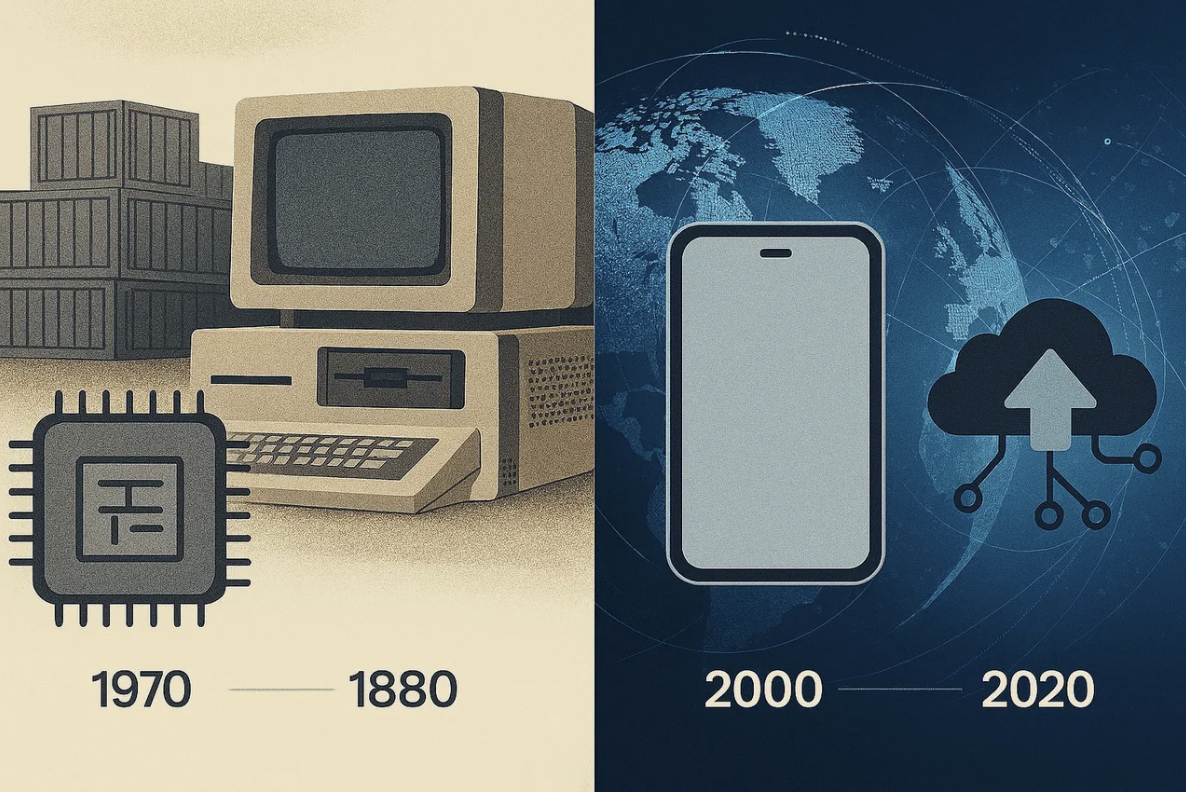
Between 1970 and 2020, the world changed faster than at any other time in human history. Microprocessors, digital sensors, personal computers, the internet, smartphones, and cloud computing all emerged over the course of five decades. The 1971 Intel 4004 chip contained just 2,300 transistors; by 2020, Apple’s M1 chip held 16 billion. These technologies now underpin everyday systems—mobile banking, telemedicine, online education—shaping how billions of people live, work, learn, and connect.
These innovations rewired the global economy. Capital now moves at the speed of light. Cross-border capital flows expanded from tens of billions to more than US$1.2 trillion. Merchandise trade grew from hundreds of billions to US$18–19 trillion. Internet use rose from millions in 1990 to 4.5 billion users in 2020. East Asian economies emerged as global manufacturing hubs, while the United States consolidated its dominance in finance, digital platforms, and knowledge networks. In Latin America and the Caribbean, new opportunities for growth, innovation, trade, and integration appeared—but exposed longstanding challenges in productivity, inequality, and institutional capacity.
Speed, scale, and knowledge exemplify today’s world. Countries that invested early in education, research, infrastructure, and capabilities became innovation leaders, lifted millions out of poverty, and intensified global competition. Participation in value chains now extends beyond natural resources and manufacturing to include data, technology acquisition, and the capabilities needed to adapt and learn.
Understanding the last fifty years is essential for shaping the next fifty. Latin America and the Caribbean have talent, natural capital, and creativity. The region could lead to the emergence of green, digital, and knowledge-based economies. Doing so will require learning from the past and adopting deliberate strategies that build on regional strengths to turn global change into regional opportunity.
This blog examines the transformations that occurred, the forces that drove them, and the role of states in shaping their trajectories.
Systemic Changes in Capital Flows at Speed and Scale
The most striking feature of this period was the speed and scale of change. Foreign direct investment stock rose from roughly US$100 billion in 1980 to nearly US$40 trillion in 2020. Finance could move instantaneously across borders. Global trade expanded from about US$2 trillion to US$18–19 trillion as supply chains stretched across continents. Trade in financial, technological, informational, and digital services reached US$6 trillion. Knowledge now moves in milliseconds, and people increasingly migrate to fill labor shortages or build skills. Trade shifted from simple goods to complex, fragmented value chains and to services and data rooted in intellectual property and knowledge.
A Reconfigured Global Economy
The global economy was fundamentally reshaped. East Asia—first Japan, then Korea, Taiwan, Singapore, Hong Kong, and later China and Vietnam—became the world’s manufacturing hub. Many of these economies moved from low‑ or middle-income status in 1970 to high-income status by 2020. South Korea’s per capita GDP rose from under US$300 in 1970 to more than US$30,000 in 2020. China became a central node for trade, manufacturing, and technology, while the United States shifted toward dominance in finance, platforms, and knowledge networks.
Advanced economies such as the United States, Germany, the Netherlands, and the Nordic countries retained their leadership in technology and finance, with large corporations becoming increasingly influential. The internet, smartphones, and digital platforms reshaped the movement of knowledge, capital, and trade. Resource-rich and well-governed exporters—including Norway, Saudi Arabia, the UAE, Qatar, and Kuwait—leveraged oil and gas rents to accelerate development, supported by large inflows of migrant labor. New middle powers such as South Korea, India, and Brazil strengthened their positions as they integrated into global supply chains.
Countries facing conflict or severe mismanagement fell further behind the global frontier, struggling to integrate into trade and knowledge flows and becoming increasingly dependent on aid, remittances, or single commodities. In Latin America, countries such as Chile, Uruguay, and Costa Rica advanced, but the region did not overcome persistent challenges in productivity and inequality.
Technologies, Liberalization, and Knowledge as Drivers of Change
The technologies of this ICT revolution reflected two powerful empirical patterns. Moore’s Law observed that the number of transistors on an integrated circuit doubles roughly every two years. Wright’s Law showed that for every cumulative doubling of production, the cost of a technology falls by a constant percentage. Together, they drove a dramatic decline in the price of computing and digital infrastructure.
The internet, mobile computing, cloud services, and fiber‑optic networks created a new technological paradigm. Borders became porous to capital, knowledge, and information. The logistics revolution—especially containerization—reduced shipping costs by 75–90% and cut shipping times in half, making global value chains more feasible and increasing the need for international standards. Financial innovations, including deregulation, derivatives, global capital markets, electronic trading, and mobile money, transformed how cash flows and laid the groundwork for digital assets such as cryptocurrencies. Daily foreign exchange trading rose from the low hundreds of billions in 1980 to US$6.6 trillion in 2019.
Cost competition drove offshoring, nearshoring, and friendshoring as global supply chains expanded. Energy shocks spurred efficiency, diversification, and a focus on energy independence. Geopolitics shifted with the end of the Cold War and the rise of China, as the global economy moved from industrialization and production toward technology and knowledge. Trade and capital liberalization, supported by international agreements, encouraged private‑sector engagement and privatization.
Capabilities as the New Currency of Nations
Capabilities became increasingly decisive. Education, research and development, and digital infrastructure were essential for securing national comparative advantages. Early movers such as the United States and the United Kingdom became financial hubs. In contrast, early, low-cost industrializers such as China and South Korea scaled up manufacturing and became hubs of production. The global economy became more integrated and moved toward digitization, knowledge, and networked production. Knowledge flowed directly through digital networks and indirectly through migration, with the Gulf states alone hosting more than 30 million migrant workers.
States and Multilateralism
States played a significant role in shaping long-term development pathways. Korea, Taiwan, and China actively pursued industrial advancement, calibrating the pace of liberalization in trade, capital, and migration. Other countries positioned themselves as financial or corporate centers or moved rapidly into clean energy to reduce dependence and volatility. Financial deregulation in the United States and the United Kingdom accelerated global capital flows by relaxing capital controls, reducing trade barriers, and promoting privatization and public-private partnerships. Many countries invested in migration, education, and R&D policies to cultivate the talent and capabilities needed to leverage innovative technologies.
Multilateral organizations—including NAFTA, ASEAN, and the EU—helped stabilize change and set standards for a global marketplace. NAFTA tripled North American trade from US$290 billion in 1993 to US$1.1 trillion in 2016. The WTO codified global trade rules and accelerated supply chain integration, while the G7 and G20 provided coordination in an increasingly complex global economy. In Latin America and the Caribbean, MERCOSUR, CARICOM, and the Pacific Alliance supported regional integration.
In some cases, state interests and multilateral systems evolved together, producing what some analysts call “hyper‑globalization.” Yet global change also created winners and losers within advanced economies. Some regions lost manufacturing jobs to trade and automation, while urban areas captured gains from finance, technology, and knowledge flows. In the United States, manufacturing employment fell from 19 million in 1979 to 12 million in 2020. These internal disparities fueled populism and domestic backlash, challenging multilateralism.
Conclusion
The last 50 years clearly show that countries can take an active role—and adopt long-term strategies—to accelerate economic growth. The Asian Tigers sustained growth rates of 6–8% for decades. The United States continued to lead in finance and innovation. The Gulf states transformed oil and gas wealth into US$3.5 trillion in sovereign wealth funds, accelerating broader development.
Latin America and the Caribbean now face a similar moment of choice. The next wave of global transformation—energy, biotechnology, advanced manufacturing, data management, and artificial intelligence—is already underway. Countries that invest in institutional and individual capabilities and open channels for knowledge and trade based on their comparative advantages will scale their economies. Those who hesitate risk missing the opportunities ahead.
The region has abundant energy resources, the world’s largest lithium reserves, exceptional solar potential, vast natural and cultural capital, and a growing digital economy. The question is whether LAC countries will work together to shape the next technological wave—or be shaped by it.