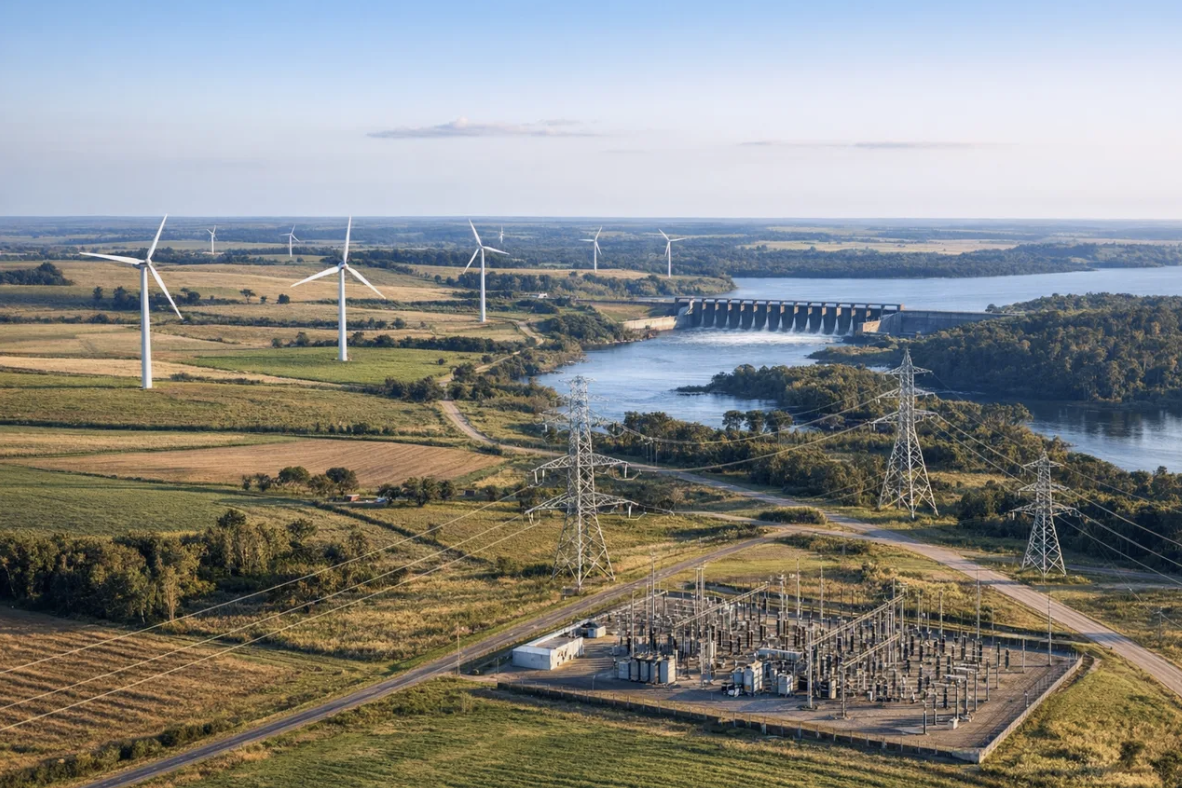
In the early 2000s, Uruguay’s electricity system was exposed on two fronts: drought could collapse hydropower output, and the backstop was imported fossil energy, exactly when regional prices were high and regional supply could be uncertain. In severe years, Uruguay could spend as much as 2% of GDP on energy imports, turning weather into a macroeconomic event.
Between 2010 and 2024, Uruguay rewired that vulnerability into a new asset base. By 2024, Uruguay generated 99% of its electricity from renewables (hydro: 42%, wind: 28%, biomass: 26%, solar: 3%, fossil: 1%). It exported 2,026 GWh of electricity—enough to treat surplus power as an economic opportunity rather than a reliability risk.
Uruguay’s story is best understood as two linked transitions. The First Energy Transition decarbonized the grid and strengthened the system’s ability to manage variable renewables; the Second Energy Transition shifts attention to what electricity alone cannot solve—especially transport, a sector Uruguay identifies as the largest source of energy-sector CO₂ emissions and the main frontier for further decarbonization.
For LAC policymakers and citizens, the transferable lesson is not “build wind.” It is how Uruguay reduced risk, redirected capital flows into domestic productive assets, and embedded learning capacity in institutions—while also managing the tradeoffs that come with long-term contracts, grid constraints, and the harder economics of decarbonizing fuels beyond the power sector.
This blog examines what changed in Uruguay, what drove those changes, and the role of the state in delivering change.
Changes in capital, institutions, and resilience
Uruguay’s energy transition fundamentally restructured the country’s physical and financial capital stock. More than US $8 billion was invested since 2010—largely by private actors—into wind, biomass, solar, and associated grid infrastructure, replacing recurrent fossil-fuel import expenditures with long-lived domestic assets. Uruguay doubled its generation capacity in about 10 years through the renewable buildout. This shift transformed energy from a source of macroeconomic vulnerability into a stabilizing factor, reducing exposure to oil price volatility and enabling Uruguay to become a net electricity exporter in average hydrological years. In 2024, Uruguay exported 2,026 GWh of energy, worth about US $104 million.
Institutionally, the transition was enabled by a distinctive public–social order. Uruguay’s 1992 referendum rejected privatizing state enterprises and preserved UTE as a trusted public utility with control over transmission and distribution. The turnout was 82.8%, and the repeal was approved by 72.6%. This allowed the creation of a hybrid market: private firms invested in generation under competitive contracts, while the grid remained a public good, maintaining social legitimacy and energy sovereignty.
At the level of social cycles, the transition decoupled economic growth from carbon emissions and hydrological risk. GDP expanded while power-sector emissions fell sharply, and drought years no longer triggered billion‑dollar fossil import shocks. Uruguay’s matrix remained at 92% renewables even during the 2023 drought, the lowest hydro year on record. A diversified renewable portfolio—hydro, wind, solar, and biomass—now acts as a systemic buffer, increasing the resilience of the human ecosystem against climate variability.
Crisis, competition, and learning-by-doing
Uruguay’s transition was catalyzed by path dependence and crisis. Lock-in to imported oil and unreliable regional gas made the pre‑2008 energy regime increasingly maladaptive. Required energy imports could cost the country up to 2% of GDP. The 2008 energy crisis functioned as a selection pressure, forcing policymakers to abandon incremental fixes and rapidly scale alternative technologies—particularly wind—that could form a new dominant regime. Uruguay used auctions for biomass, wind, and solar across different years as a deliberate regime shift.
Rather than betting on a single technology, Uruguay deliberately fostered technological variety. Competitive auctions and long-term contracts allowed evolutionary selection to favor the most cost-effective and system-compatible options. Over time, wind emerged as the cornerstone because of its strong complementarity with existing large-scale hydro, while biomass and solar filled additional niches. In 2021, Uruguay often ranked second globally, after Denmark, in terms of the share of variable renewables (solar and wind).
Crucially, the transition accumulated knowledge and hardware. Collaboration between the National Administration of Power Plants and Electric Transmission (UTE) and the Universidad de la República produced sophisticated system models using decades of climate data. This institutional learning allowed Uruguay to manage intermittency through system design and operations rather than premature investment in expensive storage, embedding intangible capital that increased the system’s adaptive capacity. Smart meter installation enhanced the digital grid and learning across the system, while hydro helped as storage.
De-risking markets, building grids, and enabling the transition
The state played a central coordinating role. Uruguay XXI: Energy Policy 2005-2030 was approved in 2008 and ratified in 2010 through a multi‑party agreement. This plan anchored the energy transition as a State Policy rather than a Government Policy, ensuring continuity across administrations. This political durability lowered investors’ perceived risk and enabled planning horizons consistent with those of long-lived infrastructure assets. Importantly, consensus is critical to lock in future direction – but should not freeze adaptive management in the face of external changes; regulatory updates are part of the Uruguay model.
Market architecture was deliberately designed to de-risk private investment while retaining public control. Long-term power purchase agreements guaranteed that UTE would buy renewable electricity at fixed prices, creating a bankable environment for international financing. Importantly, benefits were redistributed by reducing residential tariffs by 30% in real terms. At the same time, regulation evolved continuously—adjusting dispatch rules, tariffs, load shifting and electrification incentives, and standards—to accommodate very high shares of variable renewable energy.
In the Second Energy Transition, the state has again taken an active role through public investment and innovation platforms. Initiatives such as the Renewable Energy Innovation Fund (REIF) and the H2U Program are shaping new markets for electric mobility, green hydrogen, and e‑fuels. Rather than picking winners, the state is creating options: funding pilots, building enabling infrastructure, and developing regulatory frameworks that allow new sectors to emerge under managed risk. There are emerging global market risks associated with hydrogen investments that will need to be managed adaptively going forward.
Three transferable lessons—and the tradeoffs to plan for
Uruguay’s 2010–2024 experience shows that rapid power-sector decarbonization is not a technology challenge—it is an institutional challenge. Uruguay paired auctions and long-term contracting with an institutional architecture capable of planning, operating, and updating rules for a high-renewables system, resulting in a grid that can remain overwhelmingly renewable even when hydrology is unfavorable.
But Uruguay’s success also clarifies the next problem for LAC: electricity is only part of the energy system. Even as the power grid becomes ultra-low carbon, the wider energy mix can remain exposed to imported fuels—Uruguay still has a large oil share in total energy supply in recent years, which is why the country frames the Second Transition around transport electrification, efficiency, and new fuels like green hydrogen and e-fuels.
Three practical takeaways travel well across the region. First, build political durability: Uruguay’s multi-year direction reduced the risk premium that kills long-horizon investment. Second, use a credible system orchestrator: a capable utility (public or private) must run procurement, grid upgrades, and dispatch rules as one coherent strategy. Third, invest in “soft infrastructure”—data, modeling, standards, and regulatory learning—because these are what make high shares of renewables stable and what enable the Second Transition to scale without chaos in charging, tariffs, and permitting.
Finally, plan for tradeoffs rather than hiding them. Long-term contracts can lock in costs; electrification can shift peak loads; and hydrogen can become a fiscal sink if it is subsidized before demand, certification, and infrastructure are ready. Uruguay’s approach to the Second Transition—pilots, blended finance platforms, and interinstitutional coordination—offers a template for creating options in the face of uncertainty rather than betting national budgets on a single outcome.