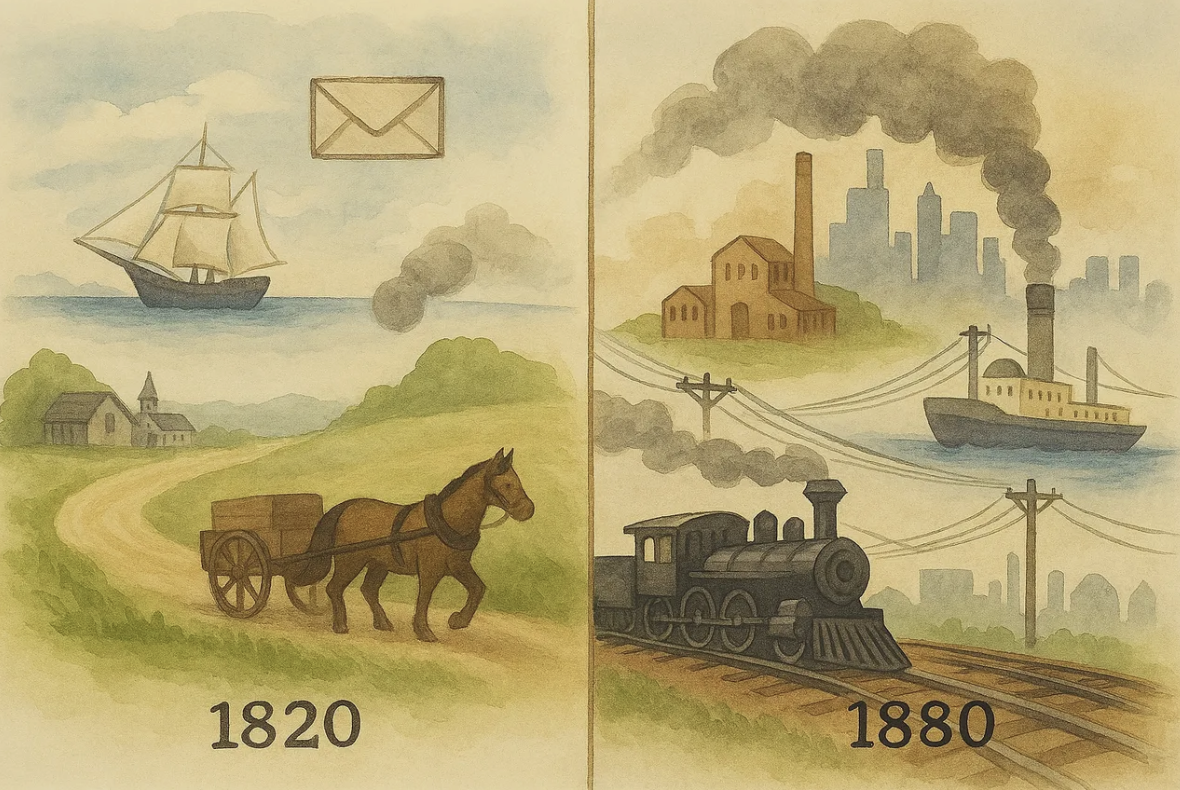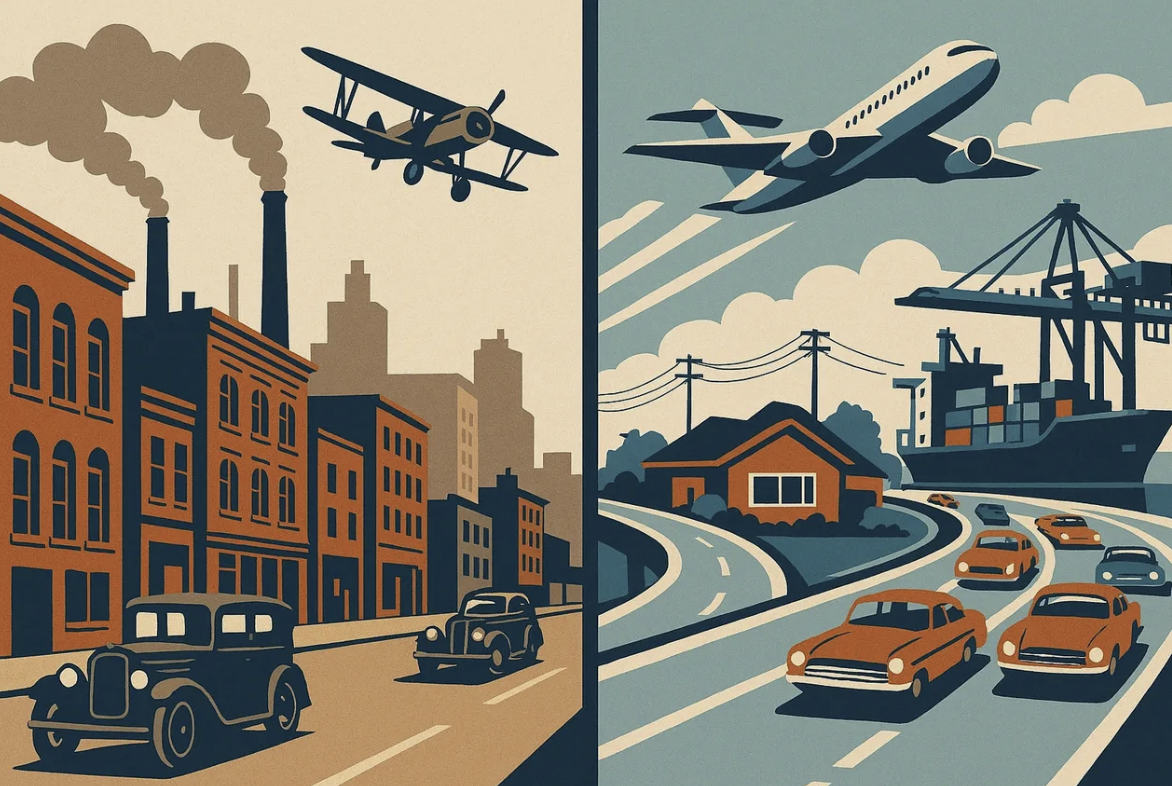
The human ecosystem changed fundamentally across many countries between 1920 and 1970. Much of what we recognize in modern life emerged during this period: cars, planes, refrigerators, televisions, and container ships. These innovations reshaped cities, reconfigured trade routes, and reordered the global hierarchy. The United States led these transformations, followed by West Germany, France, Italy, Belgium, Greece, and Sweden. South Korea, Taiwan, Hong Kong, Singapore, and the Soviet Union also underwent rapid structural change.
Two major growth booms defined the era. The first, in the United States during the 1920s, established the country as a technological leader. The second came after 1945, when U.S.-backed reconstruction accelerated industrial recovery across Europe and Asia. Together, these waves produced decades of sustained growth driven by urbanization, industrialization, and mass production—supported by government-backed development finance that took risks private banks would not.
Countries that mastered innovative technologies and organizational practices grew rapidly and became global leaders. Those that struggled with weak coordination, underinvestment in infrastructure, adversarial labor relations, or elite-dominated politics fell behind.
The lesson for Latin America and the Caribbean is clear: modernizing infrastructure, mobilizing patient capital, upgrading skills, and enforcing standards that reward quality and sustainability are essential to riding today’s technological wave. Doing so will create jobs, raise health standards, boost productivity, and strengthen urban resilience.
This blog examines the transformations of 1920–1970, the drivers behind them, and the state’s role in shaping outcomes.
A rapidly changing human ecosystem
The environmental and resource landscape shifted dramatically. Energy systems moved from coal to oil and electricity, powering growth in transport, petrochemicals, and manufacturing. These transitions varied by country: Sweden expanded hydropower, the United States built oil‑ and electricity-powered suburbs, Mexico and Venezuela leveraged petroleum, and Brazil invested heavily in hydroelectricity.
Urbanization surged, accompanied by large-scale land conversion for infrastructure, energy, and materials. In Japan, the share of urban residents rose from 60 percent in 1950 to 70 percent in 1970. Environmental stresses also became more visible. London’s Great Smog of 1952, which caused an estimated 10,000–12,000 deaths, led to the Clean Air Act of 1956. Similar concerns in the United States contributed to the Clean Air Act Amendments and the creation of the Environmental Protection Agency in 1970.
Mass production and mass consumption took hold as households acquired cars and, later, refrigerators and televisions. U.S. vehicle ownership rose from 60 cars per 1,000 people in 1920 to 516 per 1,000 by 1968. Argentina was an early adopter too, with 35 cars per 1,000 people in 1930. Ford’s assembly lines created millions of middle-class jobs, while mass production made consumer goods affordable for working families. As an anecdote about the speed of technological change, New York went from horse-drawn to motorized between 1900 and 1913.
The United States, West Germany, and Japan converted wartime industrial capacity into high-quality civilian production—cars, appliances, and electronics for export. Japan imported U.S. and German technologies, improved them, and built globally competitive firms in steel, shipbuilding, automobiles, and electronics. Between 1950 and 1970, life expectancy and per capita GDP rose sharply across the USA, Japan, West Germany, France, Italy, Belgium, Sweden, South Korea, and Greece. Britain, by contrast, experienced slower diffusion of consumer goods and weaker industrial modernization. Mexico and Brazil also industrialized, with output rising sharply between 1950 and 1980, and urbanization increasing severalfold. But LAC’s import‑substitution strategies, focused on protected domestic markets, limited economies of scale, and enabled rent‑seeking by powerful elites.
Media and mobility reshaped culture. Radio and television became dominant channels. Commercial jet travel—introduced in 1952—dramatically reduced travel times. Together, mobility and mass media helped forge national narratives and shared identities.
Global trade expanded rapidly, supported by new logistics and financial flows. Container shipping, introduced in 1956, revolutionized cargo transport by standardizing metal containers that moved seamlessly across ships, trains, and trucks. Handling costs fell from US$5.86 per ton to US$0.16 per ton. Ports such as Rotterdam, Hong Kong, and Singapore expanded dramatically. Export-led industrial models emerged in West Germany, Japan, Korea, and Taiwan, which built manufacturing clusters tied to global markets. The Marshall Plan accelerated reconstruction and market integration across Western Europe, creating new consumer markets. Many countries strengthened public institutions, expanding welfare systems, development banks, and national accounts to support fiscal management.
Drivers of change: technology, institutions, and war
Innovative technologies and practices emerged in the 1920s, including mass-production techniques such as Ford’s assembly line. Model T production rose from 170,000 vehicles in 1913 to more than 941,000 in 1920. Cars and planes evolved rapidly, culminating in jet aircraft like the Boeing 707 in 1958. Many early advances were spin-offs from World War II industrial machinery.
Containerization later standardized logistics, slashing costs and enabling modern globalization. Innovation also included new corporate structures, professionalized management, and novel approaches to quality control and workflow.
World War II mobilization accelerated research and development in aviation, petrochemicals, and electronics, and forced industrial-scale production that later shifted to civilian use. Post-war support—including the Marshall Plan and U.S. aid to Japan and Korea—helped countries adopt advanced development models. Market competition rewarded firms with access to technology and long-term finance, enabling them to outcompete protected or fragmented economies.
Strong state narratives anchored policy approaches: the U.S. “New Deal,” Japan’s “Income Doubling Plan,” West Germany and Austria’s “Wirtschaftswunder,” and France’s “Trente Glorieuses.” The United States New Deal focused on stabilizing the financial system, expanding infrastructure, and recovering from the Depression. Europe and Japan emphasized reconstruction and the expansion of welfare states. The post-war Golden Age of Capitalism delivered massive investments in highways, ports, grids, and telecommunications. Education and vocational training systems codified modern technologies and routines, spreading innovation across firms and regions.
The role of the state: rapid change, uneven results
Successful countries built strong planning agencies that set targets and coordinated across finance and industry—Japan’s Ministry of International Trade and Industry and South Korea’s Economic Planning Board are emblematic. These countries focused on industrial capability and global integration. The Soviet Union’s planned industrialization made it the world’s second-largest economy by the 1960s, but it came with serious design flaws.
Others faltered. Britain, burdened by post-war debt, weak industrial strategy, and political conflict, failed to modernize quickly. Fragmentation, strikes, and adversarial labor relations slowed progress. The former industrial leader lost momentum, competitive advantage, and investment.
Successful countries also regulated effectively and set standards. Land reform and quality standards boosted productivity. Trade agreements and the European Economic Community opened markets. Expanding welfare states provided pensions, healthcare, education, and unemployment insurance. The Soviet Union, however, set production targets without market signals or consumer‑quality standards, leading to chronic shortages. Greece’s clientelist politics limited productivity gains and left regions disconnected from export-led growth.
Public finance capacity was equally important. Development banks such as West Germany’s KfW, Japan’s JDB, and Italy’s IRI de-risked significant industrial and infrastructure investments and supported small and medium-sized enterprises. Large infrastructure projects paid off: Japan’s Shinkansen, launched in 1964, symbolized integrated investments in mobility and growth.
The Marshall Plan injected over US$13 billion (about US$200 billion today) into reconstruction, institutional reform, and the European Payments Union. This support accelerated structural change, helped prevent a repeat of the political fallout from World War I, and built consumer markets for U.S. products. Public investment also expanded human capital and welfare systems, creating skilled workforces and social stability. The most successful states cultivated innovation ecosystems by funding basic and applied research. Japan, Korea, Taiwan, and Singapore targeted specific export sectors, incentivized cluster development, and compressed industrialization timelines.
Conclusion
The period from 1920 to 1970 was one of extraordinary turmoil and transformation. Old powers declined, and new manufacturing giants emerged. This rapid change was possible because governments worked with businesses to set direction, create market space, and build the skills needed for innovation and diffusion. Development banks played a significant role in financing infrastructure that reduced costs and enabled the formation of new industrial clusters.
If Latin America and the Caribbean choose coordination over fragmentation, patient investment over short-termism, and strong standards over shortcuts, they can write their own economic miracle.
For the region, this means prioritizing infrastructure, long-term financing, skills development, standards and quality control, and export promotion—anchored in industrial clusters that leverage comparative advantages in renewables and critical minerals.