Guyana has moved quickly to put in place the core governance for its windfall — the Natural Resource Fund, a local content act, and a rapidly expanding public investment program — as production and revenues scale. The question now is whether these systems are performing well enough to govern a larger spending envelope and deliver results. The window for strengthening them is short because commitments are rising faster than institutions can mature.
In Guyana, the period from the 2015 offshore discovery to today has produced one of the fastest economic transformations recorded in a small developing state. Recoverable reserves exceeding 11 billion barrels were rapidly converted into production, and nominal GDP rose from roughly USD 4.3 billion in 2015 to about USD 16.8 billion by 2023. After the first oil, real GDP growth surged during the base-effect years, often exceeding 40 percent annually; by 2024, growth remained extraordinary at 43.6 percent, and the IMF projected roughly 14 percent for 2025 as growth normalizes from explosive liftoff to fast expansion. Offshore output has also accelerated faster than earlier projections: after reaching about 616,000 barrels per day in 2024, production climbed to roughly 900,000 barrels per day by November 2025 following the start-up of Yellowtail (the fourth FPSO) in August 2025. Poverty and welfare outcomes, however, remain the defining political-economy test. Recent poverty measurement is publicly contested — with the government arguing poverty is below 20 percent and the IDB estimating 58 percent living below USD 6.85 per day — but all credible sources converge on the same core point: the distributional gap remains large, and converting macro growth into broad-based welfare improvements is the central challenge of the current mandate.
The central policy question is whether Guyana’s institutions can keep up with its revenues. This analysis examines three dimensions of that question: what the Natural Resource Fund, local content rules, and capital-budget expansion have achieved — and where execution gaps remain; how the upstream contractual framework shaped the pace and structure of the boom; and what it will take for the state to translate growing revenues into durable services, diversification, and shared prosperity.
Building institutions at pace
Guyana is managing a historic-speed production ramp-up while building and stress-testing the institutions that must govern it. The risk is not neglect but implementation: spending and operational complexity are rising faster than oversight routines, procurement systems, and delivery capacity can fully keep pace.
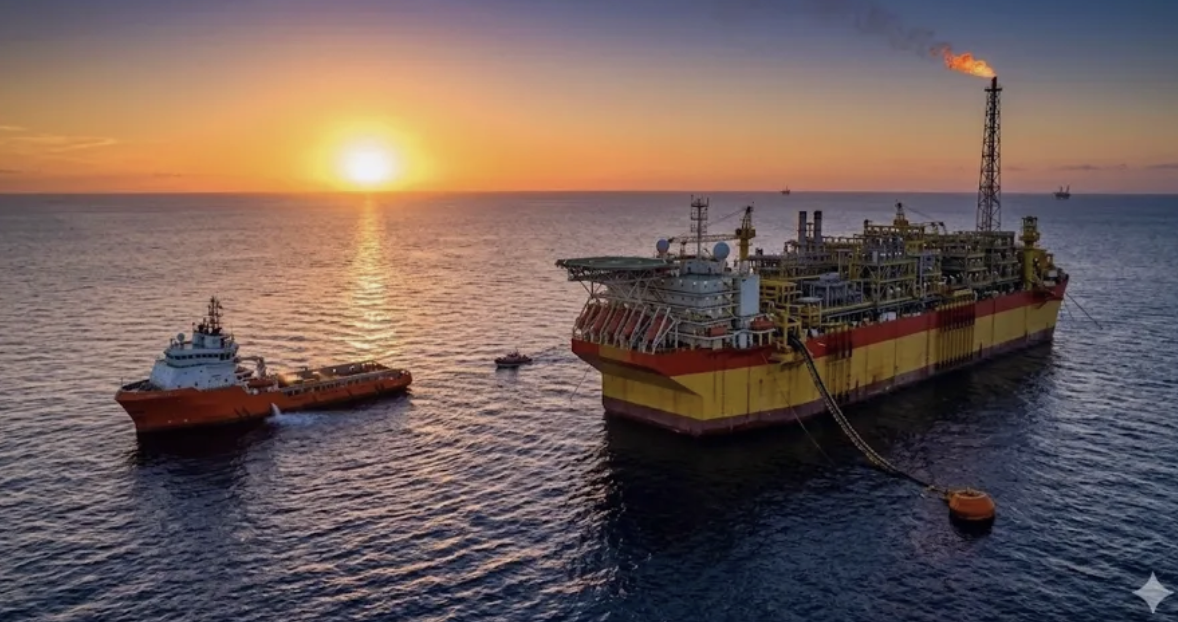
The scale of Guyana’s production ramp-up is without modern parallel for a state of this size. Offshore discoveries in the Stabroek Block — estimated at over 11 billion barrels of recoverable oil equivalent — were quickly converted from reserves into output, led by ExxonMobil as operator, alongside partners Hess Corporation and CNOOC. Production rose from zero in 2015 to about 400,000 barrels per day by 2022, reaching roughly 616,000 barrels per day by 2024. In August 2025, Yellowtail — the fourth FPSO — came online, and national production reached roughly 900,000 barrels per day by November 2025. The next wave is already scheduled: Uaru (fifth project) is expected in 2026, Whiptail in 2027, Hammerhead in 2029, and an additional project is under review. ExxonMobil now projects approximately 1.7 million barrels per day of production capacity by 2030 — a larger scale and arriving faster than earlier “late-2020s” projections implied. Petroleum has become the dominant driver of GDP, exports, and fiscal receipts, reshaping national economic aggregates faster than any domestic system — however capable — can fully adapt.
The government moved quickly to build the institutional architecture needed to manage the boom. The Natural Resource Fund (NRF), established in 2019 and revised in 2021, created a formal framework for receiving, investing, and withdrawing oil revenues before they became material. The fund has also grown rapidly: it stood at roughly USD 3.1 billion at the end of 2024 and reached approximately USD 3.5 billion by early 2026. Notably, the IMF’s 2025 Article IV consultation explicitly commended Guyana’s rules-based management of the NRF — a useful counterpoint to the common worry that discipline weakens as fiscal space expands. The Local Content Act of 2021 mandated domestic participation across 40 categories of goods and services — an ambitious attempt to convert offshore wealth into domestic employment and business opportunities at speed. These are meaningful achievements. The practical constraint that follows from them is one of sequencing: institutions created while revenues are already flowing have less time for piloting and iterative refinement before they operate at a national scale. Rules and mandates can be solid on paper, while implementation capacity, oversight routines, and market readiness are still catching up.
The social dimension of the boom has moved more slowly than the macroeconomy. Available evidence indicates persistently high poverty alongside rapid GDP growth, reinforcing perceptions that oil wealth is concentrated offshore and in coastal urban centers. These distributional concerns interact with real political pressures. The 2020 election integrity crisis — in which irregularities in the reporting of results were addressed through CARICOM and legal challenge — demonstrated that resource-era pressures test democratic institutions in specific and serious ways. That crisis was resolved, and Guyana’s institutions held. The lesson it leaves is that distributional expectations must be managed with demonstrable delivery: when citizens do not see the boom in their lives, political risk rises. Revenue debates are therefore becoming a central arena for accountability, and the government’s ability to show concrete results in health, education, and household welfare is directly linked to its political durability.
The contractual framework and its consequences
The 2016 Stabroek production-sharing agreement was negotiated when the block’s ultimate scale was unknown and deepwater frontier exploration carried genuine commercial risk. As production has far exceeded early projections, the policy priority has shifted: not renegotiation, but rigorous cost recovery oversight, disciplined fiscal management, and maximizing what the existing contractual framework can yield.
The initial driver of change was technological and geological. Operators deployed advanced seismic imaging, subsea systems, and floating production technologies, unlocking high-quality, low-sulfur crude oil previously considered marginal. The emergence of FPSO-based development introduced a modular offshore operational model that differed sharply from Guyana’s historical economy of agriculture, mining, and forestry. In effect, deepwater technology created a viable petroleum export platform where none had previously existed.
The contractual and market environment then rewarded speed and scale. Favorable production-sharing terms, high expected rents, and strong global investor appetite for low-cost, short-cycle projects created powerful incentives for rapid project sanctioning. Multiple FPSOs were approved in quick succession, enabling output to expand even amid global oil-price volatility. By 2022, oil production alone drove real GDP growth of 62.3 percent — the highest recorded globally that year. The contractual logic that produced this result also shapes the boundaries of near-term flexibility: approaches that would extend timelines, such as more stringent local-capability requirements or additional supply-side conditions, carry real execution risk and must be calibrated against delivery capacity.
The gains from this model have diffused unevenly across the economy. Production capacity and offshore routines have scaled predictably, while the institutions that spread benefits onshore — public investment management, local supplier upgrading, and accountability mechanisms — require more deliberate support. Oil production is structurally enclave-prone: operators optimize for speed and tightly controlled supply chains, limiting automatic spillovers. Onshore gains therefore require deliberate channels: supplier development programs, skills pipelines aligned to industry demand, and local content rules that reward performance — quality, delivery, and learning — rather than participation alone. Cost recovery oversight is an immediate priority: rigorously scrutinizing recoverable costs is the fastest available lever to improve Guyana’s effective fiscal take under the existing agreement.
Can the state keep up?
The state has played a decisive and deliberate role in shaping this boom. Through project approvals and the acceptance of production-sharing terms, it created conditions that attracted large-scale investment while shifting exploration and price risk to private operators — a rational strategy given the risk environment of 2016. The result has been extraordinary production growth. The challenge now is that the same pace compresses the time available to test and refine the governance systems that channel revenues into public benefits. With capacity on track to reach roughly 1.7 million barrels per day by 2030, regulatory and fiscal institutions will need to operate at higher volumes, with faster project sequencing, and with rising contractual and operational complexity.
Oil revenues have expanded fiscal space and enabled a surge in public investment: roads, energy infrastructure, health facilities, and schools. This is a serious coordination effort—public capital to lower costs for private activity and strengthen human-capital foundations. Whether it succeeds depends heavily on the quality of the implementation. Absorptive-capacity constraints — weak project appraisal, procurement bottlenecks, limited contract management capacity, thin monitoring and evaluation — can reduce value for money even when budgets are sound and intentions are clear. The gas-to-energy (gas-to-shore) project makes this risk concrete: first gas was originally expected by the end of 2024, slipped to 2025, and has since moved to mid-2026; reported costs rose from roughly USD 1.7 billion to USD 1.9 billion from a 2018 feasibility estimate of USD 478 million; and one contractor (CH4) left the partnership in July 2025. A second gas-to-shore project is already being advanced, underscoring how quickly the investment pipeline can compound. If these constraints are not addressed, the risk is not merely wasted money but hardened inequality: infrastructure that bypasses poor communities, contracts that flow to connected firms, and a gap between the headline story of prosperity and the lived experience of most Guyanese. The binding constraint may be implementation capacity rather than financing, especially as the investment pipeline continues to grow.
Whether the state can keep up will depend on institutional learning and adaptive management. Local content rules and training initiatives have increased domestic participation, and local content employment has reached a meaningful scale: around 14,000 Guyanese are now directly employed in the oil and gas sector, with another 7,000 indirectly. The government is also revising the Local Content Act in 2025–2026 to raise targets and extend coverage beyond the oil sector. At the same time, much technical expertise remains foreign-supplied, and direct oil employment is structurally limited by the capital-intensive nature of production. The key transition is therefore from compliance-based local content to capability-based local content: using transparent registries, supplier-upgrading programs, and performance expectations that reward quality and learning. This requires feedback loops — routine measurement of what is working and what is not — so policies can be adjusted before lock-in makes correction costly. The IMF, World Bank, IDB, NRGI, and civil society are notably consistent on this point: the next phase is less about setting direction and more about iterating implementation capacity at speed.
Five priorities for the next phase
These five priorities are not equally urgent. Oversight and delivery capacity are the most time-sensitive: oversight shows whether systems are working, and delivery capacity determines whether spending produces results. Both become harder to build once spending has scaled and incentives have hardened. The remaining three priorities build on these foundations.
Prioritize oversight of construction and transparent contracting while spending scales. The institutions that protect value for money — independent audit and fiscal oversight bodies, beneficial-ownership registries, transparent procurement, and cost recovery scrutiny — need to be fully operational before the investment pipeline doubles again. Oversight is not a governance formality; it is the mechanism through which the government can know whether its own programs are working. Without it, monitoring data is unreliable, course correction is guesswork, and the political cost of failures that could have been caught early falls on the administration that was too busy to look. Guyana has made progress here. The task is to make these systems fully operational in practice — staffed, funded, and empowered to act on what they find.
Pace spending to what institutions can deliver. The central risk is not spending too little — it is spending faster than institutions can execute well. Roads abandoned halfway, hospitals built but not staffed, power plants commissioned without trained operators: these are the standard failures of oil booms, not hypotheticals. Before expanding the capital budget again, strengthen public investment management by ensuring rigorous project appraisal and prioritization, competitive procurement, construction supervision, and maintenance planning. Then direct spending toward education, health, and basic services — investments that raise productivity for decades regardless of oil prices. Absorptive capacity is not a bureaucratic detail; it is the binding constraint on whether the boom delivers lasting results.
Make skills the engine of diversification — then remove the other obstacles. Diversification does not happen by hope or decree. It requires addressing specific, well-documented constraints: labor shortages and skill mismatches, unreliable infrastructure and power, and a business environment that discourages new entrants. Start with skills, because they take the longest and pay off most broadly. Fund teacher quality, expand STEM facilities, scale demand-linked training in engineering, construction trades, ICT, and energy systems, and develop the University of Guyana into an applied institution tied to national delivery priorities. Then work systematically through the infrastructure and regulatory constraints so that non-oil firms can grow, survive a price downturn, and eventually export.
Protect fiscal space across the whole oil cycle. Chile’s copper story offers a relevant model: save more during boom years, avoid locking in recurrent spending commitments that cannot be sustained when prices fall, and maintain clear, predictable withdrawal rules for the Natural Resource Fund. Norway adds a complementary discipline: spend only real returns from the fund, not principal, so that revenues benefit future generations rather than being consumed in a single boom. Trinidad and Tobago’s experience is the most instructive cautionary case — geographically and institutionally closest to Guyana — where oil revenue crowded out the non-oil industry, diversification was deferred decade after decade, and the economy was left exposed when production declined. The key domestic risk is rent substitution: if oil revenues begin to replace rather than supplement tax revenue, the accountability relationship between government and citizens quietly erodes, and the non-oil fiscal base atrophies precisely when it will eventually be needed. Strengthen tax administration and broaden the non-oil base now, while the windfall provides the political space to do so.
Turn Guyana’s climate position into a durable competitive advantage. Guyana’s Low Carbon Development Strategy — developed well before the oil boom — gives the country credibility in international climate forums that most petrostates cannot access. Combined with the world’s most intact tropical forest per capita, Guyana holds a genuine and rare claim to the carbon credit market. The task now is to make this fully operational rather than rhetorical: clarify the institutional home for LCDS implementation, scale forest-carbon revenue streams, and pair oil revenues with investments in reliable, low-carbon domestic power. The Rupununi region — explored in depth at Rupununi: Rediscovering a Lost World — is central to this agenda. Cheap, clean electricity is not only an environmental objective — it is the infrastructure precondition for data-intensive industries, manufacturing competitiveness, and the kinds of firms that can anchor a diversified economy. Oil finances the transition; the transition protects and extends what oil built.
Guyana enters the next phase of its boom in a stronger institutional position than most oil states managed at this stage. The sovereign wealth fund exists. The local content framework exists. The investment program is underway. The framework is in place, but it needs to perform at the level the coming revenue volumes will demand. The decisions made in the next three years, on oversight, on spending discipline, on skills, and on fiscal structure, will determine whether this boom builds a resilient, diversified economy or leaves the familiar legacy of missed opportunity. Guyana has the tools. The task is execution. The ecological and conservation stakes of these governance choices are explored in detail at Rupununi: Rediscovering a Lost World.
Leave a Reply