Category: Natural Resource Booms

Analysis of natural resource booms and their economic, institutional, and social‑ecological effects, including growth episodes, volatility, and long‑term development risks.

  • Ecuador Oil Boom (1972–1981): Growth and the State

    Ecuador Oil Boom (1972–1981): Growth and the State

    In August 1972, oil began flowing through a newly completed pipeline across the Andes, and Ecuador’s economy changed almost overnight. Between 1972 and 1981, the country experienced one of the fastest growth episodes in its modern history, driven by the sudden start of large-scale oil exports. Real GDP grew at close to 9 percent per year, while exports and government revenues expanded sharply within a few years. The same period also locked in a larger state, higher public spending, and rising external debt that proved difficult to reverse.

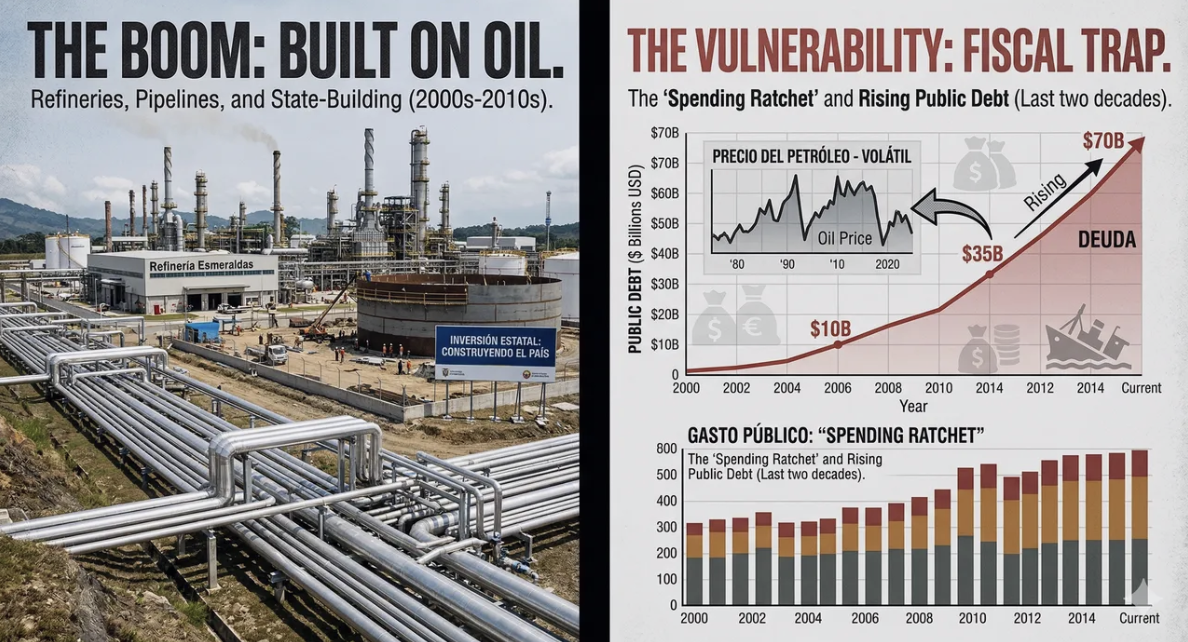
    The transformation began in August 1972 with the completion of the Trans‑Andean oil pipeline linking Amazon oil fields to the Pacific coast. Oil rapidly accounted for more than half of total exports, bringing total exports to roughly a quarter of GDP. Central government expenditure doubled as a share of GDP, while public foreign debt increased almost eighteenfold by 1981. Manufacturing output also grew rapidly in the mid-1970s, as oil revenues allowed the state to scale up import-substitution policies already in place.

    The central policy implication is that Ecuador’s oil boom reshaped the entire economic and institutional ecosystem, not just the export sector. The sections that follow examine how capital stocks, institutions, and social structures changed during the period. They then explain how these changes unfolded through variation, selection, and diffusion. Finally, they assess how state action directed, financed, and adapted to the transformation.

    Oil Rents: Capital, Institutions, Society

    The oil boom fundamentally altered Ecuador’s capital stocks by rapidly expanding physical and financial assets tied to extraction and public investment. The 503‑kilometer Trans‑Andean pipeline, completed in 1972, enabled commercial oil production at scale for the first time. Oil revenues financed large public investments, with capital expenditure averaging about 17 percent of government spending and directed mainly to highways, hydroelectric plants, and state enterprises. Financial capital also surged as oil accounted for roughly one‑third of central government revenues and generated large foreign‑exchange inflows in the early years. At the same time, external sovereign borrowing replaced foreign direct investment as the main external capital flow, pushing public foreign debt from US$248 million in 1971 to more than US$4 billion by 1981. Natural capital was drawn down rapidly through oil extraction in the Amazon, while environmental costs were not reflected in fiscal or investment decisions during the period.

    Institutional change accompanied the rapid accumulation of oil‑based capital. The 1971 Hydrocarbons Law declared hydrocarbons to be inalienable property of the state and laid the legal foundation for state control of the sector. In 1972, the government established the state oil company, CEPE. It progressively increased its ownership stake in the main oil consortium, reaching 62.5 percent by 1977 after buying out Gulf Oil. Planning and coordination functions were strengthened through JUNAPLA, Ecuador’s national planning body, which allocated oil revenues to infrastructure and industrial projects. The Industrial Promotion Law structured import‑substitution incentives, offering duty exemptions on capital goods and protection from imports for favored industries. These institutions expanded the state’s role in directing investment decisions across the economy.

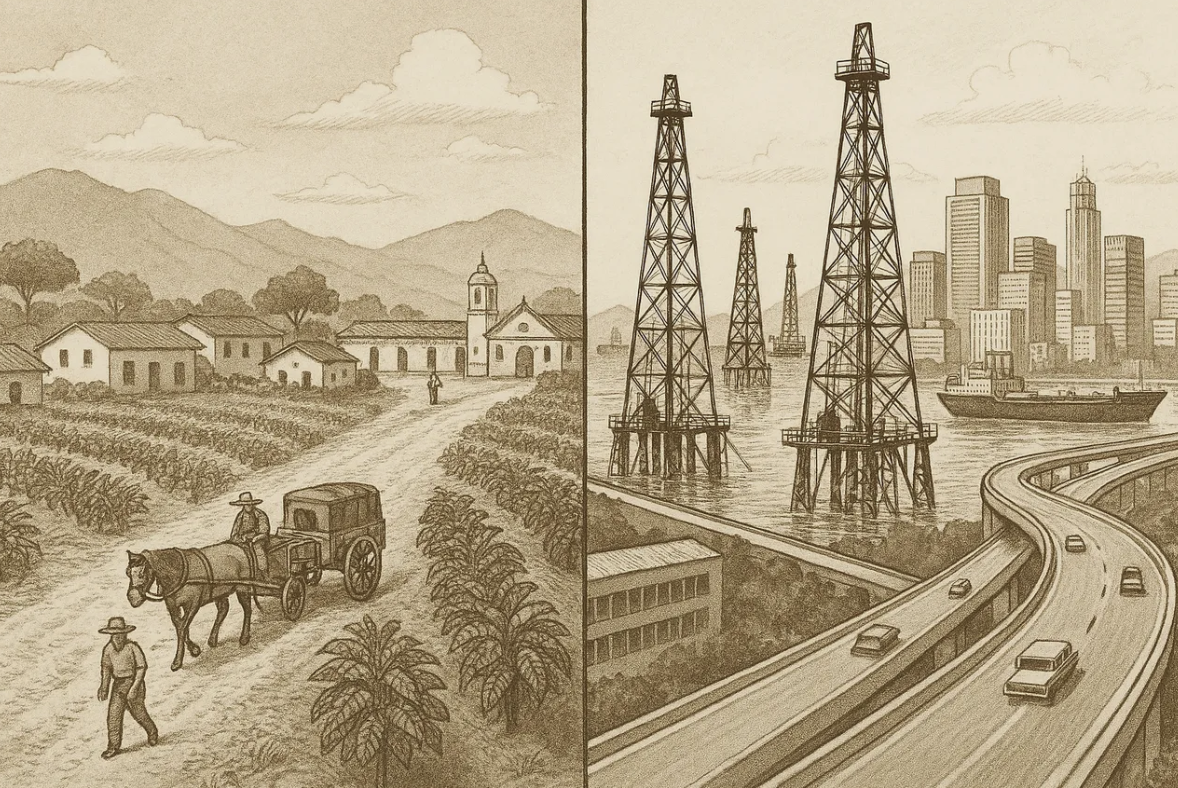
    The oil‑driven expansion reshaped Ecuador’s social and economic structure. Urbanization accelerated as public investment in roads, electricity, and water created construction and service jobs, drawing labor from rural areas. Agriculture’s share of GDP and employment declined, while construction, services, and manufacturing expanded. Public sector employment grew rapidly as ministries and state enterprises expanded payrolls, broadening urban wage employment. Distributional effects were uneven: urban wage earners benefited from rising public and industrial employment, while rural incomes lagged, and agrarian reform redistributed only a small share of cultivable land. Inflation averaged around 13 percent per year, eroding fixed incomes and placing greater pressure on poorer households.

    New Activities, Policy Selection, Lasting Effects

    The period introduced economic activities and organizational forms that had little precedent in Ecuador. Large‑scale oil extraction in the Amazon and pipeline transport across the Andes represented an entirely new production system. The creation of CEPE marked a shift from concession‑based oil development to a state‑led, joint-operations model. Import-substitution manufacturing expanded under tariff protection and capital goods subsidies, encouraging the establishment of new factories producing consumer goods and intermediate inputs. Ecuador’s accession to OPEC in 1973 integrated the country into a global oil governance regime that influenced pricing and production norms. Together, these changes increased the diversity of economic activities, though many relied heavily on state support.

    Selection mechanisms during the boom were driven primarily by policy and external shocks rather than market competition. The Hydrocarbons Law and subsequent decrees forced most foreign oil companies to relinquish concessions, leaving CEPE and its remaining partner as the dominant producers. The 1973 global oil price shock sharply increased oil export rents, reinforcing state control and dependence on petroleum revenues. Industrial policy sheltered manufacturing firms from competition, selecting activities based on access to incentives rather than efficiency or employment generation. Political events also mattered: disagreements within the military government over the pace of nationalization and fiscal expansion contributed to the 1976 leadership change, after which the expansionary model continued but with some moderation. These filters favored capital‑intensive, protected sectors while weakening traditional agriculture.

    Many features of the oil‑era transformation persisted beyond the boom years. Central government expenditure remained at roughly double its pre-1972 share of GDP even after oil prices fell, indicating strong downward rigidity. CEPE’s dominant role in oil production was consolidated through successive equity acquisitions, institutionalizing state control of the sector. Import‑substitution policies and planning institutions remained in place through the late 1970s, even as fiscal pressures mounted. By contrast, there is little evidence that systematic learning led to major course corrections during the boom, such as saving oil revenues or restructuring incentives. The diffusion of oil‑financed infrastructure and public employment created lasting expectations about the state’s role in development.

    State Policy: Investment, Regulation, Debt

    The state played a decisive role in directing the transformation through laws, regulations, and strategic choices. The Hydrocarbons Law of 1971 redefined ownership rights and enabled the state to retroactively restructure contracts. Subsequent decrees enforced territorial relinquishment by foreign companies and empowered CEPE to operate across the oil value chain. Trade, investment, and labor regulations were used to support import substitution, limit foreign ownership in selected sectors, and manage wages and working conditions. Ecuador’s participation in OPEC further embedded state involvement in determining export conditions. These measures provided a clear signal that oil rents would be centrally managed and deployed to support development objectives.

    Oil revenues allowed the state to become the economy’s principal investor and coordinator. Public capital spending expanded rapidly, financing highways, hydroelectric plants, refineries, and urban infrastructure that reshaped production and settlement patterns. The Esmeraldas refinery, which began operations in 1978, exemplified state‑directed industrial investment linked to oil extraction. Credit allocation through public banks and development funds supported favored sectors, while fuel subsidies and public employment sustained urban consumption. When revenues proved insufficient to match spending ambitions, the government relied on abundant international liquidity to borrow externally at low interest rates. This strategy mobilized resources quickly but increased vulnerability to future shocks.

    Evidence of adaptive policy management during the boom is limited. Despite rising inflation, growing imports, and mounting debt in the late 1970s, fiscal expansion largely continued. Some adjustments occurred, including currency devaluations and price increases toward the end of the decade, but these did not reverse the underlying spending trajectory. The absence of a stabilization or savings mechanism meant that oil windfalls were fully spent rather than smoothed over time. Institutional learning within CEPE and the industrial promotion system appears to have been slow, with operational inexperience and incentive misalignment persisting. As a result, the state entered the early 1980s with a larger public sector, heavy debt burdens, and limited buffers.

    Lessons for LAC Policymakers

    Ecuador’s 1972–1981 oil boom delivered rapid growth while transforming institutions and social structures. Oil exports and prices generated unprecedented revenues that financed infrastructure, industrial expansion, and a larger state. These gains were accompanied by rising debt, inflation, and uneven distributional outcomes. Many institutional changes proved durable even after the boom ended.

    The experience illustrates a development path in which resource rents accelerate accumulation but also entrench rigidities. A larger public sector, centralized control over strategic resources, and protected industries became defining features of the economy. Infrastructure and urbanization gains endured, while diversification and human capital development lagged. The legacy was an economy more complex than before 1972, but also more exposed to fiscal and external shocks.

    Over the longer run, the boom left Ecuador with a state-growth model structurally tied to oil rents. The infrastructure and expanded public administration created real capacity, but they also raised the economy’s break-even fiscal needs and hardened expectations around subsidies and public employment. When oil prices fell or external financing tightened, adjustment pressures surfaced through debt stress, stop‑go public investment, and renewed conflict over how to distribute and govern the rent. In this sense, the boom’s central legacy was not only faster growth in the 1970s, but a durable pattern of procyclical policy and volatility anchored in petroleum wealth, reinforced by oil-rent institutions built under military rule in the 1970s.

    For LAC governments managing resource windfalls today—whether from oil, gas, copper, or lithium—Ecuador’s record offers three specific warnings grounded in the evidence. First, the design of industrial incentives matters more than their scale: Ecuador’s Industrial Promotion Law channelled capital into protected factories that generated few jobs and depended permanently on state support, because the law rewarded capital intensity rather than employment or productivity. Getting incentive design right at the outset is far harder to fix once firms and lobbies have organised around the existing structure. Second, fiscal expansion during a boom is a one-way ratchet: central government spending doubled as a share of GDP. It never reversed, because the political cost of cutting it proved insurmountable once expectations were set. Stabilization funds must be established at the start of the windfall, not its end. Third, ownership transfer must be sequenced with capacity building: CEPE was handed majority control of Ecuador’s oil sector before it had the technical experience to run it, slowing exploration and operational efficiency for years. Venezuela faced the same challenge in the same decade with PDVSA. The lesson is not to avoid state ownership but to invest in institutional competence before, not after, transferring control.

  • Guyana’s Oil Boom 2015 to Today: Fast Growth, Hard Choices

    Guyana’s Oil Boom 2015 to Today: Fast Growth, Hard Choices

    Guyana has moved quickly to put in place the core governance for its windfall — the Natural Resource Fund, a local content act, and a rapidly expanding public investment program — as production and revenues scale. The question now is whether these systems are performing well enough to govern a larger spending envelope and deliver results. The window for strengthening them is short because commitments are rising faster than institutions can mature.

    In Guyana, the period from the 2015 offshore discovery to today has produced one of the fastest economic transformations recorded in a small developing state. Recoverable reserves exceeding 11 billion barrels were rapidly converted into production, and nominal GDP rose from roughly USD 4.3 billion in 2015 to about USD 16.8 billion by 2023. After the first oil, real GDP growth surged during the base-effect years, often exceeding 40 percent annually; by 2024, growth remained extraordinary at 43.6 percent, and the IMF projected roughly 14 percent for 2025 as growth normalizes from explosive liftoff to fast expansion. Offshore output has also accelerated faster than earlier projections: after reaching about 616,000 barrels per day in 2024, production climbed to roughly 900,000 barrels per day by November 2025 following the start-up of Yellowtail (the fourth FPSO) in August 2025. Poverty and welfare outcomes, however, remain the defining political-economy test. Recent poverty measurement is publicly contested — with the government arguing poverty is below 20 percent and the IDB estimating 58 percent living below USD 6.85 per day — but all credible sources converge on the same core point: the distributional gap remains large, and converting macro growth into broad-based welfare improvements is the central challenge of the current mandate.

    The central policy question is whether Guyana’s institutions can keep up with its revenues. This analysis examines three dimensions of that question: what the Natural Resource Fund, local content rules, and capital-budget expansion have achieved — and where execution gaps remain; how the upstream contractual framework shaped the pace and structure of the boom; and what it will take for the state to translate growing revenues into durable services, diversification, and shared prosperity.

    Building institutions at pace

    Guyana is managing a historic-speed production ramp-up while building and stress-testing the institutions that must govern it. The risk is not neglect but implementation: spending and operational complexity are rising faster than oversight routines, procurement systems, and delivery capacity can fully keep pace.

    The scale of Guyana’s production ramp-up is without modern parallel for a state of this size. Offshore discoveries in the Stabroek Block — estimated at over 11 billion barrels of recoverable oil equivalent — were quickly converted from reserves into output, led by ExxonMobil as operator, alongside partners Hess Corporation and CNOOC. Production rose from zero in 2015 to about 400,000 barrels per day by 2022, reaching roughly 616,000 barrels per day by 2024. In August 2025, Yellowtail — the fourth FPSO — came online, and national production reached roughly 900,000 barrels per day by November 2025. The next wave is already scheduled: Uaru (fifth project) is expected in 2026, Whiptail in 2027, Hammerhead in 2029, and an additional project is under review. ExxonMobil now projects approximately 1.7 million barrels per day of production capacity by 2030 — a larger scale and arriving faster than earlier “late-2020s” projections implied. Petroleum has become the dominant driver of GDP, exports, and fiscal receipts, reshaping national economic aggregates faster than any domestic system — however capable — can fully adapt.

    The government moved quickly to build the institutional architecture needed to manage the boom. The Natural Resource Fund (NRF), established in 2019 and revised in 2021, created a formal framework for receiving, investing, and withdrawing oil revenues before they became material. The fund has also grown rapidly: it stood at roughly USD 3.1 billion at the end of 2024 and reached approximately USD 3.5 billion by early 2026. Notably, the IMF’s 2025 Article IV consultation explicitly commended Guyana’s rules-based management of the NRF — a useful counterpoint to the common worry that discipline weakens as fiscal space expands. The Local Content Act of 2021 mandated domestic participation across 40 categories of goods and services — an ambitious attempt to convert offshore wealth into domestic employment and business opportunities at speed. These are meaningful achievements. The practical constraint that follows from them is one of sequencing: institutions created while revenues are already flowing have less time for piloting and iterative refinement before they operate at a national scale. Rules and mandates can be solid on paper, while implementation capacity, oversight routines, and market readiness are still catching up.

    The social dimension of the boom has moved more slowly than the macroeconomy. Available evidence indicates persistently high poverty alongside rapid GDP growth, reinforcing perceptions that oil wealth is concentrated offshore and in coastal urban centers. These distributional concerns interact with real political pressures. The 2020 election integrity crisis — in which irregularities in the reporting of results were addressed through CARICOM and legal challenge — demonstrated that resource-era pressures test democratic institutions in specific and serious ways. That crisis was resolved, and Guyana’s institutions held. The lesson it leaves is that distributional expectations must be managed with demonstrable delivery: when citizens do not see the boom in their lives, political risk rises. Revenue debates are therefore becoming a central arena for accountability, and the government’s ability to show concrete results in health, education, and household welfare is directly linked to its political durability.

    The contractual framework and its consequences

    The 2016 Stabroek production-sharing agreement was negotiated when the block’s ultimate scale was unknown and deepwater frontier exploration carried genuine commercial risk. As production has far exceeded early projections, the policy priority has shifted: not renegotiation, but rigorous cost recovery oversight, disciplined fiscal management, and maximizing what the existing contractual framework can yield.

    The initial driver of change was technological and geological. Operators deployed advanced seismic imaging, subsea systems, and floating production technologies, unlocking high-quality, low-sulfur crude oil previously considered marginal. The emergence of FPSO-based development introduced a modular offshore operational model that differed sharply from Guyana’s historical economy of agriculture, mining, and forestry. In effect, deepwater technology created a viable petroleum export platform where none had previously existed.

    The contractual and market environment then rewarded speed and scale. Favorable production-sharing terms, high expected rents, and strong global investor appetite for low-cost, short-cycle projects created powerful incentives for rapid project sanctioning. Multiple FPSOs were approved in quick succession, enabling output to expand even amid global oil-price volatility. By 2022, oil production alone drove real GDP growth of 62.3 percent — the highest recorded globally that year. The contractual logic that produced this result also shapes the boundaries of near-term flexibility: approaches that would extend timelines, such as more stringent local-capability requirements or additional supply-side conditions, carry real execution risk and must be calibrated against delivery capacity.

    The gains from this model have diffused unevenly across the economy. Production capacity and offshore routines have scaled predictably, while the institutions that spread benefits onshore — public investment management, local supplier upgrading, and accountability mechanisms — require more deliberate support. Oil production is structurally enclave-prone: operators optimize for speed and tightly controlled supply chains, limiting automatic spillovers. Onshore gains therefore require deliberate channels: supplier development programs, skills pipelines aligned to industry demand, and local content rules that reward performance — quality, delivery, and learning — rather than participation alone. Cost recovery oversight is an immediate priority: rigorously scrutinizing recoverable costs is the fastest available lever to improve Guyana’s effective fiscal take under the existing agreement.

    Can the state keep up?

    The state has played a decisive and deliberate role in shaping this boom. Through project approvals and the acceptance of production-sharing terms, it created conditions that attracted large-scale investment while shifting exploration and price risk to private operators — a rational strategy given the risk environment of 2016. The result has been extraordinary production growth. The challenge now is that the same pace compresses the time available to test and refine the governance systems that channel revenues into public benefits. With capacity on track to reach roughly 1.7 million barrels per day by 2030, regulatory and fiscal institutions will need to operate at higher volumes, with faster project sequencing, and with rising contractual and operational complexity.

    Oil revenues have expanded fiscal space and enabled a surge in public investment: roads, energy infrastructure, health facilities, and schools. This is a serious coordination effort—public capital to lower costs for private activity and strengthen human-capital foundations. Whether it succeeds depends heavily on the quality of the implementation. Absorptive-capacity constraints — weak project appraisal, procurement bottlenecks, limited contract management capacity, thin monitoring and evaluation — can reduce value for money even when budgets are sound and intentions are clear. The gas-to-energy (gas-to-shore) project makes this risk concrete: first gas was originally expected by the end of 2024, slipped to 2025, and has since moved to mid-2026; reported costs rose from roughly USD 1.7 billion to USD 1.9 billion from a 2018 feasibility estimate of USD 478 million; and one contractor (CH4) left the partnership in July 2025. A second gas-to-shore project is already being advanced, underscoring how quickly the investment pipeline can compound. If these constraints are not addressed, the risk is not merely wasted money but hardened inequality: infrastructure that bypasses poor communities, contracts that flow to connected firms, and a gap between the headline story of prosperity and the lived experience of most Guyanese. The binding constraint may be implementation capacity rather than financing, especially as the investment pipeline continues to grow.

    Whether the state can keep up will depend on institutional learning and adaptive management. Local content rules and training initiatives have increased domestic participation, and local content employment has reached a meaningful scale: around 14,000 Guyanese are now directly employed in the oil and gas sector, with another 7,000 indirectly. The government is also revising the Local Content Act in 2025–2026 to raise targets and extend coverage beyond the oil sector. At the same time, much technical expertise remains foreign-supplied, and direct oil employment is structurally limited by the capital-intensive nature of production. The key transition is therefore from compliance-based local content to capability-based local content: using transparent registries, supplier-upgrading programs, and performance expectations that reward quality and learning. This requires feedback loops — routine measurement of what is working and what is not — so policies can be adjusted before lock-in makes correction costly. The IMF, World Bank, IDB, NRGI, and civil society are notably consistent on this point: the next phase is less about setting direction and more about iterating implementation capacity at speed.

    Five priorities for the next phase

    These five priorities are not equally urgent. Oversight and delivery capacity are the most time-sensitive: oversight shows whether systems are working, and delivery capacity determines whether spending produces results. Both become harder to build once spending has scaled and incentives have hardened. The remaining three priorities build on these foundations.

    Prioritize oversight of construction and transparent contracting while spending scales. The institutions that protect value for money — independent audit and fiscal oversight bodies, beneficial-ownership registries, transparent procurement, and cost recovery scrutiny — need to be fully operational before the investment pipeline doubles again. Oversight is not a governance formality; it is the mechanism through which the government can know whether its own programs are working. Without it, monitoring data is unreliable, course correction is guesswork, and the political cost of failures that could have been caught early falls on the administration that was too busy to look. Guyana has made progress here. The task is to make these systems fully operational in practice — staffed, funded, and empowered to act on what they find.

    Pace spending to what institutions can deliver. The central risk is not spending too little — it is spending faster than institutions can execute well. Roads abandoned halfway, hospitals built but not staffed, power plants commissioned without trained operators: these are the standard failures of oil booms, not hypotheticals. Before expanding the capital budget again, strengthen public investment management by ensuring rigorous project appraisal and prioritization, competitive procurement, construction supervision, and maintenance planning. Then direct spending toward education, health, and basic services — investments that raise productivity for decades regardless of oil prices. Absorptive capacity is not a bureaucratic detail; it is the binding constraint on whether the boom delivers lasting results.

    Make skills the engine of diversification — then remove the other obstacles. Diversification does not happen by hope or decree. It requires addressing specific, well-documented constraints: labor shortages and skill mismatches, unreliable infrastructure and power, and a business environment that discourages new entrants. Start with skills, because they take the longest and pay off most broadly. Fund teacher quality, expand STEM facilities, scale demand-linked training in engineering, construction trades, ICT, and energy systems, and develop the University of Guyana into an applied institution tied to national delivery priorities. Then work systematically through the infrastructure and regulatory constraints so that non-oil firms can grow, survive a price downturn, and eventually export.

    Protect fiscal space across the whole oil cycle. Chile’s copper story offers a relevant model: save more during boom years, avoid locking in recurrent spending commitments that cannot be sustained when prices fall, and maintain clear, predictable withdrawal rules for the Natural Resource Fund. Norway adds a complementary discipline: spend only real returns from the fund, not principal, so that revenues benefit future generations rather than being consumed in a single boom. Trinidad and Tobago’s experience is the most instructive cautionary case — geographically and institutionally closest to Guyana — where oil revenue crowded out the non-oil industry, diversification was deferred decade after decade, and the economy was left exposed when production declined. The key domestic risk is rent substitution: if oil revenues begin to replace rather than supplement tax revenue, the accountability relationship between government and citizens quietly erodes, and the non-oil fiscal base atrophies precisely when it will eventually be needed. Strengthen tax administration and broaden the non-oil base now, while the windfall provides the political space to do so.

    Turn Guyana’s climate position into a durable competitive advantage. Guyana’s Low Carbon Development Strategy — developed well before the oil boom — gives the country credibility in international climate forums that most petrostates cannot access. Combined with the world’s most intact tropical forest per capita, Guyana holds a genuine and rare claim to the carbon credit market. The task now is to make this fully operational rather than rhetorical: clarify the institutional home for LCDS implementation, scale forest-carbon revenue streams, and pair oil revenues with investments in reliable, low-carbon domestic power. Cheap, clean electricity is not only an environmental objective — it is the infrastructure precondition for data-intensive industries, manufacturing competitiveness, and the kinds of firms that can anchor a diversified economy. Oil finances the transition; the transition protects and extends what oil built.

    Guyana enters the next phase of its boom in a stronger institutional position than most oil states managed at this stage. The sovereign wealth fund exists. The local content framework exists. The investment program is underway. The framework is in place, but it needs to perform at the level the coming revenue volumes will demand. The decisions made in the next three years, on oversight, on spending discipline, on skills, and on fiscal structure, will determine whether this boom builds a resilient, diversified economy or leaves the familiar legacy of missed opportunity. Guyana has the tools. The task is execution.

  • Venezuela’s Oil Boom 1920–1970: Institutional Lessons

    Venezuela’s Oil Boom 1920–1970: Institutional Lessons

    Venezuela’s oil boom between 1920 and 1970 represents one of the most compressed episodes of economic transformation in Latin American history, driven overwhelmingly by petroleum extraction. Real GDP per capita rose from roughly 20% of U.S. levels in 1920 to about 90% by 1958, growth unmatched elsewhere in the region during the period. This was powered almost entirely by foreign direct investment in oil, with crude production rising from about 1 million barrels annually in the early 1920s to 137 million barrels by 1929, making Venezuela one of the world’s largest oil producers and exporters. Oil’s share of exports jumped from 1.9% in 1920 to 91.2% by 1935, while agriculture’s share of GDP fell from over 30% toward single digits by mid‑century. The same mechanisms that generated rapid income growth, therefore, restructured the entire economy around a single enclave sector.

    The core policy challenge was that oil‑driven growth reconfigured Venezuela into a rent‑dependent state before institutions capable of managing diversification were built. Massive inflows of foreign capital appreciated the Bolívar, eroding competitiveness in agriculture and manufacturing, a phenomenon later known as Dutch Disease. By the 1950s, oil revenues had almost entirely replaced personal income taxation, transforming the state from a tax‑collecting institution into a rent-distributor. This fiscal architecture weakened incentives to build productivity in non‑oil sectors and severed the accountability link between citizens and the state. Inequality remained extreme despite high average incomes: in 1970, the poorest quintile received only 3% of national income, while the richest quintile received 54%.

    The implied policy objective was to convert temporary oil windfalls into a diversified, productivity‑based economy supported by durable fiscal and learning institutions. Venezuela’s own reform debates articulated this goal explicitly, most notably in the 1936 call to “sembrar el petroleo” by reinvesting rents into productive capacity beyond petroleum. Achieving this outcome required sequencing: first capturing rents, then building tax institutions, learning systems, and diversification mechanisms before rent distribution became politically locked in. The historical record shows that this transition was only partially attempted and never completed. The call to action is therefore to extract institutional lessons from this failure rather than replicate its revenue successes alone.

    Oil reshaped the whole economy around one sector

    Oil discovery irreversibly reallocated Venezuela’s dominant capital stock from cultivated land to subsoil hydrocarbons, concentrating both energy and financial flows in petroleum extraction. Between 1920 and 1935, oil’s share of exports rose from 1.9% to 91.2%, while agriculture’s contribution to GDP declined from over 30% in 1920 toward roughly 5–6% by the 1970s. Annual crude production expanded from about 1 million barrels in the early 1920s to 137 million barrels by 1929, supported by more than 100 foreign companies operating in the country by the late 1920s. These inflows generated rapid income growth but also appreciated the Bolívar, systematically undermining price competitiveness in other tradable sectors. The result was an economy whose growth depended on a single, externally operated capital stock.

    The oil boom triggered a rapid reconfiguration of social institutions as labor and population followed oil‑linked income opportunities. Venezuela’s urban population rose from an estimated 20% in 1920 to 39.2% by the 1941 census, and then accelerated further to nearly 80% by 1980. Oil revenues raised wages in the petroleum sector and the state, pulling labor out of agriculture as coffee income fell to less than one‑tenth of GDP by the 1950s. Population growth accelerated from about 2.8% per year in 1920–1940 to 3–4% thereafter, driven by falling mortality and immigration attracted by oil prosperity. The state attempted to meet surging demand for housing, health, and education primarily through oil rents rather than through broad‑based taxation.

    A new social order emerged in which political stability depended on the distribution of oil rents rather than on taxing citizens. By the 1950s, oil revenues had largely replaced personal income taxes, creating a rentier bargain between the state and society. The 1958 Punto Fijo pact institutionalized this logic by allocating state employment and oil revenues among major political parties in proportion to electoral results. While this arrangement sustained democratic stability, it concentrated wealth and entrenched inequality, with the bottom quintile receiving only 3% of income in 1970. Social services expanded, but the underlying income distribution and productive structure remained unchanged.

    Rent capture over diversification

    Early oil development generated significant institutional and technological variation, particularly under the Gómez concession regime between 1908 and 1935. More than 100 foreign firms introduced different extraction technologies, management practices, and labor models, creating a diverse organizational ecology in the oil sector. At the same time, competing development ideas emerged domestically, including the 1936 proposal to reinvest oil rents into a diversified economy. Political movements also differed in their visions, ranging from low‑royalty concession models to more assertive resource nationalism. This variation created genuine choice over Venezuela’s development trajectory.

    From this range of options, the state selected institutional arrangements that maximize revenue while preserving foreign operational control. The 1943 Hydrocarbons Law standardized concessions, set a 16.67% royalty, and codified the 50/50 profit‑sharing principle, which was strengthened in 1948. Within five years of the 1943 law, government oil income was widely reported to have increased roughly sixfold, a powerful selection signal that favored rent capture over riskier diversification strategies. At the macro level, attempts at import‑substitution industrialization were repeatedly undercut by an appreciated currency and a political preference for distributing rents. The 1958 Punto Fijo pact represented a second‑order selection, choosing a democratic patronage system over both dictatorship and radical redistribution.

    Venezuela’s chosen institutions diffused unevenly, with global influence but domestic lock‑in. Internationally, the 50/50 profit‑sharing model spread rapidly and became a global norm, and Venezuela co‑founded OPEC in 1960 to extend state sovereignty over oil pricing. Domestically, however, rentier institutions were retained and deepened: personal income taxation remained marginal, and non‑oil sectors relied on oil‑funded subsidies. Even as labor productivity in the oil sector rose by 125% between 1960 and 1970, these gains did not diffuse into broader industrial ecosystems. The economy became path‑dependent on the distribution of rents rather than on productivity growth.

    Revenue capacity outpaced learning capacity

    The Venezuelan state’s most effective interventions involved rule‑setting that increased its share of oil rents without disrupting production. The 1943 Hydrocarbons Law and its 1948 amendments created predictable fiscal rules that balanced state revenue with continued foreign investment. In 1960, the creation of the Corporación Venezolana de Petróleo inserted the state into commercial operations, and Venezuela’s role in founding OPEC demonstrated its capacity to shape global market architecture. These actions show strong regulatory and negotiating capability. However, they focused on revenue extraction rather than on steering the structure of domestic markets.

    Oil revenues financed unprecedented levels of public investment in infrastructure and social services. Between 1920 and 1958, oil rents funded road networks, urban expansion in Caracas, and improvements in health and education that reduced mortality from about 12.3 per 1,000 in 1950–55 toward 5.5 per 1,000 by 1980. In the 1960s, the state launched the Ciudad Guayana industrial complex, combining steel, aluminum, and hydroelectric power as a planned growth pole. Public investment reached 24% of total investment by 1970, rising further thereafter. Yet increasing state dominance also crowded out private capital and raised risks of misallocation.

    State capacity to absorb and diffuse knowledge lagged its fiscal power. The Corporación Venezolana de Fomento, created in 1946 to promote non‑oil industries, struggled because an appreciated currency and cheap imports undermined competitiveness. Despite a 125% rise in oil‑sector labor productivity between 1960 and 1970, the state failed to build institutions that transferred skills, technology, or management practices into downstream or unrelated sectors. Fiscal surpluses in the 1960s, averaging 0.9% of GDP, provided an opportunity to capitalize on a stabilization or sovereign wealth fund, but no such institution was created. This missed sequencing step left the economy exposed to future shocks.

    Key lessons for policymakers

    Venezuela’s oil boom demonstrates that rapid income growth without institutional sequencing can entrench structural vulnerability. The country solved the problem of rent capture, but not the harder problem of converting rents into diversified productive capacity. By substituting oil revenues for taxation, the state weakened accountability and tied political stability to commodity cycles. High growth, therefore, coexisted with persistent inequality and fragile institutions.

    Success would have required a state that used oil rents to build tax institutions, learning systems, and counter‑cyclical buffers before distributing rents broadly. In such a scenario, oil would have financed diversification rather than replaced it, and productivity gains in the enclave sector would have diffused into the wider economy. Fiscal stability would not have depended on continuous oil price growth, and political coalitions would have been anchored in productive capacity rather than rent allocation.

    For today’s LAC policymakers, the lesson is to prioritize institutional sequencing over revenue maximization. Capture rents early while simultaneously building tax capacity, learning institutions, and stabilization mechanisms before rent distribution becomes politically entrenched. Invest explicitly in knowledge transfer and absorptive capacity, not just infrastructure. Avoid designing political settlements that depend on permanent commodity windfalls. The cost of delaying these steps is not slower growth, but the long‑term fragility that Venezuela’s experience makes clear.

  • Trinidad & Tobago’s LNG Boom: 1998–2008

    Trinidad & Tobago’s LNG Boom: 1998–2008

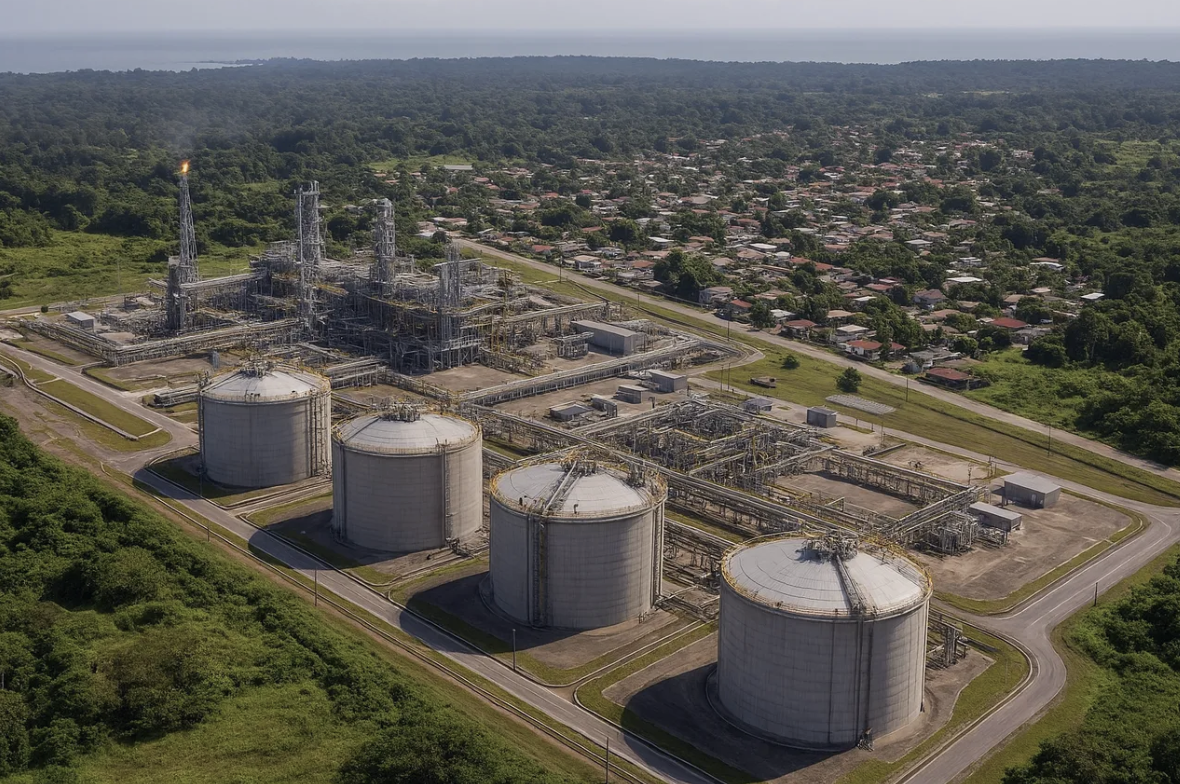
    Trinidad & Tobago transformed its development trajectory between 1998 and 2008 by converting an underused natural gas reserve into a globally competitive liquefied natural gas export platform. Over this decade, real per capita income rose sharply, and foreign investment reached historic levels as the Atlantic LNG complex expanded from a concept into four operating trains. This emergence as a major LNG exporter unlocked financing flows, attracted multinational partners, and reshaped national energy markets. At the same time, it introduced significant risks, including dependence on a narrow industrial base, exposure to global energy cycles, and limited diffusion of benefits into the broader economy. 

    This blog explains how the country’s human ecosystem changed during the boom, the evolutionary economic forces that drove the rapid transformation, and the state’s role in shaping institutions, rules, and investment sequencing. The purpose is to translate the Trinidad & Tobago experience into actionable insights for policymakers across Latin America and the Caribbean as they navigate their own transitions. 

    Economic and social transformation

    The human ecosystem changed fundamentally as natural capital was rapidly converted into financial and industrial capital. Offshore gas reserves that were largely stranded in the early 1990s led to the commissioning of four LNG production lines, or trains, between 1999 and 2005, with a cumulative investment of approximately US$3.6 billion. Gas utilization surged from ~550 million standard cubic feet per day in 1991 to ~3,760 million standard cubic feet per day by 2006, while methanol capacity expanded from 480,000 tons to 6.62 million tons and ammonia capacity from 2.17 million tons to over 5 million tons. These shifts generated major capital flows, with foreign direct investment stock reaching US$12.44 billion by 2007, and GDP per capita roughly quadrupled between the mid-1990s and mid-2000s. Social institutions evolved in parallel through the strengthening of the National Gas Company as the central aggregator and the consolidation of industrial estates at Point Lisas and Point Fortin. These governance structures created a specialized export-oriented social order focused almost exclusively on gas monetization. The social cycle also shifted into a pro-cyclical pattern, as surging LNG revenues after 1999 fueled rapid fiscal expansion and heightened vulnerability to price swings. By the mid-2000s, signals of rising reserve pressure and emerging competitors appeared, but the prevailing assumption remained continued expansion, based on discussions of additional trains and new downstream projects.

    Why LNG took off

    The country’s LNG expansion can be understood through the evolutionary dynamics of variation, selection, and diffusion. Variation emerged through multiple competing configurations for gas use, including LNG export, petrochemicals, power generation, and regional pipeline options. Within LNG itself, commercial structures varied across equity participation, tolling arrangements, and train scales, while successive trains adopted the Phillips Optimized Cascade process, enabling incremental technological learning and larger plant capacities. Selection pressures came from global demand signals in the United States and Europe, which favored Trinidad & Tobago’s reliable, cost-competitive gas supply underpinned by stable institutions. Domestic liberalization in the early 1990s and a clear gas-focused industrial policy further reinforced LNG as the dominant monetization pathway. As Train 1 succeeded, the rapid approval of Trains 2, 3, and 4 in 2000–2005 demonstrated institutional preference for scaling a proven model. Diffusion occurred through the construction of pipelines linking offshore fields to industrial nodes, long-term contracts with US and Spanish buyers in the first train, and the creation of revenue-management institutions such as the Heritage and Stabilisation Fund—these mechanisms locked in the LNG-petrochemical ecosystem, creating a durable path dependence in the industry. However, diffusion into non-energy sectors remained limited, and non-energy exports did not form a significant new cluster despite overall GDP growth.

    How the state shaped the gas economy

    The state acted as the strategic architect and market constructor by lifting the long-standing ban on gas exports, thereby enabling LNG development for the first time. It designated the National Gas Company as a quasi-monopsony buyer responsible for aggregating gas and selling it to downstream firms at administered prices, thereby helping establish competitive petrochemical production. It also developed a production‑sharing contract framework that defined how output and risks would be shared between investors and the state; this system was later recalibrated during the 2006 Petroleum Fiscal Review to improve rent capture. In parallel, the state undertook major public investments, including the 36-inch East Coast pipeline, the 56-inch Cross Island Pipeline, and industrial estate infrastructure under PLIPDECO. It also signaled willingness to absorb risk by taking equity in Train 1, which reassured private partners during the early phase. The state created revenue stabilization instruments such as the Interim Revenue Stabilisation Fund in 2000 and its successor, the Heritage and Stabilisation Fund in 2007, to buffer volatility. Despite these achievements, the state fell short in cultivating an indigenous innovation ecosystem. The industrialization-by-invitation model relied heavily on multinational expertise, limiting the development of deep domestic capabilities and contributing to the enclave character of the energy sector, which generated 80 percent of exports but only around 5 percent of jobs.

    Policy lessons from the LNG boom

    Three policy lessons stand out for resource-rich economies in Latin America and the Caribbean. First, credible rules matter more than state ownership: lifting restrictive bans, designing transparent contract frameworks, and ensuring predictable pricing can catalyze investment more effectively than insisting on large state equity shares. Second, infrastructure and institutional assets are the most durable legacies of a resource boom; pipeline networks, industrial estates, and competent energy agencies convert temporary natural capital into long-term socioeconomic value. Third, stabilization and diversification must begin early, before peak production. Stabilization funds need strict rules, and local content and skill-building mechanisms must be embedded from the outset to avoid the enclave dynamics observed in Trinidad & Tobago. The broader message is that successful industrialization requires not just capital and technology but deliberate institutional design to ensure that natural resource wealth produces sustainable, inclusive development. Policymakers today should apply these lessons to emerging opportunities in critical minerals and hydrocarbons, anticipating future vulnerabilities rather than responding to them after the fact. 

  • Booms Without Transformation: Peru’s Guano and Chile’s Nitrates

    Booms Without Transformation: Peru’s Guano and Chile’s Nitrates

    Latin America has long been rich in natural resources, and for much of its history, those resources have been presented as a promise of progress. In the nineteenth century, Peru and Chile occupied a privileged position in the global economy because they controlled something the industrial world desperately needed: nitrogen. First through guano exported from Peruvian islands, and later through nitrates mined in the Atacama Desert, these countries became essential suppliers for global agriculture and warfare. Revenues were enormous, state budgets expanded rapidly, and foreign capital poured in. From the outside, it looked like development was inevitable.

    But prosperity based on extraction alone proved fragile. Despite decades of booming exports, neither Peru nor Chile used these resources to build diversified economies, strong technological capabilities, or inclusive social systems. Instead, wealth flowed outward through foreign firms, while states focused on collecting revenues rather than transforming production. When deposits were exhausted or global technology changed, fiscal crises, unemployment, and social instability followed. What had seemed like national success quickly became national vulnerability.

    This blog revisits the guano and nitrate booms not as distant historical curiosities, but as early warnings. By examining how these industries were organized—who controlled them, how labor was used, where profits went, and what institutions were built—we can better understand why extraordinary resource wealth failed to deliver long-term development. For today’s policymakers and citizens in Latin America and the Caribbean, these cases raise a critical question that remains unresolved: how can the region turn natural wealth into lasting economic and social capacity, rather than repeating cycles of boom and collapse?

    From Islands to Desert: The Rise of Latin America’s Nitrogen Economy

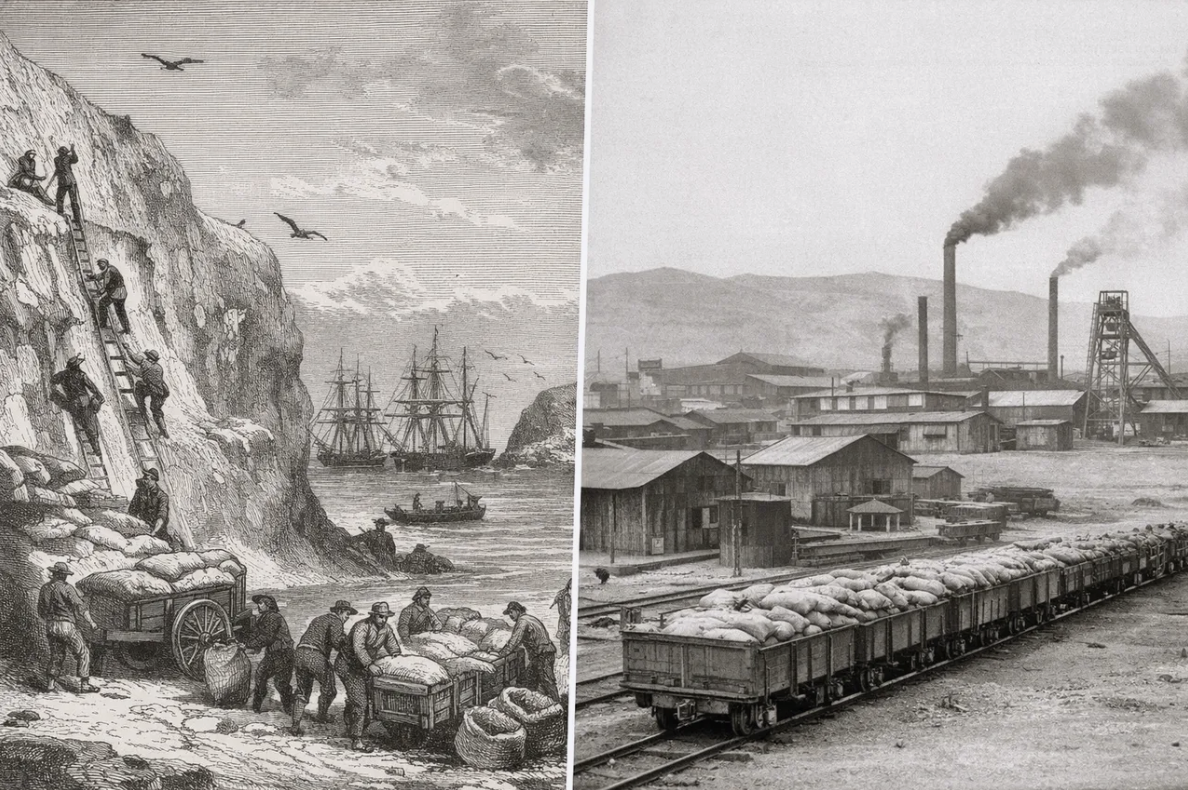
    Between the 1840s and 1860s, guano extracted from Peruvian coastal islands functioned as the dominant global source of industrial nitrogen fertilizer. Approximately 11–12 million tons were exported between 1840 and 1870, financing most Peruvian public expenditures during this period. The production system was based on rapid physical depletion rather than renewable management, leading to a collapse of the resource base beginning in the 1860s. Labor inputs were coercive and low-skilled, relying on convicts, indigenous laborers, and roughly 100,000 Chinese indentured workers operating under hazardous conditions. Exports were directed primarily to Europe and North America to support agricultural intensification during industrialization. British firms controlled shipping, marketing, and chemical validation, while Peru retained ownership through a state monopoly operating via consignment contracts. This structure maximized short-term fiscal revenue but produced minimal domestic spillovers in technology, skills, or institutional learning. 

    From the 1870s onward, sodium nitrate extracted from the Atacama Desert replaced guano as the primary nitrogen input for fertilizers and explosives. The underlying production model remained unchanged: dependence on a single export commodity, reliance on natural resource rents, dominance of foreign capital, and weak economic diversification. The War of the Pacific (1879–1883) reallocated control of nitrate reserves, with Chile annexing Peru’s Tarapacá region and Bolivia’s coastal territory, including Antofagasta. Following annexation, nitrate exports expanded rapidly, reaching approximately 2–3 million metric tons per year by 1910 and generating up to 60% of Chilean central government revenue. Extraction imposed high environmental costs, including land degradation and water depletion. Labor demand drove large-scale migration from Peru and Bolivia, with total employment reaching roughly 70,000 workers by the 1910s. Public and private investment focused on ports (notably Iquique and Pisagua) and railways connecting extraction zones to export terminals. 

    As with Argentina during the same period, British capital dominated ownership, finance, and trade logistics in Chile’s nitrate sector. A substantial share of profits was repatriated rather than reinvested domestically. Chile supplied up to 80% of global nitrate demand for European and U.S. markets. State capacity improved selectively, particularly in customs administration, export taxation, and regulatory oversight of nitrate shipments. However, institutional development remained narrowly focused on extraction. Labor protections were weak, investment in industrial diversification was minimal, and public support for technical or scientific education was limited. Mining towns operated as closed systems under company control, including housing, retail supply, and wage payment through company stores. Employment levels, fiscal revenues, and urban growth were therefore tightly coupled to nitrate price cycles, leaving the economy exposed to external shocks, including the post–World War I collapse following the introduction of synthetic nitrates. 

    The Forces Behind Expansion and Collapse

    Guano extraction exhibited limited technological variation due to its labor-intensive methods. In contrast, British-owned nitrate firms differed in size, processing approaches, logistics, and labor management. Firms adopted varying models for worker housing, compensation (cash wages versus company scrip), and transportation, particularly through railway integration. Most change occurred through expansion in the number of producing entities and consolidation rather than through innovation in extraction or processing technologies. 

    Global market selection mechanisms, institutional structures, and geopolitical pressures increased demand for nitrogen inputs as European agriculture and munitions production prioritized scale and cost efficiency. In the guano system, this favored low prices and high volumes. In Chile, export tax policy favored firms capable of sustaining high throughput. World War I temporarily increased demand for nitrates for munitions production. However, the commercialization of the Haber–Bosch process enabled synthetic nitrogen production at an industrial scale, rapidly eliminating the nitrate industry’s competitive advantage and market base.

    Profitable nitrate practices became institutionalized, but spillovers into domestic manufacturing, chemistry, or engineering education remained limited. Investment patterns reinforced specialization in raw-material extraction rather than in capability development. As a result, Chile became locked into a single‑commodity trajectory, increasing systemic vulnerability to technological substitution and demand shocks. 

    Fiscal Capacity Without Transformation

    The Peruvian state prioritized revenue generation over long-term development by maximizing guano rents without reinvesting in structural transformation. Revenues were centralized through a national monopoly and consignment system. Chile similarly relied on nitrate rents without articulating a diversification strategy or directing flows toward industrial upgrading. Neither state pursued value-added integration, such as linking nitrogen production to domestic agriculture, chemistry education, or human capital development. Fiscal capacity expanded, but political and social legitimacy eroded due to labor repression and visible inequality. 

    In Peru, state monopoly arrangements and exclusive contracts stabilized prices and volumes but constrained innovation. Public investment in railways and urban infrastructure supported extraction but not export diversification. Labor standards and resource stewardship received minimal attention. In Chile, export-oriented policy ensured stable property rights and predictable taxation for predominantly British capital. Significant public-private investment supported ports and railways servicing nitrate zones, but integration with the broader economy remained weak. Despite fiscal surpluses, funding for education, public health, and urban services remained limited. 

    The Peruvian state failed to account for depletion risk or the systemic vulnerability created by reliance on a single asset. Revenues were consumed or leveraged rather than saved or hedged. The resulting collapse triggered a fiscal crisis, sovereign default, and political instability, increasing Peru’s susceptibility to entering the War of the Pacific. Chile similarly underestimated fiscal dependence risks, consuming nitrate revenues without counter-cyclical planning. The collapse of the nitrate industry due to synthetic substitution led to mass unemployment, regional economic failure in Tarapacá and Antofagasta, and large-scale internal migration to Santiago and Valparaíso. The global economic collapse of 1929 amplified these effects. Unlike Peru, Chile used the crisis as a pivot toward state-led industrialization, expanded public ownership, and a strategic shift toward copper exports. 

    What Guano and Nitrates Still Teach Us

    The history of guano in Peru and nitrates in Chile shows that development does not come automatically from abundance. Both countries built highly effective systems to extract, tax, and export natural resources. Roads, ports, railways, and state institutions expanded rapidly. Yet these systems were designed to export raw materials rather than to strengthen domestic capabilities. Education, industrial diversification, and technological learning were treated as secondary concerns—until it was too late.

    When global conditions changed, the weaknesses became visible. Peru’s guano revenues collapsed with depletion, leaving the state financially fragile and politically unstable. Chile’s nitrate economy was destroyed not by exhaustion of the desert, but by a technological breakthrough abroad that made natural nitrates obsolete. Workers were displaced, entire regions declined, and public finances deteriorated. The difference between the two countries lies in their response: Chile eventually used the crisis as a turning point to pursue industrialization and new export sectors, while Peru lacked the institutional capacity to do so on the same scale.

    For Latin America and the Caribbean today, the lesson is not to reject natural resources, but to treat them with caution and strategy. Extractive industries can generate revenue, but without deliberate investment in people, technology, and diversification, they also generate dependency and risk. The guano islands and nitrate deserts remind us that the real challenge is not how much wealth a country extracts, but whether it uses that wealth to prepare for a future in which the boom will inevitably end. 

  • Peru’s Commodity Boom: Gains and Tensions

    Peru’s Commodity Boom: Gains and Tensions

    In 2013, Peru was one of the fastest-growing large economies in Latin America. National income had nearly doubled over the past decade. Poverty had fallen by half. The fiscal accounts were in surplus, and the central bank held reserves that most of the region envied. Yet, in the department of Cajamarca — home to Yanacocha, one of the largest gold mines in the world — the poverty rate was the highest in the country.

    That paradox is not a detail at the margins of Peru’s growth story. It is the center of it. Between 2003 and 2013, GDP per capita rose from roughly US$2,100 to nearly US$6,800, while national poverty fell from around half the population to roughly one quarter. Mining exports grew from under US$5 billion to more than US$25 billion, lifting mining’s share of total exports above 60 percent. Fiscal revenues from mining rose sharply, creating new resources for public spending and decentralization.

    The central policy implication of this period is that growth driven by extractives reshaped Peru’s economy faster than its institutions could adapt. The sections that follow examine how capital stocks, institutions, and social structures changed; how variation, selection, and diffusion shaped outcomes; and how the state steered, adjusted, and sometimes struggled to manage these dynamics. Together, these perspectives clarify why Peru achieved strong macro results but uneven territorial and social outcomes — and why the lessons matter urgently for the next commodity wave in lithium, copper, and other critical minerals now sweeping the region.

    Capital deepening reshaped institutions

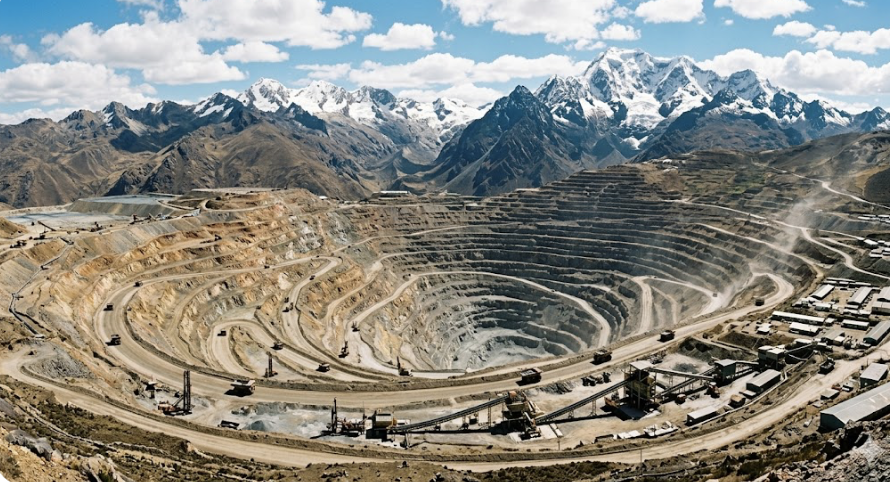
    The most visible change was a rapid expansion of physical and financial capital linked to mining. Total mining investment rose from just over US$1 billion in the mid-2000s to more than US$8 billion by 2012, while exploration spending peaked above US$1 billion — ranking Peru first in Latin America and fourth globally. Foreign direct investment stock reached over US$22 billion by 2013, with mining absorbing the dominant share. Export revenues from copper, gold, and zinc increased more than fivefold, supported by both higher prices and rising volumes, particularly in copper. These flows were accompanied by expanded transport, port, and energy infrastructure connecting Andean mining zones to global markets.

    Running alongside the mining boom — and analytically distinct from it — was the Camisea natural gas project, the decade’s defining non-mining extractive investment. Camisea did not simply replicate the mineral dynamic. By substituting imported fuels and lowering domestic energy costs, it solved a structural input constraint: cheaper, more reliable gas reduced costs for industry and power generation across the economy. When Peru began exporting liquefied natural gas from 2010 onward, Camisea added a third major source of extractive income alongside copper and gold. The critical institutional choice, however, was made at inception: the 2003 royalty reductions offered to attract Camisea’s investors also locked in a gas pricing and offtake architecture oriented primarily toward export revenue. Trinidad and Tobago, facing an analogous choice, used its state gas company, NGC, as a monopsony buyer to price gas cheaply for domestic industrial users, seeding a world-scale petrochemicals cluster at Point Lisas. Peru’s architecture made a different bet — and a different developmental outcome followed. Like mining, Camisea also generated distributional and environmental conflict, particularly along pipeline corridors crossing Amazonian indigenous territories, reinforcing the broader governance challenge that ran through the entire boom period.

    Institutional change lagged capital accumulation but remained consequential. The mining legal framework established new obligations, including mine closure requirements and royalties, while decentralization laws redirected a large share of mining income taxes to regional and local governments. The Canon Minero mechanism dramatically increased subnational revenues from 2007 onward, multiplying transfers relative to the previous decade. New consultation rights for indigenous communities were enacted late in the period, reflecting rising conflict pressures. However, administrative capacity at subnational levels remained weak, limiting the effective use of transferred resources.

    Economic expansion altered Peru’s social structure unevenly. Labor gradually shifted from agriculture to services, construction, and mining, supporting the emergence of a larger urban middle class. National poverty declined rapidly, but outcomes diverged sharply across regions. Several mining-intensive regions continued to record high poverty rates despite large fiscal inflows. At the same time, social conflict around mining projects escalated, signaling tensions between national growth gains and local environmental and distributional concerns.

    Shocks and choices drove outcomes

    Variation during this period came primarily from new and expanded extractive projects rather than from broad-based industrial diversification. Large-scale copper and gold mines expanded capacity, and new projects entered production as prices rose. Mining technologies and operational practices diversified across sites, including lower-grade ore extraction made viable by global prices. Camisea introduced a separate variation track — gas-based petrochemical linkages at Pisco — and initiated a domestic gas distribution network, though neither reached the level of industrialization achieved in Trinidad and Tobago. Outside extractives, some non-traditional exports and services grew, but from relatively small bases. Policy experimentation also occurred through new social programs and decentralization mechanisms, introducing institutional diversity.

    Global commodity prices acted as the dominant selection mechanism. Rapid increases in copper, gold, and zinc prices determined which projects advanced and which sectors attracted capital. Peru’s open investment regime and fiscal stability reinforced this selection, channeling resources toward mining and related activities. The 2008–09 global crisis tested this model, briefly reducing growth before recovery confirmed the resilience of macroeconomic policies. Social conflict functioned as an additional selection pressure, delaying or halting projects that lacked local acceptance.

    Successful practices diffused unevenly — and the enclave pattern was structural, not incidental. Mining investment scaled rapidly as early projects demonstrated profitability and regulatory predictability. Fiscal and monetary discipline became entrenched across successive administrations, reinforcing macro stability. Revenue-sharing arrangements and social programs were institutionalized and expanded nationwide. But productivity gains and technological practices remained narrowly confined within extractive sectors. The mining and hydrocarbon complex was an enclave in the most precise sense: high in capital intensity, limited in direct job creation, and weakly linked to the domestic technology or manufacturing economy. This is the same structural outcome that characterized Trinidad and Tobago’s LNG industrialization and Venezuela’s oil boom of the mid-twentieth century: strong export revenues, weak productive spillover. Peru replicated the pattern in a new commodity and a new century.

    The state enabled growth, managed fallout

    The state provided clear direction through a stable macroeconomic and investment framework. Fiscal discipline, inflation targeting, and open trade policies reduced uncertainty and supported capital inflows. Mining-specific laws introduced royalties, closure obligations, and later profit-based taxation, shaping how rents were shared. Consultation requirements and environmental oversight expanded late in the period in response to conflict. The sequencing favored rapid investment and growth before governance mechanisms fully matured — the same sequencing that produced Peru’s central paradox: Cajamarca grew poorer as the mine above it grew richer.

    Public investment rose alongside private capital, financed in part by mining revenues. Infrastructure spending expanded in transport, energy, and urban services, while public–private partnerships mobilized additional resources. Canon Minero transfers provided unprecedented funding to subnational governments, intended to support local development. However, coordination challenges and limited project execution capacity constrained the developmental impact of these funds. Social programs scaled up nationally, cushioning poverty reduction but remaining largely separate from productive transformation strategies.

    The state demonstrated episodic adaptation rather than systematic learning. Mining tax reforms in 2011 adjusted the fiscal regime in response to political and social pressures. Consultation laws and ad hoc commissions responded to high-profile conflicts, signaling recognition of governance gaps. Yet conflicts persisted, and administrative weaknesses remained largely unresolved by 2013. The contrast with Chile is instructive. Chile built a three-layered fiscal buffer architecture — the Copper Stabilization Fund in 1987, a structural fiscal rule in 2001, and the Economic and Social Stabilization Fund in 2006 — before the super-cycle reached its peak. That architecture was constructed during periods of relative price normalcy, which gave it political legitimacy when the cycle turned. Peru managed a boom. Chile managed the cycle.

    Lesson: Growth can outpace institutions

    The strongest evidence shows that Peru’s 2003–2013 growth was rapid, externally driven, and fiscally transformative. Mining and hydrocarbon exports expanded dramatically, supporting macro stability and poverty reduction at the national level. Institutional frameworks enabled investment but adapted slowly to distributional and environmental pressures. Strong national performance developed alongside persistent local tensions and a structural enclave dynamic that transferred wealth upward and outward more readily than it built local productive capacity.

    A desirable future state builds on Peru’s demonstrated capacity for stability while closing the governance gaps the boom exposed. Effective management of resource revenues at subnational levels remains central to translating growth into local development. Stronger consultation, environmental enforcement, and administrative capacity would reduce conflict risks. Pre-positioning fiscal buffers before the next price peak — not during it — is the lesson Chile demonstrates and Peru did not fully implement.

    This evidence supports three immediate policy priorities for LAC policymakers as they face the next wave of commodities, including copper, lithium, and other critical minerals.

    First, build subnational institutional capacity before scaling revenue transfers. The Canon Minero experience is unambiguous: transferring fiscal resources to governments that lack the staff, systems, and accountability mechanisms to deploy them produces conflict, clientelism, and wasted capital — not development. The next wave of lithium and copper revenues will flow to subnational entities in Chile, Argentina, Peru, and Ecuador. The absorptive capacity question must be answered before the transfers arrive.

    Second, sequence investment frameworks with early attention to consultation and environmental governance. The projects that stall are not those with the worst deposits but those with the weakest social licenses. Delayed consultation and reactive environmental rules are not only governance failures — they are investment risks. The regulatory design choices made now for lithium in the Puna, copper in the Andes, and green hydrogen along southern coasts will determine project viability for decades. Third, treat gas, royalty, and local content architectures as industrial policy choices, not passive fiscal settings. Peru’s Camisea gas pricing decision in 2003 determined whether the country would receive export revenues or an industrial cluster. The same logic applies today: whether lithium is exported as raw brine or refined carbonate, whether copper concentrate is smelted domestically or shipped abroad, and whether green hydrogen is produced for export or anchors domestic industry are all structural choices that compound over decades. The window to make them is before investors commit capital, not after projects are running.