In 2015, Costa Rica registered fewer than 500 electric vehicles. By 2024, EVs accounted for more than 1 in 10 new registrations—powered almost entirely by renewable electricity. The country did this without oil money, without a massive industrial base, and across two major political transitions. That is the puzzle this blog tries to explain—and to translate for policymakers elsewhere in the region.
Costa Rica shifted toward high-value manufacturing and knowledge-based services after 2015. Services accounted for most output and export earnings, and export earnings concentrated in sophisticated segments. Real GDP growth averaged about 3.5% before 2020, contracted sharply when the pandemic hit, then rebounded strongly in 2021 and remained solid through 2023–2024. The free trade zone (FTZ) platform and foreign direct investment (FDI) in life sciences and corporate services anchored export performance and modern-sector jobs.
The core argument is simple: Costa Rica’s transformation since 2015 did not come from a single policy or sector. Three enabling systems reinforced each other—an export platform anchored in FTZ-led sophistication, a renewable electricity base that enables low-carbon electrification, and a state able to digitize high-volume services. The lesson for policymakers elsewhere in Latin America is not to copy a flagship reform, but to focus on sequencing and reinforcement: what changes when these systems are built in parallel rather than in isolation.
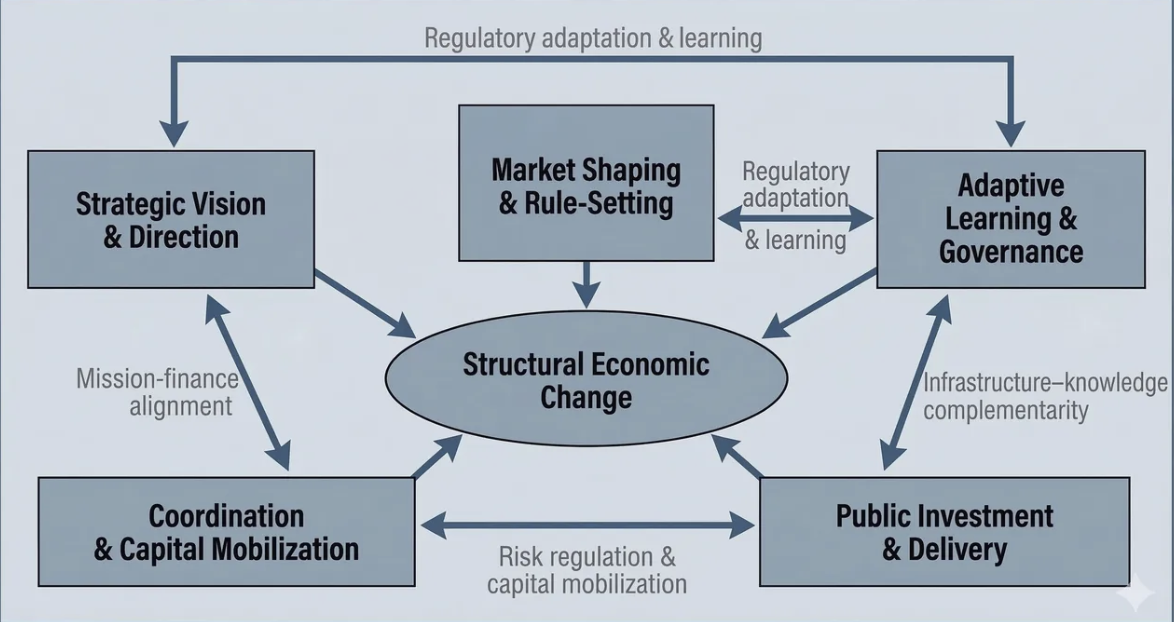
The sections that follow show how the systems compounded: first, shifts in capital stocks, institutions, and economic structure; second, how variation, selection, and diffusion turned pilots into routines; and third, how laws, market rules, coordination, and adaptive management helped reforms persist across political cycles.
What is transferable—and what is not
Costa Rica is a structural outlier in Latin America: it is small (roughly 5 million people), has maintained an overwhelmingly renewable power mix, lacks a hydrocarbon sector, and, since 2021, has been anchored by OECD accession standards. The point is not that other countries can replicate these conditions, but that many can adapt the mechanisms that turned them into durable change. Read the case by separating transferable policy design from context-dependent enablers:
Broadly transferable lessons (mechanisms): stabilize incentives with a clear glidepath (e.g., extend EV incentives to 2034 with phased adjustments rather than abrupt reversals); run charging rollout as a service network with spacing and reliability targets; start digital transformation with one or two high-volume services (such as digital health) before pushing interoperability across government; and coordinate an export platform (investment promotion, skills, and supplier development) so tradable upgrading can finance and legitimize longer-horizon transitions.
Context-dependent lessons (starting conditions): a near-zero-carbon power system makes transport electrification immediately low-emissions; countries with fossil-heavy grids may need to pair EV rollout with a credible power-sector decarbonization and reliability plan. OECD accession provided an external governance anchor (a credible external commitment that raises the cost of backsliding on institutional reforms); where that is unavailable, governments can mimic the effect through domestic fiscal rules, independent regulators, performance compacts, and peer-review partnerships. Costa Rica’s small geography and concentrated corridors simplified charging rollout; larger countries may need phased corridors (freight and bus depots first, then intercity routes, then nationwide coverage) and stronger subnational execution capacity.
Three systems, not one policy, drove the shift
Costa Rica shifted its capital stock toward knowledge-intensive production amid persistent physical infrastructure constraints. Electricity generation remained overwhelmingly renewable after 2015, anchored in hydropower and complemented by geothermal and wind power, laying the groundwork for low-carbon electrification. Fiscal reforms strengthened buffers, with debt declining from pandemic peaks and international reserves reaching historically high levels by mid‑2025. In tradables, the economy deepened its specialization in advanced manufacturing—especially medical devices—supported by FTZ infrastructure and sustained FDI inflows that recovered after the 2020 shock and reached high levels by 2024. Transport energy use remained dominated by liquid fuels because most vehicles still relied on internal combustion engines, even as new registrations shifted. The distinction is between rapid electrification in new private vehicles and slower, operations‑constrained electrification in high‑utilization segments such as buses, taxis, and delivery fleets. Those segments often deliver larger emissions and air-quality gains per vehicle but require depot charging, route planning, financing, and maintenance capacity. The dual reality is a clean-electricity base and fast-moving EV adoption at the margin, alongside a legacy fleet and public-transport systems that still drive emissions and dependence on fuel imports.
Costa Rica focused institutional reforms on three domains: fiscal governance, decarbonization policy, and digital government coordination. In 2018, the legislature passed a major fiscal reform that introduced a spending cap and broadened taxation through a value-added tax framework, reshaping what the state could fund and how it could finance it. Also in 2018, lawmakers enacted an EV incentives law that created tax exemptions for EVs and charging infrastructure and assigned responsibilities for charging rollout and fleet transitions. In 2019, the executive launched a long-horizon decarbonization plan that set economy-wide direction and embedded transport electrification targets within a broader net‑zero pathway. In public administration, successive digital transformation strategies culminated in a 2023–2027 framework, and the state created a national digital government agency to coordinate interoperability and service delivery across institutions. These moves turned political intent into enforceable rules, multi-year plans, and implementation mandates that could survive electoral cycles.
Economic and social outcomes shifted unevenly: growth strengthened alongside persistent labor-market duality and regional disparities. In 2020, tourism and contact-intensive services collapsed, unemployment surged, and household vulnerability increased. After reopening, export manufacturing, corporate services, and tourism drove the recovery, with unemployment falling to low single digits by late 2025. Informality remained high—about 40% of workers in several recent years—showing that productivity gains in the modern sector did not automatically translate into broad formalization. High-skill jobs and the export platform stayed concentrated in the Greater Metropolitan Area, while regional inequality motivated new territorial policy instruments, including a regional development law designed to strengthen regional planning and financing. The period combined macro stabilization and modern-sector dynamism with distributional frictions that complicate inclusive growth and the politics of sustained reform.
The pandemic sorted winners and losers — and Costa Rica was ready
By 2019, Costa Rica’s public health system had implemented a single nationwide digital health record, changing how clinics recorded visits, handled referrals, and interacted with patients. In transport, an EV incentives law and early charging corridors lowered the perceived risk of owning an EV and attracted private investment in EV models, chargers, and maintenance services. After the 2022 cybersecurity crisis, agencies improvised new coordination and operating practices under pressure, accelerating changes in how the state managed digital systems. When the pandemic hit in 2020, these were not contingency measures—they were already operating routines, which made them resilience assets rather than emergency responses. In evolutionary terms, these were sources of “variation”: policy experiments and shocks that introduced new routines in public services, mobility, and administrative coordination. The takeaway is that the highest-impact pilots were not symbolic; they were designed (or forced) to touch high-volume transactions and operational bottlenecks, so learning could accumulate quickly and be institutionalized.
Selection is the filter that decides which experiments scale and which fade. In Costa Rica, the 2018 EV incentive law tilted relative prices toward battery-electric vehicles and helped EVs outcompete conventional vehicles where exemptions and operating costs mattered most. As more global manufacturers offered EV models and prices fell, competition expanded choice and lowered entry barriers. The pandemic acted as an economy-wide selection event: it punished tourism in 2020 while favoring export manufacturing and digitally enabled services that could keep operating. Fiscal rules and IMF-supported stabilization limited room for recurrent spending expansions, pushing the state toward reforms that improved compliance and efficiency rather than simply adding programs. OECD accession reinforced institutional upgrades by tying governance standards and peer expectations to membership. These filters favored tradable upgrading, digital service modernization, and electrified mobility—while making infrastructure delivery, skills supply, and implementation capacity the binding constraints.
Diffusion is where Costa Rica’s story is most useful for implementation-minded readers: it shows how a pilot becomes “the way the system works.” In digital health, a single record and workflow moved from partial rollout to near-universal use by 2019. Clinics and hospitals stopped treating digitization as an add-on and treated the digital record as the default system of record for visits, prescriptions, and referrals. That shift required a multi-year bet: standardized processes and an implementation owner able to roll the system out site by site until coverage became routine. In electric mobility, diffusion looked like an ecosystem: as registrations rose, charging points expanded, dealerships broadened model lines, and early user experience reduced perceived risk for the next cohort of buyers. Diffusion sticks when rules are stable enough for private actors to invest, the service platform is visible to users (a record they must use, a charger they can find), and an accountable owner sustains execution through the unglamorous years of rollout. But diffusion at this scale doesn’t happen by accident — it requires a state that has converted political intent into durable rules and institutions, which is the subject of the next section.
Rules outlast governments: how policy survived three elections
Costa Rica made the transition durable by embedding long-horizon objectives in rules, standards, and market architecture rather than relying on ad hoc programs. The 2019 decarbonization plan defined a pathway to net‑zero by 2050 and translated it into sectoral commitments, with transport electrification as a central pillar. The EV law established a concrete incentive regime—tax exemptions and institutional obligations—that altered relative prices and clarified the responsibilities of agencies and utilities. The 2018 fiscal reform created binding constraints through a fiscal rule and tax base changes, narrowing the feasible set of public choices while strengthening credibility with lenders and investors. OECD accession in 2021 added a governance anchor, reinforcing continuity across areas such as competition policy, statistics, and institutional standards. These actions reduced uncertainty for investors and households and created a predictable environment for adoption and upgrading.
The state backed the rules with enabling infrastructure and platforms, even as infrastructure quality remained a constraint. The national electricity utility (ICE) and the broader electricity system maintained near-universal access and a renewable generation base, giving Costa Rica a backbone for electrifying end uses without increasing power-sector emissions. After the EV law set rollout expectations, utilities and partners expanded public charging points as EV demand rose. In health, the public system financed and rolled out nationwide digital records and supporting applications through a multi-year effort. Telecommunications policy and regulator-led programs expanded broadband coverage, widening the user base for digital public services. In tradables, the state sustained the FTZ framework and export promotion institutions that helped attract and retain investment in life sciences and corporate services. Coordination across ministries, regulators, utilities, and promotion agencies aligned rules, investments, and execution—and often shaped outcomes as much as budget spending did.
Costa Rica’s institutions learned by adjusting policies, carrying out reforms across administrations, and changing implementation practices after shocks exposed weaknesses. In 2022, policymakers revised the EV incentive regime and extended it through 2034, phasing benefits as the market matured and reducing the risk of abrupt withdrawal. After the 2022 cyber crisis, agencies changed how they govern and operate digital systems by introducing new coordination mechanisms and strengthening operational security for cross-agency response. Successive digital transformation strategies signaled a shift from isolated digitization projects to whole-of-government interoperability. In macro-fiscal management, the fiscal rule and post-pandemic consolidation kept stabilization mechanisms in place as debt ratios declined from their peaks. Institutions learned by recalibrating incentives as markets evolved, strengthening governance after failures, and retaining reforms that improved credibility and reduced fiscal risk.
One episode illustrates crisis-driven learning: the 2022 cybersecurity attack disrupted core government digital services and forced leaders to treat cyber resilience as an operational problem rather than an IT add-on. Agencies responded by tightening incident-response routines (who declares an incident, who communicates, and how systems are isolated and restored), increasing cross-agency coordination, and strengthening continuity planning for critical services. Digital government scales safely only when the state invests in the backbone—security standards, shared monitoring, clear authority in a crisis, and practiced recovery procedures—alongside visible user-facing platforms.
The lesson for LAC: sequence matters more than ambition
The compounding dynamic shows up in outcomes. Growth dipped sharply in 2020 but rebounded with record growth in 2021 and remained robust through 2023–2024, reflecting resilience in tradables and recovery in services. EV adoption moved from near zero to a sizable share of new registrations by 2023–2024, supported by a stable incentive regime and expanding charging availability. Digital delivery proved feasible at scale in health services, where nationwide digital records and high usage normalized citizen interaction with state systems through digital channels. These outcomes show how an export base, clean power, and state capacity reinforce one another—while also revealing where constraints (skills, infrastructure delivery, and electricity-system resilience) become binding as adoption grows. The sequence that worked in Costa Rica—stabilize the fiscal position, anchor a renewable power base, build export sophistication, then layer in electrification and digital transformation incentives—is not a universal template, but the logic is: don’t let adoption outrun the infrastructure and institutions that make it durable. That is why the next phase is harder: as electrification and digital government move from early wins to economy-wide coverage, fiscal space, digital service capacity, and electricity-system resilience increasingly determine whether progress continues.
The desired future state is an economy that sustains export upgrading while turning electrification and digitalization into broad productivity gains rather than enclave performance. That requires transport electrification to move beyond early adopters toward high‑utilization segments—buses, taxis, ride-hailing, municipal fleets, and logistics—while maintaining electricity reliability as hydrological variability increases pressure on the generation mix. It also requires digital government to move from flagship systems to routine, cross-agency interoperability so firms and households face lower transaction costs and better everyday service. On the labor side, narrowing skill mismatches and reducing informality would help tradable sophistication translate into broader income security and tax capacity. The practical question is not just “train more,” but “build pathways”: competency-based technical programs aligned with employer demand, paid work-based learning (apprenticeships/internships), portable certifications, and placement mechanisms that connect graduates—especially from outside the main metropolitan area—to formal jobs in export-linked firms and their suppliers.
Policymakers can act by prioritizing measures that strengthen infrastructure-to-adoption feedback loops, reduce duality, and improve execution capacity across institutions—while adapting choices to national starting conditions (power mix, geography/scale, and available governance anchors). First, align workforce development with the export platform’s needs by moving from “training supply” to “training-to-job pathways”: co-designed curricula with employers, paid apprenticeships, short modular credentials in priority occupations, and placement support that connects trainees to formal jobs (including in supplier networks and outside the capital region). Second, protect the credibility of EV incentives while tightening delivery on charging corridor coverage and reliability so adoption does not outpace infrastructure—and treat public transport and fleets as the scale lever by pairing vehicle incentives with operator-ready enablers (depot charging, grid connections, maintenance training, and financing/procurement models that pay for uptime). In countries with fossil-heavy grids or weak reliability, pair EV scaling with a power-sector plan that improves firmness, affordability, and emissions intensity. Third, scale digital government by enforcing interoperability standards and institutional workplans, using platforms like digital health as templates for other high-volume services. Fourth, preserve macro-fiscal credibility by maintaining fiscal rule discipline while prioritizing high-return public investment to relieve infrastructure bottlenecks, strengthen electricity system resilience, and support productivity.