All economies change over time. Most of the time, that change is slow and incremental. But under certain conditions, an economy can shift rapidly — almost explosively — into a new mode of creating value. These moments are economic revolutions: system-wide reorganizations of production, technology, and social coordination. During these periods, annual growth rates can jump from 1–3% to 5–25%, reducing doubling times from 24–72 years to 3–14 years.
Revolutions compress centuries of change into 50 years.
The world is in the middle of a technological wave. The question for Latin America and the Caribbean (LAC) is whether countries will ride this wave or watch it pass by. To seize the moment, countries will need to transform, despite uneven capabilities, fragmented institutions, and rising external shocks.
Bringing together evolutionary economics and the study of technological revolutions can help identify where action is most urgent — and most possible.
Natural resources and economic change
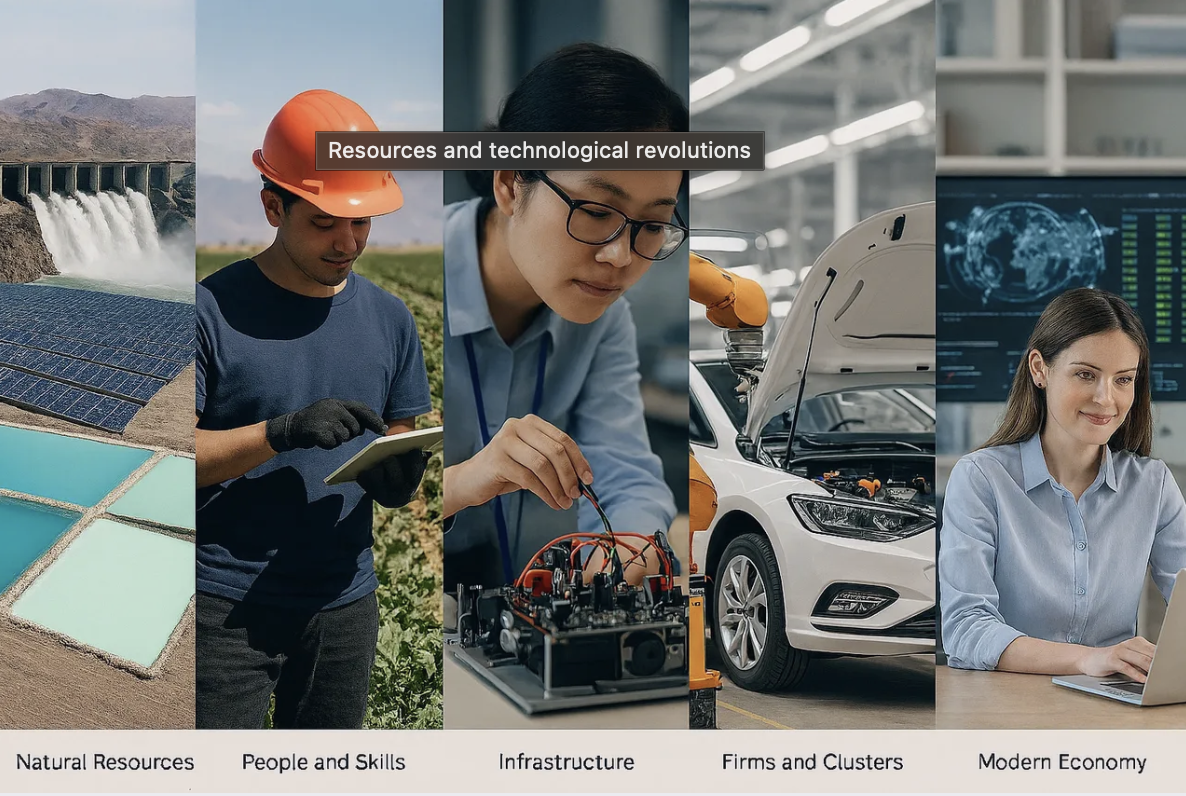
Economic health depends on the stocks and flows of natural, socio-economic, and cultural capital. Natural resources — minerals, land, water, forests, and energy — often form the backbone of development. Countries with strong natural endowments can position themselves strategically in global supply chains. Chile’s Atacama Desert, with its high levels of solar radiation and lithium reserves, gives it leverage in the battery and electric vehicle sectors. Brazil’s landmass and hydropower underpin its agricultural and bioenergy strength. Suriname and Guyana are navigating the opportunities and risks of new offshore oil discoveries, balancing fiscal expectations with the need to diversify before the next commodity cycle turns.
Natural‑resource rents from copper, soy, oil, and hydropower can expand fiscal space for investments in infrastructure, digital connectivity, innovation, and institutional capabilities. Chile and Brazil have used this space to extend transmission lines and integrate renewable energy into their grids. In contrast, Haiti’s long history of resource extraction and deforestation has eroded soils, reduced agricultural productivity, and trapped the country in a low‑productivity equilibrium.
Countries with resource constraints face different pressures. Droughts affecting water for drinking and agriculture have pushed Central American governments to reform water governance and invest in drought-resistant crops. Chile’s lack of domestic oil and gas has accelerated its push toward solar, wind, and storage. Fossil‑fuel import dependence in the Caribbean and Central America exposes economies to price shocks and balance‑of‑payments stress, creating strong incentives to adopt renewables, efficiency measures, and regional energy integration. When traditional energy pathways are expensive or politically constrained, countries may leapfrog directly to renewables and distributed systems — as Uruguay and Costa Rica have demonstrated.
Resource shocks can also trigger paradigm shifts. Commodity booms and busts — such as the post‑2014 decline in oil and mineral prices — have forced Brazil and Colombia to rethink their dependence on extractives and explore diversification and green competitiveness. Climate-related shocks, including hurricanes, droughts, and floods, can cause losses of 10–30% of GDP in Caribbean and Central American countries. In extreme cases, such as Dominica, Grenada, and Antigua & Barbuda, when hit by Maria, Ivan, and Irma, estimated damages have exceeded annual GDP. These events reshape business models, accelerate resilience investments, and open political space for reforms that would otherwise be impossible.
Resource flows are the basis of economies
People are a foundational economic resource. Worker mobility, migration, and diasporas spread knowledge across firms and borders. In Costa Rica, engineers trained at Intel have seeded capabilities across the local tech ecosystem. Regional hubs — Campinas (ICT/biotech), Guadalajara (electronics), Montevideo (gov-tech/fintech) — accelerate innovation and diffusion. The Colombian diaspora in Miami and Madrid has become a channel for entrepreneurial knowledge, fintech innovation, and cultural industries. Education and training institutions amplify these flows. SENAI in Brazil, INCAE and CATIE in Costa Rica, and Mexico’s automotive training centers build absorptive capacity and help firms adopt innovative technologies and business models.
Scaling during economic revolutions depends on scaling resource flows. Capital flows matter not only for firms but for the infrastructure that moves people, energy, materials, and knowledge. Grids, transmission lines, ports, roads, railways, fiber‑optic cables, canals, and airports are the physical networks that enable production. Panama’s canal, ports, and free zones illustrate how logistics platforms can become regional hubs for trade, data, and services. Cheap and reliable energy underpins global competitiveness and enables electricity-intensive industries such as data centers.
Other socio-economic resources — ideas, standards, regulations, and networks — create coherence across firms and sectors. Government standards and procurement can level the playing field and accelerate diffusion. Online platforms and performance-based contracts can push innovation. Cultural capital — trust, legitimacy, professional associations, chambers of commerce, and clusters — reduces perceived risk and helps new practices spread.
Financial resources are crucial
Crises can accelerate change. Debt, inflation, and banking crises in the 1980s forced structural adjustments across the region. Commodity shocks reshape investor expectations and redirect capital. Public finance remains essential for strategic change: aligning budgets, supporting state-owned or parastatal enterprises, and using development banks to steer investment toward future-ready sectors. Brazil’s BNDES has long shaped national priorities through investments in biofuels, agriculture, and renewables.
Economics is about how systems work, not just about money. But economic revolutions depend heavily on finance. Capital allocation is shaped by profitability (past and present performance) and investment attractiveness (future potential). The hardest part of a technological revolution is identifying future winners and losers as global paradigms shift. Early phases of a technological wave attract speculative finance; later phases see production capital scale proven models. Countries that align their policies, regulations, infrastructure, and capabilities with emerging technologies are best positioned to attract long‑term investment.
Two features of technological revolutions matter especially for LAC. First, as production expands, costs fall, and quality improves — a dynamic known as Wright’s Law. Second, innovative technologies emerge in clusters that reinforce one another. LAC is already seeing clusters around artificial intelligence, online platforms, cloud computing, electric vehicles, batteries, renewable energy, digital payments, e-commerce, and logistics. These clusters spill over into digital identity, e-government, and improved tax collection. Countries should target clusters rather than isolated technologies, using policy to connect finance with energy, transport, and skills to enable scalable production.
Conclusion
Economic revolutions occur when resources — natural, human, institutional, cultural, and financial — align and reinforce one another. Finance alone cannot drive transformation; it must be connected to knowledge, raw materials, energy, and human capabilities. Today’s technological wave is a once-in-a-generation opportunity for LAC countries to reposition themselves and expand their productive capacity. The region has the resources to succeed. What it needs now is the commitment, organization, and capability to recombine those resources into new engines of growth.
As Carlota Perez argues, countries must target clusters of technologies and avoid slipping back into the role of raw‑material suppliers. The challenge — and the opportunity — is to turn natural endowments into competitive advantages and become core actors in the next global technological surge.
The advice would be to:
· Target clusters of technologies, not isolated technologies. Build ecosystems around EVs, batteries, AI, and digital services.
· Redirect capital toward future-ready sectors rather than patching old systems.
· Invest in absorptive capacity. Skills, standards, and institutions determine whether technologies take root.
· Align public finance with the new paradigm. Development banks, budgets, and regulations should steer investment toward scalable and integrated systems.
· Build infrastructure that lowers costs. Energy, transport, universities, and digital networks are the backbone of competitiveness.