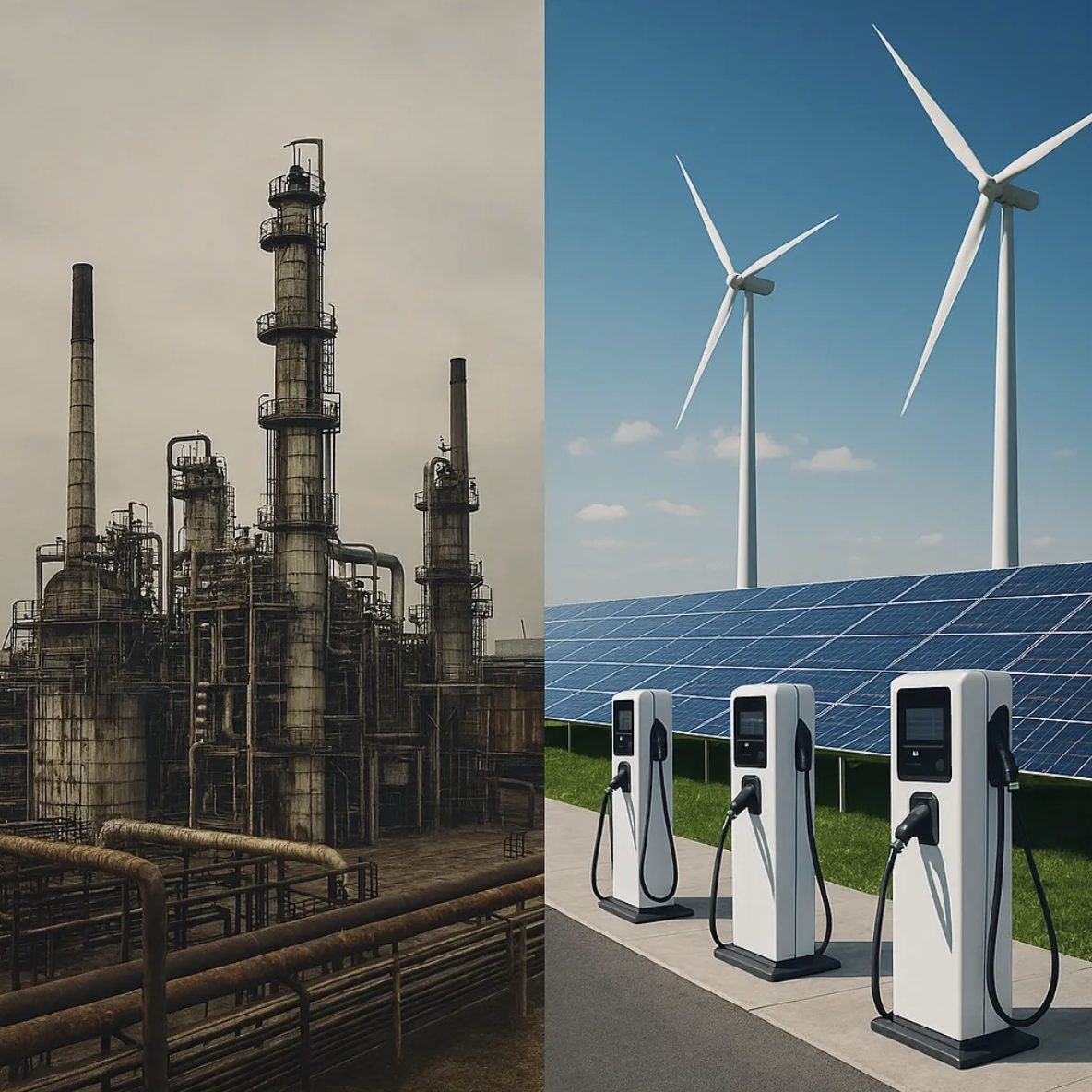
Over forty years ago, Nelson and Winter argued that economies evolve through a process like biological evolution: firms follow routines, experiment with new ways of doing things, and those that succeed grow while others decline. Technological revolutions accelerate this process by reshaping industries, altering competitive advantages, and shifting geopolitical power.
Many analysts argue that the world entered a sixth technological revolution around 2020. Countries in Latin America and the Caribbean now face a strategic choice: lead, follow, or fall behind. This wave will determine competitiveness, fiscal stability, and resilience for decades.
Historically, the region has been commodity-dependent and vulnerable to crises. Yet evolutionary economics teaches that history is not destiny. Countries can change their trajectories by building capabilities, strengthening institutions, and setting clear direction. The region has a rare opportunity to shape its future—if it acts decisively.
This blog explores how technological innovations drive rapid economic change, how institutions and capabilities determine who benefits, and how shocks and opportunities have historically opened windows for transformation.
Technological innovations drive rapid economic change.
Across the last five technological waves, innovative technologies have created entirely new industries, firms, and investment opportunities—first attracting venture capital, then large-scale real‑economy finance. Chile’s solar boom since 2015 and Mexico’s electric‑vehicle investments since 2020 illustrate how quickly new industry blocks can emerge. At the same time, older industries and business models decline in a process of creative destruction.
Diffusion is uneven and path‑dependent. Countries and regions adopt technologies at separate times depending on geography, capabilities, and institutional readiness. Argentina and Mexico built extensive railway networks from the 1880s onward, while Central America lagged. Hydropower dominated Brazil, Costa Rica, and Paraguay from the 1970s, while Caribbean islands remained oil‑dependent. Guyana’s 2015 oil discovery triggered rapid development just as Venezuela’s mismanagement (2014–2020) collapsed its own sector.
Path dependence matters: once a country builds enabling infrastructure, complementary technologies diffuse faster. Brazil’s smart grid pilots from 2008 made the later adoption of solar and distributed energy far easier.
Technologies can be transferred, but absorption requires capabilities. Dominant technologies often emerge in leading economies and spread globally, but receiving countries must have the skills, learning systems, and firms to adapt and improve them. Brazil’s EMBRAPA, founded in 1973, transformed tropical agriculture by adapting foreign technologies to local conditions—an example of evolutionary “retention” and capability building.
Institutions, capabilities, and visionary incentives determine who benefits.
Institutions evolve alongside technologies. They can enable adoption or block it. Linear infrastructure, such as railways and transmission lines, requires land‑use reforms. Electricity systems require urban planning and regulatory clarity. In much of the region, governance fragmentation, weak regulation, and fiscal constraints slow institutional adaptation. Evolutionary economics emphasizes that institutional flexibility— “selection environments”—is as important as the technologies themselves. Brazil’s transmission reforms (2004–2010) unlocked long-distance lines for hydropower integration.
Capabilities and learning systems determine whether firms can seize new opportunities. Dynamic firms grow when they can experiment, learn, and scale. Countries with strong learning systems and entrepreneurial ecosystems move faster during technological waves. Uruguay’s digital‑government investments (2007–2020) and Costa Rica’s engineering reforms after Intel’s arrival in 1997 show how capabilities compound over time. Conversely, Venezuela’s circumstances since 2000 eroded institutional capacity and accelerated sectoral collapses.
Incentives shape direction. Commodity dependence has created powerful interests invested in maintaining the status quo. Subsidies and tax structures often reinforce older technologies and discourage investment in new ones. Evolutionary economics highlights that incentives influence which routines survive and which fade. Fossil-fuel subsidies across the region slow renewable adoption, while in 2014 Chile nudged utilities away from coal and toward solar and wind.
Shocks and opportunities create strategic choices that can shape the future.
Shocks can accelerate change or derail it. Wars, depressions, pandemics, and natural disasters reshape priorities and can disrupt long-term planning. The Latin American Debt Crisis of 1982 forced austerity and delayed modernization for a decade. Hurricane Maria in 2017 caused 225% of GDP losses in Dominica, overwhelming its fiscal capacities, but also triggered a bold goal to become the world’s first climate-resilient nation. Evolutionary economics shows that shocks alter selection pressures: some firms and institutions adapt, others fail.
Occasionally, shocks open windows for reform—if institutions and capabilities are ready. Chile’s 2010 earthquake accelerated the implementation of seismic‑resilient infrastructure upgrades.
Today’s technological wave—AI, ride‑sharing, augmented reality, renewable energy, battery storage, electrification, and digital platforms—is already diffusing globally. The region has real advantages: high renewable energy penetration, hydropower, early adoption of electromobility, and globally significant forests. But success depends on strong institutions, capabilities, and the ability to attract investment. Brazil’s ride-sharing boom (2014–2020) and Costa Rica’s and Uruguay’s rapid EV adoption show what is possible when markets and institutions align.
Strategic vision and long-term directionality determine whether the region can leapfrog.
Economies evolve rapidly when leaders choose a direction and sustain it. Evolutionary economics emphasizes “directionality”—the ability to guide variation, selection, and retention toward preferred futures. Long-term planning up to 30 years is essential for attracting private investment, which depends on stable rules, credible institutions, and fiscal reforms.
The region has examples of long-term strategic vision:
- Costa Rica’s 2050 Decarbonization Plan
- Guyana’s Low Carbon Development Strategy 2030
- Chile’s 2015–2050 Energy Road Map
- Brazil’s Ecological Transformation Plan
These strategies create predictable environments where firms can invest, innovate, and scale.
Conclusion
Technological waves drive rapid economic evolution, and the sixth wave is already reshaping global competitiveness. Evolutionary economics teaches that countries succeed when they build capabilities, adapt institutions, and create incentives that reward innovation. Latin America and the Caribbean have a once-in-a-generation opportunity to shape their trajectory and leapfrog into a more resilient, competitive, and prosperous future. The choices made today will determine who leads, who follows, and who gets left behind.