Category: Structural Change & Transformation

Examines processes of structural change and economic transformation, with attention to production systems, employment, energy transitions, and state‑led coordination.

  • Reducing Risk, Enabling Scale: Argentina’s Export Boom 1880-1914

    Reducing Risk, Enabling Scale: Argentina’s Export Boom 1880-1914

    Across Latin America, governments face a familiar challenge: how to accelerate growth under intense global competition, technological change, and constrained public resources. Argentina’s export boom between 1880 and 1914 offers a concrete case of how rapid growth can occur when markets, institutions, and the state align in support of export-led, integrated development.

    At the end of the nineteenth century, Argentina transformed from a sparsely populated frontier economy into one of the world’s leading food exporters. This transformation is sometimes attributed to good fortune: fertile land, rising European demand, and mass immigration. These conditions mattered, but they do not fully explain the mechanism. Fertile land does not, by itself, build railways, mobilize foreign capital at scale, or coordinate millions of individual production decisions about capital, infrastructure, markets, and rules into a globally competitive system. Growth at that speed required deliberate choices and sustained coordination.

    Argentina’s experience shows that rapid growth emerged from the interaction of three forces that remain highly relevant today. First, the country undertook a large-scale economic transformation, reshaping land use, logistics, and technology to meet external demand. Second, it allowed competitive selection to operate—favoring production models, regions, and firms that could scale, standardize, and integrate into global markets. Third, the state played an active but focused role, reducing risk, guaranteeing infrastructure, protecting property rights, and maintaining policy continuity rather than attempting to direct production decisions.

    This blog does not present Argentina’s historical model as something to be copied wholesale. Its social costs were real, and its long-term vulnerabilities became more visible after 1914. In the long term, Argentina became dependent on primary exports and foreign investment, thereby limiting its industrial development. Land was concentrated in the hands of a few, indigenous populations were marginalized, and social conditions were precarious for many immigrants. However, for countries across Latin America seeking faster growth today, the export boom remains a useful case for understanding how incentives, infrastructure, and institutions can combine to accelerate growth by enhancing coordination.

    Building an agricultural export system 

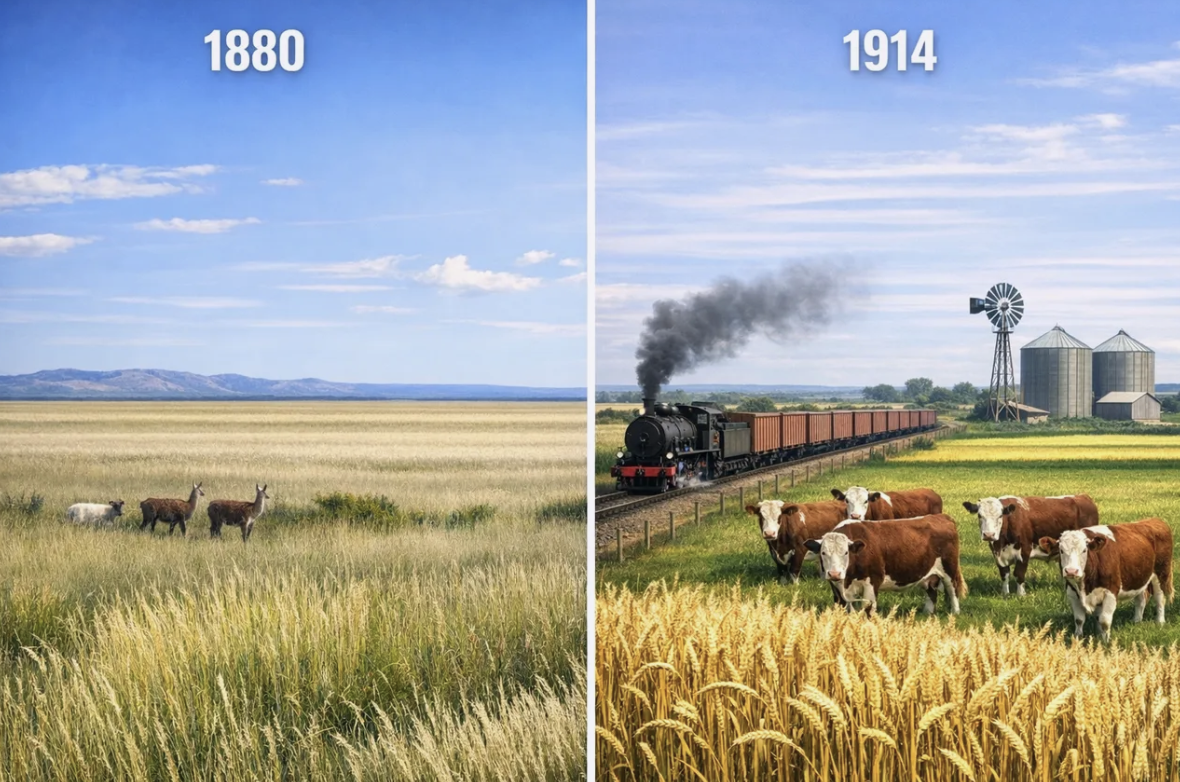
    Between 1880 and 1914, the Argentine Pampas were converted from grassland into a global export system for wheat, maize, beef, and wool. This shift coincided with the rapid urbanization and industrialization of developed countries, supported by steel, railways, electricity, and food-processing technologies. By 1913, Argentina accounted for 12% of the world’s wheat trade and was among the world’s leading exporters of chilled beef, with exports comparable to those of Canada and Australia. Exports values expanded sixfold from 1881–85 to 1910–14. Railways expanded from 2,200 km in 1880 to over 35,000 km by 1914. The railways integrated production with ports and global markets.

    Much of the financing came from Britain, which funded railways, ports, utilities, and banks. Foreign investments accounted for about half of Argentina’s capital stock; 60% of this investment came from Britain. British investors controlled about 80% of the railway system. After 1900, foreign investment grew by over 11% annually. Argentina attracted 3 million immigrants—mainly from Italy and Spain—who arrived between 1880 and 1914, doubling the country’s population. As steam shipping and refrigeration technologies became widespread, Argentine agricultural production was linked directly to increasingly urbanized European consumers.

    These changes also reshaped society and politics. A landowning oligarchy consolidated economic and political power, while urban working and middle classes expanded in Buenos Aires and Rosario. Buenos Aires grew into a global port city, reaching nearly 1.5 million inhabitants by 1914, up from about 180,000 in 1869. The region became increasingly Europeanized in language, norms, and institutions through migration and commercial ownership. Europeans owned about 70% of commercial houses in Buenos Aires. Land under cultivation expanded from 100,000 hectares in 1862 to 25 million hectares in 1914. At the same time, Indigenous knowledge and traditional land claims were marginalized through frontier expansion.

    Why the Pampas scaled first

    Argentina imported livestock breeds and grain varieties from Europe and adapted them to the specific conditions of the Pampas. Over time, producers kept the techniques, breeds, crop varieties, and labor arrangements that delivered the highest profits under local constraints and global demand. Provinces that were better connected and had stronger institutions gained easier access to capital, allowing them to expand more rapidly. In 1879, Argentina began exporting more wheat than it imported, and by 1914, it was among the world’s top wheat exporters.

    The Pampas region proved to be the most productive and cost-effective base for export agriculture in Argentina. Fertility mattered, but so did connectivity: railways, ports, and refrigeration reduced transport costs, reduced price dispersion, and increased price transparency. The port of Buenos Aires linked producers to global demand and world market prices. Consequently, global demand and pricing rewarded large-scale, standardized, and focused production over small-scale, diversified agriculture oriented toward local markets. Producers in the Pampas were typically more profitable, gained easier access to global markets, and became more attractive to investors. Foreign trade accounted for nearly half of Argentina’s GDP between 1870 and 1913, with wheat accounting for about 25% of exports.

    Technologies such as railway logistics and cold storage, new institutions including export houses and banks, and large-scale production approaches reduced unit costs and improved reliability. Frozen and chilled meats accounted for approximately 12% of exports between 1900 and 1913. Producers learned through imitation and experimentation, hired targeted foreign expertise, and benefited from the inflow of skilled workers from Europe. Over time, these complementary inputs—raw materials, capital, skills, infrastructure, and institutions—reinforced economies of scale and export specialization.

    The state played a crucial role in driving change

    The oligarchic Argentine state between 1880 and 1914 concentrated political power among landowners, commercial elites, lawyers, bureaucrats, and financiers. This coalition defined a national focus on export-led growth and global integration. Policy priorities included land titling and the expansion of agricultural frontiers, which would yield clearer titles, enforceable claims, and a lower risk of disputes for investors. Trade and immigration policies also favored openness, supporting export competitiveness and labor inflows. As a result, agricultural and meat exports grew at an average rate of 4% between 1875 and 1913.

    The state also established legal frameworks to protect private property, contracts, and foreign investments, thereby lowering perceived risk. Political institutions preserved elite control, thereby creating policy continuity aligned with export interests, even as this entailed exclusion, inequality, and repression. Regulation and public administration focused on expanding the agricultural export economy rather than promoting industrial diversification, thereby shifting expected returns toward specialized export agriculture.

    Finally, the state provided guarantees and concessions to railway companies, reducing investment risk and crowding in foreign capital: public spending prioritized ports, railways, customs, and urban infrastructure over education or industrial policy. The state ensured policy consistency and absorbed coordination risks, thereby enabling the agricultural export-driven development path to persist.

    Conclusion

    Argentina’s export boom shows that rapid growth is rarely the result of a single reform, sector, or single favorable condition. It is the outcome of coordinated change across production systems, institutions, and public policy. The Pampas did not become globally competitive simply because they were fertile. They became competitive because infrastructure connected them to markets, finance supported large-scale investment, technology reduced distance, and the state consistently reinforced this direction over time. Natural resource endowments are necessary conditions, but state leadership and coordination are required to use them productively at scale. 

    For today’s Latin American policymakers, the most important lesson is not about agriculture or exports per se. It is about focus and selection. Argentina’s state did not attempt to develop every sector simultaneously. Instead, it concentrated public resources on a narrow set of priorities—transport, ports, trade openness, and legal certainty—and allowed firms and regions to compete within that framework. Those that could scale and adopt relevant technologies advanced; those that could not fell behind. Thus, global integration and competition did the work of discovery and delivery. Growth was rapid precisely because choices were made and trade-offs were managed.

    At the same time, Argentina’s experience also highlights a structural warning. Once established, development paths become self-reinforcing. Infrastructure, land ownership patterns, political coalitions, and fiscal systems adapt to the dominant model. Infrastructure networks, fiscal reliance on specific revenues, and political coalitions can lock in economies for the future. This makes early success powerful, but it can also make subsequent adjustments difficult. Countries that accelerate growth, therefore, need to consider not only how to grow quickly, but also what kind of economy they are locking in.

    The broader takeaway for Latin America today is clear. Accelerating growth does not require choosing between markets and the state. It requires a state that shapes incentives, absorbs risk where private actors cannot, and commits credibly to a long-term direction, while allowing competition and global integration reveal what can scale and penalize what cannot. Argentina’s early success shows what is possible when this alignment is achieved—and why getting the initial policy direction and investment priorities right matters for the decades that follow.
  • From Microchips to Megatrends: The Global Shifts of 1970–2020

    From Microchips to Megatrends: The Global Shifts of 1970–2020

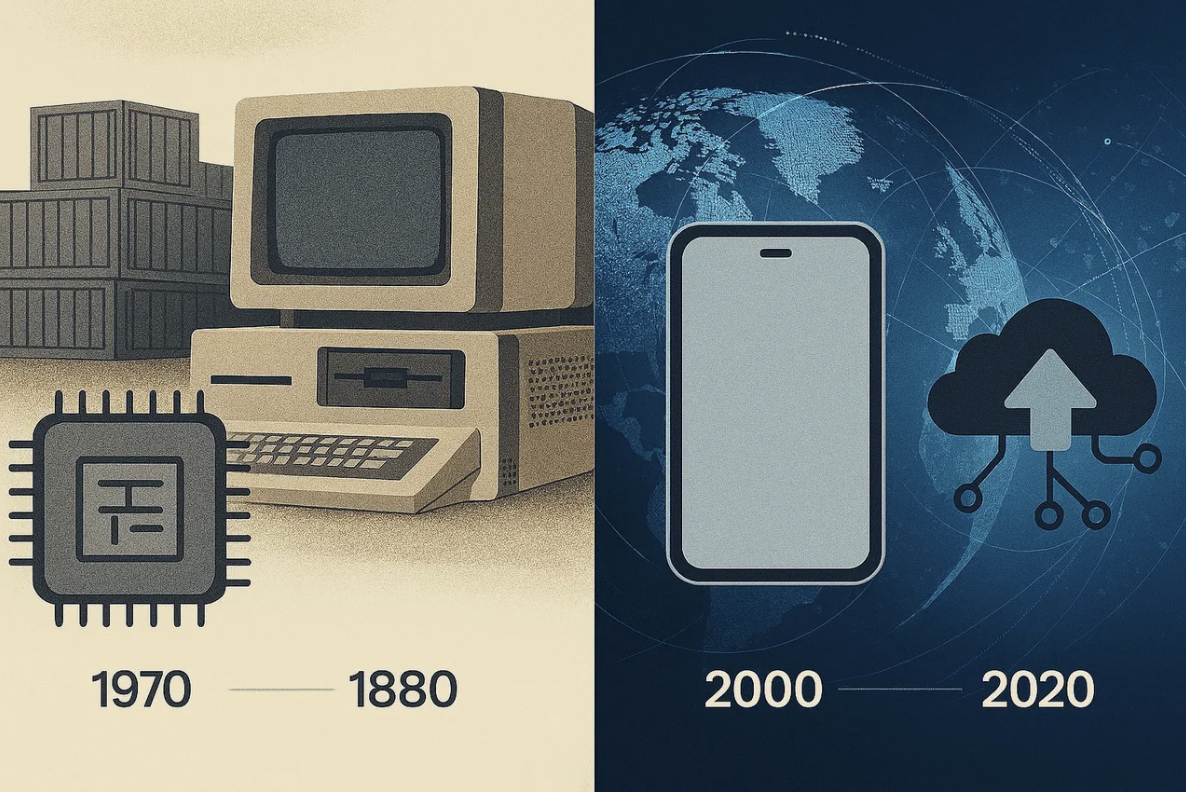
    Between 1970 and 2020, the world changed faster than at any other time in human history. Microprocessors, digital sensors, personal computers, the internet, smartphones, and cloud computing all emerged over the course of five decades. The 1971 Intel 4004 chip contained just 2,300 transistors; by 2020, Apple’s M1 chip held 16 billion. These technologies now underpin everyday systems—mobile banking, telemedicine, online education—shaping how billions of people live, work, learn, and connect.

    These innovations rewired the global economy. Capital now moves at the speed of light. Cross-border capital flows expanded from tens of billions to more than US$1.2 trillion. Merchandise trade grew from hundreds of billions to US$18–19 trillion. Internet use rose from millions in 1990 to 4.5 billion users in 2020. East Asian economies emerged as global manufacturing hubs, while the United States consolidated its dominance in finance, digital platforms, and knowledge networks. In Latin America and the Caribbean, new opportunities for growth, innovation, trade, and integration appeared—but exposed longstanding challenges in productivity, inequality, and institutional capacity.

    Speed, scale, and knowledge exemplify today’s world. Countries that invested early in education, research, infrastructure, and capabilities became innovation leaders, lifted millions out of poverty, and intensified global competition. Participation in value chains now extends beyond natural resources and manufacturing to include data, technology acquisition, and the capabilities needed to adapt and learn.

    Understanding the last fifty years is essential for shaping the next fifty. Latin America and the Caribbean have talent, natural capital, and creativity. The region could lead to the emergence of green, digital, and knowledge-based economies. Doing so will require learning from the past and adopting deliberate strategies that build on regional strengths to turn global change into regional opportunity.

    This blog examines the transformations that occurred, the forces that drove them, and the role of states in shaping their trajectories.

    Systemic Changes in Capital Flows at Speed and Scale

    The most striking feature of this period was the speed and scale of change. Foreign direct investment stock rose from roughly US$100 billion in 1980 to nearly US$40 trillion in 2020. Finance could move instantaneously across borders. Global trade expanded from about US$2 trillion to US$18–19 trillion as supply chains stretched across continents. Trade in financial, technological, informational, and digital services reached US$6 trillion. Knowledge now moves in milliseconds, and people increasingly migrate to fill labor shortages or build skills. Trade shifted from simple goods to complex, fragmented value chains and to services and data rooted in intellectual property and knowledge.

    A Reconfigured Global Economy

    The global economy was fundamentally reshaped. East Asia—first Japan, then Korea, Taiwan, Singapore, Hong Kong, and later China and Vietnam—became the world’s manufacturing hub. Many of these economies moved from low‑ or middle-income status in 1970 to high-income status by 2020. South Korea’s per capita GDP rose from under US$300 in 1970 to more than US$30,000 in 2020. China became a central node for trade, manufacturing, and technology, while the United States shifted toward dominance in finance, platforms, and knowledge networks.

    Advanced economies such as the United States, Germany, the Netherlands, and the Nordic countries retained their leadership in technology and finance, with large corporations becoming increasingly influential. The internet, smartphones, and digital platforms reshaped the movement of knowledge, capital, and trade. Resource-rich and well-governed exporters—including Norway, Saudi Arabia, the UAE, Qatar, and Kuwait—leveraged oil and gas rents to accelerate development, supported by large inflows of migrant labor. New middle powers such as South Korea, India, and Brazil strengthened their positions as they integrated into global supply chains.

    Countries facing conflict or severe mismanagement fell further behind the global frontier, struggling to integrate into trade and knowledge flows and becoming increasingly dependent on aid, remittances, or single commodities. In Latin America, countries such as Chile, Uruguay, and Costa Rica advanced, but the region did not overcome persistent challenges in productivity and inequality.

    Technologies, Liberalization, and Knowledge as Drivers of Change

    The technologies of this ICT revolution reflected two powerful empirical patterns. Moore’s Law observed that the number of transistors on an integrated circuit doubles roughly every two years. Wright’s Law showed that for every cumulative doubling of production, the cost of a technology falls by a constant percentage. Together, they drove a dramatic decline in the price of computing and digital infrastructure.

    The internet, mobile computing, cloud services, and fiber‑optic networks created a new technological paradigm. Borders became porous to capital, knowledge, and information. The logistics revolution—especially containerization—reduced shipping costs by 75–90% and cut shipping times in half, making global value chains more feasible and increasing the need for international standards. Financial innovations, including deregulation, derivatives, global capital markets, electronic trading, and mobile money, transformed how cash flows and laid the groundwork for digital assets such as cryptocurrencies. Daily foreign exchange trading rose from the low hundreds of billions in 1980 to US$6.6 trillion in 2019.

    Cost competition drove offshoring, nearshoring, and friendshoring as global supply chains expanded. Energy shocks spurred efficiency, diversification, and a focus on energy independence. Geopolitics shifted with the end of the Cold War and the rise of China, as the global economy moved from industrialization and production toward technology and knowledge. Trade and capital liberalization, supported by international agreements, encouraged private‑sector engagement and privatization.

    Capabilities as the New Currency of Nations

    Capabilities became increasingly decisive. Education, research and development, and digital infrastructure were essential for securing national comparative advantages. Early movers such as the United States and the United Kingdom became financial hubs. In contrast, early, low-cost industrializers such as China and South Korea scaled up manufacturing and became hubs of production. The global economy became more integrated and moved toward digitization, knowledge, and networked production. Knowledge flowed directly through digital networks and indirectly through migration, with the Gulf states alone hosting more than 30 million migrant workers.

    States and Multilateralism

    States played a significant role in shaping long-term development pathways. Korea, Taiwan, and China actively pursued industrial advancement, calibrating the pace of liberalization in trade, capital, and migration. Other countries positioned themselves as financial or corporate centers or moved rapidly into clean energy to reduce dependence and volatility. Financial deregulation in the United States and the United Kingdom accelerated global capital flows by relaxing capital controls, reducing trade barriers, and promoting privatization and public-private partnerships. Many countries invested in migration, education, and R&D policies to cultivate the talent and capabilities needed to leverage innovative technologies.

    Multilateral organizations—including NAFTA, ASEAN, and the EU—helped stabilize change and set standards for a global marketplace. NAFTA tripled North American trade from US$290 billion in 1993 to US$1.1 trillion in 2016. The WTO codified global trade rules and accelerated supply chain integration, while the G7 and G20 provided coordination in an increasingly complex global economy. In Latin America and the Caribbean, MERCOSUR, CARICOM, and the Pacific Alliance supported regional integration.

    In some cases, state interests and multilateral systems evolved together, producing what some analysts call “hyper‑globalization.” Yet global change also created winners and losers within advanced economies. Some regions lost manufacturing jobs to trade and automation, while urban areas captured gains from finance, technology, and knowledge flows. In the United States, manufacturing employment fell from 19 million in 1979 to 12 million in 2020. These internal disparities fueled populism and domestic backlash, challenging multilateralism.

    Conclusion

    The last 50 years clearly show that countries can take an active role—and adopt long-term strategies—to accelerate economic growth. The Asian Tigers sustained growth rates of 6–8% for decades. The United States continued to lead in finance and innovation. The Gulf states transformed oil and gas wealth into US$3.5 trillion in sovereign wealth funds, accelerating broader development.

    Latin America and the Caribbean now face a similar moment of choice. The next wave of global transformation—energy, biotechnology, advanced manufacturing, data management, and artificial intelligence—is already underway. Countries that invest in institutional and individual capabilities and open channels for knowledge and trade based on their comparative advantages will scale their economies. Those who hesitate risk missing the opportunities ahead.

    The region has abundant energy resources, the world’s largest lithium reserves, exceptional solar potential, vast natural and cultural capital, and a growing digital economy. The question is whether LAC countries will work together to shape the next technological wave—or be shaped by it.

  • Engines of Change 1920-1970 Cars, Planes, Fridges, Assembly Lines

    Engines of Change 1920-1970 Cars, Planes, Fridges, Assembly Lines

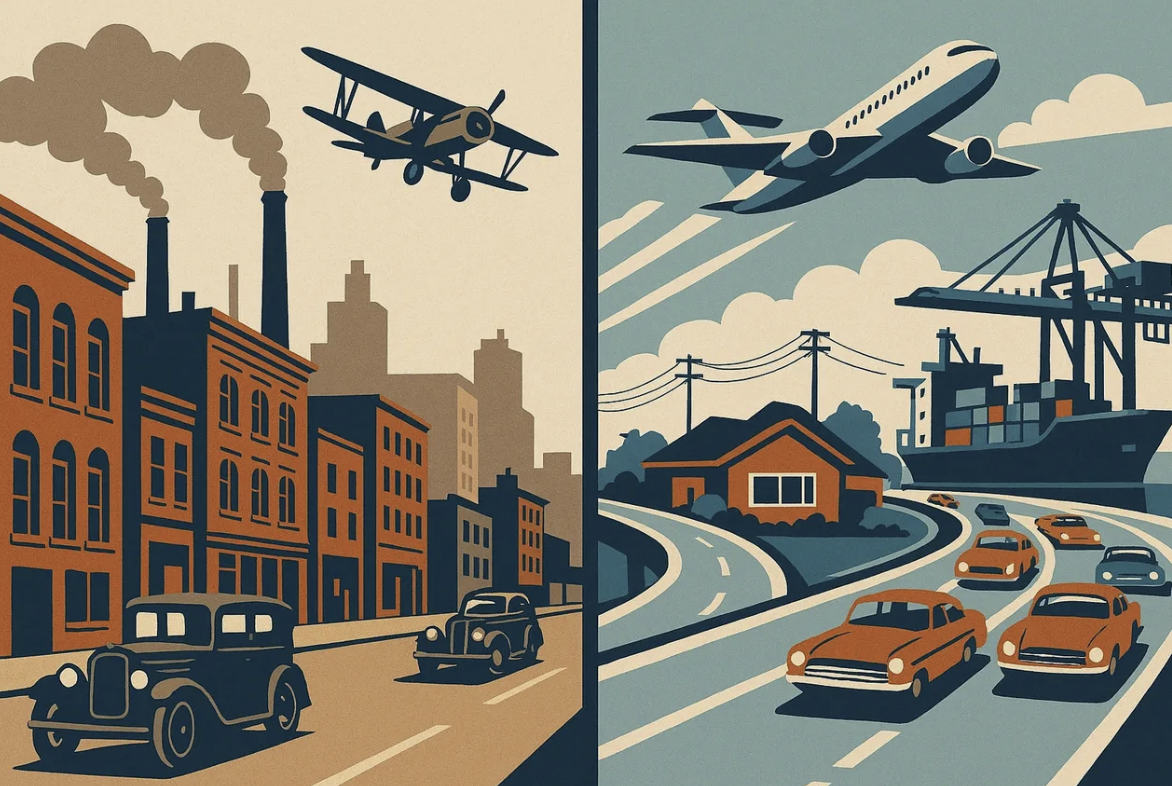
    The human ecosystem changed fundamentally across many countries between 1920 and 1970. Much of what we recognize in modern life emerged during this period: cars, planes, refrigerators, televisions, and container ships. These innovations reshaped cities, reconfigured trade routes, and reordered the global hierarchy. The United States led these transformations, followed by West Germany, France, Italy, Belgium, Greece, and Sweden. South Korea, Taiwan, Hong Kong, Singapore, and the Soviet Union also underwent rapid structural change.

    Two major growth booms defined the era. The first, in the United States during the 1920s, established the country as a technological leader. The second came after 1945, when U.S.-backed reconstruction accelerated industrial recovery across Europe and Asia. Together, these waves produced decades of sustained growth driven by urbanization, industrialization, and mass production—supported by government-backed development finance that took risks private banks would not.

    Countries that mastered innovative technologies and organizational practices grew rapidly and became global leaders. Those that struggled with weak coordination, underinvestment in infrastructure, adversarial labor relations, or elite-dominated politics fell behind. 

    The lesson for Latin America and the Caribbean is clear: modernizing infrastructure, mobilizing patient capital, upgrading skills, and enforcing standards that reward quality and sustainability are essential to riding today’s technological wave. Doing so will create jobs, raise health standards, boost productivity, and strengthen urban resilience.

    This blog examines the transformations of 1920–1970, the drivers behind them, and the state’s role in shaping outcomes. 

    A rapidly changing human ecosystem

    The environmental and resource landscape shifted dramatically. Energy systems moved from coal to oil and electricity, powering growth in transport, petrochemicals, and manufacturing. These transitions varied by country: Sweden expanded hydropower, the United States built oil‑ and electricity-powered suburbs, Mexico and Venezuela leveraged petroleum, and Brazil invested heavily in hydroelectricity.

    Urbanization surged, accompanied by large-scale land conversion for infrastructure, energy, and materials. In Japan, the share of urban residents rose from 60 percent in 1950 to 70 percent in 1970. Environmental stresses also became more visible. London’s Great Smog of 1952, which caused an estimated 10,000–12,000 deaths, led to the Clean Air Act of 1956. Similar concerns in the United States contributed to the Clean Air Act Amendments and the creation of the Environmental Protection Agency in 1970.

    Mass production and mass consumption took hold as households acquired cars and, later, refrigerators and televisions. U.S. vehicle ownership rose from 60 cars per 1,000 people in 1920 to 516 per 1,000 by 1968. Argentina was an early adopter too, with 35 cars per 1,000 people in 1930. Ford’s assembly lines created millions of middle-class jobs, while mass production made consumer goods affordable for working families. As an anecdote about the speed of technological change, New York went from horse-drawn to motorized between 1900 and 1913.

    The United States, West Germany, and Japan converted wartime industrial capacity into high-quality civilian production—cars, appliances, and electronics for export. Japan imported U.S. and German technologies, improved them, and built globally competitive firms in steel, shipbuilding, automobiles, and electronics. Between 1950 and 1970, life expectancy and per capita GDP rose sharply across the USA, Japan, West Germany, France, Italy, Belgium, Sweden, South Korea, and Greece. Britain, by contrast, experienced slower diffusion of consumer goods and weaker industrial modernization. Mexico and Brazil also industrialized, with output rising sharply between 1950 and 1980, and urbanization increasing severalfold. But LAC’s import‑substitution strategies, focused on protected domestic markets, limited economies of scale, and enabled rent‑seeking by powerful elites.

    Media and mobility reshaped culture. Radio and television became dominant channels. Commercial jet travel—introduced in 1952—dramatically reduced travel times. Together, mobility and mass media helped forge national narratives and shared identities.

    Global trade expanded rapidly, supported by new logistics and financial flows. Container shipping, introduced in 1956, revolutionized cargo transport by standardizing metal containers that moved seamlessly across ships, trains, and trucks. Handling costs fell from US$5.86 per ton to US$0.16 per ton. Ports such as Rotterdam, Hong Kong, and Singapore expanded dramatically. Export-led industrial models emerged in West Germany, Japan, Korea, and Taiwan, which built manufacturing clusters tied to global markets. The Marshall Plan accelerated reconstruction and market integration across Western Europe, creating new consumer markets. Many countries strengthened public institutions, expanding welfare systems, development banks, and national accounts to support fiscal management.  

    Drivers of change: technology, institutions, and war

    Innovative technologies and practices emerged in the 1920s, including mass-production techniques such as Ford’s assembly line. Model T production rose from 170,000 vehicles in 1913 to more than 941,000 in 1920. Cars and planes evolved rapidly, culminating in jet aircraft like the Boeing 707 in 1958. Many early advances were spin-offs from World War II industrial machinery.

    Containerization later standardized logistics, slashing costs and enabling modern globalization. Innovation also included new corporate structures, professionalized management, and novel approaches to quality control and workflow.

    World War II mobilization accelerated research and development in aviation, petrochemicals, and electronics, and forced industrial-scale production that later shifted to civilian use. Post-war support—including the Marshall Plan and U.S. aid to Japan and Korea—helped countries adopt advanced development models. Market competition rewarded firms with access to technology and long-term finance, enabling them to outcompete protected or fragmented economies.

    Strong state narratives anchored policy approaches: the U.S. “New Deal,” Japan’s “Income Doubling Plan,” West Germany and Austria’s “Wirtschaftswunder,” and France’s “Trente Glorieuses.” The United States New Deal focused on stabilizing the financial system, expanding infrastructure, and recovering from the Depression. Europe and Japan emphasized reconstruction and the expansion of welfare states. The post-war Golden Age of Capitalism delivered massive investments in highways, ports, grids, and telecommunications. Education and vocational training systems codified modern technologies and routines, spreading innovation across firms and regions. 

    The role of the state: rapid change, uneven results

    Successful countries built strong planning agencies that set targets and coordinated across finance and industry—Japan’s Ministry of International Trade and Industry and South Korea’s Economic Planning Board are emblematic. These countries focused on industrial capability and global integration. The Soviet Union’s planned industrialization made it the world’s second-largest economy by the 1960s, but it came with serious design flaws.

    Others faltered. Britain, burdened by post-war debt, weak industrial strategy, and political conflict, failed to modernize quickly. Fragmentation, strikes, and adversarial labor relations slowed progress. The former industrial leader lost momentum, competitive advantage, and investment.

    Successful countries also regulated effectively and set standards. Land reform and quality standards boosted productivity. Trade agreements and the European Economic Community opened markets. Expanding welfare states provided pensions, healthcare, education, and unemployment insurance. The Soviet Union, however, set production targets without market signals or consumer‑quality standards, leading to chronic shortages. Greece’s clientelist politics limited productivity gains and left regions disconnected from export-led growth.

    Public finance capacity was equally important. Development banks such as West Germany’s KfW, Japan’s JDB, and Italy’s IRI de-risked significant industrial and infrastructure investments and supported small and medium-sized enterprises. Large infrastructure projects paid off: Japan’s Shinkansen, launched in 1964, symbolized integrated investments in mobility and growth.

    The Marshall Plan injected over US$13 billion (about US$200 billion today) into reconstruction, institutional reform, and the European Payments Union. This support accelerated structural change, helped prevent a repeat of the political fallout from World War I, and built consumer markets for U.S. products. Public investment also expanded human capital and welfare systems, creating skilled workforces and social stability. The most successful states cultivated innovation ecosystems by funding basic and applied research. Japan, Korea, Taiwan, and Singapore targeted specific export sectors, incentivized cluster development, and compressed industrialization timelines. 

    Conclusion

    The period from 1920 to 1970 was one of extraordinary turmoil and transformation. Old powers declined, and new manufacturing giants emerged. This rapid change was possible because governments worked with businesses to set direction, create market space, and build the skills needed for innovation and diffusion. Development banks played a significant role in financing infrastructure that reduced costs and enabled the formation of new industrial clusters.

    If Latin America and the Caribbean choose coordination over fragmentation, patient investment over short-termism, and strong standards over shortcuts, they can write their own economic miracle. 

    For the region, this means prioritizing infrastructure, long-term financing, skills development, standards and quality control, and export promotion—anchored in industrial clusters that leverage comparative advantages in renewables and critical minerals. 

  • Third Technology Wave, 1870-1920: Steel, Electricity, & Telephone

    Third Technology Wave, 1870-1920: Steel, Electricity, & Telephone

    One hundred and fifty years ago, countries faced challenges like those confronting Latin America and the Caribbean today. Beginning in 1870, a group of nations chose to enter the next phase of the Industrial Revolution and underwent rapid, far-reaching transformation. 

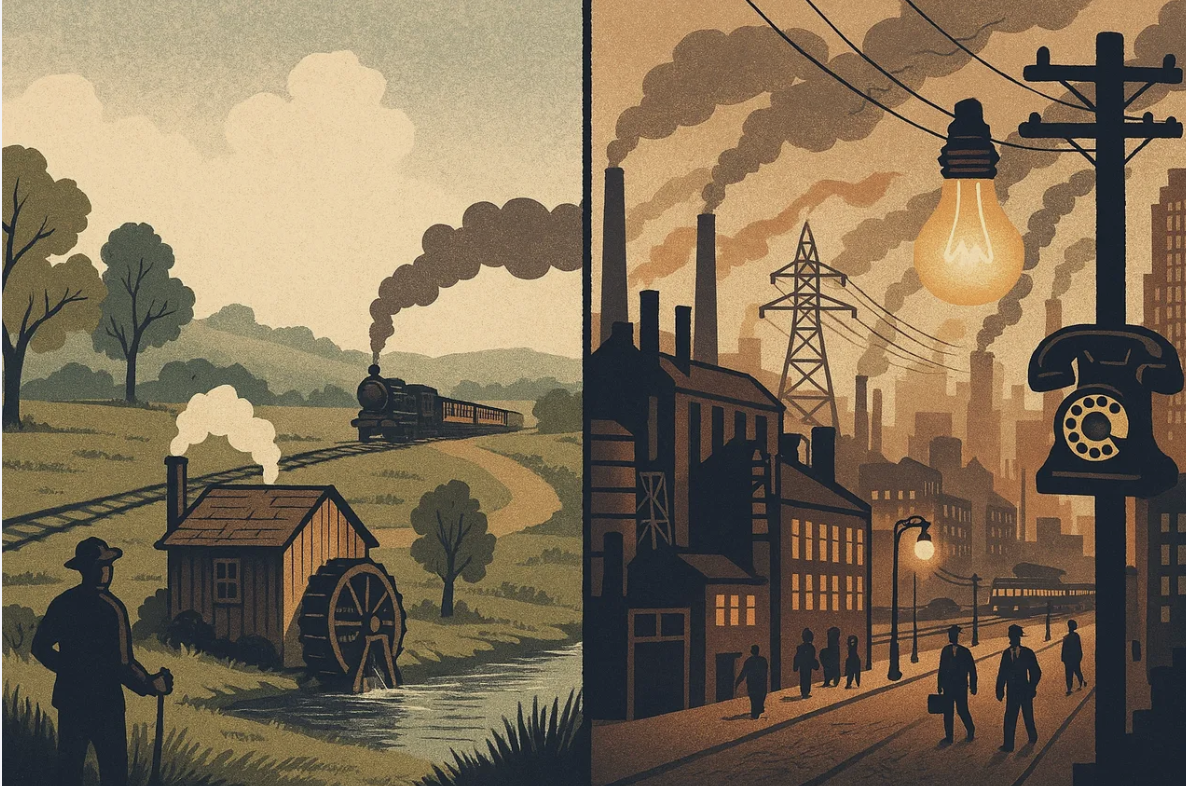
    By 1920, these countries were replete with steel mills, rail systems, electricity generation and transmission, electric lighting, telephones, canneries, and large industrial cities. Their economies reorganized around new infrastructure, industries, and social arrangements.

    The governments of eight countries — the USA, Britain, Germany, France, Italy, Belgium, the Netherlands, and Japan — played decisive roles in steering these changes in partnership with the private sector. Governments set national missions, built infrastructure, shaped markets, expanded education, and helped manage inherent disruption and conflict.

    For Latin America and the Caribbean, this history matters. The world is entering a new era of disruptive technological change built around green and digital technologies. This new wave presents a significant opportunity for the region. Government choices will determine national trajectories over the next 50 years. This blog shows that rapid transformation is possible, even for latecomers, when states, societies, and markets align around a shared mission.

    This blog examines how these countries navigated the third great technology wave by exploring what changed, what drove those changes, and the role governments played. 

    The global human ecosystem was transformed.

    From 1870 to 1920, natural and socio-economic systems changed dramatically across these countries. The Bessemer and Siemens‑Martin steelmaking processes became the backbone of development in Germany and the USA. US steel production rose from 68,000 tons in 1870 to 42 million tons in 1920 — a 600-fold increase. Electrification after 1890 reorganized production and urbanization, with the USA and Germany building large grids, followed by Britain, France, and Belgium. These countries went from producing no electricity in 1870 to generating tens of terawatt‑hours by 1920.

    Coal extraction intensified environmental change in the Ruhr, Appalachia, Wallonia, and northern France, while Japan and Italy relied on imported minerals, demonstrating that resource scarcity was not a limitation. Rail networks unified national markets and helped accelerate urbanization. Electric lighting extended working hours, and telephones and telegraphs enabled broader and more effective coordination — supporting US corporations, Britain’s global trade, and Germany’s universal banks. Canning, led by the USA and Britain, reshaped diets and urban supply chains. Public health systems — water, sanitation, and pasteurization — improved urban living conditions and supported population growth.

    Social systems and institutions also evolved. State capacities expanded to universal schooling, welfare, and stronger regulation. Land‑grant colleges in the USA, technical education in Germany, and republican schools in France built human capital. Germany pioneered social insurance; Britain introduced national insurance; Belgium and France expanded labor protections. Antitrust laws emerged in the USA; labor laws strengthened in Britain and France; and administrative modernization advanced in Japan and the Netherlands.

    Nationalist narratives linked modernization and industrial strength in Germany, Japan, Britain, and the USA. Mass media — newspapers, cinema, and early radio — diffused national cultures. Scientific and technical capacities expanded, with universities in Germany, France, and Britain leading globally. Class structures hardened, with strong labor movements in Britain, Belgium, and Germany, and labor conflicts in the USA and France. Women’s suffrage expanded toward the end of the period, though patriarchal norms persisted. 

    Britain was the world’s premier creditor until World War I, holding foreign assets worth twice its GDP in 1914. The USA shifted from a capital importer in 1870 to a major creditor by 1920, with New York rivaling London. Germany, France, Belgium, and the Netherlands also exported capital, while Italy and Japan imported capital and technology.

    Transatlantic migration reshaped labor markets: Italians, Germans, and Belgians migrated in the millions, many to the USA. Britain, France, Belgium, and the Netherlands extracted resources and labor from their empires. Rural‑to‑urban migration accelerated, fueling industrialization and transforming social institutions.

    Steel, electricity, and telecommunications diffused rapidly through global trade networks. Germany and the USA dominated machinery and chemical exports. Japan and Italy imported technologies to industrialize. By 1920, these eight countries — home to about 20% of the world’s population — produced half of global economic output and 70% of global industrial production. 

    Drivers of change between 1870 and 1920.

    Countries with strong coal and iron resources — the USA, Germany, Britain, Belgium, and France — built heavy industry. Japan, Italy, and the Netherlands relied on trade and efficiency. Technologies such as steel, electricity, and machinery reorganized production and logistics. Canning, refrigeration, sanitation, and public health supported dense urbanization.

    The USA and Germany built large integrated corporations and universal banks; Britain and Belgium relied on merchant‑finance networks. US Steel, founded in 1901, became the world’s first billion-dollar corporation; economies of scale are critical in global competitiveness. Germany and France built strong bureaucratic and fiscal states; Britain and the Netherlands refined liberal‑parliamentary systems. Built infrastructure — railways, ports, and electrical grids — shaped national trajectories.

    Cultural traditions — German Bildung, French republicanism, British imperialism, American settler republicanism, and Japanese nationalism — shaped modernization. Belgium and the Netherlands developed pillarized societies: separate social groups with their own institutions. Strong unions emerged in Britain and Germany; class politics intensified in Italy and France.

    Countries that produce steel, machinery, electricity, and chemicals dominate the global industry. Japan and Italy entered global markets through textiles and light industry. Military competition reinforced demand for steel and machinery, unfortunately, culminating in World War I.

    Large integrated firms outcompeted smaller producers. Industrial clusters — the Ruhr, Northeast USA, northern Italy, Wallonia, and the Randstad — became growth poles. Electrified and connected cities outperformed historical coal‑and steam regions. Labor movements reshaped institutions: countries that reformed adaptively maintained stronger trajectories. National narratives tied modernization to national destiny. 

    Successful countries institutionalized new routines. They enacted laws, built infrastructure, and expanded education systems. Germany, France, the USA, Japan, and the Netherlands moved toward universal schooling. High-cost infrastructure — railways, ports, power grids, telecommunications — are locked in development paths. Path dependence means that early choices matter. State set 

    Welfare and labor institutions expanded. Technologies diffused through trade, foreign investment, and imitation. Corporate and financial models spread. The media shaped ideas about modern lifestyles. Once heavy industry bases were established, research, skills, and capital created cascades of innovation. Japan and Italy selected technologies suited to their conditions, shaping future constraints.

    Multiple institutional models emerged — corporate capitalism (USA), liberal‑parliamentary capitalism (Britain), state-organized capitalism (Germany), pillarized systems (Netherlands and Belgium), and French republican statism. 

    What was the role of the state?

    The state sets direction, mandates, coordinates, and partners with the private sector. Governments articulated modernization narratives — the USA’s continental expansion, Britain’s imperial mission, Germany’s industrial‑scientific state, Japan’s “rich country, strong army.” Statutory reforms in education, civil service, and the military created durable foundations. State-mandated delivery units — railway ministries, telecommunications authorities, public works agencies — coordinated large-scale projects.

    States identified bottlenecks and developed solutions — Germany’s technical education, Japan’s administrative modernization. They expanded suffrage, enacted parliamentary reforms, and introduced welfare and labor protections. Multi-level governance coordinated diverse regions. Crises — wars, depressions, financial shocks — were managed to accelerate reforms.

    States shaped markets through rules and standards. Spatial planning and eminent domain enabled infrastructure. Standardized gauges, safety codes, and engineering norms reduced costs. Technical standards for electricity, telephones, and railways enabled diffusion. Urban zoning and public health systems supported density.

    Corporate law reforms enabled capital pooling. Labor laws stabilized industrial relations. Financial regulation enabled long-term industrial finance. Tariffs shaped specialization: subsidies and procurement created early markets for steel, telephones, and electrification.

    States mobilized capital through development banks, sovereign bonds, insurance, and guarantees. They invested in railways, ports, electricity, telegraph and telephone networks, and water systems. Education and public health improved productivity. R&D ecosystems — German chemical institutes, US agricultural experiment stations, Japanese technical schools — built absorptive capacity. Industrial clusters were supported through targeted policy. Adaptive management, statistics, and monitoring improved governance.

    States also managed social conflict resulting from change and disruption. Early welfare systems, arbitration, inspectors, and social insurance reduced the risks of unrest. Migration policies shaped labor supply. The USA received more than 30 million immigrants between 1870 and 1920.  

    Conclusion – 

    The transformations of 1870–1920 were fundamental. They were not only about steel mills, power grids, and telephones — they were about nation-building. Countries that aligned technology, institutions, and finance advanced rapidly. Crises became opportunities for reform.

    For Latin America and the Caribbean, the lesson is clear: rapid change is possible when the state provides direction, legitimacy, and market-shaping tools to mobilize capital toward new objectives. The region is at a turning point. Green technologies and digitalization are reshaping global competition.

    Countries that industrialized between 1870 and 1920 did three things: they aligned behind a national mission; they built institutions and infrastructure; and they managed disruption by protecting people. These principles remain essential today. 

  • Railways, Rail Engines, Steam Ships, and Telegraph

    Railways, Rail Engines, Steam Ships, and Telegraph

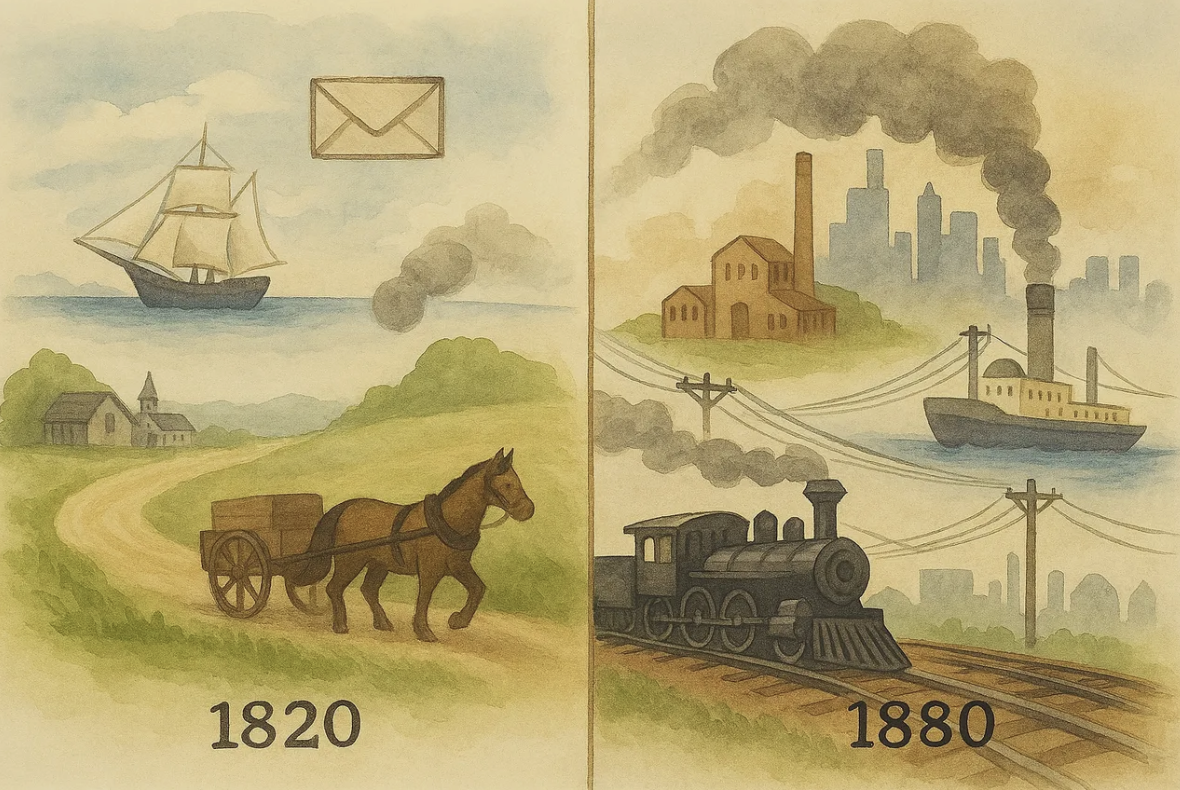
    Between 1820 and 1880, leading industrial economies transitioned from waiting weeks for messages and materials to arrive to waiting minutes for messages and hours for materials. 

    Within a single lifetime, cities exploded in size, countries built vast railway networks, and steamships increasingly replaced sailing ships on major cargo routes. Some nations seized the moment and surged ahead, while others—despite their size and resources—chose different paths or delayed action.

    Understanding these historical processes of change helps us grasp the choices facing Latin America and the Caribbean today. This blog examines the changes that occurred, why they happened so quickly, and the role of central governments in these transformations. 

    The World Changed Radically Between 1820 and 1880

    If the first industrial revolution reflected rapid change in Britain, the second industrial revolution saw tectonic shifts globally. Railways, coal extraction, and steam-powered transport expanded dramatically between 1820 and 1880. These changes swept across Britain, Germany, France, Belgium, and later Russia and Japan, with the United States emerging as the fastest-growing industrial power. Railway lines grew from near zero in 1810 to well over 150,000 miles globally by 1880, transforming landscapes and creating industrial corridors. The Manchester-Liverpool Railway of 1830 cut travel time from 12 hours by canal to just 1.5 hours by rail. Coal production grew exponentially, with Britain increasing from 20 million tons in 1820 to 150 million tons by 1880. This marked a shift from an agrarian economy to one driven by fossil-fuel energy. Steam engines and steamships multiplied, enabling major nations to expand trade routes, strengthen national industries, and project economic influence worldwide. By 1880, Britain controlled around 60% of the world’s steamship tonnage. 

    Industrial machinery and national financial systems expanded rapidly alongside urbanization. Railway engine production surged from dozens to thousands by the 1880s, with the USA and Britain leading and Germany catching up. Urban populations in leading industrial countries grew from 10 million in 1820 to over 50 million by 1870, creating labor markets, new social classes, and purchasing power. Britain was over 70% urbanized by 1880. Telegraph networks did not exist in 1820, yet by 1870, there were 200,000 miles of lines helping to coordinate markets and governments. Financial capital deepened as London became the first financial hub, closely followed by New York, while Germany and France built modern banking systems for industrial investment at scale. The London Stock Exchange’s capitalization grew by an order of magnitude between 1825 and 1880.  

    Countries changed culturally, as literacy, communication, civic norms, and national identities emerged and grew. Literacy rates rose, reaching over 80% in some countries by 1870. Improvements in schooling, newspapers, and scientific societies helped diffuse new knowledge. Print culture and the telegraph accelerated the spread of ideas, connecting cities and regions within countries and nations, and facilitating trade. The Atlantic Telegraph Company laid the first transatlantic cable in 1858, which became operational by 1866, cutting communication time from 10 days to minutes. Working-class cultures generated reform movements that influenced labor laws and public health, as rapid urbanization and industrialization accelerated. Cultural systems evolved from locally focused communities to nationally connected societies, allowing people to coordinate economic activity and share ideas at unprecedented speed. 

    Why and How Did These Changes Happen?

    Railways, steam engines, steamships, and coal together created a powerful positive feedback loop. More coal enabled more engines, which enabled more transport, which enabled more coal extraction, leading to more machines and railway lines. As production grew exponentially under what we now call Wright’s Law, costs fell rapidly. Telegraph communications were much faster than courier and postal systems, reducing communication from weeks to minutes and enabling modern finance, journalism, coordination, and global trade. Improved information flows meant firms, cities, and countries could experiment at scale and rapidly select the best solutions, diffusing them quickly across the international landscape. This technological surge reshaped national economies far faster than the first industrial revolution, opening new opportunities for workers, businesses, and entire regions that evolved with innovative technologies. Britain, the USA, Belgium, and then Germany built early rail networks and developed financial markets, engineering capabilities, and regulatory systems, enabling rapid expansion. Countries scaled telegraph systems, urbanized, implemented banking reforms, and connected across regions with resources—coal mines, ports, and industrial centers. These early choices created momentum; once the right systems were in place, progress accelerated and set each country on a long-term path. 

    Cultural and institutional changes further accelerated the differences between the “early industrializers” and other countries. High literacy, scientific societies, and civic cultures were critical in Britain, Germany, France, and the USA, accelerating the absorption of innovative technologies. Countries like Russia and Japan, before the Meiji period, with rigid hierarchies and limited educational access, experienced much slower diffusion until institutional reforms took place. Early changes in infrastructure and institutions created long-term advantages for the early movers. Urbanization deepened these changes by concentrating skilled labor, capital, and knowledge in dense cities, fostering rapid innovation and imitation. Notably, Qing China, the Ottoman Empire, the Mughal States, Persia, and Southeast Asian Kingdoms saw little industrialization at this time—highlighting how rare the USA and European takeoff truly was. 

    What Was the Role of the State?

    As in the first industrial revolution, the centralized state played a decisive role in accelerating economic transformation. Governments set clear rules, enabled private investment, and built essential infrastructure to support business growth. Britain’s Railway Acts, the US Federal Land Grants, and Germany’s post-unification industrial strategy all stabilized predictable contexts to align private investment with national priorities. States also shaped markets with property rules, standards, and permitting systems that determined where to build railways, extract coal, or connect telegraph networks. Public investments in transport, education, and statistics lowered costs and expanded the skilled workforce. Development banks, public guarantees, and capital markets further reduced risk and helped crowd in private capital, enabling large long-term infrastructure projects.

    Countries that moved early did so because their states built the institutional and financial architectures needed to increase returns and lock in innovative technologies. Britain’s parliamentary reforms, legal protections, and financial institutions, which were necessary for canal building, enabled it to finance railways and mining well before everyone else. The USA accelerated after 1850 as federal and state governments combined to pursue land policy, public finance, and regulation to build a vast railway network. Germany caught up after 1871 due to strong centralized coordination, technical education, and social insurance systems, which stabilized labor markets. By setting stable rules and investing in core infrastructure, governments created the conditions for private enterprise to innovate, compete, and expand at extraordinary speed. 

    Countries that progressed more slowly did so because their governments lacked the capacity, political cohesion, and financial systems to mobilize and coordinate massive transformations. In Russia, autocracy and serfdom, weak fiscal institutions, limited labor mobility, limited capital formation, and reduced technological diffusion meant they did not move until well after 1860, despite abundant natural resources. Japan was constrained under the Tokugawa shogunate, with feudal governance and limited external engagement, until the Meiji Restoration established the modern state. France was slowed by repeated political upheavals—revolutions, regime changes, and wars—that disrupted long-term plans and weakened investor confidence. Stable governance, coherent rules, and institutions capable of learning and adaptation are crucial, along with resources, to convert innovative technologies into rapid economic transformation.

    Conclusion

    While history may not repeat, it is full of lessons. The forces that shaped the period between 1820 and 1880—technologies, institutions, and leadership—are at play again. The second industrial revolution teaches us that countries that invest early, coordinate effectively, and build strong institutions are most likely to shape the future. History shows that countries that delay investment or lack a clear national strategy often miss the moment—and the opportunity goes to others. As the world enters a new technological wave, the choices countries make today will determine whether Latin America and the Caribbean are part of the leadership group, follow slowly, or remain on the sidelines.  

  • First Industrial Revolution: Mines, Canals, Steam, and Textiles

    First Industrial Revolution: Mines, Canals, Steam, and Textiles

    From 1760 to 1830, Britain did not just industrialize; it rewired its economy, society, and infrastructure. In about 50 years, the country moved from cottage industries and water wheels to steam-powered factories, canal transport networks, and global trade dominance. 

    Britain’s share of world industrial output rose from modest to dominant over this period. Britain’s economy grew because of rapid changes across an integrated system of capital, natural resources, and institutions. 

    What can we learn from examining Britain’s and the world’s first experience in changing capital and capital flows through shifting social institutions and active state support? This blog explores Britain’s unique capital, the changes in capital flows, the context and institutions that drove them, and why Britain moved first and fastest to lead the world’s first industrial revolution. 

    Capital and capital flows shifted rapidly. 

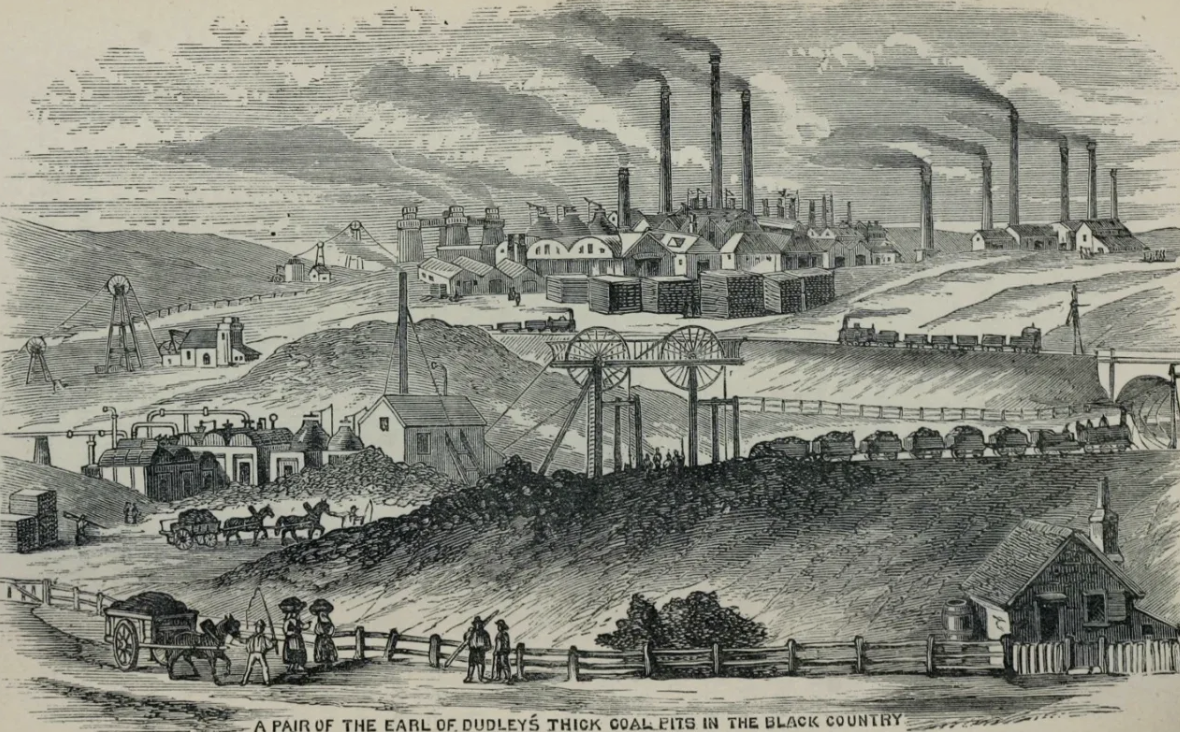
    The changes in Britain were not just technological; they were systemic. Coal replaced timber as the energy source, and output more than tripled from 1770 to 1820 to 15-20 million tons. Iron and copper became strategic as part of supply chains, as the basis for steam engines, factories, transport, and industrial infrastructure. Cotton imports from the Americas became the core input for the newly mechanized textile production system. 

    Mechanization transformed textile production. Innovations like the spinning jenny, water frame, mule, and power loom became standard. As a result, labor productivity soared, and the number of factories grew from 120 in 1760 to 5,500 in 1830. Where a hand spinner worked a single spindle, early spinning jennies let one worker operate 8–24 spindles; later models operated over 100; and spinning mules in large mills eventually carried over a thousand spindles on a single machine. These machines reorganized production around centralized power sources and standardized processes, enabling levels of scale and speed impossible in the cottage industry. 

    Steam power expanded 30-fold between 1770 and 1820, enabling rapid scaling and greater reliability. Geographical flexibility came from canal systems expanding from 55 miles in 1760 to 2,600 miles in 1830, reducing transport costs and helping the concentration of factories and connections to export and import ports. Cotton output rose from 105 million pounds to 950 million pounds, a 9-fold increase. Coal prices at the mine versus delivered prices changed with improved canal transportation. Mechanized British textiles, powered by coal-fired steam engines and fed by imported raw cotton, became dramatically cheaper than hand-spun and hand-woven cloth produced in traditional centers such as India. The number of steam engines grew exponentially, with energy production increasing by a factor of 30.

    Financial investments for large projects, including canals and factories, expanded through national banks, canal share markets, and credit circles, which acted as intermediaries. The enlightenment reframed knowledge as a productive asset, and scientific societies, technical publications, and patent law created a culture of innovation and diffusion. As a result, the urban population doubled, with cities like Manchester and Liverpool seeing tenfold growth and creating both labor markets and expanding national product demand. Britain’s exports grew from £14.7 million in 1760 to £43.2 million in 1800. 

    The context and the system accelerated change. 

    High wages and cheap coal exerted intense pressure for labor-saving, energy-intensive technologies, including steam-powered textile machines. Steam power massively increased factory productivity, driving textile growth and urbanization. Britain had abundant coal and iron, which became more accessible through the canal network, and these resources were geographically close to rapidly growing ports, notably Liverpool, which handled over 80% of the cotton, and Newcastle, which became a coal-export powerhouse. Britain imported raw cotton from the rapidly expanding agriculture of the Americas to feed its increasingly mechanized textile mills. 

    The “industrial enlightenment” reframed knowledge as a productive good, enabling systems for experimentation, improvement, and knowledge sharing. Britain’s culture of experimentation drew on institutions like the Royal Society—founded in 1660—which had already spent a century nurturing scientific exchange and practical inquiry by the time industrial innovators began transforming machines, materials, and production. Networks of artisans, engineers, and entrepreneurs, and scientific studies and burgeoning scientific publications, accelerated innovation and diffusion across the country. Apprenticeships were also important, allowing the rapid scaling of skilled labor. People were connected through workshops, foundries, patent records, scientific societies, and informal knowledge circuits, accelerating the development and diffusion of innovative technologies. Continuous incremental improvements in spinning, weaving, carding, and steam power reduced costs, increased reliability, and made factory production decisively cheaper than traditional methods.

    The state played an essential role in ensuring predictable rules, property rights, and contract enforcement, enabling private investment. Parliament shaped infrastructure through the Canal Acts, which helped create structures to raise funds, addressed eminent-domain issues, and set predictable transportation fees. Financial institutions mobilized capital at scale – pooling savings and commercial profits to fund factories, mines, canals, and machinery – thereby reducing financial risk and enabling capital pooling. For example, the Bridgewater Canal Company—authorized by Parliament in 1759—raised capital through shares that merchants, manufacturers, and even small savers could purchase. Its success in halving coal prices in Manchester sparked a wave of canal companies financed through similar joint‑stock structures.

    Canal and mining infrastructure were major catalysts, enabling industrial-scale expansion by connecting coal and iron mines to manufacturing and ports, thereby reducing transport costs. Parliament also approved the Enclosure Acts, which changed agriculture by consolidating farms, eliminating common rights, and enabling more intensive agriculture, but disrupted traditional rural livelihoods and indirectly displaced rural populations. The state approved patent law that enhanced innovation and supportive commercial regulations. The “system” was path-dependent and replete with positive feedback loops. Canals provided cheaper coal and cheaper energy for textile production with machines, leading to higher exports and generating more capital for canals and mining. Infrastructure enhanced production through mines and canals, opening the space for steam engines to expand. Steam power was already available and used in mines before textile factories. The textile expansion drove cotton imports, port growth, and urbanization, creating and reinforcing national demand and productive labor. Britain also worked to expand Atlantic and imperial trade networks, so that capital, infrastructure, technology, production, and trade all reinforced one another. 

    Britain moved extremely fast; other countries did not.

    Britain had the natural, economic, and social capital, the social systems, and an appropriate social order to enable rapid change. They had a unified market, stable governance, high labor costs, and weak guilds, which lowered barriers to mechanization. They had the bases for dense clusters for focused growth in Manchester, Birmingham, and the Midlands. They also had substantial export markets that rewarded scale, standardization, and cost-reducing innovations. British real wages were also higher than those in France and Germany, while coal was cheaper.

    France, on the other hand, had lower wages, higher energy costs, fragmented markets, and prolonged political upheaval, which reduced incentives for mechanization. France underwent a revolution for 12 years from 1787, then revolutionary wars with other European states for 10 more years, followed by the Napoleonic wars for 12 more years. The German states had strong guilds, fragmented governance reflected in wars among the states and then war with Napoleon, and an underdeveloped infrastructure for their coal. Britain’s stable governance and unified market directly enabled rapid industrialization, while France’s political turmoil and Germany’s fragmentation hindered them. The United States was at an earlier stage of development, with abundant land, scarce labor, and only nascent infrastructure, which pushed it toward a different early path, e.g., water-powered mills and frontier expansion, before large-scale coal-based industrialization.

    Britain was also at war, but never in Britain – the wars created massive state demand for iron, ships, textiles, and weapons – and the wars also allowed Britain to have global naval dominance to secure trade routes and cotton supplies.

    Belgium was the second European country to industrialize after 1807. They had ready access to coal and iron, merchant capital, and benefited from Napoleonic legal reforms and direct imports of British machinery and expertise. Belgium’s success was remarkable, but it could not occur until other states had stopped fighting over their territories.  

    Conclusion. 

    Britain’s industrial revolution offers essential lessons about the conditions that engender technological revolutions. The lessons include the critical importance of infrastructure – canals and mining – that built the backbone for economic change. The second lesson is the importance of aligning and integrating financial capital, institutions, and innovation for growth. Britain’s unified approach enabled it to achieve economies of scale. Third, Britain was able to move because it was ready to move – it had the natural capital, social and economic capital, and already the bases of strong institutions. One condition was critical: labor costs were high enough to ensure the profitability of a shift to textile machines and steam engines. The British state played a strong leadership role – they fully supported the direction of growth, set the rules, invested in infrastructure, helped manage risk, created innovation ecosystems, and reinforced trade systems. The positive feedback loops and economies of scale continued to reduce costs and sustain the system’s growth. 

    What lessons from Britain’s industrial revolution can guide today’s technological transformations? 

  • Economic Evolution and Revolution: Resources

    Economic Evolution and Revolution: Resources

    All economies change over time. Most of the time, that change is slow and incremental. But under certain conditions, an economy can shift rapidly — almost explosively — into a new mode of creating value. These moments are economic revolutions: system-wide reorganizations of production, technology, and social coordination. During these periods, annual growth rates can jump from 1–3% to 5–25%, reducing doubling times from 24–72 years to 3–14 years. 

    Revolutions compress centuries of change into 50 years.

    The world is in the middle of a technological wave. The question for Latin America and the Caribbean (LAC) is whether countries will ride this wave or watch it pass by. To seize the moment, countries will need to transform, despite uneven capabilities, fragmented institutions, and rising external shocks. 

    Bringing together evolutionary economics and the study of technological revolutions can help identify where action is most urgent — and most possible. 

    Natural resources and economic change

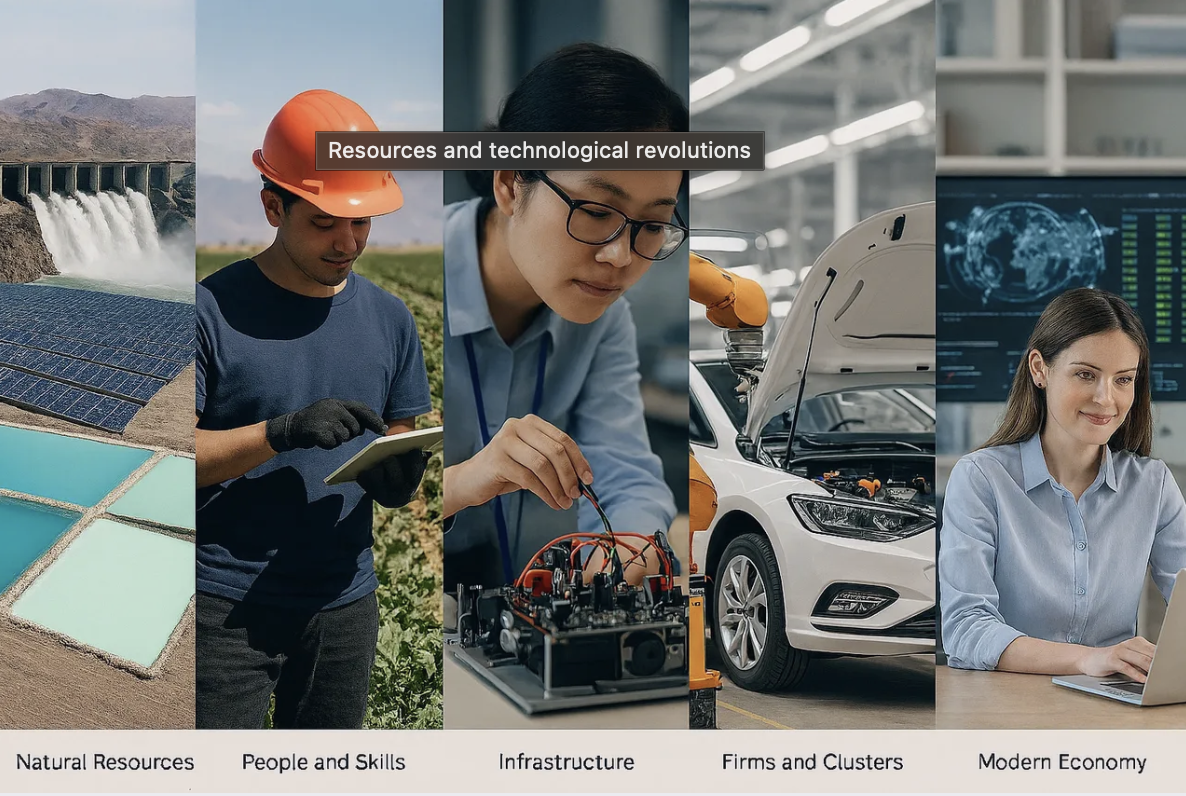
    Economic health depends on the stocks and flows of natural, socio-economic, and cultural capital. Natural resources — minerals, land, water, forests, and energy — often form the backbone of development. Countries with strong natural endowments can position themselves strategically in global supply chains. Chile’s Atacama Desert, with its high levels of solar radiation and lithium reserves, gives it leverage in the battery and electric vehicle sectors. Brazil’s landmass and hydropower underpin its agricultural and bioenergy strength. Suriname and Guyana are navigating the opportunities and risks of new offshore oil discoveries, balancing fiscal expectations with the need to diversify before the next commodity cycle turns.

    Natural‑resource rents from copper, soy, oil, and hydropower can expand fiscal space for investments in infrastructure, digital connectivity, innovation, and institutional capabilities. Chile and Brazil have used this space to extend transmission lines and integrate renewable energy into their grids. In contrast, Haiti’s long history of resource extraction and deforestation has eroded soils, reduced agricultural productivity, and trapped the country in a low‑productivity equilibrium.

    Countries with resource constraints face different pressures. Droughts affecting water for drinking and agriculture have pushed Central American governments to reform water governance and invest in drought-resistant crops. Chile’s lack of domestic oil and gas has accelerated its push toward solar, wind, and storage. Fossil‑fuel import dependence in the Caribbean and Central America exposes economies to price shocks and balance‑of‑payments stress, creating strong incentives to adopt renewables, efficiency measures, and regional energy integration. When traditional energy pathways are expensive or politically constrained, countries may leapfrog directly to renewables and distributed systems — as Uruguay and Costa Rica have demonstrated.

    Resource shocks can also trigger paradigm shifts. Commodity booms and busts — such as the post‑2014 decline in oil and mineral prices — have forced Brazil and Colombia to rethink their dependence on extractives and explore diversification and green competitiveness. Climate-related shocks, including hurricanes, droughts, and floods, can cause losses of 10–30% of GDP in Caribbean and Central American countries. In extreme cases, such as Dominica, Grenada, and Antigua & Barbuda, when hit by Maria, Ivan, and Irma, estimated damages have exceeded annual GDP. These events reshape business models, accelerate resilience investments, and open political space for reforms that would otherwise be impossible. 

    Resource flows are the basis of economies

    People are a foundational economic resource. Worker mobility, migration, and diasporas spread knowledge across firms and borders. In Costa Rica, engineers trained at Intel have seeded capabilities across the local tech ecosystem. Regional hubs — Campinas (ICT/biotech), Guadalajara (electronics), Montevideo (gov-tech/fintech) — accelerate innovation and diffusion. The Colombian diaspora in Miami and Madrid has become a channel for entrepreneurial knowledge, fintech innovation, and cultural industries. Education and training institutions amplify these flows. SENAI in Brazil, INCAE and CATIE in Costa Rica, and Mexico’s automotive training centers build absorptive capacity and help firms adopt innovative technologies and business models.

    Scaling during economic revolutions depends on scaling resource flows. Capital flows matter not only for firms but for the infrastructure that moves people, energy, materials, and knowledge. Grids, transmission lines, ports, roads, railways, fiber‑optic cables, canals, and airports are the physical networks that enable production. Panama’s canal, ports, and free zones illustrate how logistics platforms can become regional hubs for trade, data, and services. Cheap and reliable energy underpins global competitiveness and enables electricity-intensive industries such as data centers.

    Other socio-economic resources — ideas, standards, regulations, and networks — create coherence across firms and sectors. Government standards and procurement can level the playing field and accelerate diffusion. Online platforms and performance-based contracts can push innovation. Cultural capital — trust, legitimacy, professional associations, chambers of commerce, and clusters — reduces perceived risk and helps new practices spread. 

    Financial resources are crucial

    Crises can accelerate change. Debt, inflation, and banking crises in the 1980s forced structural adjustments across the region. Commodity shocks reshape investor expectations and redirect capital. Public finance remains essential for strategic change: aligning budgets, supporting state-owned or parastatal enterprises, and using development banks to steer investment toward future-ready sectors. Brazil’s BNDES has long shaped national priorities through investments in biofuels, agriculture, and renewables.

    Economics is about how systems work, not just about money. But economic revolutions depend heavily on finance. Capital allocation is shaped by profitability (past and present performance) and investment attractiveness (future potential). The hardest part of a technological revolution is identifying future winners and losers as global paradigms shift. Early phases of a technological wave attract speculative finance; later phases see production capital scale proven models. Countries that align their policies, regulations, infrastructure, and capabilities with emerging technologies are best positioned to attract long‑term investment.

    Two features of technological revolutions matter especially for LAC. First, as production expands, costs fall, and quality improves — a dynamic known as Wright’s Law. Second, innovative technologies emerge in clusters that reinforce one another. LAC is already seeing clusters around artificial intelligence, online platforms, cloud computing, electric vehicles, batteries, renewable energy, digital payments, e-commerce, and logistics. These clusters spill over into digital identity, e-government, and improved tax collection. Countries should target clusters rather than isolated technologies, using policy to connect finance with energy, transport, and skills to enable scalable production. 

    Conclusion

    Economic revolutions occur when resources — natural, human, institutional, cultural, and financial — align and reinforce one another. Finance alone cannot drive transformation; it must be connected to knowledge, raw materials, energy, and human capabilities. Today’s technological wave is a once-in-a-generation opportunity for LAC countries to reposition themselves and expand their productive capacity. The region has the resources to succeed. What it needs now is the commitment, organization, and capability to recombine those resources into new engines of growth.

    As Carlota Perez argues, countries must target clusters of technologies and avoid slipping back into the role of raw‑material suppliers. The challenge — and the opportunity — is to turn natural endowments into competitive advantages and become core actors in the next global technological surge. 

    The advice would be to: 

    · Target clusters of technologies, not isolated technologies. Build ecosystems around EVs, batteries, AI, and digital services.

    · Redirect capital toward future-ready sectors rather than patching old systems.

    · Invest in absorptive capacity. Skills, standards, and institutions determine whether technologies take root.

    · Align public finance with the new paradigm. Development banks, budgets, and regulations should steer investment toward scalable and integrated systems.

    · Build infrastructure that lowers costs. Energy, transport, universities, and digital networks are the backbone of competitiveness.

  • Latin America and the Caribbean: Three Centuries of Competition

    Latin America and the Caribbean: Three Centuries of Competition

    For more than 300 years, powerful economic selection forces have shaped Latin America and the Caribbean (LAC). Much like natural selection in biology, competition has repeatedly rewarded firms, sectors, and countries with the right “traits” — capabilities, institutions, technologies — while punishing those that fail to adapt. These forces have determined which firms thrive, which stagnate, and which disappear.

    Understanding this long history of economic selection is not an academic exercise. It is essential for today’s policymakers and citizens because the same pressures that shaped the past are intensifying again. Across the region, thousands of small, low‑productivity, often informal firms dominate the economy, concentrated in sectors that employ many people but struggle to compete globally. Decades of institutional choices, policy incentives, and structural legacies have interacted with markets to produce this outcome.

    The challenge for LAC countries is clear: strengthen their economic systems so they can compete globally on their own terms. The selection environment should reward investment, innovation, and productivity rather than protection, lobbying, or regulatory evasion. In a moment defined by rapid technological change, digital platforms, and the emerging low‑carbon economy, decisions made now will determine future prices, job quality, service reliability, and access to opportunity. Viewing competition policy through the lens of economic natural selection offers a powerful diagnostic tool. It helps identify which institutions and incentives hold back economies, which reforms can unlock productivity, and who stands to gain or lose from business‑as‑usual versus change. It reframes competition not as a narrow regulatory issue, but as the mechanism that shapes the region’s long‑term development path.

    From colonial extraction to commodity booms, from import‑substitution to neoliberal liberalization, and from digital disruption to climate shocks, LAC has endured wave after wave of competitive upheaval. One pattern stands out: the region is a battlefield of strong selection, where winners emerge through adaptation, learning, and institutional strength, and losers succumb to path dependence, volatility, and weak state capacity. This blog explores that history and shows how understanding economic selection can help LAC build more resilient, innovative, and inclusive economies.

    The Shadow of History: Early Selection Shaped the Regional Trajectory

    Colonial extraction created the region’s first major economic selection pressures, shaping how local societies learned to compete, adapt, and eventually assert independence. From 1720 to 1820, plantation systems in Barbados, Jamaica, and Hispaniola generated extraordinary wealth for European powers. France even sent tens of thousands of soldiers to Haiti in 1801–02 in a failed attempt to preserve its plantation empire. Spain extracted immense riches from the silver mines of Potosí and Zacatecas, while Portugal dominated gold and diamond extraction in Minas Gerais. These systems created protected “winners” — colonial elites and monopolies — while suppressing indigenous economies and blocking diversification. When these monopolies collapsed, they left behind highly unequal, undiversified, and institutionally fragile economies.

    Independence did not break the commodity cycle. Instead, British merchants and financiers stepped into the vacuum, driving booms in guano, coffee, sugar, and rubber from the 1820s to the 1880s. Peru’s guano wealth fueled a short‑lived expansion before it collapsed. Coffee reshaped Brazil’s Paraíba Valley and later São Paulo, while Central American coffee elites consolidated land and political power. The Amazon rubber boom created fleeting prosperity in Manaus before Asian plantations outcompeted it. These cycles entrenched path dependence in precious metals, sugar, coffee, and, later, oil in Mexico, Trinidad and Tobago, and Venezuela. These industries shaped infrastructure and institutions around their needs, often at the expense of innovation and diversification.

    Limited access to skills and opportunity weakened the region’s ability to build a broad, competitive workforce. Narrow elites retained privileged access to education, entrepreneurship, and innovation. Only a few countries began to break this pattern. Chile built a professional bureaucracy and public education system after the 1830s. Uruguay expanded labor rights, pensions, and public education to grow a middle class. Costa Rica abolished its army in 1948 and reinvested in education and institutions. Barbados strengthened rule‑of‑law institutions and social partnerships. Elsewhere, elite dominance and commodity dependence reinforced each other, limiting the emergence of more complex, competitive industries.

    The 20th Century: Protection, Liberalization, and Extinctions

    From 1930 to 1980, import‑substitution industrialization (ISI) protected domestic firms through high tariffs, enabling rapid manufacturing growth. State‑owned enterprises such as PEMEX, Petrobras, and YPF expanded. Brazil built automotive and steel industries and founded Embraer in 1969. Mexico’s textile and consumer goods industries grew, but rarely exported. Argentina developed machinery and chemical industries, but became increasingly inefficient. Protection created national champions — but also insulated them from global competition. Many firms failed to innovate or meet international standards.

    The 1980s debt crisis delivered a brutal selection shock. Hyperinflation, austerity, and structural adjustment wiped out many protected firms. In Mexico, manufacturing output fell sharply in the early 1980s. Brazil shifted toward financial engineering for hyperinflation rather than sustained industrial upgrading. Argentina saw widespread closures in textiles, footwear, and machinery. Peru and others experienced explosive growth in informality as households sought survival strategies.

    The 1990s reshaped winners and losers again. Global trade created new competitive pressures. Brazil built competitive aerospace capabilities, with Embraer becoming a world leader. Argentina and Brazil expanded agribusiness, supported by EMBRAPA and modern technologies. Chile expanded export services and agroindustry, including salmon, fruit, and wine. Mexico, under NAFTA, deepened its electronics, auto‑parts, and assembly industries. But weak industrial policy and macroeconomic volatility meant LAC missed the manufacturing boom that lifted East Asia. Privatization often replaced public monopolies with private ones — Telmex in Mexico being a famous example — limiting actual competition. Across the Caribbean, privatized utilities and telecoms frequently became entrenched oligopolies with little incentive to innovate or reduce prices.

    The 21st Century: New Selection, Winners, and Vulnerabilities

    The commodity supercycle between 2000 and 2014 reshaped competitive dynamics once again. High global prices fueled extractive booms. Vale expanded iron ore production in Brazil. Oil exporters — including Brazil, Mexico, Argentina, Colombia, and Guyana — also benefited. Soy production surged in Brazil, Argentina, and Paraguay due to Chinese demand. But efficiency gains were limited. When prices collapsed in 2014, many economies faced fiscal crises and accelerated deindustrialization.

    After 2010, as the commodity boom faded, a vastly different kind of competition emerged. Digital technologies introduced a new wave of selection. Fintech, e‑commerce, and delivery platforms scaled rapidly across the region. Nubank became one of the largest digital banks in Latin America, with tens of millions of customers. Kavak and Rappi expanded across Mexico, Colombia, and Brazil. Traditional intermediaries lost ground as network effects favored scale, creating new oligopolies and squeezing analog firms.

    Extreme weather, shifting markets, and new energy technologies are becoming major economic forces that countries must prepare for. Caribbean tourism faces existential threats from hurricanes, sea‑level rise, sargassum, and potential European carbon taxes on flights. Hurricanes Irma and Maria devastated tourism infrastructure in Dominica, the British Virgin Islands, and Puerto Rico in 2017. Countries such as Uruguay and Costa Rica are using renewables to reduce dependence on imported fuels, stabilize energy costs, and attract data centers and new industries. Chile and Peru benefit from rising copper demand, while Chile, Argentina, and Brazil are major producers of lithium. Costa Rica, Guatemala, Belize, Brazil, and Guyana are advancing forest‑based climate strategies. Renewables and storage technologies are becoming more competitive, offering new opportunities for countries that invest early and strategically. These pressures are not abstract environmental concerns — they are already reshaping investment decisions, insurance markets, and the competitiveness of entire sectors.

    The Most Adaptable Survives

    Across three centuries, relentless selection pressures have shaped LAC — colonial extraction, commodity booms, industrialization, liberalization, financial crises, technological revolutions, and now climate change. The winners have consistently been those who adapted, built capabilities, invested in institutions, and aligned with global technological waves. The losers were those who relied on protection, windfalls, or political privilege rather than productivity and innovation.

    The next era of selection is already underway. The traits most likely to be favored are low‑carbon competitiveness, institutional reliability, technological adaptability, and social inclusion. In this evolving landscape, LAC’s future winners will be those who treat competition not as a threat, but as a catalyst for transformation. The question now is whether leadership across the region will seize this opportunity — or allow history’s selection pressures to repeat themselves.

  • Why Economies Change – Lessons from Evolutionary Economics

    Why Economies Change – Lessons from Evolutionary Economics

    Over forty years ago, Nelson and Winter argued that economies evolve through a process like biological evolution: firms follow routines, experiment with new ways of doing things, and those that succeed grow while others decline. Technological revolutions accelerate this process by reshaping industries, altering competitive advantages, and shifting geopolitical power.

    Many analysts argue that the world entered a sixth technological revolution around 2020. Countries in Latin America and the Caribbean now face a strategic choice: lead, follow, or fall behind. This wave will determine competitiveness, fiscal stability, and resilience for decades.

    Historically, the region has been commodity-dependent and vulnerable to crises. Yet evolutionary economics teaches that history is not destiny. Countries can change their trajectories by building capabilities, strengthening institutions, and setting clear direction. The region has a rare opportunity to shape its future—if it acts decisively.

    This blog explores how technological innovations drive rapid economic change, how institutions and capabilities determine who benefits, and how shocks and opportunities have historically opened windows for transformation.

    Technological innovations drive rapid economic change.

    Across the last five technological waves, innovative technologies have created entirely new industries, firms, and investment opportunities—first attracting venture capital, then large-scale real‑economy finance. Chile’s solar boom since 2015 and Mexico’s electric‑vehicle investments since 2020 illustrate how quickly new industry blocks can emerge. At the same time, older industries and business models decline in a process of creative destruction.

    Diffusion is uneven and path‑dependent. Countries and regions adopt technologies at separate times depending on geography, capabilities, and institutional readiness. Argentina and Mexico built extensive railway networks from the 1880s onward, while Central America lagged. Hydropower dominated Brazil, Costa Rica, and Paraguay from the 1970s, while Caribbean islands remained oil‑dependent. Guyana’s 2015 oil discovery triggered rapid development just as Venezuela’s mismanagement (2014–2020) collapsed its own sector.

    Path dependence matters: once a country builds enabling infrastructure, complementary technologies diffuse faster. Brazil’s smart grid pilots from 2008 made the later adoption of solar and distributed energy far easier.

    Technologies can be transferred, but absorption requires capabilities. Dominant technologies often emerge in leading economies and spread globally, but receiving countries must have the skills, learning systems, and firms to adapt and improve them. Brazil’s EMBRAPA, founded in 1973, transformed tropical agriculture by adapting foreign technologies to local conditions—an example of evolutionary “retention” and capability building.

    Institutions, capabilities, and visionary incentives determine who benefits.

    Institutions evolve alongside technologies. They can enable adoption or block it. Linear infrastructure, such as railways and transmission lines, requires land‑use reforms. Electricity systems require urban planning and regulatory clarity. In much of the region, governance fragmentation, weak regulation, and fiscal constraints slow institutional adaptation. Evolutionary economics emphasizes that institutional flexibility— “selection environments”—is as important as the technologies themselves. Brazil’s transmission reforms (2004–2010) unlocked long-distance lines for hydropower integration.

    Capabilities and learning systems determine whether firms can seize new opportunities. Dynamic firms grow when they can experiment, learn, and scale. Countries with strong learning systems and entrepreneurial ecosystems move faster during technological waves. Uruguay’s digital‑government investments (2007–2020) and Costa Rica’s engineering reforms after Intel’s arrival in 1997 show how capabilities compound over time. Conversely, Venezuela’s circumstances since 2000 eroded institutional capacity and accelerated sectoral collapses.

    Incentives shape direction. Commodity dependence has created powerful interests invested in maintaining the status quo. Subsidies and tax structures often reinforce older technologies and discourage investment in new ones. Evolutionary economics highlights that incentives influence which routines survive and which fade. Fossil-fuel subsidies across the region slow renewable adoption, while in 2014 Chile nudged utilities away from coal and toward solar and wind.

    Shocks and opportunities create strategic choices that can shape the future.

    Shocks can accelerate change or derail it. Wars, depressions, pandemics, and natural disasters reshape priorities and can disrupt long-term planning. The Latin American Debt Crisis of 1982 forced austerity and delayed modernization for a decade. Hurricane Maria in 2017 caused 225% of GDP losses in Dominica, overwhelming its fiscal capacities, but also triggered a bold goal to become the world’s first climate-resilient nation. Evolutionary economics shows that shocks alter selection pressures: some firms and institutions adapt, others fail.

    Occasionally, shocks open windows for reform—if institutions and capabilities are ready. Chile’s 2010 earthquake accelerated the implementation of seismic‑resilient infrastructure upgrades. 

    Today’s technological wave—AI, ride‑sharing, augmented reality, renewable energy, battery storage, electrification, and digital platforms—is already diffusing globally. The region has real advantages: high renewable energy penetration, hydropower, early adoption of electromobility, and globally significant forests. But success depends on strong institutions, capabilities, and the ability to attract investment. Brazil’s ride-sharing boom (2014–2020) and Costa Rica’s and Uruguay’s rapid EV adoption show what is possible when markets and institutions align.

    Strategic vision and long-term directionality determine whether the region can leapfrog.

    Economies evolve rapidly when leaders choose a direction and sustain it. Evolutionary economics emphasizes “directionality”—the ability to guide variation, selection, and retention toward preferred futures. Long-term planning up to 30 years is essential for attracting private investment, which depends on stable rules, credible institutions, and fiscal reforms.

    The region has examples of long-term strategic vision:

    • Costa Rica’s 2050 Decarbonization Plan
    • Guyana’s Low Carbon Development Strategy 2030
    • Chile’s 2015–2050 Energy Road Map
    • Brazil’s Ecological Transformation Plan

    These strategies create predictable environments where firms can invest, innovate, and scale.

    Conclusion

    Technological waves drive rapid economic evolution, and the sixth wave is already reshaping global competitiveness. Evolutionary economics teaches that countries succeed when they build capabilities, adapt institutions, and create incentives that reward innovation. Latin America and the Caribbean have a once-in-a-generation opportunity to shape their trajectory and leapfrog into a more resilient, competitive, and prosperous future. The choices made today will determine who leads, who follows, and who gets left behind.

  • Why Technologies Rise, Transform the World, and Eventually Fade.

    Why Technologies Rise, Transform the World, and Eventually Fade.

    Every so often, societies experience periods of accelerated change. Innovative technologies emerge that do more than improve daily life — they reshape economies, reorganize communities, and alter how people relate to one another. In these moments, the decisions that individuals, businesses, and institutions make determine whether they adapt, stagnate, or fall behind.

    Today, we are living through one of those periods.

    Across the world, the systems that support modern life — energy, information, production, mobility, and finance — are shifting at a pace that would have been difficult to imagine a generation ago. Solar and wind power have become among the most affordable sources of new electricity. Battery costs have fallen dramatically, enabling the expansion of electric mobility. Artificial intelligence is spreading faster than any previous technology. Digital payments, online commerce, streaming services, and virtual learning have become part of everyday routines. Electric vehicles, once a niche product, now outsell gasoline cars in several major markets.

    These changes are not gradual. They are exponential.

    Some societies and companies are moving quickly, investing in innovative technologies and building the skills and infrastructure needed to support them. Others are moving more slowly. As in every significant period of transformation, the pace of adaptation shapes who benefits and who struggles.

    We Have Seen Transformations Like This Before

    Although today’s technologies feel new, the pattern of rapid change is not. Over the past 400years, human societies have experienced repeated waves of innovation — each reshaping how people use energy, materials, information, and capital.

    Early industrialization(1770–1820) introduced steam engines, canals, textile machinery, and the factory system. Britain’s textile output increased tenfold between 1770 and 1830. Coal powered the machines, and plantation agriculture provided raw materials and capital that supported industrial expansion.

    The transportation revolution (1820–1870) connected regions at unprecedented speed. By 1870, industry had built 100s of thousands of kilometers of railway worldwide, and steam had begun to replace sailing ships. Telegraph lines linked markets and accelerated communication, drawing distant regions into shared economic systems.

    Early electrification (1870–1920) transformed cities and industries through the widespread adoption of lightbulbs powered by expanding electrical networks. Steel production rose from 1 million tons in 1870 to more than 28 million tons by 1900. With the steel came canned products. Electric lighting, telephones, and mass manufacturing reshaped daily life.

    The oil and automobile revolution (1920–1970) changed mobility and consumption. By 1970, more than 200 million cars were on the road, and oil had become a central resource in global trade and industry. Petrochemicals from oil and electronics from refrigerators to color televisions appeared in every house. 

    The digital revolution (1970–2020) rewired the world. Computers, the internet, smartphones, cloud computing, and global supply chains created a new economic architecture. Today, more than 5 billion people use the internet, and digital platforms have become essential infrastructure. At the same time, global trade grew, fed by the shift to container shipping.

    It is tempting to imagine these revolutions as cleanly separated eras, but technological change rarely works that way. Old and new systems often coexist for decades. Infrastructure, institutions, and cultural norms evolve more slowly than the technologies themselves. Revolutions are not single events — they are long, uneven transitions.

    Over the past 250 years, the pace of technological change has accelerated dramatically. During the first wave of industrialization (1770–1820), core technologies like canals and steam engines grew at an average annual rate of 3.7%. By the age of rail and coal (1820–1870), growth had reached 6.84%. Electrification and steel (1870–1920) pushed this to 8.58%, while the oil and automobile era (1920–1970) sustained growth at 7.93%. The digital revolution (1970–2020) surged to 9.34%, and today’s transformation — driven by AI, renewables, and electrification — is accelerating even faster, with early indicators suggesting a growth rate of 11.56% and rising.

    What History Shows: Adapting to Change

    Despite the complexity, history reveals a consistent pattern. Societies and organizations that adapt successfully tend to:

    · Invest early in emerging technologies

    · Build strong institutions and skills

    · Remain open to innovative ideas

    · Take calculated risks

    · Develop infrastructure that supports innovation

    · Maintain a long-term perspective even when the path forward is uncertain

    Those who struggle often:

    · Resist change because the present feels familiar

    · Remain tied to older industries and systems

    · Underestimate new competitors

    · Delay decisions until options narrow

    In past transitions, companies that shaped their eras — from early trading companies to industrial manufacturers to digital platforms — did so by recognizing change early and building systems around it. Individuals who played key roles in these transformations — from engineers and inventors to entrepreneurs and financiers — were not simply creators of new tools. They were builders of new systems.

    At the same time, technologies only succeed with support. Societies influence which technologies grow through policy choices, infrastructure investments, education systems, and cultural acceptance. The steam engine, the railway, the automobile, and the internet all scaled up because governments and communities chose to support them.

    Why Technologies Rise — and Why They Fade

    Technologies tend to succeed when they offer more value for less cost. They fade when something better emerges.

    History offers many examples:

    · Cars replaced horse-drawn carriages between 1900 and 1930.

    · Internal combustion engines replaced steam between 1870 and 1920.

    · Steamships replaced sailing ships between 1800 and 1880.

    · Telephones replaced telegraphs between 1876 and 1920.

    · Digital cameras replaced film between 1990 and 2010.

    · Mobile phones replaced landlines between 1970 and 1990.

    · Streaming replaced broadcast television in less than a decade.

    Today, electric vehicles are replacing gasoline cars because they are faster, cheaper to operate, and easier to maintain — and because infrastructure and policy increasingly support them. Some old technologies survive in niche roles — books, mechanical clocks, candles, sailing ships — but they no longer define the economy. The direction of travel is consistent: societies move toward technologies that deliver greater value.

    But transitions also bring disruption. The first industrial revolution devastated traditional textile industries in India and created harsh working conditions in early factories. The first and second industrial revolutions relied heavily on agricultural products produced through enslaved labor and colonial extraction. The digital revolution has created new inequalities and new vulnerabilities.

    Technological change creates winners and losers within societies, not just between them. The social costs are real and must be managed.

    We Are Living Through the Sixth Great Transition

    Today’s transformation involves artificial intelligence, ride-sharing, virtual and augmented reality, renewable energy, battery storage, electrification, and digital platforms. These technologies are reshaping everything from household budgets to global supply chains. They offer the potential for cleaner air, lower costs, more resilient economies, and new forms of work.

    But the outcomes are not predetermined.

    The benefits depend on choices — by institutions, by businesses, and by individuals. Some communities have more resources and capacity to adapt than others. Not everyone begins from the same starting point.

    Leadership in this moment means more than embracing innovation. It means managing risks, supporting those who may be left behind, and ensuring that the benefits of change are widely shared.

    The future is not something that happens to us. It is something we build.

    And each of us has a role to play in shaping what comes next.