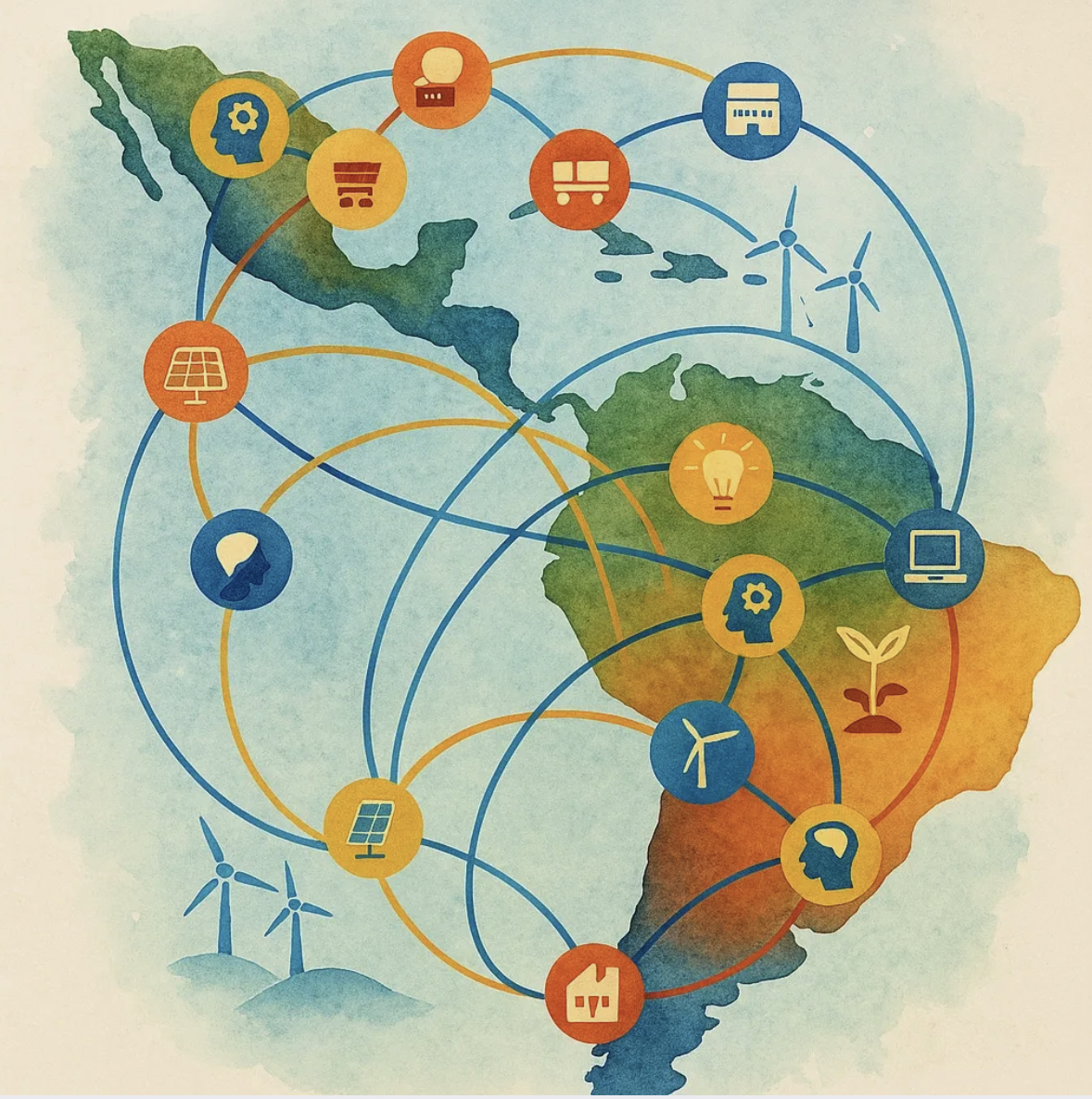
The most significant difference between Latin American and Caribbean economies that move forward and those that fall behind is not necessarily how many innovative ideas they generate, but how quickly innovative ideas spread across people, firms, and sectors. When promising routines and technologies remain trapped in a few places, productivity stalls, inequality widens, and public confidence erodes. When ideas move freely, societies learn, adapt, and grow faster.
This blog highlights how LAC countries can strengthen the systems that help innovative ideas travel across individuals, firms, sectors, and borders.
Good Ideas Spread When People and Firms Can Absorb Them
Diffusion begins with people. Workers and managers who can learn, adapt, and apply new routines are the first carriers of change. Firms that invest in training and managerial capabilities become engines of transmission, spreading better practices across supply chains and sectors.
In Brazil, Embraer’s long partnership with the Instituto Tecnológico de Aeronáutica (ITA)—dating back to the 1950s—created a steady flow of engineers who could absorb and adapt to global aerospace technologies. These capabilities spread internally through rotations and project teams, and externally through suppliers and spinoffs, helping Brazil build a competitive aerospace sector.
Uruguay’s Plan Ceibal, launched in 2007, expanded digital literacy by equipping students and teachers with devices and training. Rather than claiming global leadership, Ceibal helped Uruguay build a solid foundation for digital adoption, enabling firms and public agencies to take up new tools more easily.
In Mexico, automotive firms in Guanajuato and Nuevo León—including Nissan, GM, and Toyota—co-developed training centers with state institutes during the 2010s. These centers helped local suppliers upgrade quality systems and robotics capabilities, spreading global production routines across the region. Many recognize the Bajío as one of the more competitive manufacturing regions in the Americas; it got there by sharing training and supplier upgrading, which accelerated diffusion.
Crises also accelerate learning. The early-2000s economic crisis drove Medellín’s shift from a manufacturing city to a knowledge-intensive economy, pushing firms to adopt new digital and managerial practices. Ruta N, created in 2009, helped hundreds of firms reorganize around innovation, spreading agile methods and digital tools across the city.
Worker mobility, return migration, and diasporas also carry ideas. Engineers trained at Intel Costa Rica, for example, later moved into local firms and startups, spreading global production and management routines across the country.
Good Ideas Spread Faster When Institutions Scale What Works
Policies that support experimentation create the raw material for diffusion. Start‑Up Chile, launched in 2010, did more than attract entrepreneurs—it spread routines for rapid prototyping, customer testing, and global networking. These practices diffused into Chilean firms, universities, and public agencies, strengthening the country’s entrepreneurial culture.
Diffusion depends on variation, selection, and transmission—the three conditions that determine whether innovative ideas survive and spread.
Costa Rica’s Payments for Ecosystem Services (PES) program, created under Forestry Law 7575 in 1996, also generated variation. By compensating landowners for conservation, PES introduced new routines for monitoring, verification, and contract management. These routines later spread into water utilities, municipalities, and private firms, helping scale sustainable land management.
Institutions shape which ideas win. Brazil’s transmission auctions (2004–2010) rewarded firms that could deliver reliable, low-cost infrastructure. The auctions sharpened competition, encouraged managerial upgrading, and spread best practices across the electricity sector.
Public procurement and finance amplify scaling. ChileCompra, launched in 2003, allows agencies to purchase innovative solutions, creating demand for firms that meet higher standards. Development banks across the region increasingly use performance-based financing to reward firms that adopt cleaner, safer, or more efficient technologies.
Supply chains are powerful transmission channels. In Colombia and Mexico, supplier development programs in automotive, aerospace, and agribusiness help smaller firms adopt quality systems, digital tools, and logistics practices used by global buyers. These upgrades spill over into other sectors—manufacturing practices migrate into services, logistics improvements spread into agriculture, and digital tools move across industries.
Standards also accelerate transmission. Mexico’s energy‑efficiency standards (NOMs) and Chile’s renewable‑energy auctions created clear expectations that pushed firms to adopt better technologies more quickly.
Good Ideas Spread Through Networks and Trust
Dense networks—clusters, associations, and digital platforms—help ideas travel faster. The Campinas Technology Hub in Brazil, anchored by UNICAMP since the 1990s, connects researchers, startups, and established firms, enabling rapid exchange of ICT and biotech capabilities. In Peru, the Colegio de Ingenieros del Perú spreads engineering standards and best practices across regions. In Jamaica, the JMEA helps SMEs adopt modern production and export routines.
Digital platforms multiply these effects. Brazil’s SENAI expanded online training in robotics and automation in the mid‑2010s, allowing firms across the country to access advanced skills without geographic barriers. Open data systems—such as Chile’s Open Energy Data Platform—enable innovators to build forecasting tools and renewable‑integration solutions.
Trust and legitimacy make cooperation possible. Brazil’s ANVISA, established in 1999, is widely respected for its technical rigor, encouraging firms to adopt food and pharmaceutical safety standards. Barbados’ Social Partnership Model, in place since 1993, builds trust among government, employers, and unions, helping the country adopt new labor and productivity practices more smoothly.
Latin America and the Caribbean have no shortage of creativity. The challenge is ensuring that innovative ideas do not remain trapped in a few firms, sectors, or cities, but instead spread widely across individuals, firms, sectors, and countries. When societies strengthen their capabilities, institutions, networks, and trust, they accelerate the movement of ideas that improve productivity, resilience, and opportunity. The faster LAC economies learn and adapt, the quicker people will see better jobs, better services, and better prospects for the future.
Leave a Reply