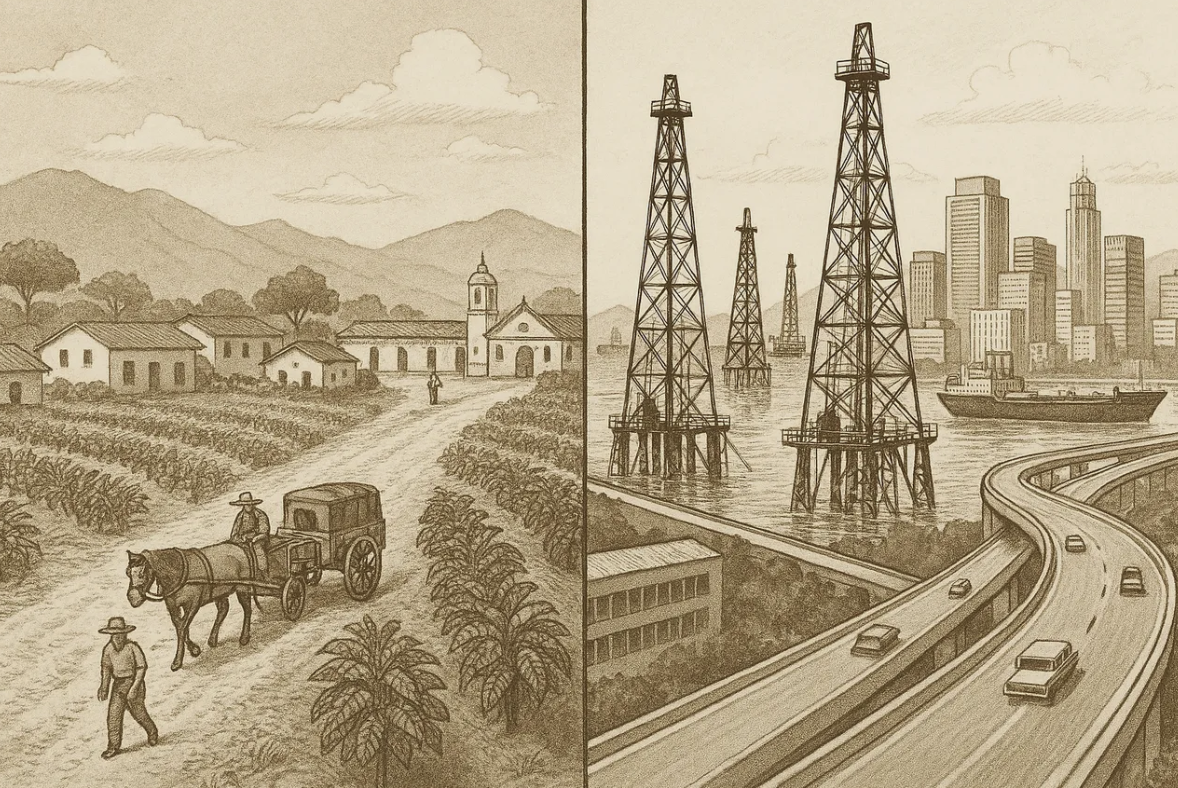
Venezuela’s oil boom between 1920 and 1970 represents one of the most compressed episodes of economic transformation in Latin American history, driven overwhelmingly by petroleum extraction. Real GDP per capita rose from roughly 20% of U.S. levels in 1920 to about 90% by 1958, growth unmatched elsewhere in the region during the period. This was powered almost entirely by foreign direct investment in oil, with crude production rising from about 1 million barrels annually in the early 1920s to 137 million barrels by 1929, making Venezuela one of the world’s largest oil producers and exporters. Oil’s share of exports jumped from 1.9% in 1920 to 91.2% by 1935, while agriculture’s share of GDP fell from over 30% toward single digits by mid‑century. The same mechanisms that generated rapid income growth, therefore, restructured the entire economy around a single enclave sector.
The core policy challenge was that oil‑driven growth reconfigured Venezuela into a rent‑dependent state before institutions capable of managing diversification were built. Massive inflows of foreign capital appreciated the Bolívar, eroding competitiveness in agriculture and manufacturing, a phenomenon later known as Dutch Disease. By the 1950s, oil revenues had almost entirely replaced personal income taxation, transforming the state from a tax‑collecting institution into a rent-distributor. This fiscal architecture weakened incentives to build productivity in non‑oil sectors and severed the accountability link between citizens and the state. Inequality remained extreme despite high average incomes: in 1970, the poorest quintile received only 3% of national income, while the richest quintile received 54%.
The implied policy objective was to convert temporary oil windfalls into a diversified, productivity‑based economy supported by durable fiscal and learning institutions. Venezuela’s own reform debates articulated this goal explicitly, most notably in the 1936 call to “sembrar el petroleo” by reinvesting rents into productive capacity beyond petroleum. Achieving this outcome required sequencing: first capturing rents, then building tax institutions, learning systems, and diversification mechanisms before rent distribution became politically locked in. The historical record shows that this transition was only partially attempted and never completed. The call to action is therefore to extract institutional lessons from this failure rather than replicate its revenue successes alone.
Oil reshaped the whole economy around one sector
Oil discovery irreversibly reallocated Venezuela’s dominant capital stock from cultivated land to subsoil hydrocarbons, concentrating both energy and financial flows in petroleum extraction. Between 1920 and 1935, oil’s share of exports rose from 1.9% to 91.2%, while agriculture’s contribution to GDP declined from over 30% in 1920 toward roughly 5–6% by the 1970s. Annual crude production expanded from about 1 million barrels in the early 1920s to 137 million barrels by 1929, supported by more than 100 foreign companies operating in the country by the late 1920s. These inflows generated rapid income growth but also appreciated the Bolívar, systematically undermining price competitiveness in other tradable sectors. The result was an economy whose growth depended on a single, externally operated capital stock.
The oil boom triggered a rapid reconfiguration of social institutions as labor and population followed oil‑linked income opportunities. Venezuela’s urban population rose from an estimated 20% in 1920 to 39.2% by the 1941 census, and then accelerated further to nearly 80% by 1980. Oil revenues raised wages in the petroleum sector and the state, pulling labor out of agriculture as coffee income fell to less than one‑tenth of GDP by the 1950s. Population growth accelerated from about 2.8% per year in 1920–1940 to 3–4% thereafter, driven by falling mortality and immigration attracted by oil prosperity. The state attempted to meet surging demand for housing, health, and education primarily through oil rents rather than through broad‑based taxation.
A new social order emerged in which political stability depended on the distribution of oil rents rather than on taxing citizens. By the 1950s, oil revenues had largely replaced personal income taxes, creating a rentier bargain between the state and society. The 1958 Punto Fijo pact institutionalized this logic by allocating state employment and oil revenues among major political parties in proportion to electoral results. While this arrangement sustained democratic stability, it concentrated wealth and entrenched inequality, with the bottom quintile receiving only 3% of income in 1970. Social services expanded, but the underlying income distribution and productive structure remained unchanged.
Rent capture over diversification
Early oil development generated significant institutional and technological variation, particularly under the Gómez concession regime between 1908 and 1935. More than 100 foreign firms introduced different extraction technologies, management practices, and labor models, creating a diverse organizational ecology in the oil sector. At the same time, competing development ideas emerged domestically, including the 1936 proposal to reinvest oil rents into a diversified economy. Political movements also differed in their visions, ranging from low‑royalty concession models to more assertive resource nationalism. This variation created genuine choice over Venezuela’s development trajectory.
From this range of options, the state selected institutional arrangements that maximize revenue while preserving foreign operational control. The 1943 Hydrocarbons Law standardized concessions, set a 16.67% royalty, and codified the 50/50 profit‑sharing principle, which was strengthened in 1948. Within five years of the 1943 law, government oil income was widely reported to have increased roughly sixfold, a powerful selection signal that favored rent capture over riskier diversification strategies. At the macro level, attempts at import‑substitution industrialization were repeatedly undercut by an appreciated currency and a political preference for distributing rents. The 1958 Punto Fijo pact represented a second‑order selection, choosing a democratic patronage system over both dictatorship and radical redistribution.
Venezuela’s chosen institutions diffused unevenly, with global influence but domestic lock‑in. Internationally, the 50/50 profit‑sharing model spread rapidly and became a global norm, and Venezuela co‑founded OPEC in 1960 to extend state sovereignty over oil pricing. Domestically, however, rentier institutions were retained and deepened: personal income taxation remained marginal, and non‑oil sectors relied on oil‑funded subsidies. Even as labor productivity in the oil sector rose by 125% between 1960 and 1970, these gains did not diffuse into broader industrial ecosystems. The economy became path‑dependent on the distribution of rents rather than on productivity growth.
Revenue capacity outpaced learning capacity
The Venezuelan state’s most effective interventions involved rule‑setting that increased its share of oil rents without disrupting production. The 1943 Hydrocarbons Law and its 1948 amendments created predictable fiscal rules that balanced state revenue with continued foreign investment. In 1960, the creation of the Corporación Venezolana de Petróleo inserted the state into commercial operations, and Venezuela’s role in founding OPEC demonstrated its capacity to shape global market architecture. These actions show strong regulatory and negotiating capability. However, they focused on revenue extraction rather than on steering the structure of domestic markets.
Oil revenues financed unprecedented levels of public investment in infrastructure and social services. Between 1920 and 1958, oil rents funded road networks, urban expansion in Caracas, and improvements in health and education that reduced mortality from about 12.3 per 1,000 in 1950–55 toward 5.5 per 1,000 by 1980. In the 1960s, the state launched the Ciudad Guayana industrial complex, combining steel, aluminum, and hydroelectric power as a planned growth pole. Public investment reached 24% of total investment by 1970, rising further thereafter. Yet increasing state dominance also crowded out private capital and raised risks of misallocation.
State capacity to absorb and diffuse knowledge lagged its fiscal power. The Corporación Venezolana de Fomento, created in 1946 to promote non‑oil industries, struggled because an appreciated currency and cheap imports undermined competitiveness. Despite a 125% rise in oil‑sector labor productivity between 1960 and 1970, the state failed to build institutions that transferred skills, technology, or management practices into downstream or unrelated sectors. Fiscal surpluses in the 1960s, averaging 0.9% of GDP, provided an opportunity to capitalize on a stabilization or sovereign wealth fund, but no such institution was created. This missed sequencing step left the economy exposed to future shocks.
Key lessons for policymakers
Venezuela’s oil boom demonstrates that rapid income growth without institutional sequencing can entrench structural vulnerability. The country solved the problem of rent capture, but not the harder problem of converting rents into diversified productive capacity. By substituting oil revenues for taxation, the state weakened accountability and tied political stability to commodity cycles. High growth, therefore, coexisted with persistent inequality and fragile institutions.
Success would have required a state that used oil rents to build tax institutions, learning systems, and counter‑cyclical buffers before distributing rents broadly. In such a scenario, oil would have financed diversification rather than replaced it, and productivity gains in the enclave sector would have diffused into the wider economy. Fiscal stability would not have depended on continuous oil price growth, and political coalitions would have been anchored in productive capacity rather than rent allocation.
For today’s LAC policymakers, the lesson is to prioritize institutional sequencing over revenue maximization. Capture rents early while simultaneously building tax capacity, learning institutions, and stabilization mechanisms before rent distribution becomes politically entrenched. Invest explicitly in knowledge transfer and absorptive capacity, not just infrastructure. Avoid designing political settlements that depend on permanent commodity windfalls. The cost of delaying these steps is not slower growth, but the long‑term fragility that Venezuela’s experience makes clear.