Tag: rent-dynamics

Explores the generation, capture, and use of economic rents in development processes.

  • Booms Without Transformation: Peru’s Guano and Chile’s Nitrates

    Booms Without Transformation: Peru’s Guano and Chile’s Nitrates

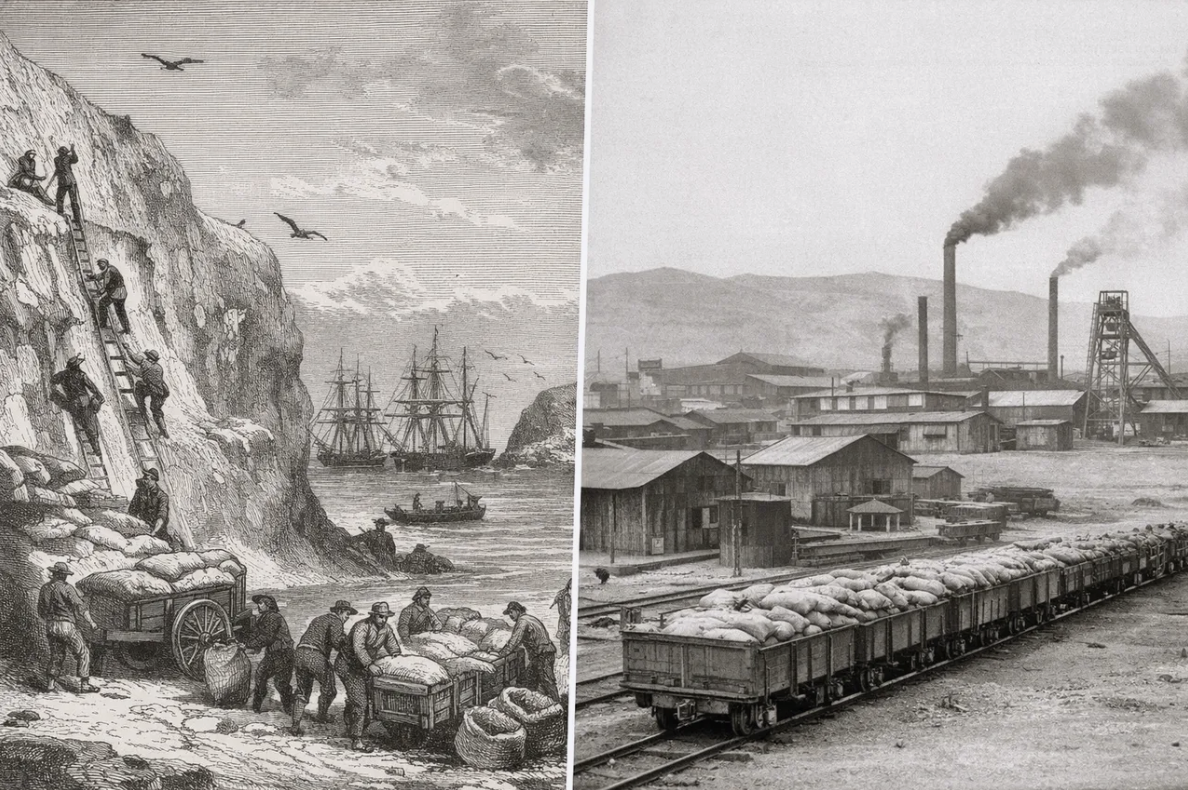
    Latin America has long been rich in natural resources, and for much of its history, those resources have been presented as a promise of progress. In the nineteenth century, Peru and Chile occupied a privileged position in the global economy because they controlled something the industrial world desperately needed: nitrogen. First through guano exported from Peruvian islands, and later through nitrates mined in the Atacama Desert, these countries became essential suppliers for global agriculture and warfare. Revenues were enormous, state budgets expanded rapidly, and foreign capital poured in. From the outside, it looked like development was inevitable.

    But prosperity based on extraction alone proved fragile. Despite decades of booming exports, neither Peru nor Chile used these resources to build diversified economies, strong technological capabilities, or inclusive social systems. Instead, wealth flowed outward through foreign firms, while states focused on collecting revenues rather than transforming production. When deposits were exhausted or global technology changed, fiscal crises, unemployment, and social instability followed. What had seemed like national success quickly became national vulnerability.

    This blog revisits the guano and nitrate booms not as distant historical curiosities, but as early warnings. By examining how these industries were organized—who controlled them, how labor was used, where profits went, and what institutions were built—we can better understand why extraordinary resource wealth failed to deliver long-term development. For today’s policymakers and citizens in Latin America and the Caribbean, these cases raise a critical question that remains unresolved: how can the region turn natural wealth into lasting economic and social capacity, rather than repeating cycles of boom and collapse?

    From Islands to Desert: The Rise of Latin America’s Nitrogen Economy

    Between the 1840s and 1860s, guano extracted from Peruvian coastal islands functioned as the dominant global source of industrial nitrogen fertilizer. Approximately 11–12 million tons were exported between 1840 and 1870, financing most Peruvian public expenditures during this period. The production system was based on rapid physical depletion rather than renewable management, leading to a collapse of the resource base beginning in the 1860s. Labor inputs were coercive and low-skilled, relying on convicts, indigenous laborers, and roughly 100,000 Chinese indentured workers operating under hazardous conditions. Exports were directed primarily to Europe and North America to support agricultural intensification during industrialization. British firms controlled shipping, marketing, and chemical validation, while Peru retained ownership through a state monopoly operating via consignment contracts. This structure maximized short-term fiscal revenue but produced minimal domestic spillovers in technology, skills, or institutional learning. 

    From the 1870s onward, sodium nitrate extracted from the Atacama Desert replaced guano as the primary nitrogen input for fertilizers and explosives. The underlying production model remained unchanged: dependence on a single export commodity, reliance on natural resource rents, dominance of foreign capital, and weak economic diversification. The War of the Pacific (1879–1883) reallocated control of nitrate reserves, with Chile annexing Peru’s Tarapacá region and Bolivia’s coastal territory, including Antofagasta. Following annexation, nitrate exports expanded rapidly, reaching approximately 2–3 million metric tons per year by 1910 and generating up to 60% of Chilean central government revenue. Extraction imposed high environmental costs, including land degradation and water depletion. Labor demand drove large-scale migration from Peru and Bolivia, with total employment reaching roughly 70,000 workers by the 1910s. Public and private investment focused on ports (notably Iquique and Pisagua) and railways connecting extraction zones to export terminals. 

    As with Argentina during the same period, British capital dominated ownership, finance, and trade logistics in Chile’s nitrate sector. A substantial share of profits was repatriated rather than reinvested domestically. Chile supplied up to 80% of global nitrate demand for European and U.S. markets. State capacity improved selectively, particularly in customs administration, export taxation, and regulatory oversight of nitrate shipments. However, institutional development remained narrowly focused on extraction. Labor protections were weak, investment in industrial diversification was minimal, and public support for technical or scientific education was limited. Mining towns operated as closed systems under company control, including housing, retail supply, and wage payment through company stores. Employment levels, fiscal revenues, and urban growth were therefore tightly coupled to nitrate price cycles, leaving the economy exposed to external shocks, including the post–World War I collapse following the introduction of synthetic nitrates. 

    The Forces Behind Expansion and Collapse

    Guano extraction exhibited limited technological variation due to its labor-intensive methods. In contrast, British-owned nitrate firms differed in size, processing approaches, logistics, and labor management. Firms adopted varying models for worker housing, compensation (cash wages versus company scrip), and transportation, particularly through railway integration. Most change occurred through expansion in the number of producing entities and consolidation rather than through innovation in extraction or processing technologies. 

    Global market selection mechanisms, institutional structures, and geopolitical pressures increased demand for nitrogen inputs as European agriculture and munitions production prioritized scale and cost efficiency. In the guano system, this favored low prices and high volumes. In Chile, export tax policy favored firms capable of sustaining high throughput. World War I temporarily increased demand for nitrates for munitions production. However, the commercialization of the Haber–Bosch process enabled synthetic nitrogen production at an industrial scale, rapidly eliminating the nitrate industry’s competitive advantage and market base.

    Profitable nitrate practices became institutionalized, but spillovers into domestic manufacturing, chemistry, or engineering education remained limited. Investment patterns reinforced specialization in raw-material extraction rather than in capability development. As a result, Chile became locked into a single‑commodity trajectory, increasing systemic vulnerability to technological substitution and demand shocks. 

    Fiscal Capacity Without Transformation

    The Peruvian state prioritized revenue generation over long-term development by maximizing guano rents without reinvesting in structural transformation. Revenues were centralized through a national monopoly and consignment system. Chile similarly relied on nitrate rents without articulating a diversification strategy or directing flows toward industrial upgrading. Neither state pursued value-added integration, such as linking nitrogen production to domestic agriculture, chemistry education, or human capital development. Fiscal capacity expanded, but political and social legitimacy eroded due to labor repression and visible inequality. 

    In Peru, state monopoly arrangements and exclusive contracts stabilized prices and volumes but constrained innovation. Public investment in railways and urban infrastructure supported extraction but not export diversification. Labor standards and resource stewardship received minimal attention. In Chile, export-oriented policy ensured stable property rights and predictable taxation for predominantly British capital. Significant public-private investment supported ports and railways servicing nitrate zones, but integration with the broader economy remained weak. Despite fiscal surpluses, funding for education, public health, and urban services remained limited. 

    The Peruvian state failed to account for depletion risk or the systemic vulnerability created by reliance on a single asset. Revenues were consumed or leveraged rather than saved or hedged. The resulting collapse triggered a fiscal crisis, sovereign default, and political instability, increasing Peru’s susceptibility to entering the War of the Pacific. Chile similarly underestimated fiscal dependence risks, consuming nitrate revenues without counter-cyclical planning. The collapse of the nitrate industry due to synthetic substitution led to mass unemployment, regional economic failure in Tarapacá and Antofagasta, and large-scale internal migration to Santiago and Valparaíso. The global economic collapse of 1929 amplified these effects. Unlike Peru, Chile used the crisis as a pivot toward state-led industrialization, expanded public ownership, and a strategic shift toward copper exports. 

    What Guano and Nitrates Still Teach Us

    The history of guano in Peru and nitrates in Chile shows that development does not come automatically from abundance. Both countries built highly effective systems to extract, tax, and export natural resources. Roads, ports, railways, and state institutions expanded rapidly. Yet these systems were designed to export raw materials rather than to strengthen domestic capabilities. Education, industrial diversification, and technological learning were treated as secondary concerns—until it was too late.

    When global conditions changed, the weaknesses became visible. Peru’s guano revenues collapsed with depletion, leaving the state financially fragile and politically unstable. Chile’s nitrate economy was destroyed not by exhaustion of the desert, but by a technological breakthrough abroad that made natural nitrates obsolete. Workers were displaced, entire regions declined, and public finances deteriorated. The difference between the two countries lies in their response: Chile eventually used the crisis as a turning point to pursue industrialization and new export sectors, while Peru lacked the institutional capacity to do so on the same scale.

    For Latin America and the Caribbean today, the lesson is not to reject natural resources, but to treat them with caution and strategy. Extractive industries can generate revenue, but without deliberate investment in people, technology, and diversification, they also generate dependency and risk. The guano islands and nitrate deserts remind us that the real challenge is not how much wealth a country extracts, but whether it uses that wealth to prepare for a future in which the boom will inevitably end. 

  • What Coffee Did That Rubber Didn’t: Brazil, 1879–1912

    What Coffee Did That Rubber Didn’t: Brazil, 1879–1912

    Between 1879 and 1912, Brazil experienced two commodity booms that unfolded simultaneously within the same country and under the same global economic forces, yet produced radically different long-term outcomes. Rubber and coffee both connected Brazil to world markets, generated export revenues, and attracted labor and capital. But only one of these commodities helped build durable institutions, accumulate productive capabilities, and lay the groundwork for sustained development. The other collapsed, leaving behind wealth and growth but no transformation.

    This contrast matters well beyond Brazilian history. Across Latin America and the Caribbean, policymakers continue to grapple with a familiar dilemma: how to convert commodity abundance into long-term prosperity. Natural resources remain central to national economies, whether in agriculture, mining, energy, or biodiversity-based products. Yet the region’s experience shows that export success alone is not enough. What matters is how production is organized, how labor is incorporated, how infrastructure is built, and—above all—how the state engages with markets over time.

    The comparison between rubber and coffee offers a powerful lens for examining these issues. Rubber was extracted from the Amazon under conditions of weak governance, fragmented markets, coercive labor systems, and minimal state coordination. Despite Brazil’s near-monopoly position in global rubber markets, the boom proved fragile and collapsed rapidly once external competition emerged. Coffee, by contrast, became embedded in a denser institutional environment in São Paulo and the Southeast. It helped generate transport, finance, regulation, and labor systems that gradually aligned private incentives with public capacity. Over time, this alignment enabled adaptation, learning, diversification, and ultimately industrialization.

    Coffee production was not benign or equitable, nor was rubber doomed by nature or geography alone. Instead, this blog demonstrates how distinct institutional choices and state roles shaped the evolution of two commodity systems under similar external conditions. For contemporary policymakers and citizens alike, the lesson is clear: development is not determined by what a country exports, but by how economic activity is governed, coordinated, and allowed to evolve.

    How rubber and coffee rewired Brazil’s economy

    Between 1879 and 1912, Brazil underwent substantial economic and social transformations centered on rubber and coffee. Rubber was exported primarily as latex, with minimal value-added processing, whereas coffee production required processing, transportation, and the development of financial intermediation capacity. Rubber followed a classic boom‑and‑bust cycle, while coffee evolved through a longer-term, managed cycle.

    Rubber-producing cities such as Manaus and Belém expanded rapidly in the Amazon, while São Paulo grew as the center of the coffee economy. However, whereas population settlement in São Paulo was persistent, migration to the Amazon was more precarious and often reversible, with substantial return migration following the collapse of rubber prices. The Amazonian rubber economy relied on a transient labor system, while coffee production anchored migrants more durably into local demographic structures.

    Infrastructure investments in both the Amazon and Sao Paolo focused on ports, river steam navigation, and railways in areas where sufficient resources and political coordination were available. Despite export growth, most of Brazil remained poorly integrated and underdeveloped.

    Skill formation remained limited, particularly in the rubber economy, where production remained centered on extraction. Nevertheless, there was significant migration from northeastern Brazil to the Amazon and from Europe to São Paulo. Formal education systems advanced little during this period. Rubber extraction required minimal training and relied heavily on local ecological knowledge, whereas coffee production demanded agronomic, financial, and logistical expertise that could be accumulated, transmitted, and diffused regionally.

    Institutional capacity expanded significantly in São Paulo through taxation, rail regulation, and financial development. In contrast, the Amazon retained an informal, personalized governance structure characterized by weak, coercive authority and limited support for public goods. These patterns persisted after the fall of the Empire in 1889, as regional oligarchies consolidated power and continued their respective development paths. Social systems were highly hierarchical, with extreme inequality between owners and indigenous or migrant laborers, often enforced through violence.

    The rubber boom required relatively limited transformation of natural ecosystems, as latex was extracted directly from dispersed wild Hevea trees. Coffee cultivation, by contrast, required extensive land‑use conversion and soil depletion, pushing agricultural frontiers deeper into forested areas. In both systems, natural capital was treated as effectively inexhaustible.

    Coffee elites acquired national prominence and political influence. In contrast, wealth and power in the rubber economy were concentrated among the so-called “rubber barons,” who remained socially and culturally isolated within the Amazon. Rubber production relied heavily on debt peonage and coercion to secure labor, frequently accompanied by extreme violence, while coffee plantations gradually transitioned toward wage labor and contractual arrangements.

    Export rents from rubber were largely consumed or transferred abroad, including investment in luxury projects such as the Manaus opera house, rather than reinvested in productive diversification. 

    Why did the two systems evolve differently?

    In the rubber economy, production was constrained by an extractive system that could not be scaled efficiently because trees were widely dispersed and extraction techniques changed little over time. Coffee, in contrast, could be scaled through plantation agriculture and supported by innovations in transport, finance, and labor organization. Rubber production was structured around patronage-based debt networks between traders and tappers, whereas coffee was organized through firms, banks, transport systems, and export houses. The Amazon posed severe logistical challenges, including limited connectivity, high disease burdens, and weak or nonexistent institutions. The Southeast, by contrast, benefited from ports, railways, skilled migrants, and dense financial networks.

    Rubber succeeded as a raw material primarily in the absence of external competition. The industry collapsed rapidly once Asian plantation rubber entered global markets. Initial rubber profits were high but volatile and fragile. Coffee remained competitive as economies of scale expanded, supporting infrastructure development and improved coordination. Although coffee margins were lower, the system proved more resilient to external shocks, in part because coffee-growing regions developed institutions aligned with market needs. Rubber regions failed to institutionalize learning or adapt their production model.

    As an extractive industry, rubber exhibited little innovation and remained locked into coercive labor arrangements. Coffee production evolved in response to competition, developing increasingly sophisticated financial, logistical, and contractual systems. São Paulo later built on these institutional foundations to transition to industrialization after 1910.  

    The state makes a decisive difference

    In the early stages, the state played a limited role in both coffee and rubber, beyond promoting export expansion and relying heavily on commodity rents. Over time, coffee elites gained influence over federal policy, while rubber elites remained politically isolated and lacked national leverage. As infrastructure and public services expanded in São Paulo, the state assumed a progressively more legitimate and active role. In the Amazon, the absence of state authority enabled coercive labor practices and land appropriation, whereas in São Paulo, property rights, contract enforcement, and financial regulation became increasingly important for coffee production.

    Coffee production in São Paulo and the Southeast became embedded within strong state governments that developed fiscal, administrative, and coordination capacities. These governments actively shaped markets through infrastructure investment, immigration policies, banking development, and price management. By contrast, the rubber boom unfolded largely in the absence of effective state presence, with government involvement confined primarily to export taxation and territorial sovereignty. Coordinated market governance proved essential for stabilizing coffee prices amid external shocks, whereas such mechanisms were absent in the rubber economy. Labor systems in rubber production remained characterized by debt peonage, coercion, and violence, whereas coffee production gradually transitioned toward regulated free labor following abolition, supporting longer-term development. Political alignment between São Paulo, the Southeast, and the federal government was critical in securing national support, whereas the Amazon’s limited political power translated into minimal federal assistance.

    Rubber extraction depended almost entirely on river transport, and attempts to extend rail infrastructure—such as the Madeira–Mamore railway—were extraordinarily costly and often disastrous. Railways, ports, and financial institutions were central to the expansion of coffee. Coffee benefited from coordinated export systems, while the rubber market remained fragmented and predatory. In São Paulo and the Southeast, infrastructure development was part of an integrated, state-led process linking politics and the economy, creating durable institutions and enabling diversification. In the Amazon, rubber production was driven by the boom itself, with limited state involvement in long-term development or institutional durability.

    Export taxes played an important role in both systems, but were not effectively deployed to promote diversification or stabilization. The state proved unable to respond to the displacement of Amazonian rubber by Asian production after 1912. In contrast, the coffee sector adapted through price management and institutional evolution, supporting a gradual transition toward industrialization. 

    Lessons for development policy

    The Brazilian experience between 1879 and 1912 demonstrates that commodity booms are not inherently a curse or a blessing. They are moments of choice. Rubber and coffee generated wealth under similar global conditions, yet only one sustained a trajectory of development. The difference lay not in prices or demand, but in institutions, governance, and the evolving relationship between the state, markets, and society.

    Rubber’s collapse was not caused by a lack of global importance—Brazil supplied the vast majority of the world’s rubber at the height of the boom—nor by a lack of profits. It failed because production remained locked into an extractive model that discouraged learning, relied on coercion rather than contracts, fragmented markets, and operated largely beyond the reach of effective public authority. When competition arrived, the system had no capacity to adapt or shift focus. Coffee, by contrast, faced recurring crises of overproduction and price volatility, yet proved more resilient because it was embedded in institutions that enabled coordination, investment, and gradual transformation.

    For Latin America and the Caribbean today, this historical comparison carries a direct and practical message. Commodity-based growth can support development only when it is accompanied by deliberate efforts to build state capacity, regulate markets, protect labor, and reinvest rents into productive systems. Infrastructure without institutions is fragile. Market power without coordination is fleeting. And growth without learning rarely endures.

    As the region confronts new commodity frontiers—from energy transition minerals to artificial intelligence to biodiversity-based products and climate-related services—the question is not whether these resources can generate exports, but whether they can be embedded in economic systems that promote resilience, inclusion, and adaptation. Brazil’s past shows that outcomes are not predetermined. It is shaped by policy choices, political coalitions, and states’ willingness to move beyond extraction toward governance.

    History does not offer simple templates, but it does offer warnings—and possibilities. The tale of rubber and coffee ultimately reminds us that development is built not on commodities themselves, but on the institutions that grow around them.