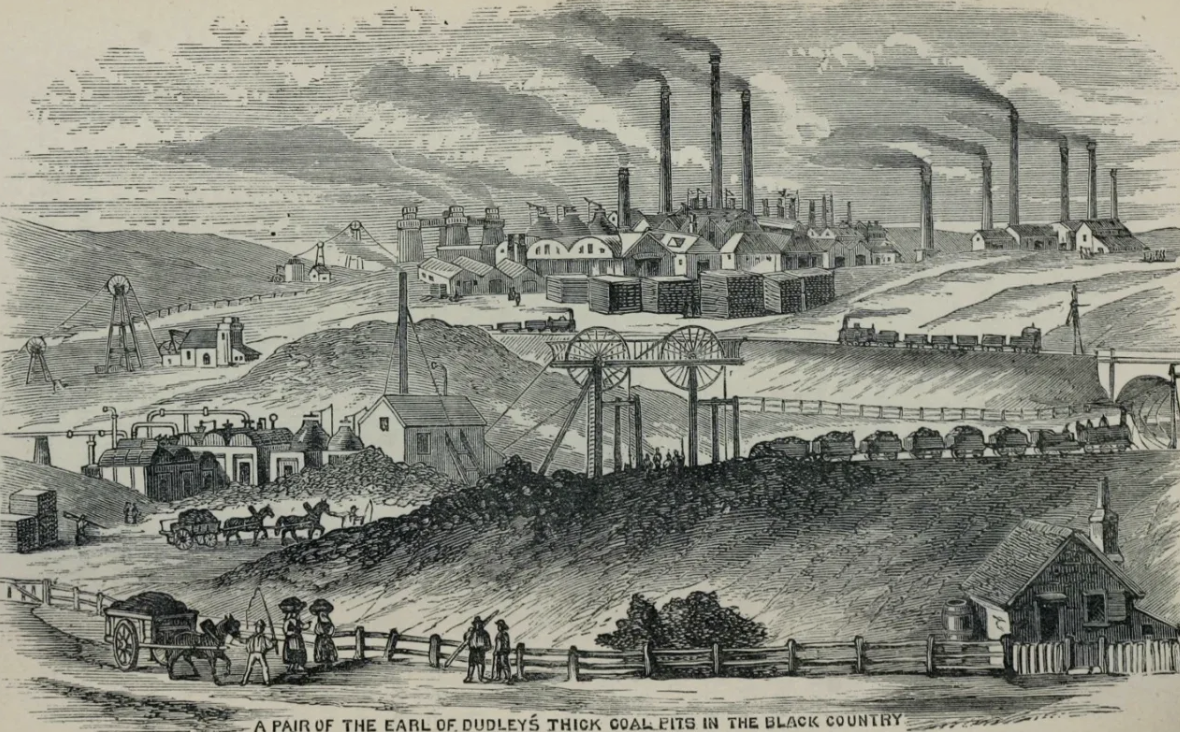
From 1760 to 1830, Britain did not just industrialize; it rewired its economy, society, and infrastructure. In about 50 years, the country moved from cottage industries and water wheels to steam-powered factories, canal transport networks, and global trade dominance.
Britain’s share of world industrial output rose from modest to dominant over this period. Britain’s economy grew because of rapid changes across an integrated system of capital, natural resources, and institutions.
What can we learn from examining Britain’s and the world’s first experience in changing capital and capital flows through shifting social institutions and active state support? This blog explores Britain’s unique capital, the changes in capital flows, the context and institutions that drove them, and why Britain moved first and fastest to lead the world’s first industrial revolution.
Capital and capital flows shifted rapidly.
The changes in Britain were not just technological; they were systemic. Coal replaced timber as the energy source, and output more than tripled from 1770 to 1820 to 15-20 million tons. Iron and copper became strategic as part of supply chains, as the basis for steam engines, factories, transport, and industrial infrastructure. Cotton imports from the Americas became the core input for the newly mechanized textile production system.
Mechanization transformed textile production. Innovations like the spinning jenny, water frame, mule, and power loom became standard. As a result, labor productivity soared, and the number of factories grew from 120 in 1760 to 5,500 in 1830. Where a hand spinner worked a single spindle, early spinning jennies let one worker operate 8–24 spindles; later models operated over 100; and spinning mules in large mills eventually carried over a thousand spindles on a single machine. These machines reorganized production around centralized power sources and standardized processes, enabling levels of scale and speed impossible in the cottage industry.
Steam power expanded 30-fold between 1770 and 1820, enabling rapid scaling and greater reliability. Geographical flexibility came from canal systems expanding from 55 miles in 1760 to 2,600 miles in 1830, reducing transport costs and helping the concentration of factories and connections to export and import ports. Cotton output rose from 105 million pounds to 950 million pounds, a 9-fold increase. Coal prices at the mine versus delivered prices changed with improved canal transportation. Mechanized British textiles, powered by coal-fired steam engines and fed by imported raw cotton, became dramatically cheaper than hand-spun and hand-woven cloth produced in traditional centers such as India. The number of steam engines grew exponentially, with energy production increasing by a factor of 30.
Financial investments for large projects, including canals and factories, expanded through national banks, canal share markets, and credit circles, which acted as intermediaries. The enlightenment reframed knowledge as a productive asset, and scientific societies, technical publications, and patent law created a culture of innovation and diffusion. As a result, the urban population doubled, with cities like Manchester and Liverpool seeing tenfold growth and creating both labor markets and expanding national product demand. Britain’s exports grew from £14.7 million in 1760 to £43.2 million in 1800.
The context and the system accelerated change.
High wages and cheap coal exerted intense pressure for labor-saving, energy-intensive technologies, including steam-powered textile machines. Steam power massively increased factory productivity, driving textile growth and urbanization. Britain had abundant coal and iron, which became more accessible through the canal network, and these resources were geographically close to rapidly growing ports, notably Liverpool, which handled over 80% of the cotton, and Newcastle, which became a coal-export powerhouse. Britain imported raw cotton from the rapidly expanding agriculture of the Americas to feed its increasingly mechanized textile mills.
The “industrial enlightenment” reframed knowledge as a productive good, enabling systems for experimentation, improvement, and knowledge sharing. Britain’s culture of experimentation drew on institutions like the Royal Society—founded in 1660—which had already spent a century nurturing scientific exchange and practical inquiry by the time industrial innovators began transforming machines, materials, and production. Networks of artisans, engineers, and entrepreneurs, and scientific studies and burgeoning scientific publications, accelerated innovation and diffusion across the country. Apprenticeships were also important, allowing the rapid scaling of skilled labor. People were connected through workshops, foundries, patent records, scientific societies, and informal knowledge circuits, accelerating the development and diffusion of innovative technologies. Continuous incremental improvements in spinning, weaving, carding, and steam power reduced costs, increased reliability, and made factory production decisively cheaper than traditional methods.
The state played an essential role in ensuring predictable rules, property rights, and contract enforcement, enabling private investment. Parliament shaped infrastructure through the Canal Acts, which helped create structures to raise funds, addressed eminent-domain issues, and set predictable transportation fees. Financial institutions mobilized capital at scale – pooling savings and commercial profits to fund factories, mines, canals, and machinery – thereby reducing financial risk and enabling capital pooling. For example, the Bridgewater Canal Company—authorized by Parliament in 1759—raised capital through shares that merchants, manufacturers, and even small savers could purchase. Its success in halving coal prices in Manchester sparked a wave of canal companies financed through similar joint‑stock structures.
Canal and mining infrastructure were major catalysts, enabling industrial-scale expansion by connecting coal and iron mines to manufacturing and ports, thereby reducing transport costs. Parliament also approved the Enclosure Acts, which changed agriculture by consolidating farms, eliminating common rights, and enabling more intensive agriculture, but disrupted traditional rural livelihoods and indirectly displaced rural populations. The state approved patent law that enhanced innovation and supportive commercial regulations. The “system” was path-dependent and replete with positive feedback loops. Canals provided cheaper coal and cheaper energy for textile production with machines, leading to higher exports and generating more capital for canals and mining. Infrastructure enhanced production through mines and canals, opening the space for steam engines to expand. Steam power was already available and used in mines before textile factories. The textile expansion drove cotton imports, port growth, and urbanization, creating and reinforcing national demand and productive labor. Britain also worked to expand Atlantic and imperial trade networks, so that capital, infrastructure, technology, production, and trade all reinforced one another.
Britain moved extremely fast; other countries did not.
Britain had the natural, economic, and social capital, the social systems, and an appropriate social order to enable rapid change. They had a unified market, stable governance, high labor costs, and weak guilds, which lowered barriers to mechanization. They had the bases for dense clusters for focused growth in Manchester, Birmingham, and the Midlands. They also had substantial export markets that rewarded scale, standardization, and cost-reducing innovations. British real wages were also higher than those in France and Germany, while coal was cheaper.
France, on the other hand, had lower wages, higher energy costs, fragmented markets, and prolonged political upheaval, which reduced incentives for mechanization. France underwent a revolution for 12 years from 1787, then revolutionary wars with other European states for 10 more years, followed by the Napoleonic wars for 12 more years. The German states had strong guilds, fragmented governance reflected in wars among the states and then war with Napoleon, and an underdeveloped infrastructure for their coal. Britain’s stable governance and unified market directly enabled rapid industrialization, while France’s political turmoil and Germany’s fragmentation hindered them. The United States was at an earlier stage of development, with abundant land, scarce labor, and only nascent infrastructure, which pushed it toward a different early path, e.g., water-powered mills and frontier expansion, before large-scale coal-based industrialization.
Britain was also at war, but never in Britain – the wars created massive state demand for iron, ships, textiles, and weapons – and the wars also allowed Britain to have global naval dominance to secure trade routes and cotton supplies.
Belgium was the second European country to industrialize after 1807. They had ready access to coal and iron, merchant capital, and benefited from Napoleonic legal reforms and direct imports of British machinery and expertise. Belgium’s success was remarkable, but it could not occur until other states had stopped fighting over their territories.
Conclusion.
Britain’s industrial revolution offers essential lessons about the conditions that engender technological revolutions. The lessons include the critical importance of infrastructure – canals and mining – that built the backbone for economic change. The second lesson is the importance of aligning and integrating financial capital, institutions, and innovation for growth. Britain’s unified approach enabled it to achieve economies of scale. Third, Britain was able to move because it was ready to move – it had the natural capital, social and economic capital, and already the bases of strong institutions. One condition was critical: labor costs were high enough to ensure the profitability of a shift to textile machines and steam engines. The British state played a strong leadership role – they fully supported the direction of growth, set the rules, invested in infrastructure, helped manage risk, created innovation ecosystems, and reinforced trade systems. The positive feedback loops and economies of scale continued to reduce costs and sustain the system’s growth.
What lessons from Britain’s industrial revolution can guide today’s technological transformations?