Tag: market-design

Market design is the deliberate structuring of market rules, contracts, and incentives to shape outcomes such as prices, investment, reliability, and inclusion.

  • Mexico’s Mobile Leapfrog (1990–2010): Lessons for Transitions

    Mexico’s Mobile Leapfrog (1990–2010): Lessons for Transitions

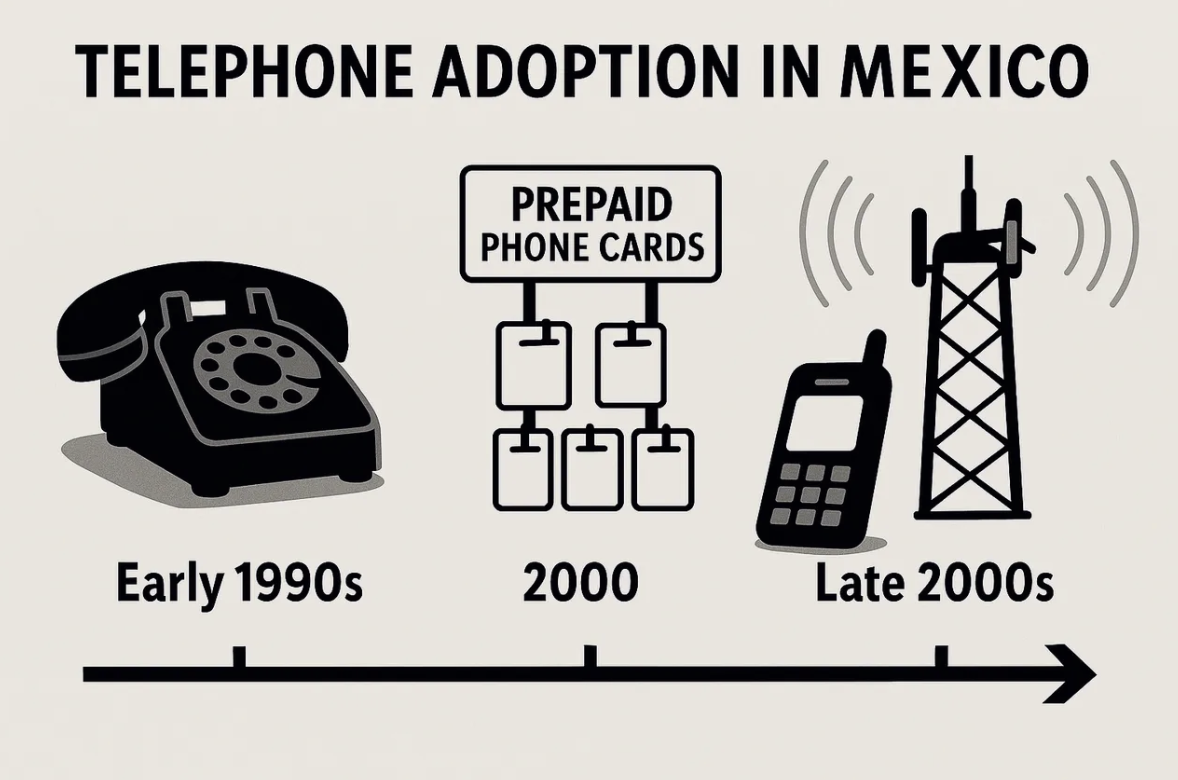
    Between 1990 and 2010, Mexico experienced one of the most rapid transformations in communications in the developing world. At the start of the 1990s, the country had fewer than five fixed telephone lines per 100 inhabitants, multi-year waiting lists for connections, and a geographically uneven copper network concentrated in major cities. By contrast, by 2007, Mexico had more than 60 mobile subscriptions per 100 inhabitants, rising to roughly 80 by 2010, making mobile telephony the dominant form of access nationwide. This transformation was driven not by incremental extensions of legacy infrastructure, but by moving directly to mobile networks, prepaid billing models, and large-scale private investment enabled by regulatory reform.

    For policymakers across Latin America and the Caribbean (LAC), this is not simply a telecom success story. It is a concrete, data-rich case of how infrastructure transitions unfold under conditions of scarcity, inequality, and institutional weakness—conditions that closely resemble those faced today in today’s transformation. Mexico shows how rapid access expansion can be achieved at scale, but also how early design choices around competition, regulation, and public investment can lock in market concentration and regressive cost burdens for decades. 

    Critically, Mexico’s leapfrog did not eliminate monopoly power; it transformed it. The 1990 privatization of Telmex replaced a state-owned monopoly with a privately controlled one, concentrated under Carlos Slim’s business group. While this shift accelerated investment and access, it also transferred extraordinary market power to a single actor in the absence of effective competition enforcement — a choice with distributional and welfare consequences that persisted for decades.

    After reading this blog, policymakers should be better equipped to identify which elements of Mexico’s experience enabled speed and scale, and which design failures undermined affordability, equity, and long-term innovation. The call to action is to design future transitions that combine quick rollout with a strong market structure, credible regulation, and clear ways to include everyone. 

    The analysis proceeds in three sections: how Mexico’s human ecosystem changed, what evolutionary forces drove those changes, and how the state shaped outcomes—for better and worse.

    How mobiles reshaped capital and social systems

    Mexico’s capital stocks were transformed primarily through substitution rather than accumulation. Instead of closing its fixed-line gap—Mexico remained at least six percentage points behind peers such as Chile and Argentina in landline penetration in the early 2000s—the country bypassed copper entirely. Spectrum, allocated by the state through regional licenses in the early 1990s, became the critical productive asset. By 2007, Telcel alone operated more than 48,000 points of sale and over 1,100 exclusive distributors, creating a dense commercial infrastructure that extended mobile access deep into peri-urban and rural areas where fixed lines had never been viable. Mobile telephony thus became a new form of socio-economic capital, accessible without a fixed address or formal employment.

    Capital flows also shifted in structure and velocity. The introduction of prepaid SIM cards in the mid-1990s eliminated the need for credit histories and monthly contracts, converting telecommunications revenue into millions of micro-transactions purchased at pharmacies, corner shops, and street stalls. By the mid-2000s, more than 80 percent of Mexican mobile subscriptions were prepaid, one of the highest shares in the OECD. Knowledge flows accelerated in parallel: migrants—numbering roughly 9 to 11 million Mexicans in the United States during this period—used mobile phones to coordinate remittances that exceeded USD 25 billion annually by 2007, while informal workers and small firms used SMS and voice calls to reduce transaction and coordination costs.

    Social institutions and social order adjusted more slowly than technology. Although Mexico established a telecommunications regulator (COFETEL) and liberalized the sector through the 1995 Federal Telecommunications Law, enforcement lagged behind. By 2006, Telcel controlled roughly 80 percent of the mobile market, and high interconnection fees acted as a de facto tax on competitors. Social cycles compressed dramatically—Mexico moved from analog cellular systems to nationwide GSM digital networks in little more than a decade—but distributional effects persisted. Household survey evidence shows that by 2006, low-income households were spending a growing share of their budgets on mobile services, often cutting expenditures on clothing, hygiene, and home maintenance to remain connected.

    How mobile spread: innovation, competition, and coverage

    From an evolutionary economics perspective, variation in Mexico’s telecom transition came less from domestic technological invention than from business-model innovation. Cellular technologies such as GSM were imported, but the decisive innovation was the adoption of prepaid billing for a large unbanked population. Entry-level handsets fell below USD 50 by the early 2000s due to the scale of global manufacturing, and operators experimented with low-denomination airtime cards, on-net discounts, and bundled offers. Users themselves generated variation through practices such as missed call signaling and phone sharing, which fed back into tariff design and reinforced prepaid dominance.

    Selection pressures strongly favored scale, coverage, and distribution density. Telcel benefited from Telmex’s inherited infrastructure, early access to spectrum across all nine regions, and a regulatory environment that failed to impose cost-based interconnection pricing. Competitors such as Iusacell, Movistar, and Nextel survived only in niches—urban postpaid users or specialized business services—because they could not match Telcel’s nationwide reach or absorb interconnection costs. Crucially, this was not neutral market selection: weak regulatory enforcement shaped the selection environment, systematically favoring the incumbent and selecting for concentration rather than diversity.

    Diffusion was nevertheless rapid because mobile telephony required minimal complementary infrastructure. Unlike fixed broadband, which depended on copper networks and personal computers, mobile access required only a handset and a SIM card. Mobile subscriptions rose from negligible levels in the early 1990s to roughly 12 million by 2000 and around 68 million by 2007. Econometric studies for Mexico show statistically significant positive effects of mobile and ICT diffusion on GDP over the 1990–2014 period. Yet diffusion had limits: penetration in Mexico City exceeded 90 lines per 100 inhabitants by the mid-2000s. At the same time, poorer states such as Chiapas lagged far behind, illustrating how national leapfrogging can coexist with deep regional inequality.

    How the state shaped winners, losers, and learning

    The Mexican state played a decisive but uneven role. Direction-setting was front-loaded and bold: the 1990 privatization of Telmex raised approximately USD 1.76 billion and transferred operational control to a private consortium with foreign technical partners, while mobile services were opened to limited competition through regional licenses. This dual strategy catalyzed rapid investment and modernization—by 1994, 75 percent of Telmex’s switching systems were digital—but coordination during implementation weakened. Key operating rules for local competition were delayed until 1998, effectively granting the incumbent several additional years of dominance.

    Rule-setting and enforcement proved to be the system’s weakest link. Although COFETEL was established by law, it lacked the authority to impose meaningful penalties or structural remedies. High interconnection fees persisted throughout the 2000s, and the OECD later estimated that weak competition in telecommunications cost the Mexican economy roughly USD 25 billion per year in excess prices and lost welfare. Public investment in infrastructure and public goods was limited: Mexico did not deploy a robust universal service fund or publicly financed backbone networks during the leapfrog period, relying instead on private capital guided by commercial incentives.

    Innovation and learning were similarly concentrated. Mexico captured large consumer-side welfare gains from connectivity, but it did not build a broad domestic industrial ecosystem around telecommunications. Handsets were imported, applications were largely foreign, and organizational learning accrued mainly within a single dominant firm. América Móvil’s replication of the prepaid mobile model across 18 countries created a Mexican multinational valued at over USD 100 billion by 2007. Still, this success did not translate into a competitive, innovation-rich domestic ecosystem—an outcome with clear parallels for future transitions that prioritize local value creation over simple asset deployment.

    Three lessons for designing transitions

    Mexico’s mobile leapfrog yields three core lessons. First, leapfrogging succeeds when business models match income realities. Prepaid services, micro-transactions, and low-cost handsets—not technology alone—enabled rapid expansion to populations excluded from formal credit and fixed infrastructure. Second, weak competition enforcement casts long shadows. Delayed regulation allowed market concentration to solidify, imposing high prices and limiting innovation for more than a decade. Third, access gains do not guarantee equity. Without sustained public investment and explicit inclusion mechanisms, regional and income disparities persisted even as national indicators improved.

    The core message for LAC policymakers is that speed and scale must be balanced with institutional strength. In renewable energy and power systems, as in telecommunications, transitions that rely exclusively on private incentives risk reproducing monopoly power, regressive cost burdens, and uneven spatial outcomes. The call to action is to build in competition policy, universal service mechanisms, and learning ecosystems into transition design from the start. Mexico’s experience demonstrates both what is possible when societies leapfrog—and what must be deliberately designed to avoid repeating its costly mistakes.
  • Chile’s Renewable Leap: What LAC Can Copy—and What to Fix

    Chile’s Renewable Leap: What LAC Can Copy—and What to Fix

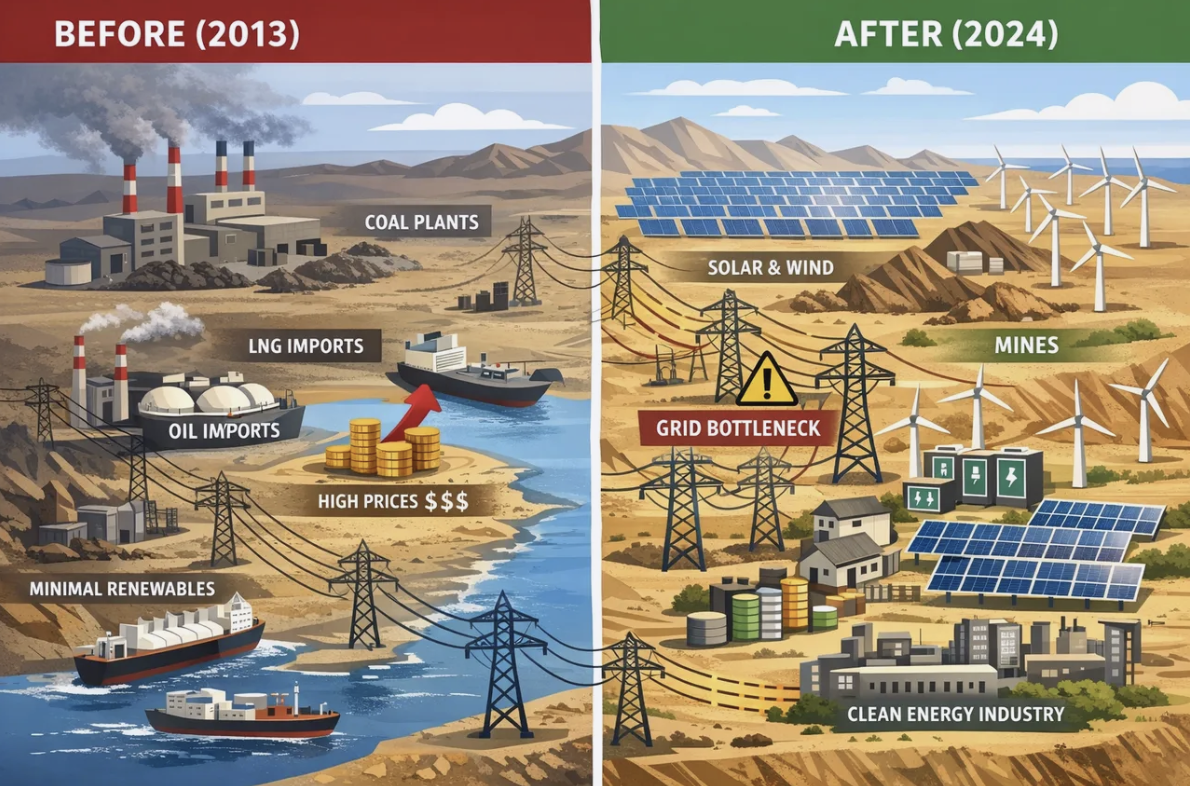
    Chile shows that clean power can be a competitiveness strategy—not just an environmental commitment. In one decade, the country moved from about 63% fossil-fuel generation in 2013 to a system in which renewables provided about 70% of electricity in 2024, with solar and wind accounting for roughly one-third of national generation. 

    The hard part was not “getting renewables built.” The hard part was building systems that scale—grids, flexibility, permitting capacity, and social license—fast enough that cheap renewable power becomes usable power, not curtailed power. Chile’s experience makes this visible: solar and wind curtailment reached about 6 TWh in 2024, a warning sign that infrastructure and governance can lag private investment. 

    Chile’s transition was engineered through market design and state capability. Competitive auctions and long-term contracts drove prices down—bids reached US$13/MWh in the 2021 supply auction, with an average awarded price of US$24/MWh—and mining demand served as an anchor buyer through corporate power purchase agreements (PPAs). Transmission reform and institutional upgrades were aimed at keeping the system reliable as renewables grew. 

    For LAC countries, the prize is clear: lower power costs, stronger export competitiveness, and a credible path to transformation—without triggering backlash from communities or destabilizing the grid. This blog highlights what changed in Chile, why it changed, and why renewables won, and what the state did to turn private capital into scale, and where it still needs to catch up. 

    What changed: assets, money, power flows, and institutions

    Natural capital – the Atacama Desert’s solar resources – was converted into installed solar photovoltaic (PV) capacity. Capacity grew from below 500 MW in 2014 to more than 13 GW in 2024. Wind capacity expanded from 1 GW to over 4 GW in the same period. Socio-economic capital deepened through investment and new industrial energy portfolios. By 2023, there was a pipeline of planned renewable investments that exceeded US$ 15B, mostly foreign direct investment in Atacama solar, transmission, and storage. Mining and energy firms built new, long-term portfolios of utility-scale PV, wind, and storage assets to address risks from imported fuel prices and stabilize energy supply. Chile shifted culturally and institutionally toward “green energy” and away from “energy scarcity.” 

    Energy flows were decarbonized—but also constrained by the grid. Chile reduced fossil-fuel import dependence. Fossil-fuel generation accounted for about 63% in 2013, and renewables reached about 70% by 2024. Yet the success of attracting finance for generation created congestion: renewable curtailment reached around 6 TWh in 2024, because low-cost supply outpaced transmission and grid flexibility. Finance shifted toward competitive pricing and new instruments. Chile attracted low-cost renewable energy finance and shifted from conventional project finance to green bonds and sustainability-linked lending. Auction design and long-term contracting led to dramatic price reductions—solar bids fell from more than US$100/MWh in 2013 to about US$13/MWh in 2021, reinforcing capital reallocation toward renewables. Knowledge flows accelerated through learning-by-doing and improvements in system operations—new capabilities formed in grid management, dispatch, and storage integration. By 2025, 1.7 GW of storage was operational or in testing, with more than 1 GW operational by mid-2025, deployed in part to mitigate curtailment challenges. Public-private partnerships (e.g., through Chile’s Economic Development Agency, CORFO) illustrate that Chile was not only importing technology but also adapting it to national and local operating conditions. 

    Market institutions were reorganized around auctions and corporate PPAs. Chile’s auction system and bilateral contracting (especially for large customers) became central in steering investment. Mining companies became major renewable buyers through corporate PPAs, turning industrial demand into an ‘anchor’ that reduced risk and accelerated scale. Technical institutions such as the Electricity Coordinator (CEN) and the National Energy Commission (CNE) strengthened planning and dispatch to modernize the energy system, but coordination gaps remained. The Energy Transition Law (2024) was intended to expedite the adoption of transmission and grid-forming technologies—an institutional response to system complexity. Social order shifted with new distributional tensions. While renewables improved air quality in coal-heavy regions and supported competitiveness through lower prices, the changes led to conflicts over land use, transmission corridors, consultation, and water governance—especially in the Atacama Desert. 

    Why things changed: experimentation → market selection → rapid scaling

    Chile’s transition began with competing pathways to energy self-sufficiency: coal expansion, liquefied natural gas imports, and renewables. Over the decade, the system tested utility-scale PV, onshore wind, and concentrated solar power with storage, such as Cerro Dominador, as well as small-scale distributed generation projects (500 kW–9 MW) under stabilized pricing regimes. Hybrid projects pairing renewables with 4-hour battery energy storage systems also emerged to address intermittency. Policy innovation produced ‘institutional variation.’ A key reform was the auction redesign (2014 onward), which allowed renewable providers to bid into specific time blocks, enabling solar to compete with 24/7 thermal generation on a more comparable product basis. Spatial variation mattered: Atacama’s resource strength attracted mass deployment but also highlighted the importance of siting, grid access, and social license, leading to uneven project outcomes across different regions. 

    Cost-based selection strongly favored solar and wind. Competitive auctions and corporate procurement revealed solar as the cheapest scalable option; coal and other thermal assets lost viability when solar prices dropped to around US$13/MWh in 2021. Environmental and political selection accelerated coal decline, including through coal phase-out agreements accompanied by just transition strategies for communities. By 2024, 11 plants, or about 1.2 GW of coal capacity, had been retired or converted, reflecting both the direction of climate policy and shifting economics. Industrial selection, especially from mining, is reinforcing the case for renewables. Large mining firms (e.g., Codelco and BHP) selected renewables to lower costs and meet emerging ‘green copper’ demand, making export competitiveness a direct selection pressure. 

    Technology diffusion was rapid: solar and wind spread from Atacama/northern corridors toward central Chile as capabilities and financing templates matured. Storage diffusion followed the pressures that arose from curtailment. Institutional diffusion also occurred: the ‘Chilean model’ of auctions has been studied and adapted by other LAC countries (e.g., Colombia) to de-risk renewable energy pipelines. Diffusion depended on enabling infrastructure. Major transmission projects, e.g., the 1,500 km Kimal–Lo Aguirre line, were considered public goods and designed to connect Atacama solar to central demand. Diffusion thus required both market signals and grid build-out. 

    What the state did: markets, grids, risk, and legitimacy

    Chile used long-horizon planning and policy to provide a ‘North Star’ for investors and agencies. Energy 2050 is a state policy designed to outlast political cycles, in line with the direction set by the Framework Law on Climate Change. The state’s coordination role was essential because the climate transition is cross-sectoral. Energy policy interacted with mining competitiveness, environmental justice, and territorial governance; government convening and planning capacity shaped the pace and credibility of the transition. Where coordination lagged—especially between generation growth and grid expansion—system costs rose through congestion and curtailment, underscoring the state’s responsibility for sequencing reforms and infrastructure. 

    Technology-neutral auctions rewarded the lowest cost and created transparent price signals. Auction reforms and time-block design enabled renewables to compete credibly and delivered price discovery that reoriented investment away from fossil options. Grid access and system rules evolved to support higher variable renewable penetration. Changes included stronger technical agencies (CEN and CNE), modernization of the national energy system, and reforms to allow non-discriminatory grid access and stabilized pricing for smaller developers. Environmental and social standards were both enabling and constraining. Chile worked to streamline permitting and develop standards (e.g., green hydrogen certification and environmental impact assessments). But uneven local impacts—water use, land conflict, and Indigenous consultation—show that standards and enforcement capacity must scale with deployment. 

    Transmission reform was a decisive state intervention. The 2016 transmission law enabled long-distance solar integration, and the state treated major projects (e.g., the US$2B Kimal–Lo Aguirre high-voltage direct current line) as public goods essential for the transition. Public risk absorption catalyzed early investments and first-of-a-kind projects. Blended finance and early risk-sharing, including through state instruments and development finance, e.g., the Cerro Pabellón geothermal project, reduced barriers until private finance scaled. Innovation ecosystems were actively fostered. CORFO supported research and development and concessional finance for first-of-a-kind green hydrogen facilities and public-private initiatives, building Chile’s capacity to deploy and partially adapt technologies rather than only import them. 

    The LAC takeaway: build systems that scale

    Three headlines from Chile’s decade:

    · Market design can unlock scale. Technology-neutral auctions and bankable long-term contracts made renewables investable and drove dramatic price discovery.

    · Competitiveness anchors transitions. Mining demand and corporate PPAs helped convert renewable potential into real investment and industrial advantage. 

    · Success creates new challenges. When grid expansion and flexibility lag, abundance becomes waste: solar and wind curtailment in 2024, demonstrating that the transition’s bottleneck shifts from “building MW” to “integrating MW.”

    For LAC policymakers, some key lessons include that well-designed auctions and contracts can reward low-cost generation and deliverability; investing early in transmission and grid system flexibility as public goods prevents the grid from becoming a constraint; and building permitting and consultation capacity so projects have social license at the pace needed for deployment – legitimacy is as critical as finance. 

    It is not just about building more renewables – but about building systems that value reliable renewables and make them politically durable.