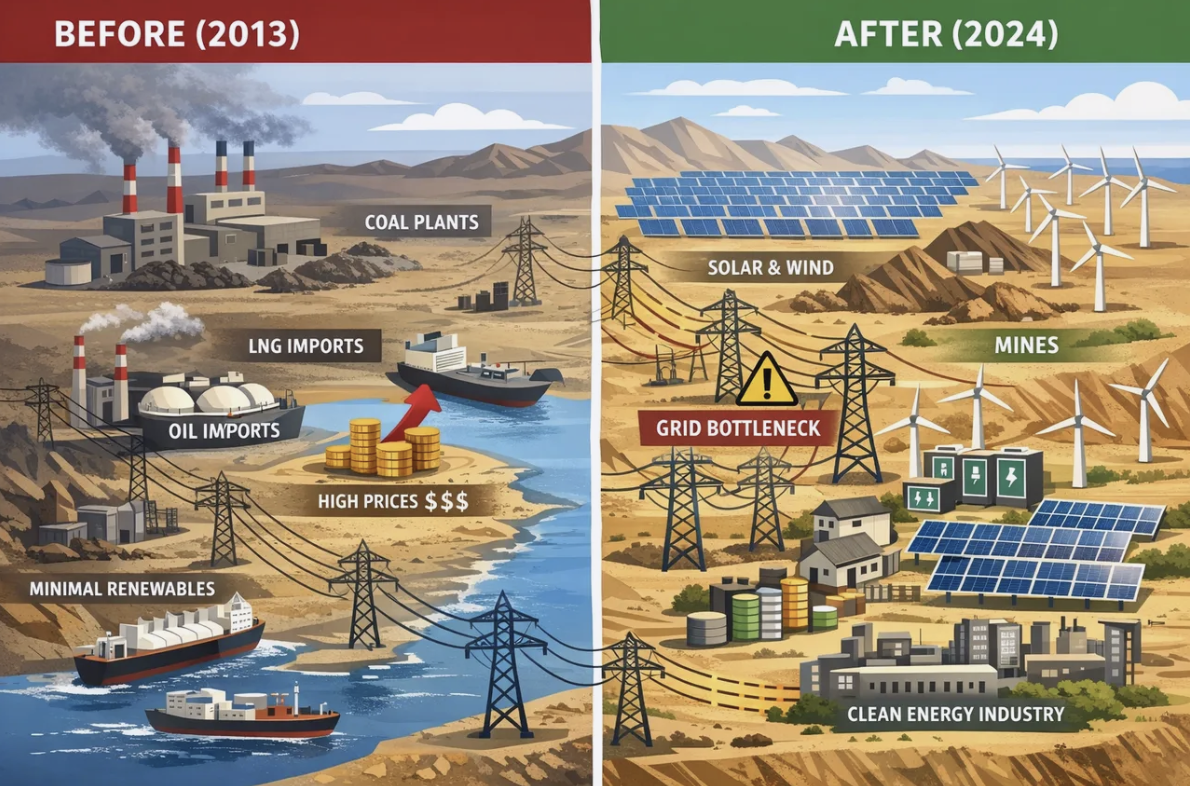
Recent changes in Brazil’s power system provide a clear case study of rapid renewable-scale-up under real constraints, including droughts, high domestic interest rates, and land-use challenges. Between 2010 and 2025, Brazil added more than 30 GW of wind and tens of gigawatts of solar capacity, including distributed photovoltaics. Brazil fundamentally changed who produces electricity and how the grid operates. This case study shows how to lower prices through competitive procurement, mobilize capital through development finance, and build industrial capabilities. It also illustrates challenges—such as curtailment, licensing bottlenecks, and distributional conflicts—that can derail the transition process.
The region already has relatively clean energy matrices, and many countries are committed to expanding renewables—but lack the institutional and infrastructure capacity to make renewables reliable and socially legitimate. Brazil’s experience demonstrates the upside of market‑making and the downside of permitting processes and equity considerations lagging deployment.
Renewable energy plans should deliver four outcomes simultaneously: (1) low-cost supply, (2) drought resilience, (3) bankable investment contexts, and (4) credible social and environmental safeguards without depending on unsustainable fiscal subsidies. Renewable energy should be viewed as a systemic transformation, not just technology procurement. As such, changes to market rules, grids, financing, and governance are needed to enable wind and solar to scale without creating stranded assets or social conflicts.
This blog examines how the human ecosystem surrounding renewable energy has changed, what drove those changes, and what the state did to implement them.
Shifting assets, flows, and risks
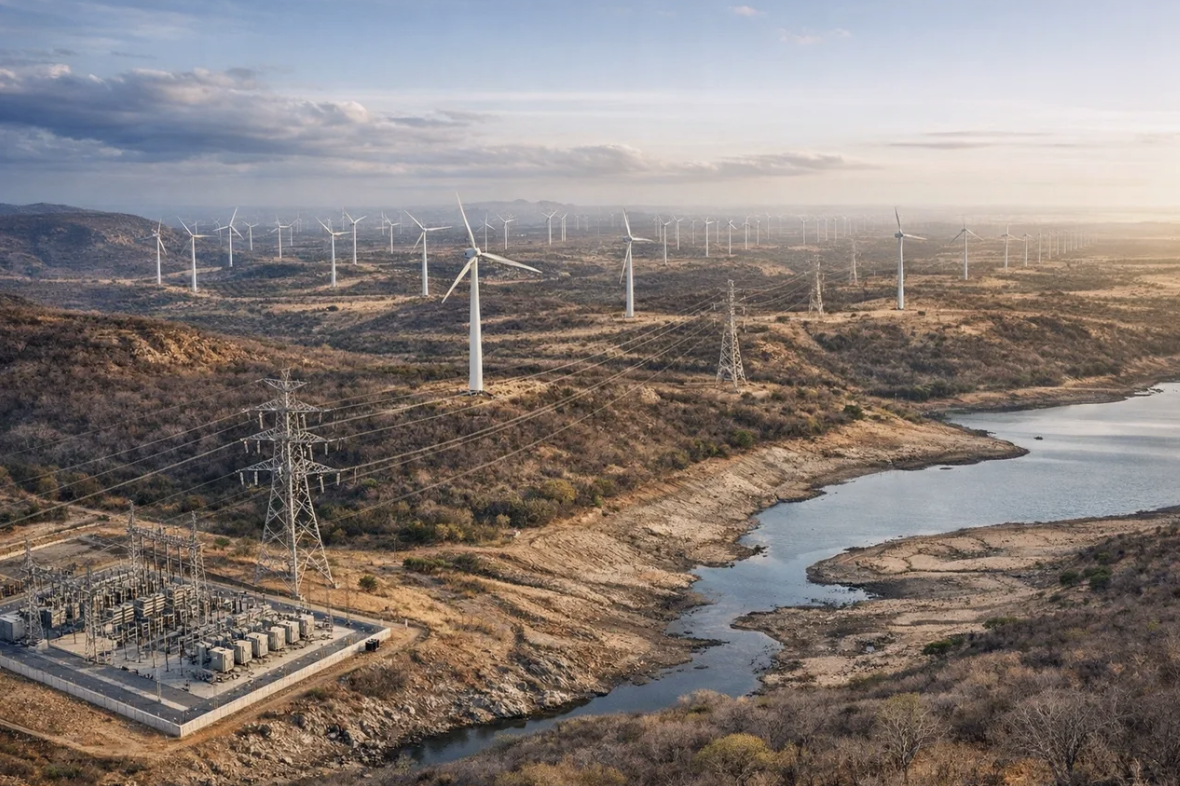
Capital stocks shifted from hydroelectric plants toward a more diverse portfolio, including wind, utility-scale solar, and mass-distributed solar. Wind capacity scaled from about 1 GW in 2010 to over 33 GW by 2025—leveraging the northeastern dry season to mitigate hydropower variability. Distributed solar expanded rapidly from less than 1 GW in 2018 to over 40 GW by 2025, with 3.7 million small-scale systems installed on homes and businesses. This diversification responded directly to drought-induced constraints on hydropower production, with wind and solar taking larger shares of the generation mix.
Capital flows shifted from state-centered lending and centralized dispatch toward blended finance for new market segments and more complex grid flows. Finance evolved from heavy reliance on BNDES toward de-risking strategies aimed at attracting institutional investors, including green debentures, with public finance playing a catalytic role. Electricity flows shifted as wind from the Northeast and solar from multiple regions fed the national system. Behind-the-meter generation helped address part of the supply challenge, but also created revenue‑model challenges for utilities. Knowledge deepened as firms adapted technologies to local conditions—for example, modifying wind turbines to match Brazilian wind regimes and turbulence.
Institutions co-evolved with these changes. New tensions emerged around land use for wind farms, electricity affordability, and the risks of boom‑and‑bust investment cycles. Brazil’s national energy regulator and energy planning agency institutionalized competitive electricity auctions, setting a benchmark across Latin America for transparent pricing and investor confidence. Social tensions were particularly acute where wind farms overlapped with traditional communities and required active management. The 2025 Ecological Transformation Plan highlighted the need for a just transition, emphasizing fairness and the impacts on communities, as well as the potential creation of 2 million jobs and a 0.8% increase in GDP. The drought and water crisis of 2021 accelerated diversification, while electricity bill increases of roughly 20% between 2021 and 2023 intensified pressure to reduce costs through renewables.
Crises, markets, and policy choices
Brazilian energy policies deliberately encouraged experimentation across technologies and business models. Markets and crises then selected the most effective approaches, which diffused domestically and beyond Brazil. Policy generated diversity across technologies, ownership structures, and system solutions. Hybrid plants that combine wind, solar, and storage have emerged to address constrained transmission corridors in the Northeast. The free energy market expanded, enabling power‑purchase agreements that bypassed traditional utilities for large consumers.
Auctions and droughts pushed the system toward rewarding low-cost, complementary, and bankable projects in contrast to the fragility of large hydropower. Competitive auctions drove prices down until wind and solar outcompeted new thermal additions; by 2024, the levelized costs of new wind and solar were lower than maintaining expensive natural-gas-based backup capacity. The droughts of 2014 and 2021 forced systemic change, penalizing systems that lacked diversification or firm‑energy guarantees. Affordability became a primary driver as rising electricity bills increased pressure for lower-cost direct generation and diversified renewables.
Business models and generation systems that proved effective spread across Brazil and influenced regional peers. Brazil’s auction model informed procurement approaches in Colombia and Argentina. Infrastructure—particularly high‑voltage transmission lines—was critical to moving renewable energy from the North and Northeast to demand centers in the Southeast. Storage diffusion accelerated following regulatory advances beginning in 2023, aimed at managing the growing share of variable solar generation.
How the state made renewables bankable
Brazil’s government acted not as a passive regulator but as a market‑maker and risk absorber. This approach focused on targeted state functions that unlocked private investment while maintaining reliability and social legitimacy. The state provided direction through long-term planning and institutional continuity, anchored in investments that outlasted political cycles. The 2025 Ecological Transformation Plan articulated this mission, projecting up to 2 million jobs and an average annual increase in GDP of 0.8% under full implementation scenarios. Planning entities and system operators prioritized reliability. The independence of the National Electric System Operator was critical in buffering political instability. The 2021 drought—the worst in roughly 90 years—severely depleted hydropower reservoirs, triggering emergency measures and reinforcing diversification as an energy‑security strategy.
The state shaped market architecture through auctions, distributed‑generation legislation, bankability standards, and continuous adaptive management. Reverse auctions provided transparent price discovery and long-term contracts. Distributed generation legislation increased regulatory certainty and underpinned the rapid scaling of solar. The state also advanced green taxonomies and carbon‑market frameworks aligned with international standards.
The state mobilized capital for public investment and innovation ecosystems, but grid constraints became the binding bottleneck. BNDES concessional loans with local‑content requirements supported domestic wind‑manufacturing clusters. Transmission and interconnection emerged as strategic public goods, yet grid expansion lagged variable renewable deployment, contributing to curtailment. Eco‑Invest introduced mechanisms to hedge currency risk and reduce foreign‑exchange exposure for foreign investors. Public research and development supported agrivoltaics and floating solar on reservoirs, aiming to convert hydropower assets into hybrid generation hubs.
Three lessons from a big system transition
Brazil’s 2010–2025 transition shows that renewable energy success rests on institutions—market rules, planning capacity, financial structures, and social safeguards—not just on installed capacity. The three key messages are:
· Use auctions and clear contracting to drive costs down—but pair them with grid and permitting capacity, or curtailment and delays will destroy value.
· Development finance can catalyze private investment and industrial learning, but over-reliance is fiscally risky—design a glide path toward capital‑market financing.
· Social legitimacy is a system constraint: territorial rights, benefit sharing, and affordability must be embedded in market architecture, not treated as afterthoughts in licensing.
Brazil demonstrated that a hydropower-heavy system can evolve into a diversified renewable powerhouse. The next step—for Brazil and the region—is to make the transition not only fast and low‑cost, but also grid‑secure, fiscally durable, and socially fair.