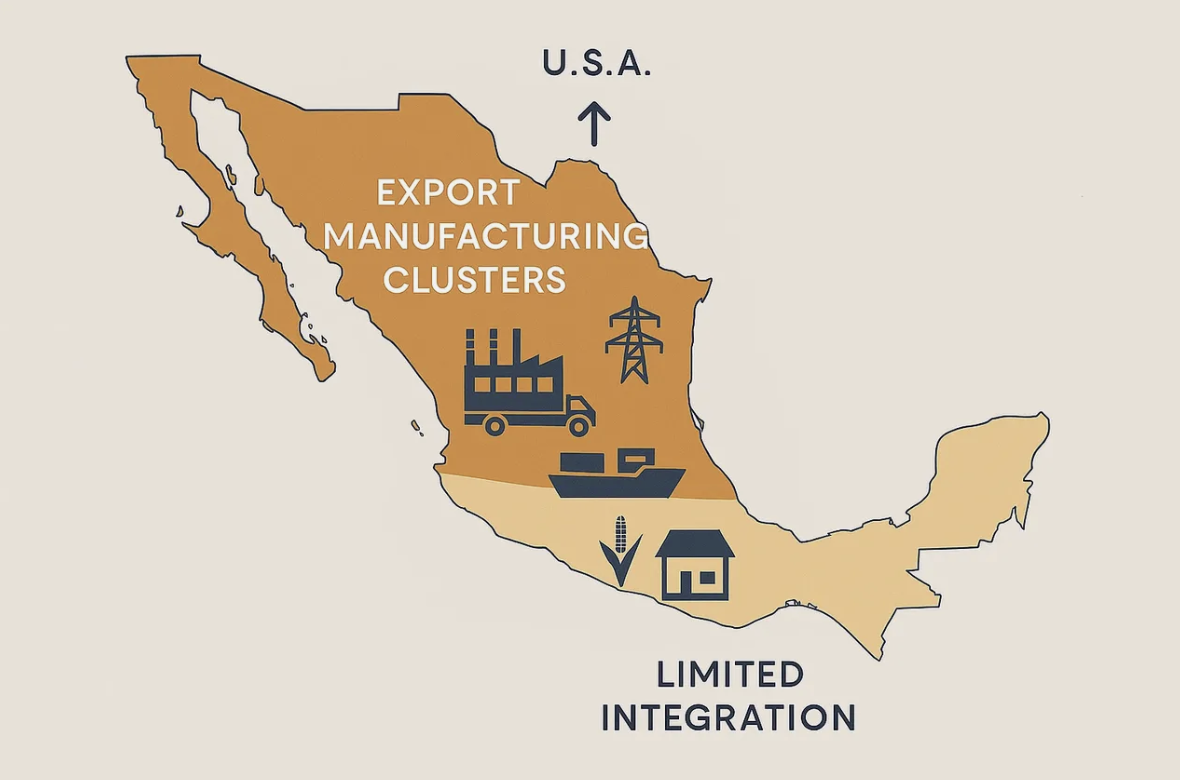
Between 1994 and 2007, Mexico carried out one of the most far-reaching economic reforms in Latin America. In little more than a decade, the country moved from a state-led, inward-oriented development model to a deeply integrated export‑manufacturing platform anchored in North American value chains. The scale of the transformation was substantial: foreign direct investment averaged USD 18–20 billion annually by the early 2000s, manufacturing exports rose to more than 80 percent of total exports, and formal employment expanded rapidly in export corridors. For policymakers across Latin America and the Caribbean, Mexico’s experience is one of the clearest real-world tests of what happens when trade openness, foreign investment, and macro stability are allowed to drive structural change at speed.
What is at stake for today’s policymakers is not whether integration can generate growth—it clearly can—but what kind of growth it generates, where it concentrates, and what capabilities it leaves behind. Mexico’s transformation produced globally competitive automotive and electronics clusters in the North and the center of the country. At the same time, large parts of the South remained trapped in low-productivity agriculture and informality. Real wages lost nearly 50 percent of purchasing power during the 1990s, employment cycles became tightly synchronized with U.S. demand, and domestic innovation capacity remained weak despite massive capital inflows. The result was a development pattern often described as “production without distribution”—high export performance combined with limited domestic upgrading and persistent territorial inequality.
This blog addresses a challenge that is directly relevant to current policy debates on renewable energy, green industrialization, and regional development: how to design growth strategies that do more than attract capital. Drawing on Mexico’s experience between 1994 and 2007, it explains how the country’s human ecosystem—capital stocks, capital flows, institutions, and social cycles—was reconfigured; how evolutionary forces of variation, selection, and diffusion shaped winners and losers; and how the state’s choices as market architect amplified both successes and failures. The central proposition is that openness without deliberate capability building leads to fragile, uneven, and environmentally costly development paths.
Hopefully, readers should come away with a sharper ability to distinguish between integration-led growth and capability-driven development, and with a clearer sense of which policy levers matter most when planning large-scale transitions—especially in energy systems that require long-term investment, learning, and territorial inclusion. The call to action is explicit: future industrial and renewable energy strategies must be designed not only to connect economies to global markets, but also to embed learning, resilience, and regional balance into the structure of growth itself.
FDI selected winners, but the policy failed to diffuse
Mexico’s capital stocks were reallocated toward export manufacturing, with the reallocation geographically concentrated. Formal employment expanded quickly in the second half of the 1990s: total employment rose from 33.9 million to 39.1 million between 1995 and 1999 (about 3.7% annually). At the same time, manufacturing became the dominant destination for foreign capital—by the early 2000s, FDI inflows averaged USD 18–20 billion annually, and manufacturing absorbed a large share of those inflows (about 53%). This concentration accelerated the build-out of industrial and urban assets in northern and central export hubs while leaving the agrarian South comparatively disconnected from high‑productivity networks.
Capital flows increased sharply and became structurally asymmetric—especially in the “import‑assemble‑export” structure of production. On the real economy side, Mexico’s export platform relied heavily on imported intermediates: raw material and intermediate imports grew at roughly 18.5% per year (1995–1999), indicating that a comparable deepening of domestic input industries did not keep pace with production expansion. On the labor side, internal migration surged northward toward export corridors. Still, knowledge spillovers remained modest because many plants operated as “assembly‑only” maquiladoraswith limited research and development and thin domestic supplier development. For policymakers, the key point is that rapid capital inflows can boost output without automatically building local capabilities unless policy deliberately strengthens learning and linkages.
Institutions were adjusted in ways that reduced investor uncertainty but weakened the inclusion and bargaining power of many workers and regions. NAFTA institutionalized trade rules and investor protections that served as durable “political risk insurance,” strengthening policy credibility beyond domestic political cycles. Yet social order became more fragile: domestic real wages lost nearly 50% of purchasing power in the 1990s following currency shocks and labor surplus. Labor institutions also became segmented—export plants often paid better than informal alternatives, but collective bargaining remained weak in many settings while informality expanded elsewhere. This matters for transitions: credibility and capital attraction are necessary, but social legitimacy depends on wages, working conditions, and distributional outcomes that markets do not fix on their own.
Social cycles became more externalized and volatile as manufacturing synchronized with U.S. demand. The early 2000s downturn is a concrete example: maquila employment fell by 17–18% between 2000 and 2003, showing how an externally driven model transmits shocks to domestic employment. Regionally, the divergence became persistent: poverty was around 57% and informality at roughly 70% in the South, versus roughly 40% informality in the North. This is not just inequity; it is a constraint on national productivity and political stability. For renewable energy, the parallel is direct: if grid upgrades, clean‑industry corridors, and skills systems concentrate only where institutions are already strongest, the transition can reproduce the same dualism—modern enclaves alongside regions left structurally unable to participate.
Infrastructure chose regions
In evolutionary terms, NAFTA was a major source of economic variation in Mexico. Trade opening introduced many “new variants” of production—new firm types, organizational models, and process standards—especially in autos, electronics, and other export platforms. Multinational firms brought modular production, just-in-time logistics, and global quality regimes (including ISO‑style standards) that reshaped the “work culture” of northern hubs. At the same time, regional initial conditions mattered: northern states were “pre-adapted” by stronger education and infrastructure. In contrast, southern states entered the period with weaker absorptive capacity and fewer connective assets.
Selection pressures then sorted these variants quickly and unevenly. The U.S. market served as the primary selective agent, rewarding proximity, speed, compliance with standards, and scale—especially in autos, electronics, and aerospace. In quantitative terms, higher-complexity states increased their share of national output (north rising from 39% to 42.7%), while less-diversified southern states saw their share decline (from 9.8% to 6.9%). Macro financial shocks also served as selection events: the 1994–95 crisis and the early 2000s downturn filtered out weaker firms. They reinforced the position of well-capitalized multinationals with access to global finance and technology, deepening foreign dominance in key export sectors.
Diffusion—the spread of practices, knowledge, and benefits—was the most incomplete stage of the evolutionary process. Some diffusion occurred within export supply chains: domestic suppliers upgraded in pockets due to quality and delivery requirements, and clusters formed in the Bajío and border regions through agglomeration effects. However, diffusion largely failed at a national scale because market failures in education, infrastructure, and finance prevented lagging regions from catching up. These factors served as diffusion barriers, keeping the South in a lower productivity “evolutionary trap.” The policy implication for transitions is operational: markets will generate variation (new technologies and projects) and selection (winners and losers), but diffusion (skills, suppliers, innovation capability, regional participation) requires explicit design.
Risk was socialized, but capability was not
The state’s central achievement during 1994–2007 was serving as a credible market architect. Mexico used NAFTA to “lock in” liberalization, signaling to global capital that the country would not revert to protectionism. Coordination then shifted toward sectoral programs and preferential conditions for multinational firms in autos and electronics, creating legal certainty and targeted support for export corridors. This approach was effective at attracting investment and scaling exports, but it also narrowed the state’s attention to what investors demanded rather than what domestic capability-building required. For transitions, this distinction is critical: credibility and market architecture can mobilize capital, but they do not guarantee domestic learning or broad inclusion unless those outcomes are built into the strategy.
Public investment was decisive—but spatially uneven—and that unevenness shaped long-run outcomes. Major public-private investments supported northern logistics, border crossings, and power grids to serve U.S. value chains. In contrast, infrastructure investment in southern states such as Oaxaca and Chiapas remained insufficient, contributing to “deficient economic institutionality” and weak FDI attraction. This pattern shows that infrastructure is not merely supportive; it is selection-shaping. When public goods concentrate in already‑competitive corridors, agglomeration strengthens, and divergence hardens. For today’s transition, the comparable risk is the buildout of transmission, ports, and industrial energy infrastructure, primarily in areas where industrial capacity already exists, thereby locking lagging regions out of clean‑industry participation.
In finance and risk management, the state served as a systemic shock absorber, most visibly during the 1995 crisis via the FOBAPROA bailout, prioritizing the survival of the financial system to maintain trade and investment flows. This preserved openness and investor confidence, but it also socialized risk and, by itself, did not create inclusive financing channels for domestic firms to upgrade. Growth reliant on external demand and foreign firms exposed Mexico to vulnerabilities when capital and demand cycles turned. For upcoming transitions—capital-intensive and exposed to price, currency, and policy shocks—this underscores the need for deliberate risk-sharing instruments and capital mobilization that build domestic balance sheets rather than just foreign project pipelines.
Innovation and learning were the state’s most significant gaps. While maquiladora learning was underway, Mexico lacked a robust national innovation capacity to move domestic firms from assembly to design and higher‑value activities, leaving the technology gap with the U.S. largely unclosed. In practice, this meant that many high-value functions remained abroad and that domestic upgrading was thinner than the scale of investment would suggest. For the future, the analogous risk is a transition dominated by imported technology and engineering, with limited domestic supplier upgrading in the construction delivery. A policy‑credible alternative is to treat innovation systems—technical institutes, supplier development, standards for learning, and finance for upgrading—as core infrastructure of the transition rather than optional add-ons.
Transitions need diffusion by design
Three core lessons from Mexico’s 1994–2007 experience stand out for policymakers. First, integration delivers scale, but it does not automatically enable development. Mexico successfully locked itself into one of the world’s most lucrative value chains, becoming a leading exporter of manufactured goods and generating millions of formal jobs. Yet the same period saw stagnant real wages, limited domestic firm upgrading, and heavy dependence on imported intermediates, underscoring that export growth alone does not create endogenous capabilities or sustained productivity gains.
Second, regional divergence is not an accident—it is an outcome of policy design. Manufacturing clusters flourished in regions with strong infrastructure, logistics, energy systems, and institutional capacity, increasing the northern and central states’ share of national output from 39 percent to over 42 percent, while the South’s share declined. The absence of sustained public investment in southern education, connectivity, and productive infrastructure created an “evolutionary trap” in which lagging regions could not absorb knowledge or capital, even as the national economy expanded.
Third, the state matters most in what it builds, not just in what it opens. Mexico’s government was highly effective at rule-setting, macro‑stabilization, and risk absorption—most notably during the 1995 financial crisis—but far less effective at fostering innovation systems, upgrading domestic suppliers, and diffusing beyond export enclaves. The state assumed an active role in shaping markets but did not fully develop comprehensive learning ecosystems. This imbalance explains why maquiladora learning remained shallow and why domestic research and development intensity stayed far below OECD benchmarks.
The core message for today’s policymakers—especially those designing renewable‑energy and green industrial strategies—is straightforward. Investment attraction is necessary but insufficient. Clean‑energy transitions will replicate Mexico-style outcomes unless they are paired with deliberate policies for skills, local supply chains, innovation, and territorial inclusion. Energy infrastructure, like manufacturing infrastructure before it, will concentrate where institutions are strongest unless the state actively counterbalances market selection.
The call to action is therefore strategic rather than technical: design transitions that treat learning, diffusion, and regional balance as core objectives rather than secondary benefits. Mexico’s experience shows that speed without structure creates growth that is vulnerable, uneven, and politically fragile. Today’s policymakers have the opportunity to apply these lessons early, building energy systems that not only decarbonize economies but also anchor inclusive, resilient, and capability-based development for decades to come.