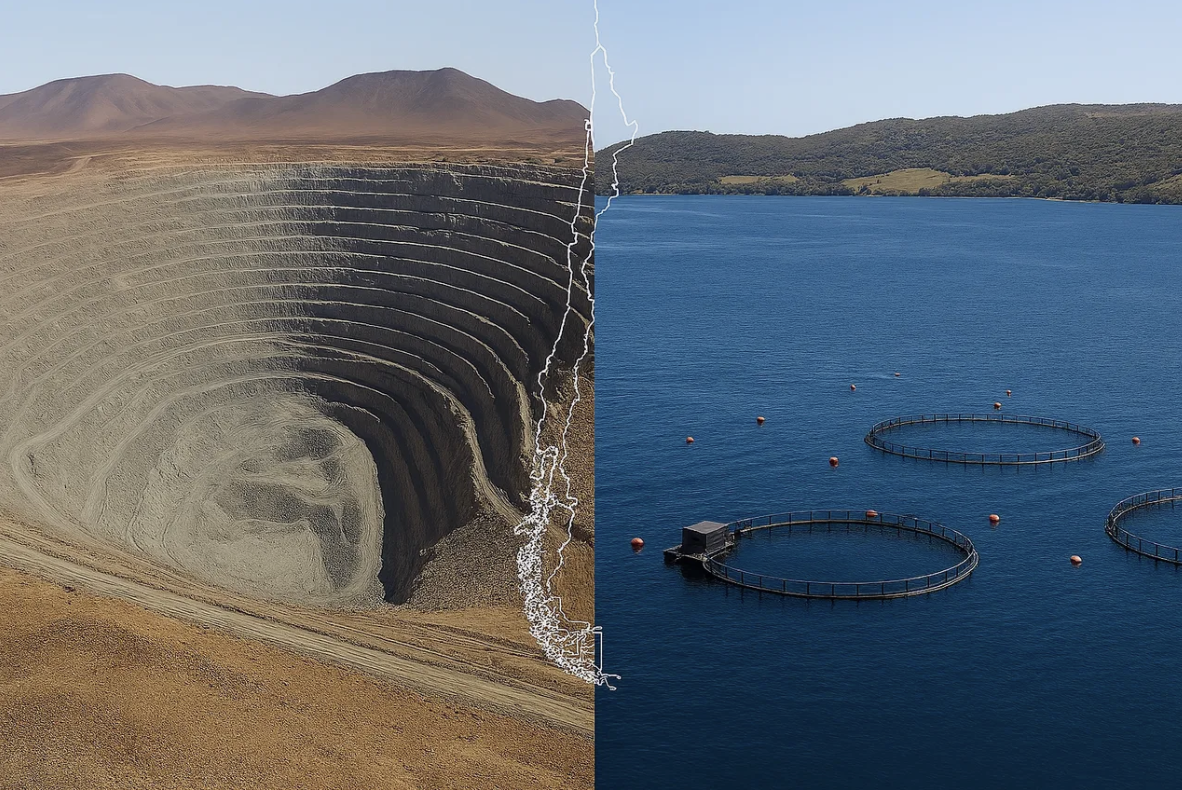
Between 1980 and 2010, Chile moved from a volatile, copper-dependent economy toward a more complex export platform—still anchored in copper but complemented by a globally significant salmon aquaculture industry. The core policy challenge was not simply “grow exports,” but to convert a highly volatile copper rent stream into stable fiscal capacity, while building new tradable sectors capable of competing in demanding markets. Chile’s experience is relevant across Latin America and the Caribbean because it highlights two design problems that recur in resource-rich settings: how to build credible macro-fiscal buffers before the boom peaks, and how to create a sector where private investors will not initially bear technology and market-entry risk.
This post unpacks the transformation through three lenses: (1) how Chile’s “human ecosystem” changed in terms of capital stocks/flows, institutions, and social cycles, (2) what drove changes via variation–selection–diffusion mechanisms, and (3) what the state did—especially in fiscal rulemaking, market architecture, and innovation catalysis. A practical objective is to make the mechanisms visible (rules, sequencing, incentives, and state capabilities), including where the economic model that was used imposed costs, most clearly in the salmon sector’s regulatory lag and disease crisis.
Human ecosystem shifts: capital, institutions, and cycles
The most visible shift in capital stocks and flows was scale. Copper production expanded from roughly 1 million metric tons (1980) to over 5.4 million (2010), reinforcing Chile’s role as a global copper leader. In parallel, salmon exports moved from near-zero in the early 1980s to a major non-traditional export. By 2007, exports reached about US$2.3 billion, and Chile became the world’s second-largest salmon producer. Macro-financial flows were also re-engineered: a stabilization fund architecture evolved from the mid-1980s copper fund into the Economic and Social Stabilization Fund (ESSF) created in 2007, enabling a countercyclical response during the global financial crisis, including a reported stimulus package of up to US$9 billion, including about US$4 billion of direct finance.
Two institution-building pathways mattered during this time. First, in copper, Chile preserved a capable state producer (Corporación Nacional del Cobre de Chile (CODELCO)) while designing a legal and fiscal environment that could support large private investments over long horizons. Second, in salmon, the institutional breakthrough was a hybrid innovation vehicle: Fundación Chile helped transfer and adapt cage-farming technologies, absorbing early-stage uncertainty and demonstrating commercial viability before wider private entry. Over time, a supporting industrial ecosystem formed: by 2010, the salmon cluster included over 4,000 small and medium-sized enterprises (SMEs) in logistics and specialized inputs (e.g., vaccines). Social outcomes shifted as well: poverty rates fell from about 45% (1987) to 11.5% (2009), thereby expanding domestic socioeconomic resilience even as growth remained export-led.
Chile’s political economy consolidated a “dual track”: copper rents were partly captured directly through CODELCO (accounting for a major share of total fiscal revenue), while private capital expanded production under secure rules. The fiscal system was redesigned to weaken boom–bust cycles through the Structural Fiscal Surplus Rule (2001) and the ESSF (2007), effectively decoupling domestic spending from copper price volatility. The salmon sector, however, illustrates the consequences of institutional lag in fast-growing resource-based activities: the infectious salmon anemia (ISA) virus crisis (2007–2010) caused a major rupture that forced post hoc upgrading of sanitary and environmental governance. The combined message is that Chile strengthened macroeconomic “shock absorbers” in copper earlier and more systematically than it built ecosystem and biosecurity shock absorbers in salmon.
What drove the changes: variation, selection, and diffusion
The 1980s are characterized as a period of experimentation. In mining, institutional variation took the form of a high-security concession model created by early-1980s changes in mining laws and the code, which introduced “constitutional concessions” that co-existed with state ownership. In aquaculture, variation combined natural endowments (southern cold waters) with imported production knowledge; Fundación Chile’s early pilots served as structured experiments that reduced uncertainty about whether salmon farming could be commercially viable at scale in Chile.
Chile’s selection environment was not purely “market.” For copper, the Foreign Investment Statute (DL 600) is described as providing guarantees that improve predictability for investors, favoring large-scale, capital-intensive projects able to ride long commodity cycles (the Escondida mine is an emblematic case). For salmon, selection occurred through a state-supported proof-of-concept logic: public or hybrid pilots helped demonstrate profitability, after which private firms and a supplier base expanded rapidly. The same selection forces also revealed weaknesses: disease dynamics (ISA) and subsequent regulatory tightening acted as a harsh selection event, penalizing high-density growth models that had outpaced monitoring and enforcement capacity.
In macroeconomic management, diffusion and retention were institutional: the copper fund architecture evolved into the ESSF, and the structural fiscal rule became a routine for transforming volatile rents into predictable fiscal space. In productive sectors, diffusion took the form of clustering and supply-chain deepening—especially in salmon, where know-how and specialized services spread through a dense regional ecosystem (including thousands of SMEs). A policy-relevant tension is apparent: Chile retained “good” fiscal governance routines relatively early. “Bad” routines in salmon production were maintained for perhaps too long, e.g., high-density expansion with insufficient biosecurity, increasing the probability and cost of a later crisis.
State role: rules, finance, and learning
The state’s central contribution was market architecture. In copper, Chile maintained a state anchor (CODELCO) while creating credible, high-security investment rules for private entry via concessions and the DL 600 framework. In macro policy, the state adopted a Structural Fiscal Surplus Rule (2001) to manage “Dutch disease” risks by saving during booms. This rules-based approach mattered because it made intertemporal trade-offs explicit and constrained short-term political spending pressures. The result was institutional continuity that survived major political transitions and supported long-duration investments typical of mining.
Chile used copper-linked institutions to convert volatile revenues into countercyclical fiscal capacity. The sequence from earlier copper stabilization mechanisms to the ESSF (2007), which supported crisis-era spending, included the reported US$9 billion stimulus during the 2008–2009 shock. In parallel, the state supported the productive base by enabling investments in ports, energy, and related infrastructure, helping both private mining and aquaculture scale in geographically remote regions. The policy lesson is not “spend more,” but “spend with buffers”: stabilization funds and fiscal rules created room to maintain public investment when external conditions deteriorated.
The salmon case underscores a specific state capability: acting as an early “venturer” when private investors will not fund uncertain learning. Through Fundación Chile (a public–private initiative between the Chilean state and International Telephone & Telegraph (ITT)), the state absorbed initial technical and market risks, proved a business model, and then exited by selling pilot companies to the private sector. This is a replicable design choice for LAC countries seeking new tradables: create an institution with technical autonomy and an explicit exit mechanism. The caution is equally important: innovation policy cannot stop at production know-how. The ISA crisis illustrates that regulatory science (biosecurity, environmental monitoring, and enforcement routines) must co-evolve with industrial scaling, or the state will have to rebuild the sector under crisis conditions.
Policy takeaways for Latin America and the Caribbean
Chile’s experience suggests that “resource-led” growth is not pre-determined by geology; it is shaped by institutional choices about rent management, market rules, and the state’s capacity to learn.
Three policy takeaways stand out:
1. Build fiscal buffers as core infrastructure, not as a “nice to have.” Chile’s stabilization architecture (structural rule plus the ESSF) is a precondition for countercyclical policy in a commodity economy, not an optional add-on.
2. Use hybrid institutions to create sectors—but design the exit and the governance. Fundación Chile’s model shows how a public–private vehicle can reduce technology and market-entry uncertainty and crowd in private investment; the institutional design (autonomy, technical capability, and an exit path) is the transferable element.
3. Do not let production scale outrun regulatory science. Salmon’s rapid expansion delivered exports and clusters, but the ISA shock illustrates the costs of regulatory lag. Governance for biosecurity and environmental risk must be built early, alongside incentives for growth.
For Latin America and the Caribbean policymakers, the practical implication is to treat sector strategy as a portfolio problem: protect the budget from commodity volatility, use targeted, capability-based institutions to build new tradables, and ensure that regulatory and monitoring capacity grows at the same pace as production. The opportunity is immediate for countries facing new mineral or aquaculture booms: build the fiscal and regulatory “shock absorbers” before scale makes reform politically and technically harder.