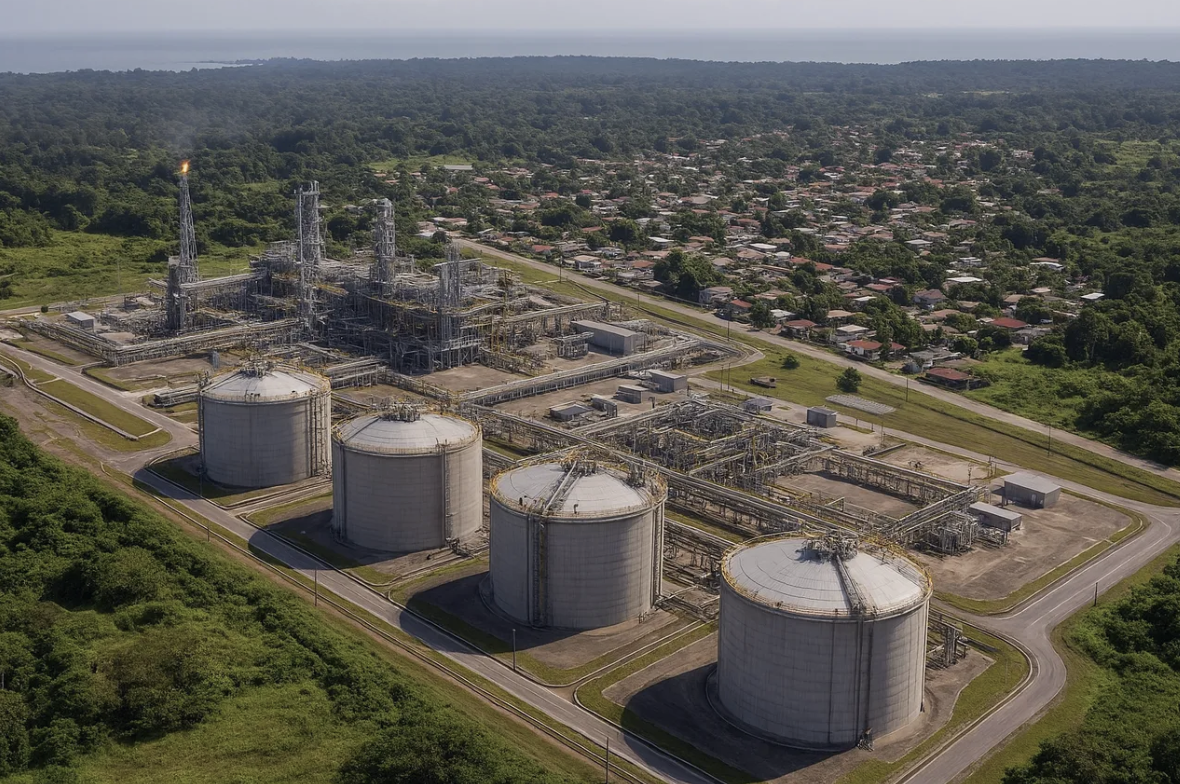
Trinidad & Tobago transformed its development trajectory between 1998 and 2008 by converting an underused natural gas reserve into a globally competitive liquefied natural gas export platform. Over this decade, real per capita income rose sharply, and foreign investment reached historic levels as the Atlantic LNG complex expanded from a concept into four operating trains. This emergence as a major LNG exporter unlocked financing flows, attracted multinational partners, and reshaped national energy markets. At the same time, it introduced significant risks, including dependence on a narrow industrial base, exposure to global energy cycles, and limited diffusion of benefits into the broader economy.
This blog explains how the country’s human ecosystem changed during the boom, the evolutionary economic forces that drove the rapid transformation, and the state’s role in shaping institutions, rules, and investment sequencing. The purpose is to translate the Trinidad & Tobago experience into actionable insights for policymakers across Latin America and the Caribbean as they navigate their own transitions.
Economic and social transformation
The human ecosystem changed fundamentally as natural capital was rapidly converted into financial and industrial capital. Offshore gas reserves that were largely stranded in the early 1990s led to the commissioning of four LNG production lines, or trains, between 1999 and 2005, with a cumulative investment of approximately US$3.6 billion. Gas utilization surged from ~550 million standard cubic feet per day in 1991 to ~3,760 million standard cubic feet per day by 2006, while methanol capacity expanded from 480,000 tons to 6.62 million tons and ammonia capacity from 2.17 million tons to over 5 million tons. These shifts generated major capital flows, with foreign direct investment stock reaching US$12.44 billion by 2007, and GDP per capita roughly quadrupled between the mid-1990s and mid-2000s. Social institutions evolved in parallel through the strengthening of the National Gas Company as the central aggregator and the consolidation of industrial estates at Point Lisas and Point Fortin. These governance structures created a specialized export-oriented social order focused almost exclusively on gas monetization. The social cycle also shifted into a pro-cyclical pattern, as surging LNG revenues after 1999 fueled rapid fiscal expansion and heightened vulnerability to price swings. By the mid-2000s, signals of rising reserve pressure and emerging competitors appeared, but the prevailing assumption remained continued expansion, based on discussions of additional trains and new downstream projects.
Why LNG took off
The country’s LNG expansion can be understood through the evolutionary dynamics of variation, selection, and diffusion. Variation emerged through multiple competing configurations for gas use, including LNG export, petrochemicals, power generation, and regional pipeline options. Within LNG itself, commercial structures varied across equity participation, tolling arrangements, and train scales, while successive trains adopted the Phillips Optimized Cascade process, enabling incremental technological learning and larger plant capacities. Selection pressures came from global demand signals in the United States and Europe, which favored Trinidad & Tobago’s reliable, cost-competitive gas supply underpinned by stable institutions. Domestic liberalization in the early 1990s and a clear gas-focused industrial policy further reinforced LNG as the dominant monetization pathway. As Train 1 succeeded, the rapid approval of Trains 2, 3, and 4 in 2000–2005 demonstrated institutional preference for scaling a proven model. Diffusion occurred through the construction of pipelines linking offshore fields to industrial nodes, long-term contracts with US and Spanish buyers in the first train, and the creation of revenue-management institutions such as the Heritage and Stabilisation Fund—these mechanisms locked in the LNG-petrochemical ecosystem, creating a durable path dependence in the industry. However, diffusion into non-energy sectors remained limited, and non-energy exports did not form a significant new cluster despite overall GDP growth.
How the state shaped the gas economy
The state acted as the strategic architect and market constructor by lifting the long-standing ban on gas exports, thereby enabling LNG development for the first time. It designated the National Gas Company as a quasi-monopsony buyer responsible for aggregating gas and selling it to downstream firms at administered prices, thereby helping establish competitive petrochemical production. It also developed a production‑sharing contract framework that defined how output and risks would be shared between investors and the state; this system was later recalibrated during the 2006 Petroleum Fiscal Review to improve rent capture. In parallel, the state undertook major public investments, including the 36-inch East Coast pipeline, the 56-inch Cross Island Pipeline, and industrial estate infrastructure under PLIPDECO. It also signaled willingness to absorb risk by taking equity in Train 1, which reassured private partners during the early phase. The state created revenue stabilization instruments such as the Interim Revenue Stabilisation Fund in 2000 and its successor, the Heritage and Stabilisation Fund in 2007, to buffer volatility. Despite these achievements, the state fell short in cultivating an indigenous innovation ecosystem. The industrialization-by-invitation model relied heavily on multinational expertise, limiting the development of deep domestic capabilities and contributing to the enclave character of the energy sector, which generated 80 percent of exports but only around 5 percent of jobs.
Policy lessons from the LNG boom
Three policy lessons stand out for resource-rich economies in Latin America and the Caribbean. First, credible rules matter more than state ownership: lifting restrictive bans, designing transparent contract frameworks, and ensuring predictable pricing can catalyze investment more effectively than insisting on large state equity shares. Second, infrastructure and institutional assets are the most durable legacies of a resource boom; pipeline networks, industrial estates, and competent energy agencies convert temporary natural capital into long-term socioeconomic value. Third, stabilization and diversification must begin early, before peak production. Stabilization funds need strict rules, and local content and skill-building mechanisms must be embedded from the outset to avoid the enclave dynamics observed in Trinidad & Tobago. The broader message is that successful industrialization requires not just capital and technology but deliberate institutional design to ensure that natural resource wealth produces sustainable, inclusive development. Policymakers today should apply these lessons to emerging opportunities in critical minerals and hydrocarbons, anticipating future vulnerabilities rather than responding to them after the fact.