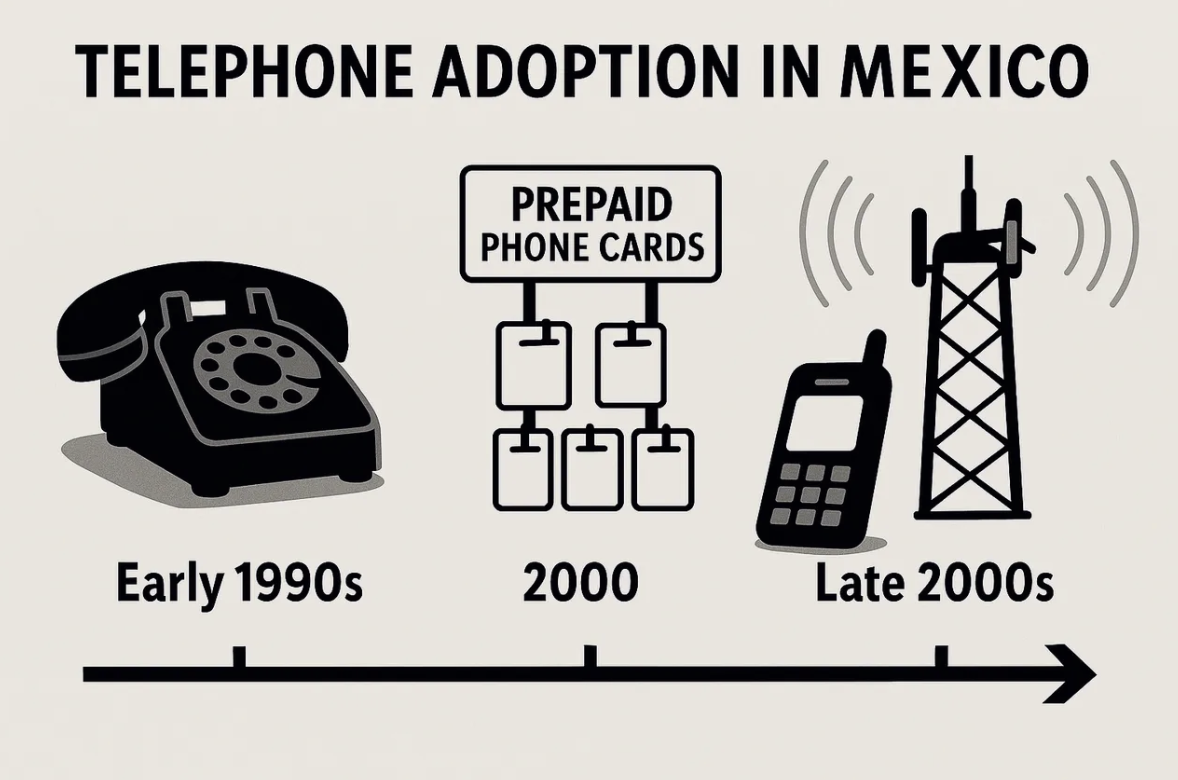
Between 1990 and 2010, Mexico experienced one of the most rapid transformations in communications in the developing world. At the start of the 1990s, the country had fewer than five fixed telephone lines per 100 inhabitants, multi-year waiting lists for connections, and a geographically uneven copper network concentrated in major cities. By contrast, by 2007, Mexico had more than 60 mobile subscriptions per 100 inhabitants, rising to roughly 80 by 2010, making mobile telephony the dominant form of access nationwide. This transformation was driven not by incremental extensions of legacy infrastructure, but by moving directly to mobile networks, prepaid billing models, and large-scale private investment enabled by regulatory reform.
For policymakers across Latin America and the Caribbean (LAC), this is not simply a telecom success story. It is a concrete, data-rich case of how infrastructure transitions unfold under conditions of scarcity, inequality, and institutional weakness—conditions that closely resemble those faced today in today’s transformation. Mexico shows how rapid access expansion can be achieved at scale, but also how early design choices around competition, regulation, and public investment can lock in market concentration and regressive cost burdens for decades.
Critically, Mexico’s leapfrog did not eliminate monopoly power; it transformed it. The 1990 privatization of Telmex replaced a state-owned monopoly with a privately controlled one, concentrated under Carlos Slim’s business group. While this shift accelerated investment and access, it also transferred extraordinary market power to a single actor in the absence of effective competition enforcement — a choice with distributional and welfare consequences that persisted for decades.
After reading this blog, policymakers should be better equipped to identify which elements of Mexico’s experience enabled speed and scale, and which design failures undermined affordability, equity, and long-term innovation. The call to action is to design future transitions that combine quick rollout with a strong market structure, credible regulation, and clear ways to include everyone.
The analysis proceeds in three sections: how Mexico’s human ecosystem changed, what evolutionary forces drove those changes, and how the state shaped outcomes—for better and worse.
How mobiles reshaped capital and social systems
Mexico’s capital stocks were transformed primarily through substitution rather than accumulation. Instead of closing its fixed-line gap—Mexico remained at least six percentage points behind peers such as Chile and Argentina in landline penetration in the early 2000s—the country bypassed copper entirely. Spectrum, allocated by the state through regional licenses in the early 1990s, became the critical productive asset. By 2007, Telcel alone operated more than 48,000 points of sale and over 1,100 exclusive distributors, creating a dense commercial infrastructure that extended mobile access deep into peri-urban and rural areas where fixed lines had never been viable. Mobile telephony thus became a new form of socio-economic capital, accessible without a fixed address or formal employment.
Capital flows also shifted in structure and velocity. The introduction of prepaid SIM cards in the mid-1990s eliminated the need for credit histories and monthly contracts, converting telecommunications revenue into millions of micro-transactions purchased at pharmacies, corner shops, and street stalls. By the mid-2000s, more than 80 percent of Mexican mobile subscriptions were prepaid, one of the highest shares in the OECD. Knowledge flows accelerated in parallel: migrants—numbering roughly 9 to 11 million Mexicans in the United States during this period—used mobile phones to coordinate remittances that exceeded USD 25 billion annually by 2007, while informal workers and small firms used SMS and voice calls to reduce transaction and coordination costs.
Social institutions and social order adjusted more slowly than technology. Although Mexico established a telecommunications regulator (COFETEL) and liberalized the sector through the 1995 Federal Telecommunications Law, enforcement lagged behind. By 2006, Telcel controlled roughly 80 percent of the mobile market, and high interconnection fees acted as a de facto tax on competitors. Social cycles compressed dramatically—Mexico moved from analog cellular systems to nationwide GSM digital networks in little more than a decade—but distributional effects persisted. Household survey evidence shows that by 2006, low-income households were spending a growing share of their budgets on mobile services, often cutting expenditures on clothing, hygiene, and home maintenance to remain connected.
How mobile spread: innovation, competition, and coverage
From an evolutionary economics perspective, variation in Mexico’s telecom transition came less from domestic technological invention than from business-model innovation. Cellular technologies such as GSM were imported, but the decisive innovation was the adoption of prepaid billing for a large unbanked population. Entry-level handsets fell below USD 50 by the early 2000s due to the scale of global manufacturing, and operators experimented with low-denomination airtime cards, on-net discounts, and bundled offers. Users themselves generated variation through practices such as missed call signaling and phone sharing, which fed back into tariff design and reinforced prepaid dominance.
Selection pressures strongly favored scale, coverage, and distribution density. Telcel benefited from Telmex’s inherited infrastructure, early access to spectrum across all nine regions, and a regulatory environment that failed to impose cost-based interconnection pricing. Competitors such as Iusacell, Movistar, and Nextel survived only in niches—urban postpaid users or specialized business services—because they could not match Telcel’s nationwide reach or absorb interconnection costs. Crucially, this was not neutral market selection: weak regulatory enforcement shaped the selection environment, systematically favoring the incumbent and selecting for concentration rather than diversity.
Diffusion was nevertheless rapid because mobile telephony required minimal complementary infrastructure. Unlike fixed broadband, which depended on copper networks and personal computers, mobile access required only a handset and a SIM card. Mobile subscriptions rose from negligible levels in the early 1990s to roughly 12 million by 2000 and around 68 million by 2007. Econometric studies for Mexico show statistically significant positive effects of mobile and ICT diffusion on GDP over the 1990–2014 period. Yet diffusion had limits: penetration in Mexico City exceeded 90 lines per 100 inhabitants by the mid-2000s. At the same time, poorer states such as Chiapas lagged far behind, illustrating how national leapfrogging can coexist with deep regional inequality.
How the state shaped winners, losers, and learning
The Mexican state played a decisive but uneven role. Direction-setting was front-loaded and bold: the 1990 privatization of Telmex raised approximately USD 1.76 billion and transferred operational control to a private consortium with foreign technical partners, while mobile services were opened to limited competition through regional licenses. This dual strategy catalyzed rapid investment and modernization—by 1994, 75 percent of Telmex’s switching systems were digital—but coordination during implementation weakened. Key operating rules for local competition were delayed until 1998, effectively granting the incumbent several additional years of dominance.
Rule-setting and enforcement proved to be the system’s weakest link. Although COFETEL was established by law, it lacked the authority to impose meaningful penalties or structural remedies. High interconnection fees persisted throughout the 2000s, and the OECD later estimated that weak competition in telecommunications cost the Mexican economy roughly USD 25 billion per year in excess prices and lost welfare. Public investment in infrastructure and public goods was limited: Mexico did not deploy a robust universal service fund or publicly financed backbone networks during the leapfrog period, relying instead on private capital guided by commercial incentives.
Innovation and learning were similarly concentrated. Mexico captured large consumer-side welfare gains from connectivity, but it did not build a broad domestic industrial ecosystem around telecommunications. Handsets were imported, applications were largely foreign, and organizational learning accrued mainly within a single dominant firm. América Móvil’s replication of the prepaid mobile model across 18 countries created a Mexican multinational valued at over USD 100 billion by 2007. Still, this success did not translate into a competitive, innovation-rich domestic ecosystem—an outcome with clear parallels for future transitions that prioritize local value creation over simple asset deployment.
Three lessons for designing transitions
Mexico’s mobile leapfrog yields three core lessons. First, leapfrogging succeeds when business models match income realities. Prepaid services, micro-transactions, and low-cost handsets—not technology alone—enabled rapid expansion to populations excluded from formal credit and fixed infrastructure. Second, weak competition enforcement casts long shadows. Delayed regulation allowed market concentration to solidify, imposing high prices and limiting innovation for more than a decade. Third, access gains do not guarantee equity. Without sustained public investment and explicit inclusion mechanisms, regional and income disparities persisted even as national indicators improved.
The core message for LAC policymakers is that speed and scale must be balanced with institutional strength. In renewable energy and power systems, as in telecommunications, transitions that rely exclusively on private incentives risk reproducing monopoly power, regressive cost burdens, and uneven spatial outcomes. The call to action is to build in competition policy, universal service mechanisms, and learning ecosystems into transition design from the start. Mexico’s experience demonstrates both what is possible when societies leapfrog—and what must be deliberately designed to avoid repeating its costly mistakes.