Brazil transformed from a coffee exporter to an industrial economy between 1930 and 1980. This is one of the most deliberate and consequential development experiments of the twentieth century. This was not simply a story of Brazil building “more factories.” It was an economy-wide transformation: what Brazil invested in, how capital moved through the system, which institutions gained influence, how cities expanded, how work and living conditions changed, and how the state learned to plan and coordinate long-horizon development. Within a single lifetime, Brazil built industrial platforms, expanded infrastructure, created development finance institutions, and assembled policy tools to mobilize investment over decades. But that transformation did not occur under a single political regime: after the 1964 military coup, industrialization was pursued under authoritarian rule, which increased technocratic insulation and centralized coordination while constraining labor politics and civic feedback—changing both the pace of growth and the distribution of its gains.
For policymakers across Latin America and the Caribbean (LAC), Brazil’s experience remains relevant because many countries today face a comparable challenge under new conditions. The green transition, rapid technological change, and geopolitical fragmentation are forcing economies to adapt quickly while maintaining social cohesion. The core question is no longer whether economies will change, but whether that change will be shaped deliberately or left to shocks. Brazil illustrates what becomes possible when structural transformation is treated as a national project—and what can go wrong when investment and production expand faster than the institutions needed to manage inflation, external exposure, and distributional conflict.
This blog offers a practical reading of Brazil’s transformation through three lenses. First, it clarifies what changed—from physical capital and capital flows to institutions, social order, and the rhythms of boom and vulnerability. Second, it explains what drove those changes—how crises and policy choices generated new economic “experiments,” how some models were selected and scaled, and how capabilities diffused across the economy. Third, it identifies how the state made the transition possible—through direction and coordination, macro rules, infrastructure and public goods, financing and risk management, and the learning systems needed to adapt over time. The goal is not to romanticize the era or offer a blueprint, but to extract usable lessons: what to emulate, what to avoid, and which institutional capacities matter most when a country attempts to industrialize under uncertainty.
Scale and composition of Brazil’s structural shift
Brazil shifted from a primarily agricultural export economy to a major industrial economy between 1930 and 1980. Import substitution played a central role, and early heavy-industry platforms were built in steel, with the National Steel Company (CSN) established in 1941 and operating by 1946. Vale (1942) and Petrobras (1953) emerged as additional platform firms supporting minerals/logistics and energy, respectively. By 1980, manufacturing accounted for roughly 30% of GDP.
Import-substitution policies reduced reliance on imported manufactures and redirected capital toward domestic production. Brazil founded its National Bank for Economic Development (BNDE) in 1952 (later renamed BNDES) to finance national development, focusing on infrastructure and industry. Alongside development banking, major private banks such as Bradesco (1943) and Itaú (1945) expanded financial intermediation as the urban-industrial economy scaled. Foreign capital inflows became increasingly important—especially in the 1970s, when imports grew faster than exports—supporting investment in capital-intensive sectors such as energy (Petrobras) and heavy-industry supply chains.
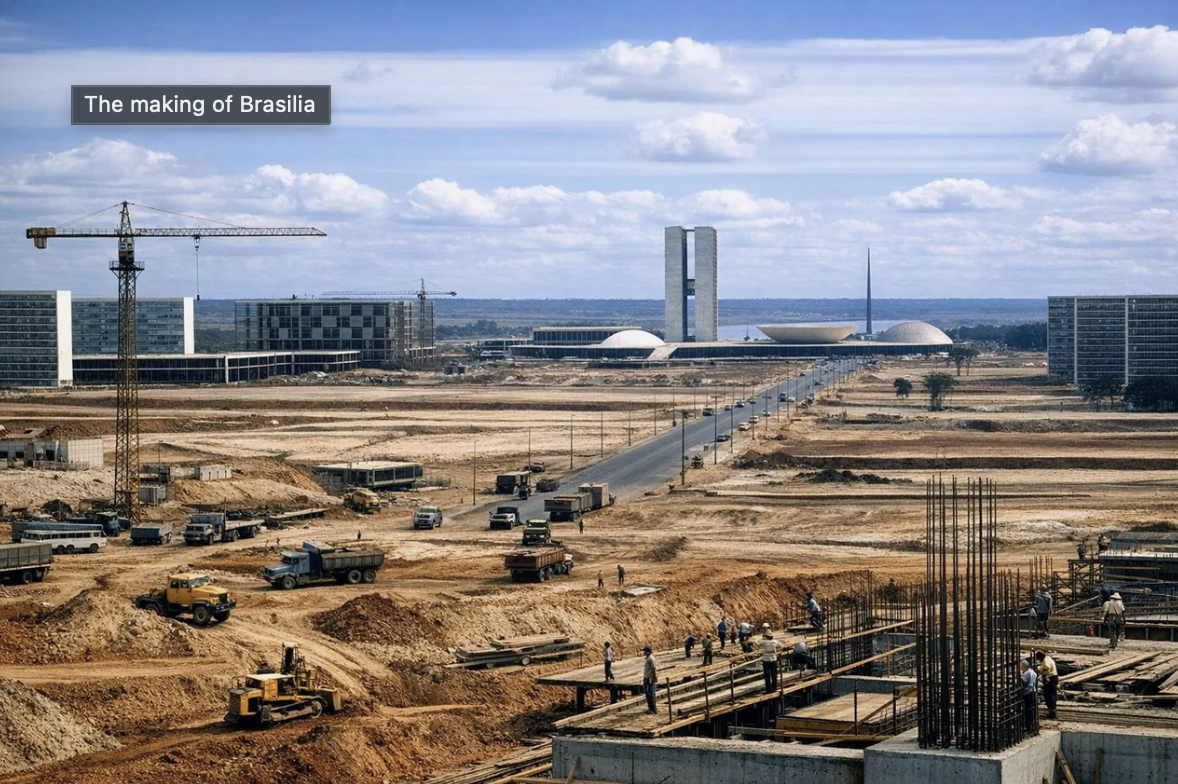
Economic planning and coordinated industrial policy became the norm. The 1956–1961 Goals Plan (Plano de Metas) reflected this growing planning capacity, prioritizing energy, transport, and industry to reduce bottlenecks and accelerate investment. This period also supported the expansion of national power capabilities through firms such as Eletrobras. BNDES played a long-term role in infrastructure and industrial finance and later expanded its use of capital-market instruments to channel funds toward development priorities. Brasília—constructed as a new federal capital beginning in 1956—became the flagship “planning-as-project” symbol of the era, bundling transport links, housing, utilities, and administrative functions into a single national initiative. The 1964 military coup marked a structural break in how this coordination operated. Planning and macroeconomic management became increasingly centralized and insulated from politics, as the authoritarian regime curtailed labor bargaining and constrained subnational autonomy. After 1964, the Government Economic Action Plan (PAEG) strengthened modern central banking functions and fiscal controls under conditions that enabled wage restraint and tighter political control, helping govern inflation and stabilize investment cycles that affected capital‑intensive champions such as Petrobras and Eletrobras, and later strategic manufacturers such as Embraer, founded in 1969.
Brazil urbanized rapidly, rising from an estimated 30% urban in 1930 to about 68% by 1980, driven by massive rural-to-urban migration of roughly 20 million people. Large transport megaprojects also reshaped settlement dynamics—most notably the Trans-Amazonian Highway, initiated in 1970 as part of a national integration strategy. Industrial labor markets and labor politics became central features of development. During the military dictatorship, rapid industrial expansion was accompanied by explicit repression of organized labor and limits on collective bargaining. Wage growth was deliberately compressed as part of a broader strategy to stabilize inflation and raise profitability, allowing capital accumulation and industry to advance while postponing distributional adjustment. As a result, the “economic miracle” rested not only on productivity gains and investment surges, but also on authoritarian management of labor relations and income distribution.
Brazil sustained very high growth for decades, averaging roughly 8% per year from the 1950s through the 1970s. Growth peaked between 1968 and 1974 at roughly 11% annual real GDP growth. This expansion coexisted with chronic inflation: inflation peaked around 100% in 1964, declined to roughly 19% by the late 1960s, and then rose again to around 80% per year in the 1970s. The post‑1964 decline in inflation reflected not only improved macroeconomic instruments but also the regime’s capacity to suppress wage‑price spirals through political control. While this strengthened short‑term investment predictability, it also masked unresolved distributional pressures that re‑emerged later as macroeconomic fragility.
Shocks, policy choices, and the build-out of capabilities
External shocks—including the Great Depression and World War II-era disruptions—pushed the state to experiment with new industrial activities, from steel and autos to capital goods. Coffee’s dominance in the export economy heightened this vulnerability: between 1889 and 1933, coffee accounted for roughly 61% of export earnings. When global demand collapsed, coffee prices fell sharply, and the state intervened aggressively, purchasing and destroying roughly 78 million sacks of coffee between 1931 and 1944. In the 1960s and 1970s, policy shifted toward export diversification and large-scale industrial upgrading.
The state protected domestic industry through tariffs, trade controls, and market structuring, allowing firms time to learn, invest, and scale. State enterprises focused on strategic sectors underprovided by private capital—especially in heavy industry. Output indicators underline the scale of industrial deepening: steel production rose from about 2.8 million tons in 1964 to about 9.2 million tons in 1976, while passenger car production increased from roughly 184,000 in 1964 to about 986,000 in 1976. BNDE/BNDES financed development priorities and later expanded industrial finance instruments, including a Special Agency for Industrial Financing (FINAME), a key mechanism for financing industrial machinery and equipment.
Energy and transport investments lowered system-wide costs and enabled industrial activities to spread beyond initial enclaves, including the São Paulo industrial core that had grown around the earlier coffee economy. Urbanization accelerated the diffusion of labor, skills, and markets, creating larger industrial labor pools and consumer demand. Policy frameworks and investment pipelines—often implemented through large development projects—helped replicate industrial capabilities across sectors, although regional gaps persisted and some areas remained underserved.
Planning, finance, and public investment as development engines
The Brazilian state guided development through planning and policy, beginning with import substitution in the 1930s and expanding into broader industrialization from the 1950s through the 1970s. Goal-based planning made priorities explicit and emphasized rapid structural change. After 1964, coordination became highly centralized under authoritarian rule, enabling technocratic agencies to scale investment, deliver major infrastructure projects, and expand export capacity with limited political resistance. This insulation accelerated execution but reduced feedback from labor, regions, and civil society.
The state also pursued macroeconomic stabilization and institution building during the 1960s, including the PAEG program in 1964 and the creation and strengthening of central banking functions. It established trade and industrial-policy rules—tariffs, incentives, and credit allocation mechanisms—that shaped investment and protected learning-by-doing in manufacturing. These reforms proved more durable under authoritarian conditions that constrained wage demands and political contestation. However, by resolving macroeconomic tensions through repression rather than negotiated adjustment, the model accumulated vulnerabilities that became visible once external conditions tightened and political liberalization began.
Public investment in infrastructure and public goods provided the base for industrial development. Investment prioritized energy and transport, reducing bottlenecks and enabling scale. In practice, this included major state-led expansion of power generation and distribution from the 1940s onward, especially large-scale hydropower that supported industrial growth. State-owned enterprises built the base for upstream industries such as steel, a critical input for machinery, construction, autos, and infrastructure. Under military rule, large-scale projects also served political and geopolitical objectives—symbolizing regime modernity, reinforcing territorial control, and channeling capital through centralized state institutions. Investment in human capital and social welfare lagged behind physical infrastructure, contributing to uneven progress and compounding the long‑run costs of rapid industrialization. Some 1970s integration projects, including frontier highways, generated environmental and social stresses that were weakly addressed under authoritarian conditions.
BNDES played a critical role in mobilizing long-term capital. It financed infrastructure and industrial development and later evolved instruments to support equipment investment and equity participation. Crowding in private and foreign capital was also central to the model, helping fund expansion in capital-intensive sectors. However, reliance on imported inputs, capital goods, and external financing increased exposure to global shocks—vulnerabilities that became more visible after the 1970s.
Import substitution built foundational capabilities for industrial production and broader industrial ecosystems. However, investment often outpaced adaptive management: the model scaled rapidly but struggled to reconfigure toward sustained export competitiveness. Urbanization and infrastructure clusters helped spread knowledge and capabilities, but the uneven diffusion across regions contributed to distributional tensions that became harder to manage over time.
Practical lessons on industrial policy, macro-stability, and inclusion
Brazil’s development arc from 1930 to 1980 shows that structural transformation can be engineered—especially when the state plays a sustained role as strategist, builder, and financier. Over these decades, Brazil expanded industrial capacity and infrastructure, strengthened planning and development finance, and built institutional scaffolding capable of coordinating long-horizon investment. At the same time, the experience of industrialization under military rule highlights that coordination achieved through authoritarian action is limited. Growth acceleration after 1964 relied on suppressing distributional conflict rather than resolving it through durable institutions. As a result, Brazil built industry faster than it built legitimate stabilizers—credible macro rules, social compacts, and adaptive governance mechanisms—leaving the model exposed when external shocks and political liberalization arrived.
At the same time, Brazil’s experience shows that growth and industrial scale are not the same as resilience and inclusion. The model’s most important weaknesses were institutional and social, not merely technical—rapid expansion coexisted with persistent inflationary pressure and rising macro fragility. Urbanization outpaced housing and service provision, and the distribution of gains often lagged what was needed to sustain long-term legitimacy. In short, Brazil built factories and infrastructure faster than it built stabilizers—credible rules, risk management, and social compacts—that protect development gains when conditions change.
For LAC policymakers today, the most useful lesson is to treat development strategy as a balanced portfolio of state functions rather than a single policy tool. Direction and coordination matter—but so do macro rules that prevent inflation and external exposure from undermining investment. Public investment must build enabling platforms and be matched with financing systems that mobilize private capital while managing risk. Above all, governments need dynamic capabilities: the ability to learn, correct course, and upgrade competitiveness as technologies and markets evolve. Brazil’s story is a reminder that industrialization is not a single leap, but a sequence of choices made over decades. Countries succeed not by avoiding shocks, but by building institutions strong enough to adapt—so that transformation becomes a source of shared prosperity rather than recurring vulnerability.