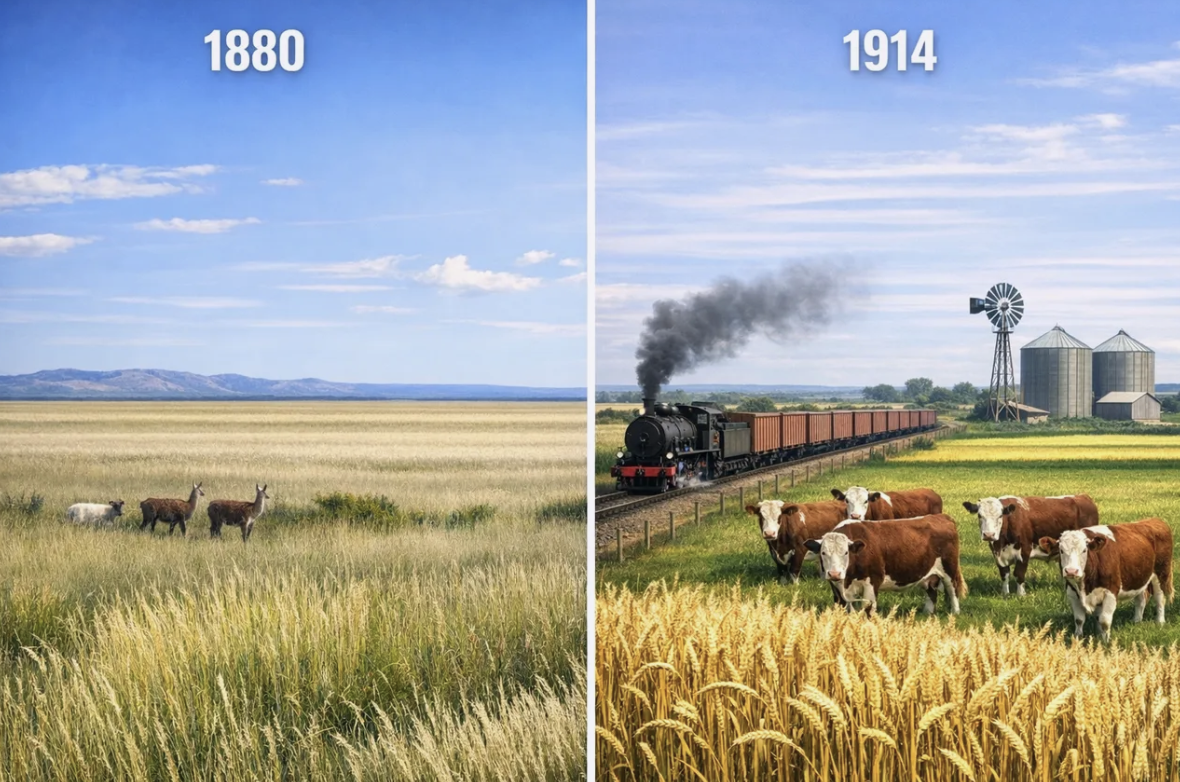
Across Latin America, governments face a familiar challenge: how to accelerate growth under intense global competition, technological change, and constrained public resources. Argentina’s export boom between 1880 and 1914 offers a concrete case of how rapid growth can occur when markets, institutions, and the state align in support of export-led, integrated development.
At the end of the nineteenth century, Argentina transformed from a sparsely populated frontier economy into one of the world’s leading food exporters. This transformation is sometimes attributed to good fortune: fertile land, rising European demand, and mass immigration. These conditions mattered, but they do not fully explain the mechanism. Fertile land does not, by itself, build railways, mobilize foreign capital at scale, or coordinate millions of individual production decisions about capital, infrastructure, markets, and rules into a globally competitive system. Growth at that speed required deliberate choices and sustained coordination.
Argentina’s experience shows that rapid growth emerged from the interaction of three forces that remain highly relevant today. First, the country undertook a large-scale economic transformation, reshaping land use, logistics, and technology to meet external demand. Second, it allowed competitive selection to operate—favoring production models, regions, and firms that could scale, standardize, and integrate into global markets. Third, the state played an active but focused role, reducing risk, guaranteeing infrastructure, protecting property rights, and maintaining policy continuity rather than attempting to direct production decisions.
This blog does not present Argentina’s historical model as something to be copied wholesale. Its social costs were real, and its long-term vulnerabilities became more visible after 1914. In the long term, Argentina became dependent on primary exports and foreign investment, thereby limiting its industrial development. Land was concentrated in the hands of a few, indigenous populations were marginalized, and social conditions were precarious for many immigrants. However, for countries across Latin America seeking faster growth today, the export boom remains a useful case for understanding how incentives, infrastructure, and institutions can combine to accelerate growth by enhancing coordination.
Building an agricultural export system
Between 1880 and 1914, the Argentine Pampas were converted from grassland into a global export system for wheat, maize, beef, and wool. This shift coincided with the rapid urbanization and industrialization of developed countries, supported by steel, railways, electricity, and food-processing technologies. By 1913, Argentina accounted for 12% of the world’s wheat trade and was among the world’s leading exporters of chilled beef, with exports comparable to those of Canada and Australia. Exports values expanded sixfold from 1881–85 to 1910–14. Railways expanded from 2,200 km in 1880 to over 35,000 km by 1914. The railways integrated production with ports and global markets.
Much of the financing came from Britain, which funded railways, ports, utilities, and banks. Foreign investments accounted for about half of Argentina’s capital stock; 60% of this investment came from Britain. British investors controlled about 80% of the railway system. After 1900, foreign investment grew by over 11% annually. Argentina attracted 3 million immigrants—mainly from Italy and Spain—who arrived between 1880 and 1914, doubling the country’s population. As steam shipping and refrigeration technologies became widespread, Argentine agricultural production was linked directly to increasingly urbanized European consumers.
These changes also reshaped society and politics. A landowning oligarchy consolidated economic and political power, while urban working and middle classes expanded in Buenos Aires and Rosario. Buenos Aires grew into a global port city, reaching nearly 1.5 million inhabitants by 1914, up from about 180,000 in 1869. The region became increasingly Europeanized in language, norms, and institutions through migration and commercial ownership. Europeans owned about 70% of commercial houses in Buenos Aires. Land under cultivation expanded from 100,000 hectares in 1862 to 25 million hectares in 1914. At the same time, Indigenous knowledge and traditional land claims were marginalized through frontier expansion.
Why the Pampas scaled first
Argentina imported livestock breeds and grain varieties from Europe and adapted them to the specific conditions of the Pampas. Over time, producers kept the techniques, breeds, crop varieties, and labor arrangements that delivered the highest profits under local constraints and global demand. Provinces that were better connected and had stronger institutions gained easier access to capital, allowing them to expand more rapidly. In 1879, Argentina began exporting more wheat than it imported, and by 1914, it was among the world’s top wheat exporters.
The Pampas region proved to be the most productive and cost-effective base for export agriculture in Argentina. Fertility mattered, but so did connectivity: railways, ports, and refrigeration reduced transport costs, reduced price dispersion, and increased price transparency. The port of Buenos Aires linked producers to global demand and world market prices. Consequently, global demand and pricing rewarded large-scale, standardized, and focused production over small-scale, diversified agriculture oriented toward local markets. Producers in the Pampas were typically more profitable, gained easier access to global markets, and became more attractive to investors. Foreign trade accounted for nearly half of Argentina’s GDP between 1870 and 1913, with wheat accounting for about 25% of exports.
Technologies such as railway logistics and cold storage, new institutions including export houses and banks, and large-scale production approaches reduced unit costs and improved reliability. Frozen and chilled meats accounted for approximately 12% of exports between 1900 and 1913. Producers learned through imitation and experimentation, hired targeted foreign expertise, and benefited from the inflow of skilled workers from Europe. Over time, these complementary inputs—raw materials, capital, skills, infrastructure, and institutions—reinforced economies of scale and export specialization.
The state played a crucial role in driving change
The oligarchic Argentine state between 1880 and 1914 concentrated political power among landowners, commercial elites, lawyers, bureaucrats, and financiers. This coalition defined a national focus on export-led growth and global integration. Policy priorities included land titling and the expansion of agricultural frontiers, which would yield clearer titles, enforceable claims, and a lower risk of disputes for investors. Trade and immigration policies also favored openness, supporting export competitiveness and labor inflows. As a result, agricultural and meat exports grew at an average rate of 4% between 1875 and 1913.
The state also established legal frameworks to protect private property, contracts, and foreign investments, thereby lowering perceived risk. Political institutions preserved elite control, thereby creating policy continuity aligned with export interests, even as this entailed exclusion, inequality, and repression. Regulation and public administration focused on expanding the agricultural export economy rather than promoting industrial diversification, thereby shifting expected returns toward specialized export agriculture.
Finally, the state provided guarantees and concessions to railway companies, reducing investment risk and crowding in foreign capital: public spending prioritized ports, railways, customs, and urban infrastructure over education or industrial policy. The state ensured policy consistency and absorbed coordination risks, thereby enabling the agricultural export-driven development path to persist.
Conclusion
Argentina’s export boom shows that rapid growth is rarely the result of a single reform, sector, or single favorable condition. It is the outcome of coordinated change across production systems, institutions, and public policy. The Pampas did not become globally competitive simply because they were fertile. They became competitive because infrastructure connected them to markets, finance supported large-scale investment, technology reduced distance, and the state consistently reinforced this direction over time. Natural resource endowments are necessary conditions, but state leadership and coordination are required to use them productively at scale.
For today’s Latin American policymakers, the most important lesson is not about agriculture or exports per se. It is about focus and selection. Argentina’s state did not attempt to develop every sector simultaneously. Instead, it concentrated public resources on a narrow set of priorities—transport, ports, trade openness, and legal certainty—and allowed firms and regions to compete within that framework. Those that could scale and adopt relevant technologies advanced; those that could not fell behind. Thus, global integration and competition did the work of discovery and delivery. Growth was rapid precisely because choices were made and trade-offs were managed.
At the same time, Argentina’s experience also highlights a structural warning. Once established, development paths become self-reinforcing. Infrastructure, land ownership patterns, political coalitions, and fiscal systems adapt to the dominant model. Infrastructure networks, fiscal reliance on specific revenues, and political coalitions can lock in economies for the future. This makes early success powerful, but it can also make subsequent adjustments difficult. Countries that accelerate growth, therefore, need to consider not only how to grow quickly, but also what kind of economy they are locking in.
The broader takeaway for Latin America today is clear. Accelerating growth does not require choosing between markets and the state. It requires a state that shapes incentives, absorbs risk where private actors cannot, and commits credibly to a long-term direction, while allowing competition and global integration reveal what can scale and penalize what cannot. Argentina’s early success shows what is possible when this alignment is achieved—and why getting the initial policy direction and investment priorities right matters for the decades that follow.