Tag: adaptive-governance

Adaptive governance refers to the state’s capacity to monitor outcomes, learn from experience, and adjust policies, institutions, and incentives over time in response to uncertainty, shocks, and new information.

  • The Discipline Behind the Miracle: Learning from Taiwan and Korea

    The Discipline Behind the Miracle: Learning from Taiwan and Korea

    Many industrial policies share a common flaw: they are designed for success and unprepared for failure. Subsidies get extended, protection becomes permanent, and development banks accumulate risk without a clear plan to exit. Taiwan and South Korea’s experience between roughly 1955 and 1990 offers a structurally different model. In one generation, both converted agrarian economies into world-class exporters—showing that late-industrializing states can scale manufacturing capabilities rapidly when policy ambition is matched by institutional discipline.

    The core mechanism was not simply “more state,” but concentrated state authority over credit and trade, paired with hard performance tests. Governments steered finance, foreign exchange, and incentives toward priority sectors—and then used export results, investment targets, and periodic restructuring to cut losses and redirect capital when bets failed. Its relevance today lies in what both states got wrong as much as what they got right: rapid gains that concentrated risk, requiring painful restructuring later. Korea’s heavy and chemical industries’ rapid expansion in the 1970s produced overcapacity and non-performing loans that contributed to the 1979–80 crisis, followed by restructuring. Taiwan faced mounting pressure in the 1980s as labor-intensive exports lost competitiveness, forcing upgrading.

    The lesson for LAC is therefore less about replicating Korea’s conglomerates or Taiwan’s SME networks than about building the public-finance and planning routines that make industrial policy reversible: clear objectives, measurable milestones, and credible exit and restructuring rules. In both economies, instruments evolved over time—shifting from tighter vertical targeting toward more horizontal, capability-building policies in the 1980s—without abandoning outward orientation. Korea eased its most directive tools and restructured chaebol after 1979–80; Taiwan adopted a 10‑year economic plan in 1980 to steer upgrading toward technology‑intensive sectors. The sections that follow document what changed, what drove it, and how the state governed the process.

    What changed (1955–1990): the shape of structural transformation

    Industrialization shifted capital stocks from agriculture toward manufacturing and tradable industry. This reallocation was reinforced by outward‑oriented flows of goods, finance, and knowledge. Export earnings financed the import of machinery, thereby raising productivity and enabling further investment. Rising domestic savings deepened this accumulation loop. In Korea, commodity trade expanded from roughly US$480 million in 1962 to nearly US$128 billion by 1990, while domestic savings rose from about 3 percent of GNP in 1962 to over 35 percent by 1989. In Taiwan, exports accounted for a large share of non‑food manufacturing growth in the 1960s, and total trade increased nearly tenfold in the 1970s.

    Both states rebuilt social institutions to support export‑oriented industrialization. Planning agencies, trade regimes, and financial systems were redesigned to privilege industrial upgrading. Control over banking and foreign exchange allowed governments to steer investment toward priority sectors. Institutional designs diverged in form but not in intent. In Korea, five‑year plans, the National Investment Fund, and the Korea Development Bank channelled credit to steel, shipbuilding, machinery, petrochemicals, and electronics after 1973. In Taiwan, exchange rate reform in 1958–1960, export processing zones in the 1960s, and a 10-year economic plan adopted in 1980 structured export promotion and technology upgrading.

    Structural change reshaped social coalitions and distributional outcomes. Export‑oriented growth expanded urban employment and new middle classes while reducing agriculture’s economic role. At the same time, sectoral and regional disparities intensified. Periodic crises forced the renegotiation of coalitions. In Korea, factories in Seoul and surrounding regions accounted for nearly half of manufacturing value added and employed almost half of factory workers by the late 1970s. In Taiwan, sugar and rice declined to about 3 percent of exports by 1970, shifting rents and political influence toward industrial and small to medium-sized enterprise interests. For LAC, this political-economy channel is not incidental: reform efforts—from phasing out agro-industrial protection to restructuring energy subsidies—often fail or stall when governments underestimate how quickly rents and regional power bases shift during structural transformation.

    What drove the changes: experimentation, selection, and upgrading

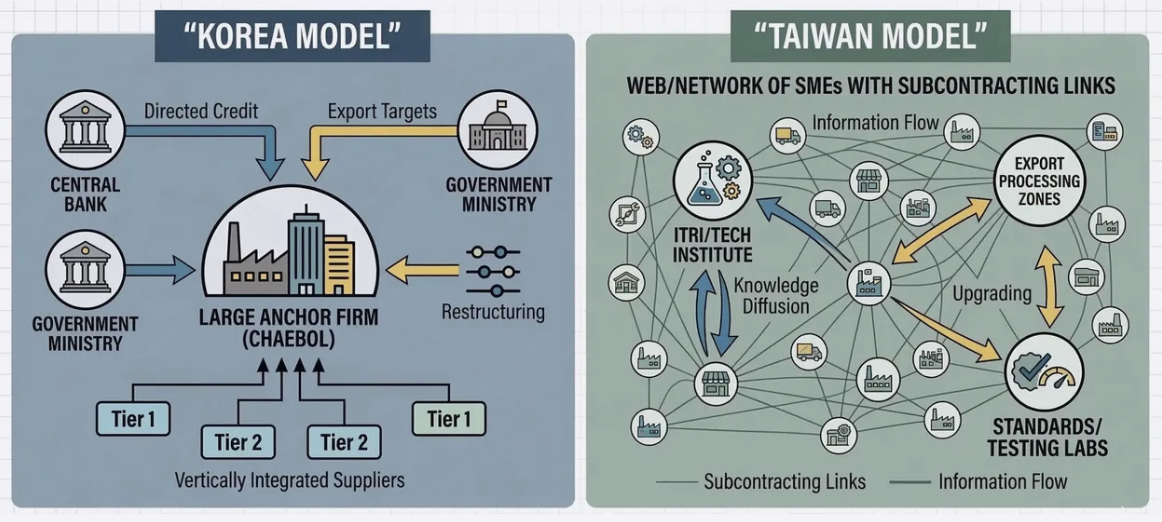
    Both economies generated variation through policy and organizational experimentation. Early import‑substitution strategies were tested and then abandoned as constraints emerged. Export promotion created new competitive environments that encouraged further experimentation. The analytically powerful contrast is that Korea and Taiwan converged on the same goal—solving the coordination problems of scale, finance, and capability upgrading—through two divergent firm structures. Taiwan’s export boom was coordinated through dense networks of small and medium-sized firms (SMEs) and flexible subcontracting. At the same time, South Korea solved the same scale‑and‑coordination problem through large, vertically integrated chaebol (large, family-controlled conglomerates organized as diversified groups of affiliated firms, historically supported by close ties to state-directed finance) backed by state‑directed credit. This is not a historical curiosity; it maps directly onto a live LAC design tension: whether states should back national champions (e.g., Brazil’s BNDES-style approach; Chile’s large copper firms) or build ecosystems that help many smaller firms scale (e.g., the Dominican Republic’s export processing zones; Costa Rica’s tech‑linked upgrading). The lesson is not that one structure is universally superior, but that each requires different instruments to coordinate investment—and different forms of discipline to prevent support from becoming permanent.

    Selection operated through state‑mediated credit allocation and international markets. Access to subsidized finance depended on meeting export and investment targets. World‑market competition filtered out firms and sectors unable to meet price and quality standards. Political reassessment followed failure. In Korea, subsidized credit was rationed through state‑controlled banks and withdrawn from underperforming firms during the 1980s restructuring. In Taiwan, preferential credit, tax incentives, and access to export processing zones rewarded firms that succeeded in export markets. Once successful, export‑oriented industrialization diffused and became entrenched. Institutional routines reduced the cost of repeating outward‑oriented strategies. Learning by doing and sunk investments created path dependence. Core features were adjusted but not abandoned. Taiwan’s growth acceleration began around 1962 and lasted for more than three decades, with real GDP growth averaging roughly 8–9 percent per year through the early 1980s. Korea maintained an export-oriented approach from the early 1960s through the 1980s, despite scaling back vertical industrial policies after the 1979–80 crisis.

    How the state guided change: credit, trade, and discipline

    The state provided clear direction and engineered market rules to align private incentives with national goals. Strategic coordination was exercised through multi‑year plans and central agencies. Trade and exchange‑rate regimes were redesigned to favor exports. Regulatory architectures shaped firm behavior. Korea’s Economic Planning Board, created in 1961, coordinated five‑year plans and export targets across ministries and banks. Taiwan’s exchange rate reform in 1958–1960 and the export promotion statutes of the 1960s restructured market incentives toward outward orientation.

    Public investment provided the infrastructure and human capital needed for industrial-scale production. Both Taiwan and Korea expanded technical and vocational training—and strengthened engineering education—to match the skill needs of export manufacturing and technology upgrading. State‑controlled finance mobilized savings and absorbed risk in priority sectors. These interventions enabled large, long‑gestation projects. They also concentrated fiscal and financial exposure. In Korea, public and public‑enterprise investment accounted for roughly 40 percent of total domestic investment between 1963 and 1979, with major spending on power, ports, and transport. Korea’s domestic savings rate rose from 3.3 percent of GNP in 1962 to 35.8 percent by 1989, channelled through controlled banking systems into industry.

    Innovation systems emerged through learning‑by‑doing within export‑oriented ecosystems. Acquisition and adaptation of technology were prioritized over frontier invention. Organizational forms shaped how learning diffused. Policy feedback adjusted support mechanisms over time. In Korea, targeted support for steel, shipbuilding, and electronics enabled chaebol to become global players by the mid‑1990s. In Taiwan, public technology institutions—most notably the Industrial Technology Research Institute (ITRI)—helped absorb foreign know‑how, incubate new capabilities (especially in electronics), and diffuse process and design improvements across networks of SMEs.

    The practical implication for LAC is not a single template but a shared design principle: the organizational form matters less than the discipline built around it. Korea’s chaebol and Taiwan’s SME networks succeeded not because one structure is superior, but because each was embedded in credible performance tests—and governments were willing to act when those tests were failed. 

    Implications for LAC 

    For finance and planning ministries, the Taiwan–Korea comparison is most relevant as a lesson in state capacity to coordinate investment under hard budget constraints. Both countries solved early coordination failures by steering credit, trade incentives, and planning priorities—but they did so with clear performance tests and a willingness to restructure when bets went wrong. The LAC takeaway is that any modern industrial or productive‑development push (nearshoring, energy transition, strategic minerals, advanced services) must be designed as a fiscally legible program: explicit objectives, quantified milestones, transparent costs (including tax expenditures), and a credible plan to manage fiscal risks arising from public banks, guarantees, state-owned enterprises, and public-private partnerships.

    A second implication is to recreate “export discipline” using instruments that sit squarely within finance and planning systems. Rather than open-ended protection, support should be conditional and time-bound—linked to verifiable indicators such as export survival, productivity, formal job creation, certification/quality adoption, and integration into higher-value-added segments of value chains. Ministries of Finance can operationalize this through results-based transfers and credit lines, rules for tax incentives (ex-ante costings, publication, and periodic review), and procurement that rewards performance and innovation while preserving competition. Planning ministries can align these tools with a national investment pipeline and a small set of priority missions that are revised as capabilities change.

    Finally, the institutional lesson is to treat structural transformation as a governed portfolio of experiments. For finance and planning authorities, the priority is not picking winners once but building routines to allocate, monitor, and exit public support in a way that protects the sovereign balance sheet. That, in turn, means agreeing on a single results framework with a short list of metrics; funding independent evaluation and public reporting; writing sunset clauses and restructuring triggers into programs from the outset; and maintaining fiscal-risk oversight of development banks, SOEs, and PPPs—including stress tests and caps on guarantees. Done well, this shifts LAC policy from ad hoc deals toward credible commitment: investors get stability and coordination, while governments retain the ability to correct course when external conditions tighten.

    Taiwan and Korea show that state-led transformation is possible—but not as a permanent arrangement. Both states eventually had to let go of favored sectors, protected firms, and comfortable credit concentrations. The question for LAC is not whether governments can pick priorities, but whether they can build the institutional reflexes to revise them. That capacity doesn’t emerge from good intentions. It must be designed from the start.
  • Why Reforms Fail: Five Functions for Change in LAC

    Why Reforms Fail: Five Functions for Change in LAC

    In 2013, Mexico’s energy reform looked like a textbook transformation package: a clear legal opening, new regulators, competitive processes to attract investment, and the promise of cheaper, cleaner, more reliable power. Within a few years, the trajectory shifted. Rules were contested, permits and contracts became politicized, and investors faced rising uncertainty. The problem was not just “policy design.” Distributional conflict, institutional veto points, capacity constraints, and credibility gaps made implementation fragile and reversals politically feasible. The lesson for governments across Latin America and the Caribbean (LAC) is straightforward: even reforms that look right on paper can fail to deliver. Institutional change only holds when legitimacy, coalitions, coordination, and learning under uncertainty are managed as an integrated pathway.

    Cases like this show that the core problem is less a lack of ideas than a lack of execution discipline across interdependent steps. Institutional change must be managed as a coordinated sequence in a contested environment. When transformation is treated as a long list of separate reforms, leaders lose clarity on what comes first, what must run in parallel, and what must be sustained long enough to become routine. They also struggle to reduce uncertainty about impacts and costs. Resistance then becomes predictable—distributional conflict, bureaucratic turf wars, capability gaps, and private interests seeking exemptions or delay. The result is familiar: partial progress, missed complementarities, and ad hoc trade-offs. Credibility erodes, and the package underperforms.

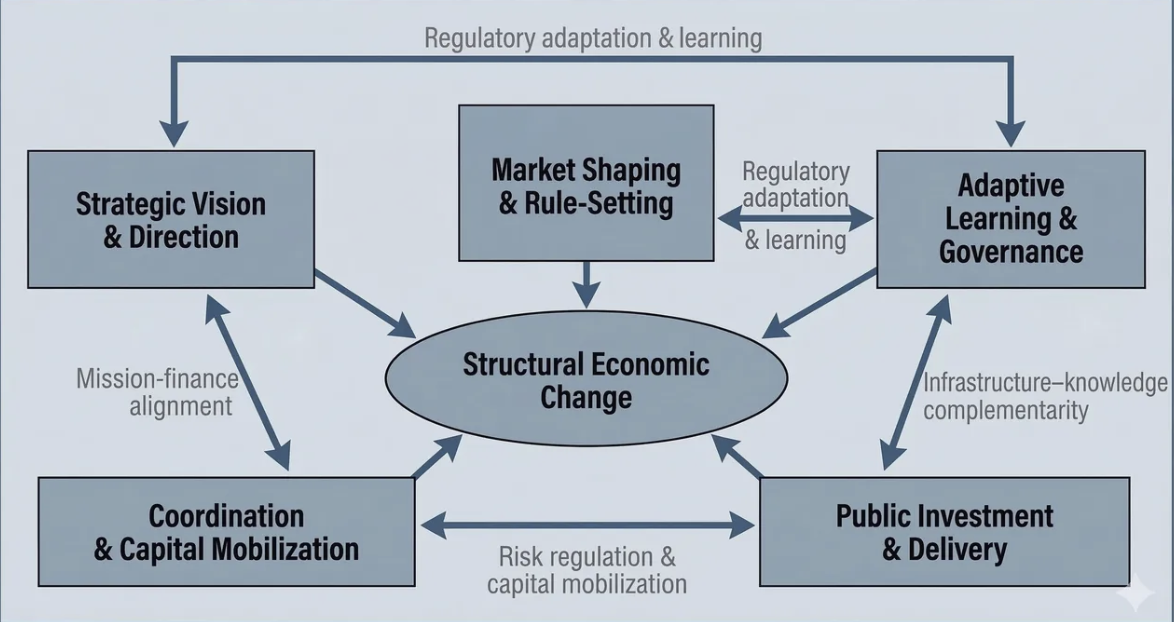
    A coherent approach starts by making the pathway explicit. It turns a complex agenda into manageable blocks that you can share, sequence, and run. I propose five state functions. These five functions don’t overlap, and you can’t skip any of them: strategic vision, market shaping, public investment, coordination and capital mobilization, and adaptive learning. Read as a change pathway, they clarify what governments must put in place. Vision sets direction, market shaping creates the rules and incentives that make it possible, investment turns intent into delivery, coordination keeps everyone aligned, and learning builds in feedback and adaptation. When these functions align, they create reinforcing loops that build capability and credibility. When they do not, predictable failure modes follow—misallocation, reversals, and erosion of trust.

    Why transformation efforts stall: complexity, silos, and partial diagnostics

    Development theories illuminate important state roles. Each tends to focus on a subset of functions rather than offering a complete map for transformation. Developmental state theory emphasizes long-term vision and coordination, but it underplays institutionalized learning and adaptation. Innovation systems theory highlights networks and knowledge flows, yet it treats the state as an implicit actor and offers limited guidance on direction-setting or market creation. New institutional economics foregrounds property rights and the enforcement of rules. It often says less about how states actively shape markets or build productive capabilities. No single framework is jointly exhaustive. Policymakers who apply any of them in isolation will overlook critical functions for sustained change.

    Standard diagnostics often reinforce the problem by treating governance, regulation, finance, and investment as separate silos. They can tell you whether rules are clear, procedures are followed, and projects are well costed. They rarely ask whether the government knows where it is going. They also rarely ask whether institutions are aligned to sustain delivery, or whether the system can learn and adapt when things go wrong. Targeted political economy work can help by identifying who stands to lose (or gain), which agencies can block implementation, and which groups can mobilize against change—such as state-owned enterprises, public-sector unions, or concentrated industry lobbies. But operational evidence still struggles to accumulate into system-level learning without a unifying functional architecture.

    Disconnected reform tracks produce predictable results. They weaken sequencing and suppress learning, which lowers the returns to reform and investment. Resistance and capture risks amplify the damage. Reforms that threaten rents can trigger pushback from incumbent firms, privileged contractors, or protected state-owned enterprises; agencies also protect turf, and weak accountability increases the risk of corruption. Countries may improve governance indicators without achieving a productivity takeoff. Missing functions—especially coordination and capability-building—often explain the gap. Ambitious investment or industrial strategies can also falter. Weak regulation, accountability, or learning then produces misallocation, capture, and backlash. Learning is rarely treated as an explicit state function. Failures persist without correction, and successes are not systematically scaled. The net result is low and volatile returns. Skepticism about state-led transformation grows.

    The five functions that drive institutional change

    Governments need a simple way to describe what must be done and how the pieces fit together over time. The goal is not simplification for its own sake. It is a pathway that is complete enough to guide execution in the real world. Structural change requires five distinct state functions that cannot be collapsed into isolated policies. Progress depends on moving through them as a coherent sequence, not as independent checkboxes. The sequence also helps manage uncertainty and resistance. Credible direction builds legitimacy, enabling rules to reduce discretion and rent-seeking; early delivery builds confidence; coordination brokers compromises; and learning course-corrects when assumptions fail. The model identifies five functions: strategic vision, market shaping and regulation, investment and service delivery, coordination and capital mobilization, and adaptive governance and learning. Each corresponds to a different mode of state action—choosing direction, setting rules, allocating resources, aligning actors, and adjusting in response to feedback. Together, they describe how change is initiated, implemented, and sustained. The absence of any one function can derail transformation even when others are strong.

    Recent LAC experience shows how a missing function can derail change. In Mexico, shifts in strategic direction weakened legitimacy and raised regulatory uncertainty after the 2013 energy opening. Weak enabling rules and oversight can also turn programs into rent opportunities. Brazil’s Petrobras contracting scandal illustrates how discretion and weak controls can corrode performance and trust. Delivery gaps can be just as damaging. In Haiti, repeated difficulties translating reconstruction and service commitments into sustained results eroded confidence. Coordination failures can stall implementation even when the direction is clear. In Colombia, implementation of the peace accord has faced coordination and financing bottlenecks that have slowed delivery in territories. Finally, weak feedback and adaptation can lock in underperforming policies. Argentina’s repeated cycles of price controls and ad hoc subsidies show how reversals can substitute for learning.

    The model is designed so that each function is distinct, yet together they cover the full spectrum of state roles. That is what makes it useful as a practical change sequence. Strategic vision concerns choosing ends. Market shaping governs rules and incentives, while investment focuses on direct provision and asset creation. Coordination and accountability manage cross-government incentives, distributional conflict, and capital mobilization across institutions. Adaptive learning institutionalizes feedback and adjustment over time. The literature maps unevenly onto these functions. Most approaches emphasize some functions but not others, which is why partial diagnostics persist. For policymakers, the implication is practical. Durable change often fails when a single block is missing, even when other reforms are advanced.

    Development outcomes depend on alignment and feedback across functions, not excellence in any single domain. Momentum must also carry early actions into institutionalized routines. Strong public investment without market discipline or accountability raises fiscal risk and lowers returns, as repeated LAC debt cycles show. Strong regulation without investment and coordination can also disappoint. Productive capabilities remain underdeveloped when delivery and alignment are weak. The model treats transformation as a system. Vision focuses effort, shaping the market enables action, investment delivers tangible progress, coordination provides the glue that holds the institution together, and learning embeds adaptation, so gains persist. Uruguay’s renewable energy transition is a useful counterexample. A clear direction, stable market rules (including auction design), credible delivery of new generation, effective coordination among public entities and investors, and ongoing learning sustained rapid change over time. This logic explains why fragmented reform packages underperform despite isolated improvements.

    How the model improves diagnosis, sequencing, and credibility

    A functional lens turns diagnosis into a plan. It shows which block in the change pathway is missing and where the capability is binding. By assessing performance across the five functions, analysts can identify whether stagnation reflects weak vision, poor market shaping, thin delivery capacity, coordination failures, or missing learning mechanisms. That is more actionable than sectoral or institutional checklists. In LAC, many countries strengthened rule-of-law and regulatory indicators, yet failed to diversify or innovate. Gaps in vision and learning often explain why governance improvements did not translate into transformation.

    The model also operationalizes political economy and financial constraints. It supports realistic sequencing from enabling conditions to delivery to durability. Sequencing choices—such as whether to reform regulation before scaling investment, or to pilot before scaling—should be evaluated based on functional readiness, not ideology. Many failures are not technical. They reflect veto points, distributional conflict, and credibility problems—for example, resistance from public-sector unions, pushback from incumbent utilities or other state-owned enterprises, or pressure from export industry lobbies for exemptions and special regimes. Pilots, phased implementation, and transparent risk governance can reduce uncertainty and lower resistance. They clarify who bears costs and how risks are managed. Large-scale capital mobilization without credible oversight can create contingent liabilities and credibility loss. Repeated renegotiations and legal disputes in some LAC transport concessions show how weak risk allocation and accountability can undermine long-term credibility. By linking finance, accountability, and learning, the model helps governments manage trade-offs transparently and sustain momentum beyond the first wave.

    Learning strengthens credibility by turning reform into a self-correcting routine. It also raises long-run impact by improving policy over time. Monitoring, evaluation, and experimentation help governments detect failure, end ineffective programs, and scale what works. Mexico’s PROGRESA illustrates the point. Rigorous evaluation supported evidence-based scaling and political sustainability. The contrast is costly. Prolonged protection of underperforming industries shows what happens when learning is missing. Treating learning as integral helps institutionalize change. Performance improves through feedback rather than waiting for a crisis.

    Making change stick

    LAC’s productivity gaps persist for many reasons, but a common pattern emerges in practice: reforms often move in pieces, and those pieces do not reinforce one another. The result is predictable. Progress stalls, credibility erodes, and governments end up reiterating the same agenda under tighter constraints.

    One practical application is to design a policy-based MDB loan around the five functions, with actions sequenced to build credibility and manage resistance. A first step could set the direction (a published, costed transformation strategy with a delivery mandate) and establish clear rules (time-bound regulatory changes that reduce discretion and clarify incentives). A second tranche could tie disbursement to early delivery (a small number of visible, implementable investments or services) and to coordination (a standing cross-ministry delivery unit with agreed financing, risk governance, and stakeholder engagement). A final tranche could institutionalize learning (monitoring and evaluation, feedback loops, and pre-agreed “course-correction” triggers if targets are missed). Across different groups, indicators would track not only outputs, but credibility signals—policy stability, dispute-resolution performance, procurement integrity, and whether feedback is acted on—so the loan supports lasting change rather than one-off compliance.

    What success looks like is alignment that compounds over time: direction that stays credible, rules that enable action, delivery that builds confidence, coordination that sustains coalitions, and learning that keeps the system adaptive. Uruguay’s renewables build-out shows what this alignment can look like in practice. The payoff is cumulative capability and resilience, not episodic reform cycles.

    Policymakers can use this functional lens to break transformation into manageable blocks and to communicate a credible pathway, internally and with partners. The key is to plan reforms as a reinforcing portfolio, not as disconnected initiatives. That requires managing uncertainty and resistance throughout implementation—distributional conflict, bureaucratic inertia, veto points, and interests seeking delay or exemptions. In practice, governments should ask two discipline questions at each stage: what function is missing, and what would make the next step politically and operationally credible? For MDB-supported programs, this lens also helps shift policy loans from checklist compliance to sequenced capability-building, with disbursements and indicators that reward delivery, coordination, and learning—not just legal changes on paper. Used this way, the model supports coherent, durable transformation.