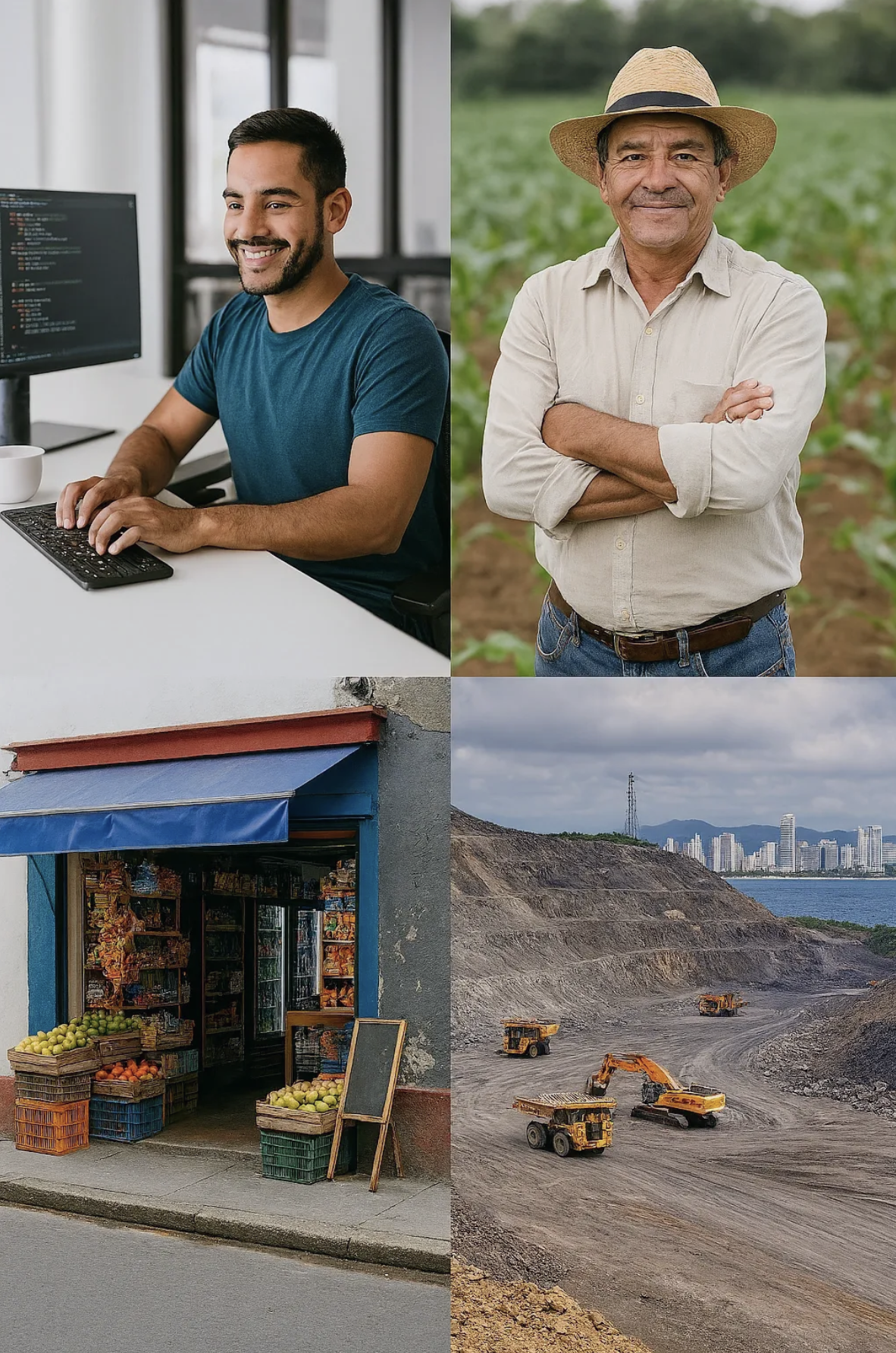
Variation and diversity define the world people experience every day. They are also the foundation of how economies evolve. Differences across people, firms, industries, and countries shape how quickly societies adapt, how they respond to shocks, and why policies succeed in one place but not another. Variation is central to productivity growth, innovation, competitiveness, job quality, fiscal stability, and resilience.
Countries in Latin America and the Caribbean (LAC) start from vastly distinct positions. They have different resource endowments, geographies, and population sizes. Their industries vary in maturity, competitiveness, and technological depth. Some countries are large and complex, making coordination difficult. Others are small, or island states that face constraints on scale but can sometimes move more quickly. Across the region, policymakers and citizens are seeking ways to build on existing strengths, raise productivity, expand opportunities, and ensure that global shifts do not derail national development paths.
This blog examines variation across people, firms, industries, and countries—and what it means for the evolution of LAC economies.
Individual and Firm-to-Firm Variation
People differ in skills, capacities, values, and behaviors. In LAC, this variation is visible in the contrast between software developers in Brazil and Mexico, agricultural workers in Guatemala and Haiti, and the millions of Venezuelan migrants who have brought new skills and practices to Colombia, Peru, Chile, and beyond. Indigenous communities across the Andes, Central America, and the Caribbean maintain distinct knowledge systems and cultural traditions that shape their engagement with markets, natural resources, and institutions.
These differences influence labor markets, entrepreneurship, and innovation. Individuals bring diverse networks, learning capacities, and experiences. They make choices based on identity, opportunity, and constraints. This micro-level variation is the foundation of broader social and economic diversity.
Firms are organizational expressions of this variation. They differ in strategy, capabilities, governance, and risk appetite. Tourism firms in the Dominican Republic and Barbados leverage global connections and economies of scale. At the same time, family-run guesthouses in Saint Lucia or Guyana compete through personalized service and niche positioning. Agribusiness leaders in Brazil, Argentina, and Paraguay use advanced technologies, logistics, and data systems, while smallholder farmers operate with limited capital and narrower risk tolerance.
Firms also respond differently to shocks. During COVID-19, online delivery platforms in Colombia, Mexico, and Brazil expanded rapidly as consumer behavior shifted. In the Caribbean, where hurricanes are becoming more frequent and intense, construction firms and hotels are adopting more resilient building practices. Leadership plays a critical role in identifying new opportunities, mobilizing diverse teams, and selecting which innovations to scale.
Industry-to-Industry Variation
Industries are clusters of economic activity that share products, technologies, skills, institutions, and competitive dynamics. They vary widely across LAC.
Some industries are highly concentrated. Water utilities in many Caribbean islands operate as natural monopolies. Telecommunications and aviation tend toward oligopoly, with a few major firms dominating national markets. By contrast, retail and informal commerce in Peru, Bolivia, and Guatemala are highly fragmented, with thousands of microenterprises competing on price and proximity.
Industries also occupy various positions in global value chains. Mining in Chile and Peru, agriculture in Brazil and Argentina, and oil and gas in Trinidad and Tobago sit upstream, supplying raw materials to international markets. Downstream industries — such as retail, hospitality, and logistics — serve domestic and regional consumers.
Capabilities vary as well. Brazil’s aerospace sector requires advanced engineering and strict safety certification. Operating the Panama Canal demands highly specialized maritime pilots and logistics managers. Fintech ecosystems in Brazil, Mexico, and Colombia innovate rapidly, supported by digital infrastructure and venture capital. Creative industries in Jamaica and Trinidad and Tobago thrive on experimentation and cultural expression.
Institutional contexts differ across sectors. Aviation, energy, and infrastructure services operate under stringent safety and regulatory frameworks. Tourism depends heavily on service culture and reputation. Industries also face distinct levels of exposure to external shocks — from commodity price cycles to hurricanes, droughts, and global market shifts.
State-to-State Variation
LAC countries share specific broad characteristics, including Indigenous, African, and Hispanic cultural roots; high inequality; persistent informality; and rapid urbanization. The region includes several megacities — Mexico City, São Paulo, Buenos Aires, Lima, and Bogotá — as well as dozens of small island states in the Caribbean.
Yet each country is distinct.
Resource endowments vary widely. Brazil has vast agricultural lands. Chile, Peru, and Argentina have world-class mineral deposits. Caribbean islands have limited land but extensive marine resources. Exposure to natural hazards also differs: Dominica, for example, ranks among the world’s most disaster-prone countries due to hurricanes and storms, while Chile faces frequent earthquakes but has strong building codes.
Geography shapes connectivity. Islands such as Jamaica and Trinidad and Tobago depend on ports and airports for all goods. Panama has leveraged its location to become a global logistics hub. Smaller states face diseconomies of scale — Saint Lucia and Grenada rely on regional partners for specialized health care and higher education.
Cultural capital also varies. Uruguay consistently ranks among the region’s most trusted and institutionally stable societies. Countries with high emigration — such as El Salvador, Haiti, Jamaica, and the Dominican Republic — have large diasporas that influence remittances, labor markets, and political dynamics. Brazil and Mexico, with large populations, can sustain more diversified domestic markets.
Governance approaches differ as well. Chile and Costa Rica have long traditions of planning and institutional continuity. Other countries face more frequent political turnover or shorter planning horizons. Smaller economies may be more vulnerable to elite capture but can also be more agile in adopting reforms. Barbados, for example, has moved quickly on climate resilience and fiscal stabilization. Regulatory capacity, legal system strength, and tolerance for experimentation vary across the region.
Conclusion
The story of Latin America and the Caribbean is one of diversity and opportunity. Variation across people, firms, industries, and countries is not a barrier to development — it is the foundation. When policymakers understand these differences, they can design strategies that match real capabilities, constraints, and opportunities. Development is most effective when solutions are country-driven, sector-specific, and grounded in local strengths.
The region’s diversity is a strategic asset. Encouraging experimentation, investing in capabilities, and learning from what works can help countries adapt more quickly, compete more effectively, and improve people’s lives. By using variation as a source of advantage, LAC can shape a more resilient and prosperous future.